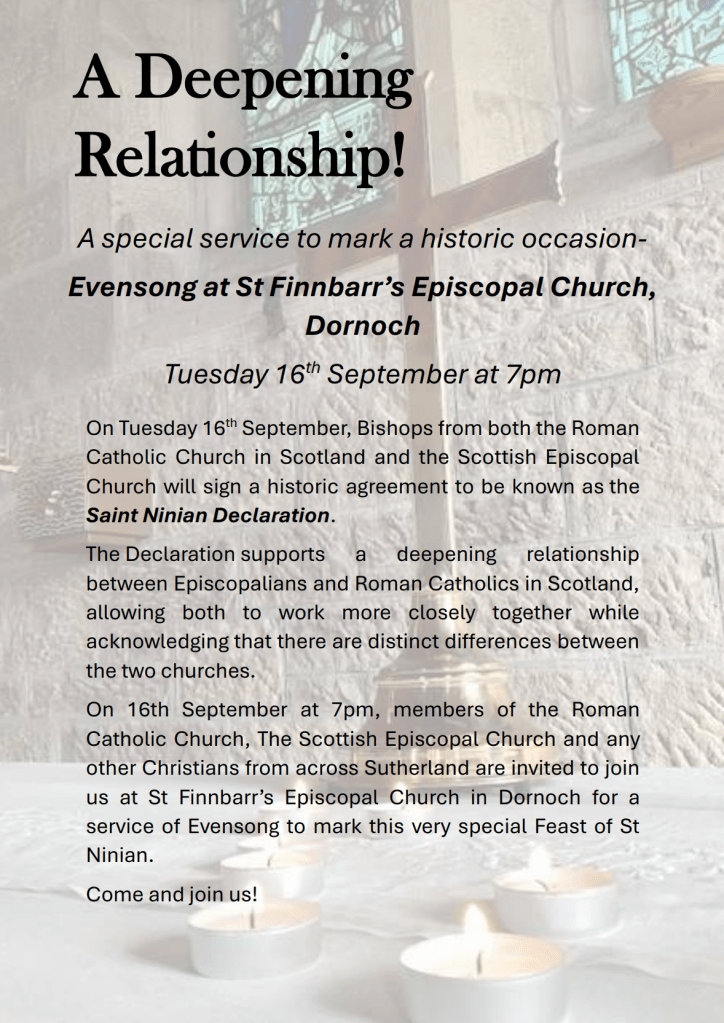
The St Ninian Declaration – Tuesday 12th September 2025

Today is the first Sunday in the Season of Creation – which lasts until the Feast of St Francis on 4th October. During this season, we spend time together thinking about the planet which we share with countless other human beings and other forms of life.
One of the great themes that we consider during this season is Water: The source of life and if you know your scriptures well, you will no doubt be able to think of some stories in the bible where water plays an important part.
Stories like those of baptism in the River Jordan, or maybe Jonah on his way to Tarshish being tossed overboard and swallowed by a big fish and of course the great flood from which Noah and his family were saved.
And what about the parting of the Red Sea – a miracle performed by God through the prophet Moses. I imagine it to be both awe-inspiring and terrifying – you may remember the scene in The Ten Commandments – the film released in 1956 starring Charlton Heston as Moses.
You know how the story goes, after the Passover, which spares the Israelites’ firstborn children but kills those of the Egyptians, Pharaoh finally agrees they may leave his country. It’s now been seven days since the Israelites’ Exodus from Egypt and Pharaoh changes his mind. He and all the chariots of Egypt pursue God’s chosen people to the water and are about to overtake them.
With their toes touching the Red Sea, it appears that the Israelites will either be slaughtered or drowned. In their panic, they cry out to Moses and he knows his people are scared, so he reassures them. And then he prays to God who tells Moses to stretch his hand out over the sea, causing a mighty east wind to blow all night long. The waters split apart, rather like an axe splitting wood, the waters become walls on their right and on their left.
The Israelites march through the parted sea on dry ground during the night, with God’s pillar of fire overhead. When the Egyptian pursuers follow, God instructs Moses to raise his hand a second time sending the waters crashing down, drowning them in its depths. Recognising the great miracle that had occurred, Moses and the people of Israel sang the Song of the Sea, and Miriam led the women in song and dance.
In this season of creation, as we intentionally reflect on the earth around us – it sometimes feels like we are bit like the Israelites on the edge of the waters, watching the Egyptian chariots draw closer and closer. Sometimes we, too, feel like we are in an impossible situation when faced with the vulnerability of this created world, with no way out.
Yet even though we might feel like the Israelites with our toes touching the edge of the Red Sea, we know that our situation is different. We know that there is danger in thinking we are too much like those fleeing Israelites. Because if we follow this line of thinking, we might come to believe that God will intervene in a similar way. That God will save us from the fires of our warming earth.
Perhaps if we trust enough.
Pray enough.
Believe enough.
God will save us, despite our careless behaviours or our polluted waters and skies. After all, doesn’t God promise, “behold I make all things new in creation”?
Now just park that idea for a minute and we’ll come back to it later.
Let’s go back to the beginning, the very beginning when God creates humankind in His own image. “God blessed them, and God said to them, ‘Be fruitful and multiply, and fill the earth and subdue it; and have dominion over the fish of the sea and over the birds of the air and over every living thing that moves upon the earth’” (Gen. 1:27–28).
“God said to them, have dominion over every living thing that moves upon the earth.” Now I believe dominion means that we have sovereignty over and responsibility for the well-being of God’s Creation. We are called to cultivate and care for the Earth in the way that God does – that is with love and wisdom. We are called to exercise dominion in ways that allow God’s original creative act to be further unfolded.
The word Dominion comes from the Latin word domus – meaning house, temple, or even the dome over the earth. And so just as we care for members who share our individual houses, our individual domus, we are also called by God to care for the fellow inhabitants of our earthly dome.
To be a wise and holy householder we are to do this out of compassion, not just for ourselves or our children, but for all people, and all people’s children. And their children’s children. And their children’s children’s children. We live under this dome together, so we must care for one another and show empathy for one another’s pain.
With this in mind, the fact that the climate crisis is perpetuated primarily by human beings and primarily affects other human beings should be of our utmost concern. It’s about justice. We as human beings are all created by God, in the image of God and loved by God. We are all equal in His eyes. And as we are all created under this same dominion or earthly dome – we should care for one another in such a way.
Recalling the story of the Red Sea today reiterates this call to community. We are reminded of God establishing the people of Israel as His own people and how He saves them so that the covenant with Abraham may be fulfilled. We hear about valuing community and doing all we can to protect our lives together.
As we focus on the environment during the Season of Creation, we are called to look at the land we share with our communities and around the earth. We are called to look at how we treat land – both the developed and undeveloped spaces. How are we caring for the creatures displaced by urban sprawl? How are we caring for the people living in the lands of food deserts? How do we care for the common spaces that are naturally wild? Do we have an interest in the places we do not own?
So, just come back to that idea that we parked.
A number of young activists have been telling us a lot lately that “we have 14 years or so to turn the earth around or else it will be too late.” Sometimes as older people, we find it hard to hear these apparently angry younger voices and I honestly have no idea where they get their numbers or even if they are true. But what I do know is that they deeply believe that what they are saying is true and they are calling us out on our sometimes selfish and careless behaviours.
Fourteen years – that feels an awful lot like being backed into a corner with no further options. Will God intervene? Will God save us, despite our careless behaviours or our polluted oceans?
God’s biblical promise is not that He will forever save us from ourselves and our selfishness. The promise is that God will forever stand with us, urging us to move in the divine way of unity and wholeness with all created beings under this shared dome. I don’t believe our God will swallow up the CO2 levels or cool the oceans or extinguish wildfires through a heavenly breath. But I do fully believe that our God will continue to remind us that we are connected to one another.
While God may not intervene to save the planet while we stand idly by, I do believe that God is in the process of saving us. God is working on us and through us at this very moment to turn us toward the healing of the planet and the healing of all people living together under this great dome.
Amen.
Proverbs 25:6-7 and Psalm 112 * Hebrews 13:1-8, 15-16 * Luke 14:1, 7-14
In recent years many people have criticised the decline of etiquette and manners in our world. To some of us, it seems that society has grown accustomed to things that would have been considered incredibly rude only a decade or so before.
But what about a hundred years before? Let’s see how you measure up to our ancestors from the Victorian era as we hear from The Gentlemen’s Book of Etiquette and Manual of Politeness, published in 1874.
1) Remove Your Gloves
“At the time of taking refreshment, of course, they must be taken off. No well-educated person would eat in gloves.”
2) Don’t Eat Too Much or Too Little
“Be careful to avoid the extremes of gluttony or over daintiness at table. To eat enormously is disgusting; but if you eat too sparingly, your host may think that you despise his fare.”
3) Eat and Drink Quietly
“It is decidedly vulgar to make a noise, either in taking the food into the mouth, in its mastication, or in swallowing.”
4) Don’t Chew with Your Mouth Open
“Do not fill your mouth so full that you cannot answer if you are addressed; nor open your mouth so wide during the process of chewing that your opposite neighbour may see the semi-chewed viands, which, if she be a delicate lady, might destroy her appetite altogether.”
5) Don’t Abstain from Taking the Last Piece
“Avoid also, that most vulgar habit which prevails among half-bred country people, of abstaining from taking the last piece on a dish. It amounts almost to an insult toward your host, to do anything which shows that you fear that the vacancy cannot be supplied and that there is likely to be a scarcity.”

Now, I haven’t asked you to raise or lower your hands to demonstrate just how polite you are when eating a meal. And that’s because today I want to talk about a different kind of table etiquette – a kind that comes from a significantly higher authority than The Gentlemen’s Book of Etiquette and Manual of Politeness.
Someone once said that in the gospel according to Luke you can always find Jesus doing one of three things. Either on his way to a meal, in the middle of a meal, or just leaving a meal, – maybe that’s why it is my favourite of the four gospels!
And that is certainly true in the passage we have heard this morning. Jesus had been invited to the home of one of the leading Pharisees, but it wasn’t just your average social occasion. The passage shares the real reason for the invitation – they were watching Jesus closely.
This group of Pharisees and religious scholars probably wanted to give Jesus a very thorough test, but in a surprising twist, the only observations made at the table came from Jesus himself, as he began to comment on their table manners. You see, the religious and social culture of that day had very strict and well-developed lists of social rules for eating together, and there were an incredible number of do’s and don’ts. The way you interacted in these settings was very much tied to your social standing and your place in society. The place where you sat at the table was incredibly important and determined your social rank, so we may not be surprised to find that as they sat down to eat, there was a great deal of jockeying for position.
Lest you think we today are above this kind of behaviour, and social ranking has nothing to do with seating, just think about the last formal meeting you attended or saw on TV. Think of a wedding where the bride and groom are seated at the top table. Or maybe the King, an MP, or somebody else important was present at a state banquet. They would likely have been seated in the place of honour so that they could see everyone and everyone could see them. Certainly there are echoes of what is happening at the house of this pharisee.
Jesus noticed how the people put in a great deal of effort as they jostled for position at the table, so he began to teach through a parable. He told the people gathering around the table the best way to go about choosing a seat. “If you’re invited to a banquet, don’t simply sit in the place of honour. You just might not be the most honoured person there, and it will be incredibly humiliating when your host asks you to give up your seat and you have to traipse back down to the end of the table…” Instead, Jesus says, “Sit at the least honourable place, so that your host can invite you to the higher place. Then you’ll receive a great honour.”
Now what happened next is what is most surprising, because Jesus doesn’t stop with what may have been accepted as reasonable and practical advice. Instead, he challenged the very notion of what honour and privilege were all about as he turned to look at the host and challenged the practical wisdom and etiquette of the day.
Meals like this one were not just occasions to gather, eat, and talk; they were occasions to build your own reputation and make connections. Gifts, such as an invitation to a meal, weren’t free but were tied to obligations to those who accepted the invitation. If you gave out an invitation, you expected to receive one in return. In a way, these dinner invitations were a lot like political rallies. You’re invited to attend, but there are expectations that are tied to the invitation. But Jesus turned this on its head when he said, “When you have a big meal, don’t invite all the people you’d normally think of inviting, just because they can invite you in return and pay you back. Instead, when you throw a party, invite the poor, those who are lame, those who are blind, because they can’t repay you. And in the end, you’ll receive your reward, not from them, but at the resurrection of the righteous.”
Jesus gives to them, and us, a completely different kind of table etiquette. In those days, common wisdom and social etiquette said jockey for position. Jesus said God’s etiquette calls for something completely different – all who exalt themselves will be humbled and those who humble themselves will be exalted.
In those days, common wisdom and social etiquette was to invite those who can give in return. Jesus said that God’s etiquette reminds us to invite the very least: the poor, the most vulnerable. And when we show generosity to those who can never give in return, Jesus says that we’ll find out something incredible. We won’t be repaid in the usual way, but we’ll be repaid by the very God who created every man, woman, and child. God himself will be the one who gives in return for those who are unable.
Jesus shows us that God’s table etiquette operates with an entirely different way of looking at the world, and I believe that is directly connected with our celebration of Holy Communion Sunday by Sunday. At God’s table, everyone is welcome. Your income bracket doesn’t matter, Your age or ethnicity is no barrier, your state of mind, physical ability, sexuality, intellectual ability, position in society – all those things that we use to promote division – do not matter.
As we approach Christ’s table today, we stand shoulder to shoulder with people from all walks of life across the world. Because around that table, we all receive the very same grace, love, and forgiveness that only God can give.
Kneeling at the feet of Jesus Christ, we are all loved, we are all cared for, and we have all been offered the same gift of forgiveness and Salvation.
And so as you prepare your heart and mind for communion today, pray that God will give you the grace to practice the kind of etiquette we learn at God’s table outside these walls in your daily lives.
Amen
Most of you will know that I love reading and talking about the stories of the saints and our episcopalian tradition encourages us to reflect on and celebrate the lives of our dear sisters and brothers who have walked the journey of faith before us. Today , we remember St Bartholomew. But do you know, Bartholomew is rather a difficult saint to celebrate and that’s because we don’t really know very much about him.

The gospel set for the feast of St Bartholomew doesn’t even mention his name. He may or may not be the same person as Nathaniel – scholars argue the one way and the other. In Matthew, Mark and Luke, Bartholomew is listed as one of the twelve. John doesn’t mention Bartholomew but does mention someone called Nathaniel – so that leads some to conclude that these two men, Bartholomew and Nathaniel to be the same person.
Some ancient writers on the history of the Christian faith claim that Bartholomew was an apostle to India – possibly working in the region of Mumbai. Along with his fellow apostle Jude, Bartholomew is reputed to have brought Christianity to Armenia in the first century.
By tradition, Bartholomew is said to have been flayed alive, before being crucified upside down, and so became the patron saint of Leather-workers. In painting and sculpture, he is often represented as a rather gruesome image, holding a knife, with his own skin neatly draped over his arm. But Bartholomew has also always been associated with healing, so a number of hospitals are named after him.
He is also associated with the small Italian Island of Lipari, where its thought that he may have been buried. During World War II, the Fascist regime in Italy, looking for ways to finance its activities, ordered that a silver statue of Saint Bartholomew from the church should be melted down. But it is said when the statue was weighed it was found to be only a few grams and so worth very little, and so it was returned to its place in the Cathedral of Lipari. In reality, the statue is solid silver and is very heavy – a relatively recent miracle associated with St Bartholomew.
But about Bartholomew himself we know almost nothing, except that he was a disciple of Jesus.
Now, far from being a negative thing, I think that not knowing very much about him is actually the most important thing for us to hold on to when reflecting on the life of this rather mysterious man, because he teaches us that the call to serve is not really to do with our own fame or status.
When we look around us today we realise we are living under the reign of ego and of fame, perhaps media stars and the glitterati are the best known for this. An increasing number of children, when asked what they want to do when they grow up, say that they want to be famous – being famous for being famous has become a vocation. Some of our politicians seem rather the same and of course, the church is not exempt: evangelists on religious television stations, pastors of megachurches, and, unfortunately, some bishops and clergy appear to love being in the spotlight and have become artists of self-publicity. I once heard someone say that their church was OK, but it was hard to see God because the priest always got in the way. It’s a temptation most clergy are aware of and try to resist – our job is to point people to God, not to ourselves.
So Bartholomew’s anonymity shows us ‘it’s not all about me’. Our job as Christians is to get out of the way and to enable people to catch a glimpse of the God whom we serve.
And something all of us must realise, something that the life of this mysterious man teaches us, is that we actually don’t need to be famous, not because we should be humble or control our egos but because God loves us, and that’s all we need – we need no other adulation.
All of us here will join the great ranks of anonymous Christians who have served God through the ages. In 2000 year’s time – probably long before that – we will all have been forgotten, except perhaps by ancestor hunters who might still be digging our names out of archives and searching church registers for information.
That might seem rather disheartening, but it needn’t be, because we know we are creatures of God’s making and redeeming: we are each loved by God more than we could ever imagine – part of our job is to try to discover a little more of this love as we go about our lives. When we understand even a little of this love our anxieties about status, importance and fame, begin to lose their hold over us. In God’s love we have everything we need.
So often we see the lives of the rich and famous descend into tragedy or disaster. Wealth and fame often don’t bring happiness. The ordinariness of our lives is something to celebrate, if, like Bartholomew, our lives are built on the rock of faith and within us we have the knowledge of God’s love, like a hidden jewel, burning deep inside.
So Bartholomew is one of us: a follower, disciple and servant of Jesus Christ. An anonymous, unshowy person who gave of his best. Someone we don’t know much about, but whose soul is now hidden with God where that great love will, at last, be fully known.
That is all that is needed. All that matters. Amen
CALLING ALL SINGERS!
NEW – CHORAL EVENSONG CHOIR!!
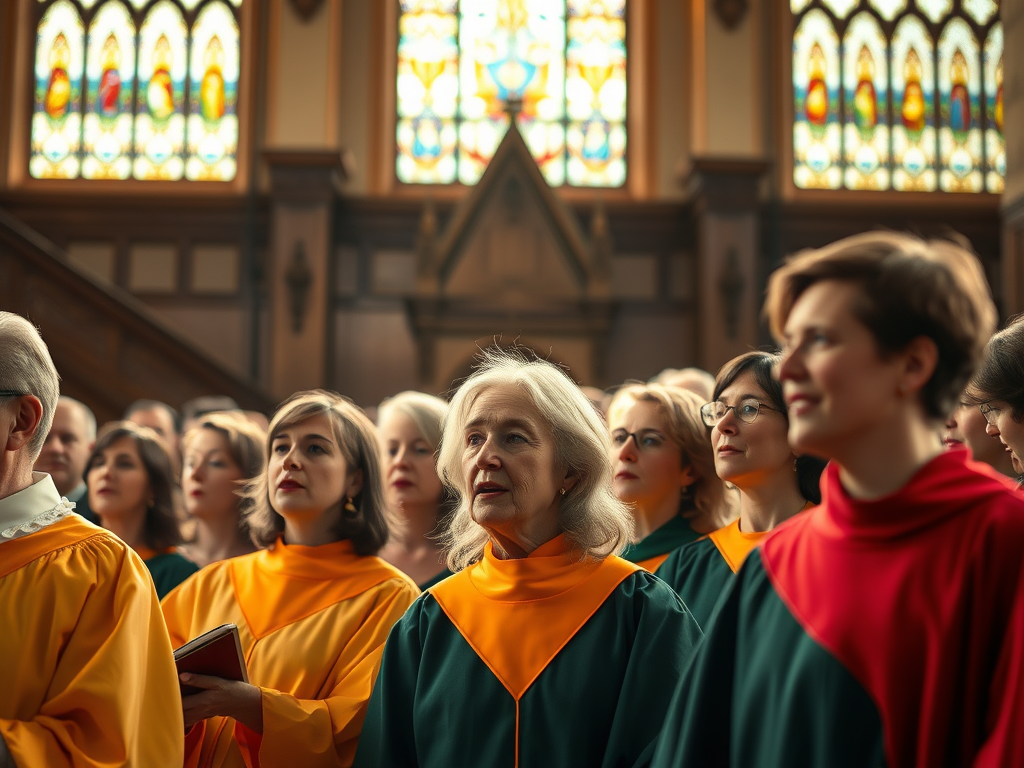
Choral evensong is one of the jewels of Episcopalian worship. We want to introduce opportunities at various times in the year to take part in this type of service. The thing is, we need a good choir to help lead us. I am asking all those who might be interested in such a group to get in touch with me by email at episcopalpriestdornoch@gmail.com and/or to come along to a first meeting and ‘sing’ in St Finnbarr’s Church, Dornoch on Tuesday 19th August at 7pm. If you know anyone from outwith our regular congregations who might be interested – SPREAD the WORD and invite them along!


As part of the VJ day celebrations in Sutherland, St Finnbarr’s, Dornoch was filled with paper cranes surrounding a single kimono in memory of a girl called Sadako. Here’s why –
Up until the time Sadako was in the seventh grade (1955) she was a normal, happy girl. However, one day during a school race that she helped her team win, she felt extremely tired and dizzy. This got worse and worse, until one day Sadako became so dizzy that she fell down and was unable to get up. Her school-mates informed the teacher, and Sadako’s parents took her to the Red Cross Hospital to see what was wrong with her. Sadako found out that she had leukemia. At that time they called leukemia the “A-bomb disease”. There was a low survival rate for ‘A-bomb disease and Sadako was very scared.
During Sadako’s stay in the hospital, her best friend, Chizuko, came to visit her. Chizuko brought some origami (folding paper) and told Sadako of a legend. She explained that the crane, a sacred bird in Japan, lives for a hundred years, and if a sick person folds 1,000 paper cranes, then that person would soon get well. After hearing the legend, Sadako decided to fold 1,000 cranes and pray that she would get well again.
Sadako’s classmates had lost many of their friends to the A-bomb disease and were saddened by the loss of Sadako. They decided to form a unity club to honor her and stay in touch after they all left school, which grew as students from 3,100 schools and from 9 foreign countries gave money to get a statue built to recognise the many children who lost their lives because of the bomb. On May 5, 1958, almost 3 years after Sadako had died, enough money was collected to build a monument in her honour. It is now known as the Children’s Peace Monument and is located in the center of Hiroshima Peace Park, close to the spot where the atomic bomb was dropped.
The act of folding a crane started by Sadako and her classmates turned into a national, then an international, children’s peace movement. Children from all over the world still send folded paper cranes to be placed beneath Sadako’s statue. In so doing, they fulfill the wish engraved on the base of the statue:
This is our cry, This is our prayer, Peace in the world.
Our thanks to all those children and adults who made our peace cranes and to Monica who has worked so hard on displaying them so beautifully in our church. The peace cranes will remain throughout the season of creation to remind us that our actions as humans affect all of God’s creation. The use of atomic weapons not only devastated human life, but the lives of animals and plants for generations to come. Lord have mercy on us.
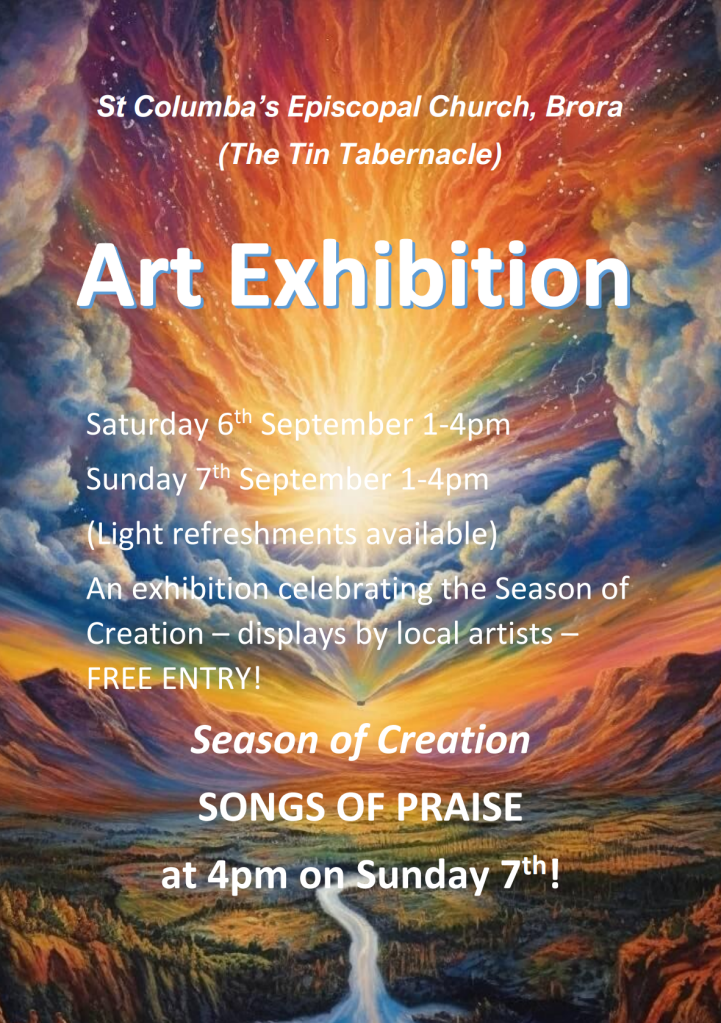
 Scottish Episcopal Church - Dornoch, Lairg, Brora, Tain & Tongue