I wonder if you have every heard the story about a young boy who was wandering around in the porch of a big city centre church one Sunday morning?
He had stopped and was examining a large bronze plaque that was fixed to the wall. The plaque bore an image of the Union and several regimental flags and in impressive letters proclaimed ‘The Fallen’. The boy wondered aloud “What are all those names up there?”
The priest was stood nearby and just happened to hear the boy and so she told him, “My dear child, those are the names of all the people who died in the services.”
After a long pause, the boy looked up and asked, was it the Sunday services or the mid-week services?”
I am happy to report today that we are celebrating a birth – not a death. On the feast of Pentecost, we celebrate the birth of the church – the birth of Christ in you and me, and in all who call on his name.
The annual celebration of the paschal mystery, which began on Ash Wednesday, culminates at Pentecost and today is Pentecost.
Now I wonder if anyone here has ever heard of something called a Holy Ghost Hole?
The Holy Ghost Hole is an architectural feature found in some medieval churches. It is literally a hole punched through the ceiling of a church which proved to be very useful on at least three holy days in the church calendar.
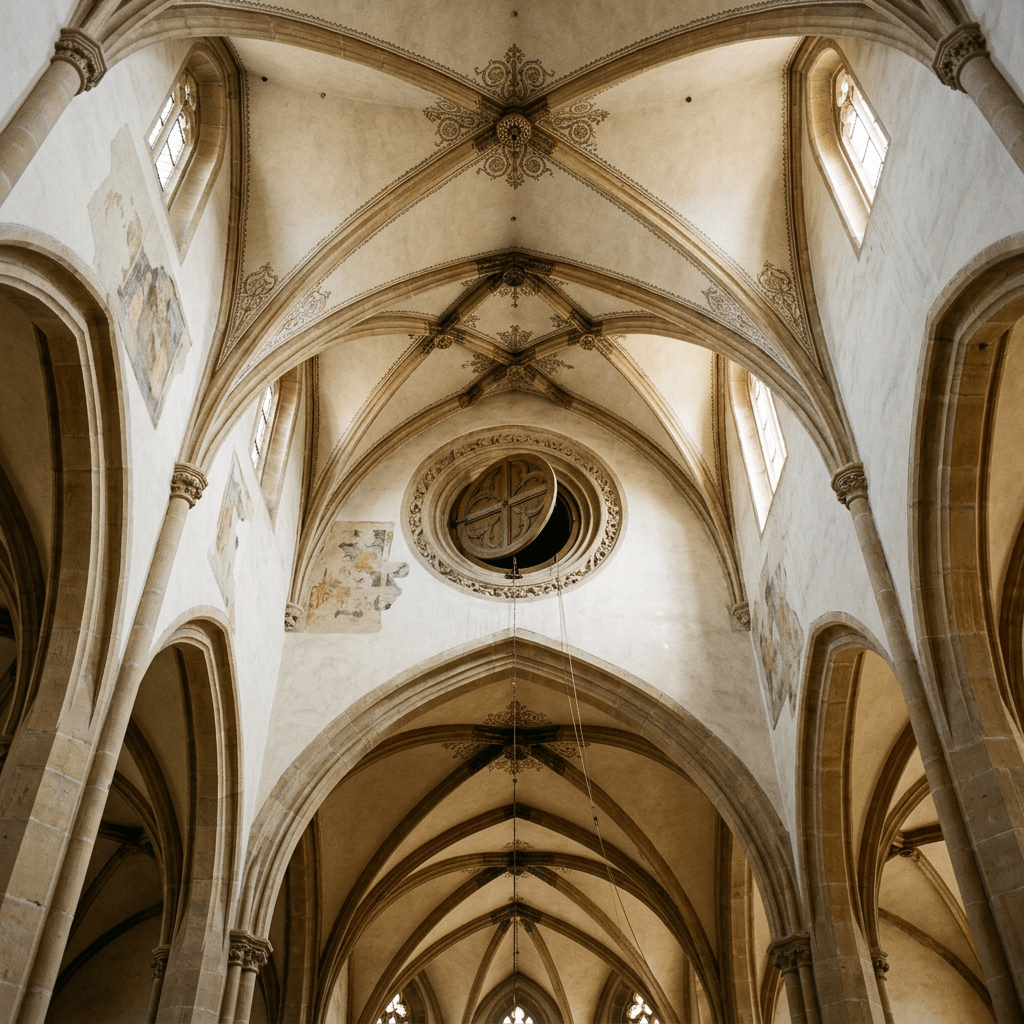
On the feast of the Annunciation (March 25), churches in western Germany that had a Holy Ghost Hole would lower a boy dressed as Saint Gabriel through the hole to address another young actor playing Mary below. As the children in the congregation looked up in awe, their parents would surreptitiously place biscuits or sweets on the pews, and encourage their children to believe that Gabriel’s heavenly companions had put them there.
Secondly, on the Ascension, some churches hoisted a statue of Jesus Christ up into the hole with a pulley after the Gospel was read. The first recorded instance of this custom is marked with tragedy: when in 1433, the Provost of the Augustinian Canons’ Monastery in Bernried in Germany, was killed by a falling figure of Christ after the rope broke. Today you can still see this custom as it continues in two parishes in the Freising district of Germany.
But the main use of the Holy Ghost Hole was on Pentecost. During the chanting of the sequence Veni Sancte Spiritus (Come Holy Spirit), communities came up with creative ways to mimic the descent of the gifts of the Holy Spirit upon the first disciples.
In some towns in central Europe people even went so far as to drop pieces of burning wick or straw from the Holy Ghost Hole, to represent the flaming tongues of Pentecost. This practice, however, was eventually stopped because it tended to set the people on fire externally, instead of internally as the Holy Spirit had done at Jerusalem.
Some French churches had a safer (but perhaps not cleaner) solution. In the thirteenth century, several cathedrals released real white pigeons that flew around inside dropped through the Holy Ghost Hole.
The records do not show how the pigeons were collected afterwards, or who had to clean up the birds’ own contributions to the floor and pews.
Perhaps the most reasonable practice was to shower the congregation with Rose petals dropped through the Holy Ghost Hole. The most famous example of this custom today is at the Basilica of St. Mary and the Martyrs in Rome, better known as the Pantheon. Volunteers from the local fire station scale the roof of the ancient temple and throw thousands of petals through the oculus, the opening in the centre of the dome. Although the oculus predates the Holy Ghost Hole by a whole millennium, it serves the same function.
Now when you think of the Holy Spirit, what bird (which I’ve already mentioned) comes to mind?
Anybody know? Right…the dove.
But instead of the dove, many Celtic Christians chose the wild goose as a symbol to represent the Holy Spirit.
Can you imagine what it would have been like if the two traditions had combined – just think, wild geese released through those holes in the ceiling above the heads of the congregation – chaos and confusion – but all very exciting.
And here, in the north west of Europe, a couple of thousand years later, what do we do on Pentecost Sunday?
Look around & you tell me.
Oh yes, we wear RED.
Doesn’t hold a candle to the church in the middle ages, does it?
At Pentecost we celebrate the coming of the Holy Spirit into the world.
This spirit, this Breath gives birth to us as the people of God.
What God gives us when he gives us his Spirit is more than strength and support and teaching and comfort, those things we normally identify with God’s presence, he gives us more too than joy, and peace, patience, and kindness, those things which we call the fruit of the Holy Spirit.
He gives us as well a set of gifts designed for the building up of the body of the church, and for the individual ministries to which we are called, and for our spiritual life.
Joel, in his prophecy of the last days, mentions some of the gifts of God through his Spirit: gifts of vision and gifts of dreams, gifts of prophecy.
Peter, in his sermon on the day of Pentecost, speaks of the gift of tongues.
And Paul lists some of the gifts that God gives and explores with the Corinthian congregation how those gifts can be used and abused: what about this for a list of gifts: the gift of teaching, the gift of discernment, the gift of exhortation, the gift of hospitality, the gift of intercession, the gift of the word of wisdom, the gift of prophecy, the gift of faith, the gift of administration, the gift of helping and the gift of mercy.
These gifts are spiritual gifts – they are gifts of our second birth – that give us the ability to minister to each other.
Over the past few years, I have received many electronic and paper communications encouraging priests and other church leaders to consider themselves to be pioneers or mission leaders.
In these communications there are usually stories of ministers who have birthed large churches out of nothing in just a few years, or who have turned dying congregations into mega churches. These are spectacular stories that are meant to inspire us. Truly, there is nothing wrong with that and I am always impressed.
The Pentecost story though is even more astounding. It contains elements that are stunning, incredible and ecstatic: the sound of a violent wind, fire appearing over the disciple’s heads and three thousand new members of the church as the result of just one sermon. Wow! It was an amazingly dramatic beginning. But I’m even more intrigued by what happened after the drama subsided.
The very next verse says, “They devoted themselves to the apostles’ teaching and fellowship, to the breaking of bread and the prayers.”
Not much drama here.
Worshiping together, eating together, learning together.
We know from the rest of Acts that there would be more excitement in the form of healings, unexpected conversions and visions.
But there would also be other types of events, far more of them and far less sensational: simple conversations, travels, meetings and more sermons.
And so we realise that our lives together are quite the same, a couple of thousand years later. Occasionally we hear of some remarkable situation: amazing church growth, surprising personal turnarounds or healings and breathtaking testimonials.
More commonplace, though, are the stories that never get told – because they are not stories of wild action, but of simply living life with God:
A nurse who has been working with Alzheimer’s patients for ten years, and whose patients will never get well.
A woman who cares for her children with humour, love and kindness even though her husband has left the scene.
A teenager who leads his community in starting a recycling project.
A woman who somehow finds peace in her soul after she’s lived through a brutal war in Ukraine or the Gaza strip.
When a person is willing to sacrifice wealth, prestige, and power, to serve in jobs that don’t pay well, but serve others.
Or when a person bears the pains of sickness and age without becoming bitter.
Where is the Spirit at work?
Well it’s right here – in the everyday.
The Spirit is at work in human hearts and minds, and souls. The Spirit is at work in the places where He is invited to take up residence. Sometimes, we don’t realise that we are allowing the spirit to work through us – and it doesn’t particularly fee as if that’s what happening.
We give people a lift to church each Sunday.
We fight to protect nature and wildlife from over development.
We knit hats for new born babies.
We serve the tea, coffee and bisuits.
We make preparations so that our worship runs smoothly.
We play the organ, we clean the church, we send encouraging messages on Facebook or by letter, we give our time in the charity shop, we pray, we care and we simply turn up here Sunday by Sunday. When we open our hearts to Him, we become people of the spirit.
And the Spirit’s people measure success, not by the number of converts or new members or programs, but by whether or not we are doing what the Spirit is urging us to do.
That is a vastly more difficult calculation. We can easily count the number of people in the pews, but how do we measure the long-lasting effect we are having on our friends, family and community?
The effect of the Spirit’s work through the Spirit’s people is indeed beyond measure. It is incalculable.
It’s a humbling, but awesome thought that He is at work through you and me, simply because we invite him in.
And so, this Pentecost Sunday, commit yourself afresh to opening your heart and mind to the Holy Spirit. Invite him in, ask him to give you the words and attitudes that will help you best serve the people around you, that they might come to know Our Lord and Saviour just as you do. Come Holy Spirit!
 Scottish Episcopal Church - Dornoch, Lairg, Brora, Tain & Tongue