Sermon John 17.1-11
The season of Easter is almost over and next Sunday we arrive at Pentecost – a day which some regard as the birthday of the church, the day when the Holy Spirit rains down on the disciples and those gathered with them – but more about that next week.
Many of you will know that love reading a good book, and perhaps fewer of you might know that one of the authors I most admire is Terry Pratchett. I am, at the moment, racing through another re-read of my all-time favourite series of books – Terry Pratchett’s ‘Discworld’ – set in a fantasy world that has many parallels with our own and certainly makes you think about our own institutions and patterns of human behaviour in many new and interesting ways.
It was the American satirist and commentator, PJ O’Rourke that said “Always read something that will make you look good if you die in the middle of it”.
Now I’m not sure that comic tales of fantasy would make me look particularly good if I suddenly shuffled off this mortal coil, so I might mention I am also reading Hope: The Autobiography of Pope Francis (though I’m sure there will be those who don’t think that makes me look any better)!
Later this month, on the 25th May to be exact, the church remembers the Venerable Bede and if anyone died reading something that made them look good, it was him. When his time came, he was right in the middle of dictating a commentary on John’s Gospel! It’s a tradition in some places to read the passage Bede was dictating and finish at the exact point that he died!
But, you know, I’m not sure that it is just a case of looking good when we die. I actually think it’s more important that the whole of the life we have lived looks good. How we face death comes from how we live life, and we know that Bede’s death was the ending of a life well-lived.
How we live and how we die are connected.
Last Thursday was Ascension Day and some of us gathered in St Finnbarr’s to celebrate the Eucharist. We had hymns, prayers and a reflection all associated with the Ascension of Jesus.
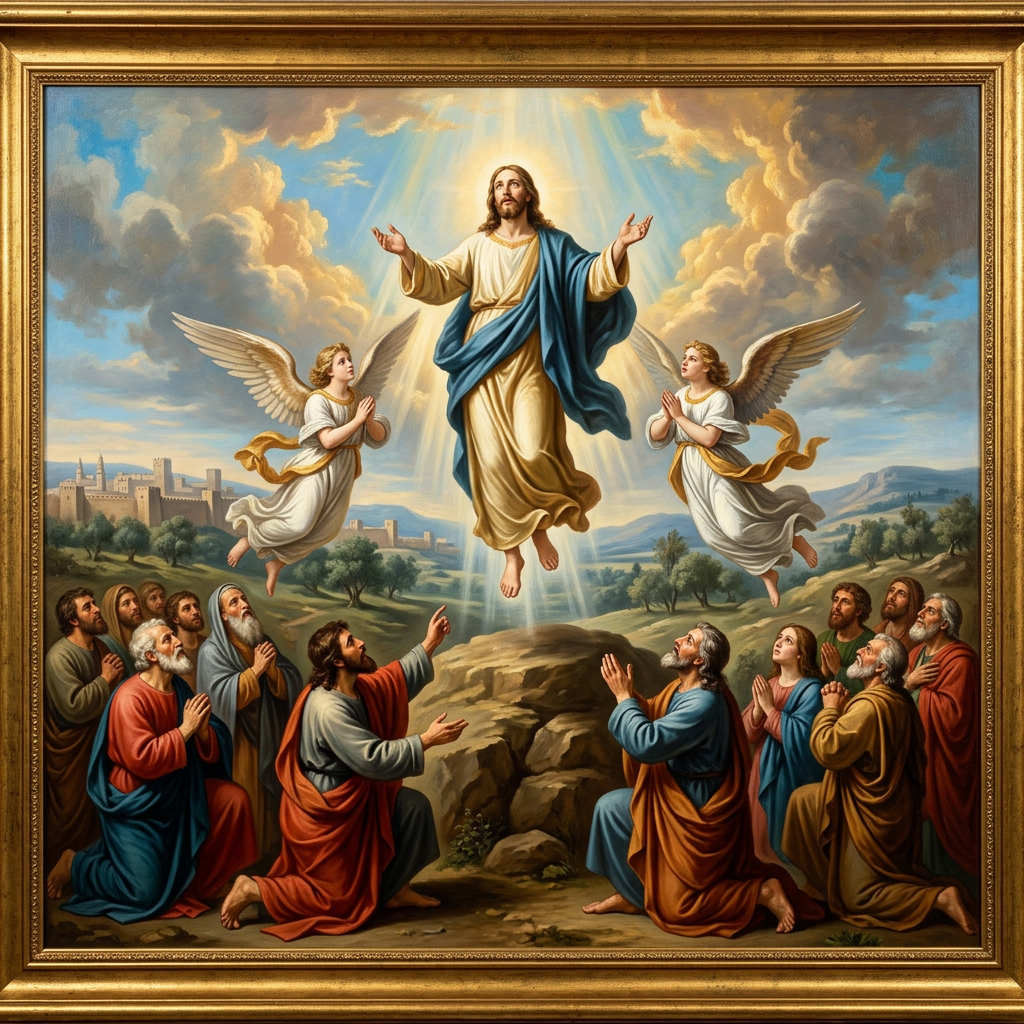
In our modern day, when there aren’t that many of us who regard that heaven is up there in the clouds, the use of the word ascension or ascend can distract us, but in the cosmology of two thousand years ago heaven was definitely ‘up’ and earth was ‘down’ and so we need to remember that world view of the time.
But more important than the direction of travel of Jesus and the Holy Spirit, is the source and destination of each journey: Jesus’ ascension links earth and heaven. Jesus, who came from God’s presence to dwell on earth and share our human nature, now returns to God’s presence taking his human nature with him.
At Pentecost, the Holy Spirit, sent by Jesus, comes from God’s presence to empower the holy people of God on earth, as happened at the creation when he moved over the face of the earth.
Ascension was a time of departure as well as arrival and departures involve last words. In today’s scripture readings we are held, liturgically, between the departure of Jesus to his Father and the arrival of the Holy Spirit which, as I said, we celebrate next Sunday.
Remember, that satirist we heard about earlier, PJ O’Rourke, wants us to be reading something that makes us look good at our death, but the challenge from today’s scriptures is about what we say to people before our final parting. We heard Jesus’ last words to the disciples and their last words to him, as well as Jesus’ last prayer to his Father in heaven. To the disciples, overhearing this prayer, his trust is clear. Jesus’ words of love and joyful trust in them must have surprised them.
In Acts, Jesus had gathered his apostles for one last conversation and their last words to him were a question. I sometimes wonder, if they had known this was going to be the final moment, would they have ended things this way or would they have said something else. But they asked Jesus if this was when he would restore the kingdom to Israel?
So, just as the disciples try to narrow the saving work of God to one nation, Jesus blows it all open by responding with words along these lines – “Never mind that. Get on with being my witnesses all over the world. Not only where you are relatively comfortable – Jerusalem and Judea (both familiar territory), but also Samaria (despised territory avoided by faithful Jews) and to the ends of the earth (way beyond anywhere any of them had previously gone).
Jesus did not send them back home to preach the gospel and the Acts of the Apostles suggests they never did go home, at least permanently. The Ascension is disruptive of comfortable life.
Since Ascension Day always falls on a Thursday it is too easily overlooked. So, on this Sunday after the Ascension, here is an important question: What would the Christian gospel look like without the ascension of Jesus?
I think that without the ascension of Christ we would be without our hope of heaven. Why? Isn’t the resurrection enough? It is vital of course, but on its own, it is not quite enough. There are fifty days of Easter and the fortieth is Ascension Day. Easter isn’t over with the resurrection. The resurrection was evidence that death is conquered, that God has destroyed its power and has the last word. But to what end? That we should hang around on Earth forever?
Without the ascension, the resurrection is the conquering of death but leaves us here on earth. The ascension of Jesus Christ, fully divine and with a place at the side of God the Father, is also the ascension of one who was fully human, who took his humanity – our humanity – into heaven and opened the door for all humanity to follow. The world-changing significance of the ascension of Jesus Christ is that there is a human in heaven, previously inhabited only by the heavenly hosts. In the words of the Te Deum, the ancient song of the church, ‘He has opened the kingdom of heaven to all believers’. As the creed affirms, our hope is in the resurrection of the dead and the life of the world to come. The ascension, an integral part of the fifty days of Easter, assures us that, in Christ, there is a place in heaven for us. In the ascension, Jesus Christ opened heaven to all believers.
So, are you ready for heaven? Are you ready to leave the Earth behind?
Well, that takes us back to where we started today. It is not just that we should look good because of what we are reading when we die, but that we should strive to make our lives good, all the time, so that whenever death comes we are found to be living well in the joyful knowledge that by his ascension Jesus Christ has opened the kingdom of heaven to all believers.
St Benedict told his monks to always keep their death before their eyes. I wonder are there any things that you and I need to put right quickly so that we are ready to die whenever that time comes? I ask that question in the glorious assurance that the Ascension has opened the gate of heaven to us and that, as the gospel reminded us, eternal life is to know God and Jesus Christ whom he has sent, and that begins right here on Earth.
This Ascension-tide we are challenged to consider whether our lives are in such order that, were we to die today, we would leave with partings well made, with a book that we would feel good about being seen to have been reading, and with people able to say the world is a better place for our having lived in it. You and I are called to live as we would wish to be found at death.
For the disciples, their parting conversation with Jesus was a question that propelled them into mission. In the light of the ascension they were sent to be his witnesses. That is, indeed, a parting well made.
After all, it is the parting we make each week – ‘Go in peace to love and serve the Lord.’
 Scottish Episcopal Church - Dornoch, Lairg, Brora, Tain & Tongue