Sermon for Epiphany 3C – 26.01.25

* Nehemiah 8:1-3, 5-6, 8-10 * Psalm 19 * 1 Corinthians 12:12-31a * Luke 4:14-21

Our scripture passage for this third Sunday after Epiphany comes from the gospel of Luke and the evangelist places the story immediately after Christ’s baptism – right at the beginning of Jesus’ ministry.

Now Jesus has already been teaching and performing miracles in other towns nearby and his reputation has spread as he returns to his home town of Nazareth.

Our gospel starts out as one of those “local boy makes good” kind of stories. You know what I mean –

Promising young man heads off to university and comes back a multi-millionaire because he invented something, or, that quiet girl with the dimples and long hair who played second violin in your school string quartet becomes conductor of the London Symphony Orchestra – it sounds like it’s going to be that sort of thing.

Imagine it, the neighbours and relatives who knew Jesus as a boy are eager to see him now – a grown man who has achieved fame for doing remarkable things, especially in nearby Capernaum. So, on the Sabbath, everyone flocks to the synagogue to hear this young preacher and to see if maybe he might perform one of those healing miracles that they’ve been hearing about.

You can just see Jesus approaching the synagogue and the minute he enters the door the senior rabbi asks if he would be willing to read from a book of the Prophets and perhaps share some insight into those words with the people.

Of course, he says. And they bring him a large scroll, which he carefully places on the reading desk. As he starts to unroll the scroll, all eyes are on him. Mary is trying hard not to show any emotion, but this is her boy up there in front of everyone, she must have felt so proud. It’s a long scroll and it takes a while for Jesus to find the passage he has in mind – one near the very end.

And here it is.

“The Spirit of the Lord is upon me, because he has anointed me to bring good news to the poor. He has sent me to proclaim release to the captives and recovery of sight to the blind, to let the oppressed go free to proclaim the year of the Lord’s favour.”

They all sit transfixed, waiting for his words of insight. His neighbours, childhood friends, his aunts, uncles and cousins, the respectable religious leaders, even his own mother – waiting to hear what he has to say.

And Jesus rolls up the scroll and gives it back to the attendant and sits down.

And then he says to them,

“Today this scripture has been fulfilled in your hearing.”

Can you imagine it? Can you imagine if that happened here and now?

Now we are in the middle of the season after Epiphany when we celebrate how God has been revealed to us in the person of Jesus Christ who came in human form and lived among us, the one we call Emmanuel.

Luke (the author of today’s gospel) liked to talk about the Holy Spirit. In fact, Luke referred to the third person of the Trinity more than all the other evangelists combined. And if we were to take the whole of chapter 4 of Luke’s gospel we see Jesus

  • being filled with the Holy Spirit at his baptism,
  • led by the Spirit into the wilderness,
  • returning to Galilee in the power of the Spirit,
  • and proclaiming the fulfillment of Isaiah’s prophecy that “the Spirit of the Lord” was upon him.

Clearly, the evidence of the Holy Spirit’s work in the life of Jesus was something Luke wanted to be sure his readers would notice.

And so why didn’t the good people of Nazareth, Jesus’ own family and neighbours, see it?

They were obviously looking for some evidence of God’s Spirit. They’d heard the rumours from other towns in the area, especially from Capernaum and the area around the Sea of Galilee. This Jesus they thought they knew so well had already gained quite a reputation as a teacher, so it isn’t surprising that they give him the scroll to read when he enters the local synagogue.

It was common practice for the teacher of the day to stand while reading the Scripture, then sit down to teach from it and no one seems surprised when Jesus does this. In fact, they all seem to be eagerly listening to what Jesus might have to say about this ancient prophecy.

A prophecy where Isaiah had started proclaiming the word of the Lord to a people returning from exile and hope was beginning to rise amongst the nation of Israel. Isaiah preached comfort to God’s people and they responded with eagerness to that message. When Jesus chooses this particular passage to read to the people of Nazareth, it was a reminder to all of them that they too should live in  hope. Remember, they were living under Roman oppression, just as their ancestors had lived under oppression from the Babylonians and the Assyrians. The people were ready for some good news.

These words have meaning for us now, just as they did for those exiles returning to Jerusalem and for the people of Nazareth who heard Jesus say, “Today, this scripture has been fulfilled in your hearing.” And just as Christ offers us hope with these words, he also calls us to be the ones who bring good news to the oppressed, who bind up the broken-hearted, who proclaim liberty and release and who announce the Lord’s favour and grace to be freely available to all. Not just in the future, but now! Today!

Good news for some can mean bad news for others, especially in our current culture where the gap between those who have much and those who have little continues to grow. When it comes down to it, all the rhetoric we hear from politicians, all the arguments we see on social media amount to nothing more than questions of justice. And justice almost always has to do with who has how much of what – whether it’s wealth, property, power or acceptance.

The really challenging part for most of us, is realising that we actually participate in much of the oppression happening around the world today – through the things we buy, the privileges we enjoy and the way we can ignore suffering – whether we like it or not, most of us are complicit in oppressing others – and our society has become so structured that it makes it really hard not to become complicit.

But today Luke shows us how we might face this dilemma. Luke tells us in verse 20 that the people of Nazareth were listening intently as Jesus sat down to teach. “The eyes of all in the synagogue were fixed on him,”

Imagine what it might be like to fix our eyes on Jesus! Because when we focus our attention completely on Him, we can also see our place in the world more clearly. Instead of letting our gaze settle on those things that irritate us, anger us or cause us pain, we would see only Jesus and the disagreements that divide us would lose their importance.

We would see the ways our lives impact others with greater clarity. When our eyes are fixed on Jesus, we can recognise the part we sometimes play in the systems and structures that send out the false message that some people have more value than others, that some people deserve more than others – and we can start to do something to change those systems and structures.

We can demonstrate in real and powerful ways that every human being has value and worth to God.

When our eyes are fixed on Jesus, good news really is good news. We engage with Christ in the work of making what’s wrong with the world right. Issues of mercy and justice are no longer just issues we talk about – mercy and justice become real in the person of Jesus Christ working through us.

This is the season after Epiphany, when Christ is revealed as God among us. As we recognise the Saviour’s presence, and fix our eyes and hearts on Him, may we point others toward Jesus and say to them, “Let me show you God’s Son. Let me show you the one who sets the captives free, who brings sight to the blind and frees those living under oppression.” Today the scripture has been fulfilled in your hearing.

Sermon for Epiphany 2C – 19.01.25

Readings * Isaiah 62:1-5 * Psalm 36:5-10 * 1 Corinthians 12:1-11 * John 2:1-11

The story of the wedding at Cana has been read in the Epiphany season for a very long time. That’s because the theme of Epiphany is the manifestation, the showing off to the world, of Jesus – of who he is and of what he is about. The business of changing water into wine was the first of Jesus’ miracles, the first time he gave a real sign to his disciples of what was going on with him and that’s what I’d like us to think about during our sermon today.

Now, when it comes to theology, this reading contains an embarrassment of riches. In John’s Gospel, one of the things Jesus does is replace the Jewish feasts with the reality of his presence. Here, the Jewish rites of purification are somehow superceded, and superceded in abundance, by who Jesus is and by what he does. There is also a real connection between this scene and the material in Isaiah that likens the return of the Messiah to a wedding, and the joy of God’s people to the joy of a bride and bridegroom. And there is much, much more too!

But of course, the wedding at Cana is also a story, and it’s a great one. Mary starts out as the real hero, telling Jesus to do something for these people who are in really serious trouble. (By the way, an ancient legend says that Mary was the aunt of the bride and might have been the person responsible for the wedding – that would certainly explain her interest.)

Anyway, Jesus says to Mary that all of this is none of his business and that he has other plans about revealing himself. His time has not come. Mary pretty much ignores that and assumes that Jesus is going to be a good Jewish boy and listen to his mother – and, of course, he does.

Now, the scholars who are experts on what society was like in those days make it really clear that running out of wine at a wedding was not just a minor social inconvenience. It was not like, “Well, the wine’s gone, so we have to start drinking beer.” This was a major breach of the demands of hospitality; it was a disgrace and it would be devastating for the couple. Everywhere they went, for the rest of their married life, they would be known, ridiculed, and talked about. The strain on their life together would be enormous. Just imagine – “oh there’s Mr and Mrs so-and-so, Oh Yes, they were the ones who ran out of wine at their wedding!”

So, knowing something really important in the lives of the people who were there, is going on, Jesus has to decide what to do. He has to decide whether to change his timetable – whether to wait before making himself known, as he had planned, or to act right then, at that moment, for that particular need. And of course, Jesus acts, the wedding was saved, and the bride and groom were given a chance.

Now, this story is not actually about the bride and groom, it is about Jesus. It is about all that theology I mentioned a minute ago. But it is very important to realise that the first time Jesus made himself known, even to his disciples, he did so – not according to his own plans, but in response to real and important human need.

Just think about it for a minute. Jesus’ first manifestation of his glory, the first of his signs, was not for or about Jesus. He didn’t throw a great big “Jesus of Nazareth Epiphany and First Miracle” party, invite everyone in the village, and then haul off and do a miracle. Instead, the signs of his calling and of his identity were drawn out of him, not by his own plans and schedule, but by the needs of those around him. What it means and what it looks like for Jesus to be the son of God is given expression in his response to the realities of human life and human need.

Jesus’ identity, the Father’s gift to him of who Jesus was, this was not something that Jesus understood or held to for his own sake, for his own satisfaction, or his own fulfillment. Jesus revealed himself for the sake of others. Who he was and what he had was not for him. It was always and only for others, from the very beginning.

Keep that in mind and let’s turn for a minute to the epistle from 1 Corinthians. That section from Paul is about some of the interesting and peculiar things that were going on in the church in Corinth in the first century. There was some pretty weird stuff, and some pretty selfish stuff, and some pretty bad stuff too! In the middle of it, as is so often true when religion goes bad, there was a strong sense of “who is best,” and a strong sense of mine. They were having a whole load of different spiritual experiences and encounters with God – which is probably fine – but they were getting possessive and competitive about all of that. They were saying things like, “this gift is mine, this way of doing things is mine, this spirituality is mine, this special something is mine.”

What Paul says to them is what Jesus discovered when the wine ran out. What Paul says to them is, “what you have is not for you. What you have is for others.” To each is given the manifestation of the spirit for the common good. This is a fundamental religious truth about the nature and purpose of God. Then and now. What you have is not for you. What you have is not even about you, not really.

The people in Corinth could never get their religion right, indeed their lives right, until they realised that what they had was not for them or about them. It was given to them so they could use it to give, and to build, and to help, and to create.

What Jesus had, who he was by gift of the Father, what it was that made him special, and unique, this was not given for his own sake. It was given so Jesus would have a choice, so that he could choose to give all of himself for others.

What we have is not for us. Not really. All that we have, whatever sort of thing it might be, all that we have is gift. It is given to us so that we might be givers, so that we might build up, so that we might help, so that we might be a part of something greater, so that we might serve our neighbours and build up the larger body. In one way or another, that is the purpose of our lives, and everything in them.

This is good news. It is good news that we do not live for ourselves alone, that what we have is not for us.

We are not created to live closed in upon ourselves, protective, possessive and defensive. We are not at our best when we try to live that way – and we do not have to live that way. When we live beyond ourselves, for others and for the larger whole, then something wonderful can happen, something greater can be created, and there is more of us than there could ever be otherwise.

At the wedding in Cana of Galilee, Jesus chose to abandon his plans and his schedule, and to reach out. In doing that, he shows us what human life can be like.

And remember, when he did that, there was plenty of wine for everyone at that wedding.

Amen!

Service at St Trolla, The Crask Inn – Thursday 16th January 2024 – 12 noon

A reminder that our first monthly Eucharist of 2025 at St Trolla’s is tomorrow (Thursday 16th January 2025) at 12 noon. The Reverend Don Grant will be presiding and it would be great to see a good gathering.

Let us always meet each other with a smile, for the smile is the beginning of love!Mother Teresa

Sermon for The Baptism of the Lord 2025

When preparing for the sermon this week, I came across a story about a young girl called Georgie who was at home with her mother.

Georgie had been a terror all day long and with each incident of bad behaviour her mother warned her, “You just wait until your father gets home!”

Eventually evening came and Georgie’s dad got home from work.

Her mother began telling him about their daughter’s behaviour. The dad looked at his daughter and before he could say anything the girl cried out, “You can’t touch me. I’ve been baptised!”

Wow! If only it was that easy, that clear, that simple. If only we could say to the sorrows and losses in our lives, “You can’t touch me. I’ve been baptised!”

Wouldn’t it be so wonderful to just be able to say to the struggles and difficulties we face, “You can’t touch me. I’ve been baptised!”

If only we could say it to the changes and chances in life, “You can’t touch me. I’ve been baptised!” But of course, that is not how baptism seems to work.

Despite our baptisms most of us have suffered sorrows and losses in our lives, we’ve encountered difficulties and struggles, we’ve had to face changes and chances in life that we would rather have avoided.

And despite her baptism, little Georgie in the story was still sent to the naughty step by her father!

And yet she speaks a deep truth. She is absolutely right; she is untouchable. At some level she knows that her existence, her identity and value are not limited to time and space; to the things she has done or left undone.

She knows herself to be more than her biological existence. She knows herself as beloved. She knows the gift of baptism.

Baptism does not eliminate our difficulties, fix our problems, take away our pain or change the circumstances of our lives.

Instead it changes us and offers a way through those difficulties, sorrows, problems and circumstances – and ultimately a way through death.

Baptism transcends our biological existence and offers us a vision of life as it might be. Baptism offers us a new way of being – one that is neither limited by, nor suffers from, our “createdness.”

Through baptism we no longer live according to the biological laws of nature but by relationship with God, who through the Prophet Isaiah says, “Do not fear, for I have redeemed you; I have called you by name, you are mine” (Isaiah 43:1).

That means when we pass through the waters of sorrow and difficulty God is with us. That the rivers that can drown will not overwhelm us. It means that when we walk through the fire of loss and ruination we are not wholly consumed by the flames. For he is the Lord our God, the Holy one of Israel, our Saviour.

To know this, to trust this, to experience this is the gift of baptism and baptism always takes place at the border of life as it is and life as it might be.

That border is the river Jordan.

Geographically, symbolically and theologically the Jordan River is the border on which baptism happens.

It is the border between the wilderness and the promised land; the border between life as survival and a life that is thriving; the border between sin and forgiveness; the border between the tomb and the womb; the border between death and life.

We all stand on that border at multiple points in our lives. Some of us might be standing there right now. Some of us experience that border as a place of loss, fear or pain. For others it is a place of joy, hope and healing. In reality, it is both of these things at the same time.

The only reason we can stand at the border of baptism is because Jesus stood there first. We stand on the very same border at which his baptism took place.

Jesus’ baptism is for our sake and salvation. His baptism makes ours possible. The water of baptism does not sanctify Jesus. Instead he sanctifies the water for our baptism. The water that once drowned is now sanctified water that gives life.

Ritually we are baptised only once. Yet throughout our life we return to the waters of baptism. Daily we must return to the baptismal waters through living our baptismal vows.

We must confess our belief in God – Father, Son, and Holy Spirit –  because God first believed in us.

We must continue in the apostles’ teaching and fellowship, in the breaking of bread and in the prayers because the Holy Spirit has descended upon us and has filled us.

We must persevere in resisting evil and whenever we fall into sin, we repent and return to the Lord because the heavens have been opened to us and we have seen our true home.

We must proclaim by word and example the good news of God in Christ because we have heard the voice from heaven declare us beloved children in whom he is well pleased.

We must seek and serve Christ in all persons, loving our neighbour as ourselves; striving for justice, peace, and dignity for every human being because that is how God has treated us and how could we do any less for another one of his children.

Sometimes our own body provides the waters of baptism – our tears.

St. Ephrem the Syrian spoke of our eyes as two baptismal fonts. Tears are the body’s own baptismal waters that cleanse, heal and renew life.

At other times the circumstances of life – things done and left undone by us and others – the ups and downs of living – push us back to the waters of baptism. We return in order to again be immersed into the open heavens, to be bathed by God’s breath, the Holy Spirit, and to let the name “beloved” wash over us.

There is truth in what little Georgie said, “You can’t touch me. I’ve been baptised!” My dear friends believe that! In and amongst life’s adversities say it and claim it for yourself! “You can’t touch me. I’ve been baptised!”

Sermon for the First Sunday of Christmas 2024

Thomas, Richard and Harold were three brothers who over the course of their careers had all done extremely well for themselves.

When they met up at Christmas they were talking about the gifts that they had bought for their elderly mother.

Thomas, the eldest and most successful, told his brothers, “I have built a big house for our mother. Four reception rooms, seven bedrooms – each of them en-suite – and even an indoor pool and sauna”

Richard, the middle child told his brothers, “I sent her a classic Rolls Royce Silver Phantom – I tracked down the actual car that she and our father had used on their wedding day.”

Harold, the third and youngest brother, smiled and said, “I’ve got you both beaten. Now you know how much our mum enjoys reading the Bible – but of course her eyesight is failing and she finds it very difficult to see even large print editions. Well, I have sent her a most remarkable parrot that recites the entire Bible. It took senior clerics in the church twelve years to teach him. He’s one of a kind. Our mother just has to name the chapter and verse, and the parrot recites it.”

A short while later the mother of these men sent out her letters of thanks.

“Dear Tom,” she wrote to the eldest, “Thank you for the house you have built for me, it is very beautiful, but I have to say is too huge. I live in only one room, but I still have to keep the whole house clean!”

“Dear Dick,” she wrote to her second child, “What a beautiful car you have given me, but my dear, I am too old to drive very far now. I stay at home most of the time, so I rarely use it, but don’t worry, it’s nice and safe under a cover in the garage.”

The mother wrote to her youngest and favourite son, “Dear Harry, my darling boy. You have the good sense to know what your Mother needs and likes.
The chicken was Dee-licious!”

As parents, relatives, teachers, guardians, and friends of children we are quite rightly concerned for their well-being. It is our duty (and our joy – most of the time) to protect and teach them, nurture and nourish their lives and ensure that they grow up healthy and feeling loved. We all need someone to guide and guard our growing up, because growing up is hard work.

Growing up means establishing our identity and figuring out our place in the world. It involves creating relationships, setting priorities and making decisions. We choose values and beliefs that structure our lives and along the way we sometimes make mistakes – we can get lost and we can backtrack on decisions that we make. At some point, growing up means moving out, away from your family and finding a new home. This may be a geographical move, but it most certainly involves psychological and spiritual moves too.

So it is no surprise that Mary would be in a panic when she discovers that Jesus is not with the group of travellers that we hear about in our gospel this morning. With great anxiety she and Joseph search for him. Three days later the one who was lost has been found and Mary’s first words are, “Child, why have you treated us like this?” What I really hear is, “Where have you been young man? Your father and I did not survive angel visits, birth in a manger and live like refugees in Egypt only to have you get lost in Jerusalem.” But Jesus isn’t the one who is lost. He knows who he is and where he belongs. Mary and Joseph are the ones who are lost.

Today’s gospel is a story about growing up, but it is not Jesus’ growing up. It is about Mary and Joseph growing up – it is about you and me growing up. Growing up is not about how old we are, it is really about moving into deeper and more authentic relationships with God, our world, each other and our very selves.

Jesus is the one who grows us up. He is the one who will grow up Mary and Joseph. Children have a way of doing that to their parents. They challenge us to look at our world, our lives and ourselves in new, different and sometimes painful ways. That is exactly what Jesus’ question to Mary does. She had put herself and Joseph at the centre of Jesus’ world and his question was about to undo that.

“Why were you searching for me?” he asks. “Did you not know that I must be in my Father’s house?” Jesus is telling Mary she should have known where he was. It is as if he is saying, “Remember, the angel told you I would be the Son of God. Remember that night in Bethlehem – angels praising God, shepherds glorifying God. Remember the three men from the East, their gifts, and adoration. Remember Joseph’s dreams that guided us to Egypt and back. Where else could I be but here?” Jesus has put the Father at the centre of his world and asks Mary and us to do the same – to move to the Father’s home.

Real, authentic growth almost always involves letting go. Mary’s move to the Father’s house, her growing up, means that she will have to let go of her “boy”. Jesus was born of Mary, but he is the Father’s Son. He is with her but does not belong to her. She can give him love but not her thoughts or ways. He is about the Father’s business. Ultimately, she must strive to be like him and not make him like her.

Jesus has moved from Mary and Joseph’s home to the Father’s home. This is not a rejection of his earthly parents but a re-prioritising of relationships. It is what he would ask of Simon, Andrew, James and John. “Follow me” would be the invitation for them to leave their homes, their nets, their fathers and move to a different place, live a different life, see with different eyes. It is today what he asks of you and me.

Growing up spiritually involves leaving our comfort zone, letting go of what is safe and familiar and moving to a bigger place, to the Father’s place. This letting go is a necessary detachment if we are to grow in the love and likeness of Christ. It means we must leave our own little homes.

We all live in many different homes. Some of us live in homes of fear, anger and prejudice. Some in homes of grief and sorrow. Some of us in homes in which we have been told or convinced that we don’t matter, that we are not enough, unacceptable or unloveable. Homes in which we have been or continue to be hurt or wounded. Homes in which we have hurt or wounded another. Homes of indifference and apathy. Homes of sin and guilt. Homes of gossip, envy or pride.

Every one of us could name the different homes in which we live, homes that keep our life small, our visions narrow and our world empty. The problem is that sometimes we have become too comfortable in these homes and they are not what God offers us. We may have to pass through them, but we do not have to stay there.

Jesus says that there is not only another home for us but invites, guides and grows us up into that home. It is a place he knows well. It is the Father’s home in which we can know ourselves and each other to be his beloved children, created in his image and called to be like him. It is a place where your seat at the banquet is already set. It is a home in which we live in rooms of mercy, forgiveness, joy, love, beauty, generosity and compassion.

Leaving home does not necessarily mean leaving our physical or geographical home though sometimes it might. It does mean examining and re-prioritising the values, beliefs and relationships that establish our identity and give our life meaning and significance.

It sometimes means letting go of an identity that is limited to our biological family, our job, community reputation, ethnic group, or political party and trusting that who we are is who we are in God. It means that we stop relating to one another by comparison, competition and judgment and begin relating through love, self-surrender and vulnerability. It means that we let go of fear about the future and discover that God is here in the present and that all shall be well. We stop ruminating on past guilt, regrets and sins and accept the mercy and forgiveness of God and each other. We see our life not in opposition to others but as intimately related to and dependent upon others.

So I wonder what are the little homes in which you live? How do they bound up your life, stifle your growth and keep you from the Father’s home? What might you have to leave behind in order to grow up and move to a better place? Those can be hard questions, painful questions. But ultimately they are questions founded on love.

“Child, why have you treated us like this?

“Because I love you. I love you enough to grow you up, to find you when you are lost and to bring you with me into the Father’s home.”

Amen

Sermon Christmas Eve 2024

Most of you will know that for many years I was a Head teacher in a number of primary schools, and since leaving that position and joining the Council’s Education Department (or as those who still work in schools would have it – ‘The Dark Side’), I really miss the run up to Christmas  – my favourite time of year in school, especially rehearsing and performing the Nativity. Watching the children act out this timeless story so confidently, used to make me feel so proud of them all and I’ve been involved with many versions over the years. Most went smoothly with doting parents ‘ooing’ and ‘aahing’ at all the right moments, but we have had the occasional hiccup.

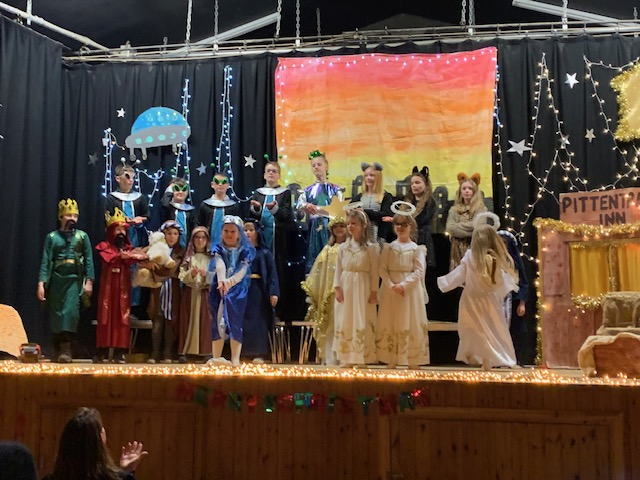
Joshua and his pals in their version of the Nativity this year - Christmas with the Aliens!

(Image – Joshua and his pals in their version of the Nativity this year – Christmas with the Aliens)!

I remember one year in a school in Bolton, when I had cast the part of Innkeeper number 3 to a five year old called Kyle. Now Kyle was not very happy about this because he wanted to be Joseph and what made it even worse, was that his seven year old brother Sam had been given the part!

However, Innkeeper Kyle learned his lines and Rehearsals went well. On the afternoon of the performance, the parents all filed in and there was a buzz of excitement as the children took their places for the start of the show.

The narrator began to read her words beautifully and Mary and Joseph went from door to door trying to find a place to stay. They knocked at the first door – Joseph spoke “I am Joseph and this is my wife Mary. She is going to have a baby and we need a place to stay”. Innkeeper 1 delivered his line perfectly – “Sorry but we have no room”. Joseph and Mary moved on to the door of the next inn.

Now it was at this point that from the side of the stage I could see Innkeeper Kyle stood behind door number three and he had a face like thunder!

Joseph knocked on door number 2. “I am Joseph and this is  my wife Mary. She is going to have a baby and we need a place to stay”. “Sorry, but we have no room” the second innkeeper responded.

So, Mary and Joseph approached door number three and knocked. The door was opened by Innkeeper Kyle with his arms folded across his chest! Kyle’s older brother delivered his line. “I am Joseph and this is my wife Mary. She is going to have a baby and we need a place to stay”. At the top of his voice, Innkeeper Kyle replied – “She can come in, but you can beggar off!”

The school nativity play has become one of the traditional ways that we celebrate Christmas.

And We celebrate the coming of God into the world in so many ways: every household has its own habits, every church its own patterns of services, every nation and community its own traditions.

In our own, and many other western nations, the preparations for Christmas involve an awful lot of shopping, food and presents.

In the words of John Betjeman:

But this is not going to be one of those sermons that tells everyone off for bowing to the commercial pressure of Christmas and missing the heart of it.  Why not?

For one thing I love presents, and I think they are a really important part of Christmas,

But really, it’s because you’re here.  Because it’s taken you time, will, energy, and in some cases, real courage to step through that door just to be here. You’ve pressed pause on the conveyer belt of Christmas so that you can truly enjoy the moment, you’ve walked through the dark, just as the shepherds did, answering the call of the carolling angels.

And because you’ve brought tributes – gifts (not gold, frankincense and myrrh, and I’m not talking about what you’re intending to put in the collection plate either, though that’s part of it, too) – you’ve brought the finest tribute that you can, that of your very selves, together with all the ‘stuff’ that you carry with you, your motivations, your thoughts, the hopes and fears of all your years, as you come to meet the Christ child tonight. You have brought who you really are, and that is the greatest gift any of us has to offer.

But mostly it’s because Christmas isn’t primarily about what we have done, it’s about what God has done. Because Christmas is the great divine ambush, the ultimate proof that it is not so much that we seek God, but that he seeks us.

He is not the precious pearl or the buried treasure that we spend a lifetime seeking, we are the precious pearls and buried treasure that spend a lifetime being found by God.

The epic journey of the Magi, and the chaotic scrambling of the shepherds down the dark Bethlehem hillside are only possible because God had already made the leap from heaven to earth to come among them.  The first move is God’s, and always was.

Our being here in church today – however long and arduous, or short and effortless our journey – is only possible because God had already got here ahead of us, reaching out all over again so that heaven could touch earth for us, right here. ‘The Word became flesh and dwelt among us’.

Because Christmas is the ultimate proof God can find his way into anything and everything, and if we are alert to it, we can see the heart of what Christmas is about wherever we look.  For the heart of Christmas is Emmanuel: God with us. The heart of Christmas is Light in darkness. The heart of Christmas is heaven touching earth.

Yes, indeed, some ways are very odd by which we hail the birth of God, but even in the glitz and bling he is there.  In every shiny Christmas bauble we see the reflection of our own face – and it is a reflection of someone who is made in the very image of God – a human being, the crown of God’s creation, in which he is pleased to dwell.

And if we look a little deeper in that reflection, we see not only ourselves, but those around us, our little corner of God’s world. We do not have to look beyond the material world to catch a glimpse of heaven: because of heaven touching earth we can find those glimpses of heaven right here and right now, everywhere we look. For when God came to earth over 2000 years ago, he never left.

Yes, if we look for him, we can see Christ even in the shiny stuff and in the trimmings.

And even in the darkest corners of the world, God is already there. Jesus called himself the Light of the World, and if you’re the light of the world, you go first to the places that need light the most: the places of deepest darkness. If you enjoyed the sight of the candles and the tree lights and the  crib as this service started, then you know something about light in darkness, that no matter how dark a place is, even the smallest light brings such hope and warmth.

If you’ve ever been blessed with the miracle of forgiveness, or an act of unexpected kindness, or a much-needed word of comfort or guidance, then you also know something of what it means for heaven to touch earth.  If you’ve ever found the grace to offer those words, or that kindness, or that forgiveness, to someone else, then you know something of heaven touching earth. If you’ve ever sung ‘Be near me Lord Jesus, I ask thee to stay close by me for ever’ and meant every word, then you know something of heaven touching earth.

God is not just here.  Here, in church, that is. God is wherever we find ourselves, God is where the angels sing with joy, and we join in; God is where it is dark, and difficult, and dangerous.  God is here, and God is in our hospitals and hospices, our prisons, and on our streets. And God is in every dark and battered street in Gaza and Ukraine and in every conflict zone in this shattered world.  For there is no place on earth that’s too dark for the light of God to shine there.

Because Christmas is the great divine ambush, you do not have to travel far to find the heart of Christmas.  But through these days ahead – whatever they bring for you, and whether you approach them with excitement, or anxiety, or dread, or hope – keep half an eye open for God at Work, and you will see him, and know that he really is there before you.  You will see him in the good stuff, you will find him in the profound moments. You can see him in the trivial ordinariness, and believe me he is there just as surely in the moments of greatest stress or sadness.

So as heaven reaches out to us this Christmas, along with so many others, scattered across the globe, let us dare to grasp the hand of the tiny child in the manger, and so find that our little bit of earth has been touched, and changed, by a little bit of heaven.

BEAUTIFUL CHRISTINGLES!

What a beautiful Carols and Christingle Service we had yesterday afternoon! Thank you to so many people who turned out on a very windy day to help us celebrate the Christingle and pray for children across the world. We collected £284 for The Children’s Society at the service. Special thanks to all who took part in the service, those who helped us make the Christingles and those who contributed all the different bits that make up the Christingle!

Sermon for Advent 4 – 22.12.24

As good episcopalians, many of us love our different liturgical seasons. With different colours adorning our church buildings and changing focus in our journey of faith, liturgical seasons are most worthwhile because they reflect the rhythm of life itself. Advent reflects seasons in our lives that are filled with hope and anticipation. We often associate these with happy times with events like waiting for a wedding, waiting for a baby to be born, or waiting for the arrival of a loved one who has been away for a long time.

But the first Christmas wasn’t exactly happy and bright, and the readings of Advent itself aren’t particularly happy, either. Advent speaks of waiting for God’s help in the midst of desperation, reminding us that we can find echoes of Advent with the homeless living on the street as well with those waiting in the maternity ward.

Advent calls to us as we carry the weight on our shoulders, and it speaks hope. As we watch the news and see the pain in the world, we are often faced with our own powerlessness. As snow and ice and cold weigh down the landscape of many northern climates, we too can feel weighed down: by our ever-extending to-do lists, by the suffering in the world, and by our own personal struggles.

Advent is here to remind us that we cannot save ourselves, but that there is hope.

Today, with four candles lit, the Song of Mary soars through the Gospel reading and into our hearts again, as it does every year.

Mary, the unwed mother, the fiancé of a poor carpenter. Mary, who knows depths of desperation that many of us will never have to know. Mary, who felt herself powerless but sang to God who was about to save the whole world.

We often think of Mary as gentle and meek, but today, Mary is brave and bold, singing loud and strong.

Everything — the very shape of human history — is about to change.

The new dawn is on the way, and Mary sings out to greet it. The weight lessens and hope is born.

I don’t know if any of you have ever read the book or watched the film, The Hunger Games. In the first instalment of the three-part series, there is a scene in the movie that is not in the book, but it sums up very well the theme of the whole trilogy.

President Snow, the dictator of the dystopian, futuristic country of Panem, is walking in his rose garden with the chief “game maker,” Seneca Crane. Crane is the man responsible for creating a game that pits young people from the twelve districts of Panem against one another in a highly publicized fight to the death each year. The winner of the Hunger Games is then held up as a brave, strong hero that represents the spirit of Panem.

President Snow asks Seneca Crane why the games must have a winner. If the Capitol simply wanted to show its power and to instil fear and control, he says, why not simply execute people? Why the games? Why a winner?

Seneca Crane does not understand. He stares back, confused.

“Hope,” President Snow says simply. “Hope is the only thing stronger than fear. A little hope is effective. A lot of hope is dangerous. A spark is fine, as long as it’s contained.”

A little hope, says Snow, would allow the games to entertain the people and would allow them to have a hero to root for, while also keeping the Capitol firmly in control.

A lot of hope would topple Snow’s oppressive regime entirely. The books and movies, as you either know or can probably guess, are about that spark not being contained. The second installment of the story is called Catching Fire as hope — a lot of hope — is revived in the country of Panem.

Hope is more than mere optimism. A lot of hope can shake the foundations of everything that weighs us down. A lot of hope can change the course of history.

For Mary’s part, she doesn’t initially greet the news of her pregnancy with her soaring song and blazing hope. When Luke’s Gospel first introduces us to Mary, she is more like the traditional image of Mary — young, meek, seemingly timid, but ultimately faithful. When the angel tells her the news, she consents, but she’s not singing yet.

As she’s absorbing the news from the angel Gabriel that she will conceive and bear a child, he tells her, perhaps to console her: Elizabeth, your relative, is pregnant too, even in her old age!

Gabriel doesn’t actually tell Mary to go to Elizabeth, but Luke says she still “made haste” to go to the Judean town in the hill country to see her.

Mary wants to be near someone who understands. Elizabeth is also pregnant by a miracle. Elizabeth, Mary knows, won’t think she’s crazy. And here, with another human being who understands that God works in really weird and unexpected and direct ways, Mary is able to find the courage to sing her song of hope. Not ordinary optimism, but great hope. The kind that catches fire. The kind that sings loud.

Today, Mary sings as she invites us into the vulnerable territory of daring to hope big. Optimism looks behind us to find comfort in what we’ve experienced before. Hope — the big, world-shaking, musical hope of Mary — looks ahead, knowing that we cannot imagine what God is able to do.

There is, of course, nothing wrong with optimism. Optimism hopes for good fortune, for fun with friends and family during the holidays, for a blessed and happy new year, and for love and warmth to surround us. There is nothing wrong with a little optimistic Advent cheer.

But if you have experienced the depths of despair, if you have seen the pain that exists in the world, you know that optimism is not enough on its own. It is too difficult to sustain. The world is too broken, too violent, and too divided, and we alone cannot fix it. Our one spark of hope is that God has spoken and told us that someday, all things — all things — from our personal struggles to the weight of the world’s pain, shall be made right. That hope is why Mary sings.

Today, the Gospel story invites us, like Mary, to seek out others in order to find our song of hope. It wasn’t until Mary was with Elizabeth in the Judean hills that her hope burst into song. And maybe, whether we know it or not, that’s what we’ve done today, too. We have made haste to seek one another out, to gather together so that we, too, can sing songs of hope.

Our song is one of extraordinary hope. Hope that has seen the broken and divided state of the world and knows that it cannot afford to hope too small because we cannot repair the world on our own. Only God can, and only God will. In the meantime, we are called to make our corner of the world that God so loves a less divided, more trustworthy, more hopeful place. We are called to sing.

The best part about Mary’s song of hope is that it is never hope unfulfilled. Every year, we remember her bold song to remind ourselves that God has already broken through.

Even in the darkness, even in the deepest disappointments, even when we are betrayed, and even when the world looks most broken, we keep this crazy hope alive that God has and God will break through. And today, we make haste to find each other to sing that hope again, to fan that spark into flame again.

Every year, Christmas always arrives. Even if we are exhausted or brokenhearted, the Light of Christ always comes to the Church. Always. The final candle is always lit.

Advent and Christmas are here every year to remind us that God has already broken through. Despite the world’s pain, the dawn is well on the way.

And that is why Mary finds Elizabeth and sings her heart out. So, let us today find one another and sing our hearts out to the God who breaks through, who sustains our lives, and who dares us to hope big — and beckons us to sing loud. Amen.

Rogart Mart Carol Service – CANCELLED

We are so sad to have to let you know that due to the very high winds forecast for tomorrow (Saturday 21st), the Carol Service at Rogart Mart has been cancelled. Disappointing for us, but everybody’s safety must come first! Please can you help get the message out?