Author: Simon Scott
St Finnbarr’s welcomes Sutherland Trefoil Guild!
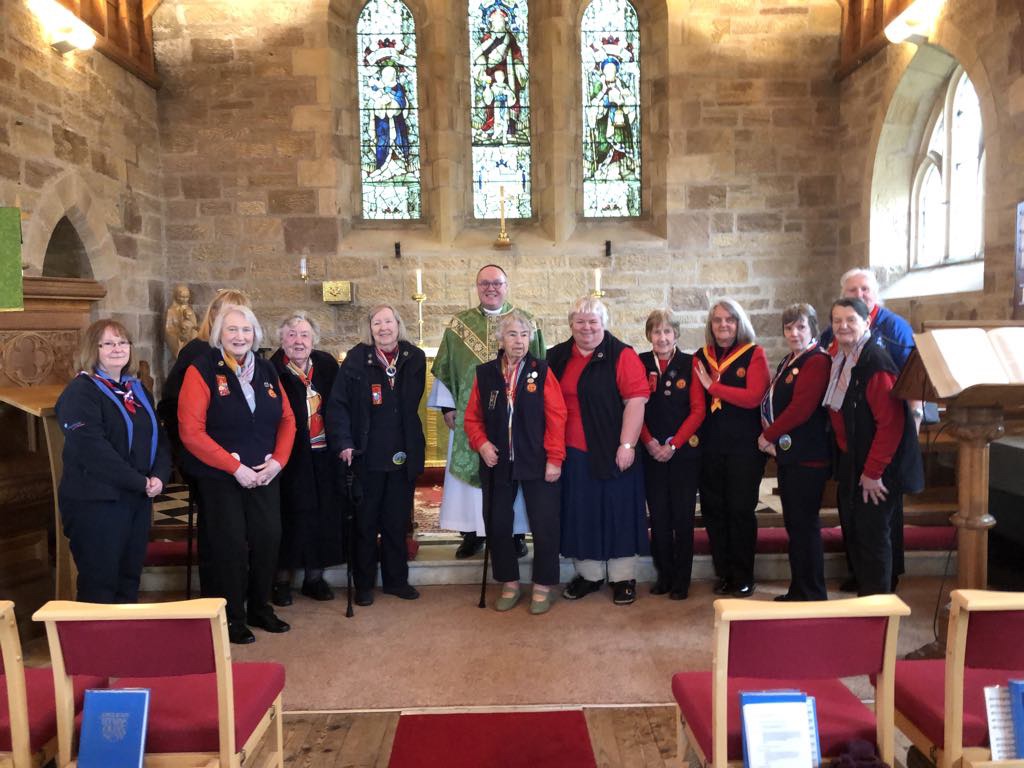
Yesterday (22nd February) was the 99th annual World Thinking Day – a very special day celebrated and promoted by the World Association of Girl Guides and Girl Scouts – and so a number of members from the Sutherland Trefoil Guild joined the congregation at St Finnbarr’s in Dornoch this morning to mark the occasion. Our theme was Love Your Enemies and in the sermon we heard about two young girls, from very different places and very different times who were models of grace and forgiveness – Maria Goretti and Myriam from Qaraqosh – read today’s sermon to find out more!
Sermon for Epiphany 7C – 23.02.25
* Genesis 45:3-11, 15 * Psalm 37:1-11, 39-40 * 1 Corinthians 15:35-38, 42-50 * Luke 6:27-38
Old Mrs Cameron was celebrating her one hundredth birthday.
She’d received her telegram from the King. She’d been made a fuss of by her grandchildren and great grandchildren and now she was being interviewed by a reporter from the Raggy.
“One hundred years old” the young reporter exclaimed. “You must have done so much in all those years! Tell me what are you most proud of?”
After a moment or two, Mrs Cameron responded, “Well, I don’t think I have a single enemy in all the world”.
“What a beautiful thought! How inspirational!” said the reporter.
“That’s right, not one enemy in all the world” the old girl said,
“I’ve outlived every last one of them!”
For many people, even those of us who identify ourselves as Christians, this morning’s gospel passage may be one of the most difficult in all of our holy scriptures.
Love your enemies.
I don’t know about you, but sometimes that expression seems to me to describe an ideal that feels totally unrealistic and unattainable.
In contrast to the humourous little story I told you about old Mrs Cameron (which of course was entirely fictional – but possibly reflects the real attitude of many), I want to tell you a true story.
It’s the story of Maria Goretti.
Maria was an Italian peasant girl who is remembered both for her extreme devotion and for her tragic death at a young age.
Born in 1890 in Corinaldo, Italy, Maria was the youngest of the five children in her family. Her childhood was marked by poverty and hardship, and her parents struggled to make ends meet. But Maria was known for her deep devotion to her faith and for her love of prayer. Despite the difficulties of her life, she was said to be a joyful and generous child, always willing to help others.
In 1902, at the age of 11, Maria was attacked and stabbed by a 19 year old neighbour, Alessandro Serenelli. Despite her severe injuries, Maria forgave her attacker and asked that he be forgiven before she sadly died of her injuries the following day.
Maria’s death and her forgiveness of her attacker made a profound impact on those around her and quickly spread throughout the local community. Serenelli, her attacker, was arrested, tried and convicted of her murder, and served 30 years in prison. He later converted to Christianity and credited Maria’s forgiveness and her intercession for his redemption.
Maria’s mother, Assunta, also forgave Serenelli and testified on his behalf at his trial.
A true story of forgiveness.
We live today in a world of great turmoil – of terrorism, a world full of violence and murder, of vicious vendettas and wars that are often stirred up in the tabloid press and online media. Is Jesus really saying to us that acts like these are not to be avenged?
In order to understand what Jesus is really saying to us, we have to put aside our prejudices and assumptions and really listen to his words.
“Love your enemies, do good to those who hate you, bless those who curse you, pray for those who treat you badly.”
In the Old Testament hatred and vengeance towards evildoers was presumed to be the right attitude to have. But Jesus, as he so often does, turns this on its head and calls for an attitude of love towards the enemy and the persecutor.
Often, the first big hurdle for us is the word “love”. It is of course a very emotional word, implying both affection and intimacy. For us to “love” is often to “be in love with”, to “be attracted to”.
But Jesus is not telling us to be in love with our enemies. He is not even telling us to like them.
Rather he is telling us to express the kind of love that God has for us. It is a one-sided love in the sense that a return is not expected. God reaches out in infinite love to every single person without exception.
Our problem is that we can sometimes focus too much on ourselves and our own immediate needs and so overlook the needs of others.
To love as God loves is to focus more on others.
To begin to ask “Why do they act in this way? What is hurting inside them that drives them to such behaviour?” Already we are just by thinking in this way, beginning to care for our enemy and beginning to love him or her.
And is this not a much better solution to the problem? To bring peace back into that person’s life and initiate a healing process in them and between them and me.
Jesus is not at all asking us to do something “unnatural”. We do not naturally want to hate or be hated. We want to love and to be loved.
We see many parts of the world where – for years – there has been a process of hatred and retaliation in a never-ending spiral of vengeance and loss of life.
The only way to break this cycle is to follow Jesus’ advice. It is not a lose-lose or lose-win situation; it is a win-win situation where everyone benefits.
Perhaps these words of the late Mother Teresa are appropriate here:
“Love, to be true, has to hurt. I must be willing to give whatever it takes not to harm other people and, in fact, to do good to them. This requires that I be willing to give until it hurts. Otherwise, there is no love in me and I bring injustice, not peace, to those around me.”
To put Jesus’ teaching into effect is not a matter of strengthening our will to do something very difficult but to change our conventional thinking at the deepest level, to see things his way. Once we do that, it becomes much easier.
And, through us, the compassion of God can then be experienced by all people.
To end today, let me tell you about Myriam.
In December 2014, a children’s television crew visited Iraqi Kurdistan, where they planned to tell the stories of child refugees who had fled from ISIS. But in a camp in Erbil, something even more profound took place. Presenter Essam Nagy met a little girl who would change his life and inspire millions around the world.
Nine-year-old Myriam was from Qaraqosh, the largest Christian town in the Nineveh plains. She loved watching this particular children’s programme and was delighted to talk to the presenter on camera.
Despite her suffering, Myriam said she felt grateful to God for protecting her family and providing for them. Then, the presenter asked her how she felt about the ISIS fighters who had seized her hometown – and Myriam spoke the words that would resonate with millions.
“I will only ask God to forgive them,” she said. Did Myriam forgive them herself? Yes, she replied – without missing a beat.
Myriam’s words were powerful because they show the heart of the Christian faith. Some of Jesus’ last words on earth were, ‘Father, forgive them, because they don’t know what they are doing.’ Myriam’s testimony shows the same faith.
I’m going to finish with the words with which Myriam finished her interview –
“God is always protecting you, and you can count on Him,” she says. Then, with a light in her eyes, she speaks about Jesus. “He is my friend, my brother … my everything.”
Amen
Bonanza Year for St Finnbarr’s Charities Shop!
Our heartfelt thanks go to all our brilliant volunteers who help out at St Finnbarr’s Charities Shop and to all our lovely customers. At this time of year, we distribute donations to local charities and we are delighted to be able to share that we have distributed a whopping £29,000 to 29 charities! Well done team!!
We would also like to take this opportunity to give special thanks to Adele (one of our regular volunteers) who has made such a good job refreshing our shop sign – it looks absolutely stunning and so welcoming!

If you’d like to volunteer to help out in our little shop, please do get in touch – as you can see, it makes a huge difference in the lives of so many people from our area! It’s a great way to get to know people and have fun too!
“Without work, it is impossible to have fun.” – St Thomas Aquinas
List of Charities Receiving Donations 2025
Alzheimers Scotland, Caithness and Sutherland Women’s Aid, Bradbury Centre, Dornoch Academy School Fund (to be used for additional support needs), Connecting Communities, Dornoch Beach Wheelchairs, Friends of Oversteps, Historylinks, Lawson Cambusavie Memorial Hospital Friends, Meadows Patient’s Comfort Fund, Mikeysline, ESRA, DADCA, CCAST (foodbank), SSAFA, DFG, Dornoch Community Electric Car, Enable Works, Dornoch Bowling Club, Friends of Sutherland Veterans, CAB Golspie, Highland Wildlife Trust,
Fyrish Gym Club, Blood Bikes, Scotland’s Charity Air Ambulance, Kats Second Editions, Munlochy Animal Aid, and Dornoch Indoor Senior Bowling Club.
Total £29,000!!!!!
Service at St Trolla, The Crask Inn – Thursday 20th February 2025 – 12 noon

A reminder that our monthly Thursday Eucharist at St Trolla’s at The Crask is this Thursday (20th February 2025) at 12 noon. The Reverend David Balfour will be presiding and it would be great to see a good gathering.
Let us always meet each other with a smile, for the smile is the beginning of love! – Mother Teresa
Sermon for Epiphany 6C – 16.02.25
* Jeremiah 17:5-10 * Psalm 1 * 1 Corinthians 15:12-20 * Luke 6:17-26
Over the next couple of weeks, the season of Epiphany draws to a close. If there is a single central theme or image to Epiphany, it is ‘light’.
Epiphany begins with the light of the star leading the Wise Men to Bethlehem and many of our readings and collects in this season are threaded with the image of light.
Luke’s telling of the beatitudes, which we just heard, fits right in with this because the purpose of the beatitudes is to shed some new light on an old subject. But in order to truly understand what’s going on, we need to know what that old subject is. Without that, it is easy to misunderstand these powerful sayings.
For example, it is all too easy to imagine that the beatitudes are about us; that they are commands for how we should live, and what we should do. So, we might imagine that Jesus is telling us, or at least telling some of us, that we should ‘go out there and become poor’, or that we should ‘learn how to weep more’, or ‘become more persecuted’.
If this really is what Jesus is up to, then I think he is pretty much wasting his time. After all, advice like that, whether given by Jesus or by anybody else, usually does nothing more than make us feel frustrated and guilty. We might think that it might be sweet and humble to be a bit more ‘weepy for Jesus’; but it is pretty unlikely that most of us would set out to do it. Bedsides, does being poor, or weeping, or being persecuted really count if you do it on purpose in order to get blessed? That somehow doesn’t seem right.
The harder you try to make these odd sayings into ‘marching orders’, the less sense they make. Besides which, nowhere in the beatitudes is there a command or directive to us or to anybody. Nowhere does Jesus use the imperative, nowhere does he give any orders or requirements. The entire section is in the indicative. Jesus is simply describing reality, he is not telling the disciples, or us, or anybody else, to do anything.
And that’s because The Beatitudes are not really about us; they are not a set of instructions on how we should live, or what we should do.
But if they are not about us, what are they about? If they don’t shine any light on how we are supposed to behave, then what are they good for?
Some people think that their meaning has been for the world. That is, the beatitudes have been presented as ways to help people live well in the word; or at least as things to do that will make the world a better place.
It has been suggested that if we would only become spiritually poor or hungry, or persecuted, that this will bring out the best in others and that they will be the better because of it. So, sooner or later, people will realise how nice and valuable we are and give us what we want. Or, by and by the whole world will end up being a much better place for all involved; and everyone will somehow come out on top in the long run. So the beatitudes become a handy tool, a cosmic way to win friends, influence people, and clean up our communities.
The problem with this, of course, is that it is just plain silly. You can only believe that the world respects and responds kindly to the sort of behaviour found in the beatitudes if you know absolutely nothing about the world.
In reality, things just don’t work like that. If you turn the other cheek, you will probably end up with two sore cheeks. And being poor now, spiritually or especiall, physically, will probably ensure that you won’t get very far in the real world of business, politics, or industry. That’s just the way it is, and that’s the way it always has been, and Jesus was no fool. He knew that. In the Beatitudes Jesus was not trying to shine any light on how the world works.
If there is a point here about the world, it is really that, as far as the world is concerned, the beatitudes don’t make any sense at all. There is nothing rational about living the beatitudes with the hope that it will result in a more successful or prosperous life.
Yet still, the beatitudes shine light, but they really don’t shine any light about the way the world works. They are not about the world, just like they are not about telling us how to act.
The beatitudes are about God, they are about who God is, and who God blesses, and what the kingdom of God is like. They tell us what matters to God, they tell us who is especially important to God, and they tell us what God pays attention to.
Now, Jesus gives us this surprising information about God hoping, no doubt, that such knowledge may have a valuable effect on us. But that is up to us.
In the beatitudes, and the entire Sermon on the Mount, Jesus offers us his picture of God’s values and God’s priorities; and he offers them as an alternative to the vision of life we usually carry around with us.
We can only act on what we can see; and Jesus is giving us the chance to see further, and clearer, and deeper than ever before. The idea is that if we can see, really see, who God considers blessed, or happy, then we will at least know the road to blessedness, and perhaps be able to use that knowledge.
The beatitudes are a glimpse into the heart and mind of God. Again, they don’t tell us what our world is like. We already know that so well that we assume that anything of value will work really well in and with this world. Jesus is trying to shake us loose from that assumption, and give us a different vision of life, one that has its foundations, not in the world, but in the very nature of God.
Jesus tells us that the world’s insignificant players, the losers, are blessed by the Father, and he tells us this so we can know a little better who the Father is. He tells us this to give us a bit more light so we can see a little better.
Now, of course what we do with that is up to us. Remember, we are not getting a whole list of moral laws here. We are being offered a new vision of our world and our lives. The point is not that we must obey a rule that says ‘thou shalt be poor and persecuted’. The point is that, by this light, we can look at the mind of God and discover all sort of new possibilities.
So, we have some new light on God. And a question. The question is: if God is really like this; if God has the preferences and the priorities of the beatitudes, then what could that mean?
How could our lives be different, how could you be different?
That’s the issue, and that is the question Jesus leaves us with. It’s a good question, and worth considering in your life.
Sermon for Epiphany 5C – 09.02.25
* Isaiah 6:1-8, (9-13) * Psalm 138 * 1 Corinthians 15:1-11 * Luke 5:1-11
This week our sermon begins with a ‘Fishy Quiz’
Can you guess these five fish from their descriptions:
- This fish will make you laugh.
- This fish will help if your piano doesn’t sound quite right.
- This fish is perfect for people who re-enact 15th century battles.
- This fish is for you if you like to glide across frozen ponds in the winter.
- This fish is the one that would help your parrot take a rest.
(If you are reading online, please see the end of this sermon for the answers)!
Today’s gospel is a story about fishing, but it is not about fish! It’s a story where Peter and others come to the lake wanting to catch fish, but actually, deep down, there is something else they really desire – a desire beyond their immediate desire.
I wouldn’t be a bit surprised if you might be thinking to yourself, “What in the world is Simon talking about?” That’s a good and legitimate question, but stay with me because I am asking that today we “put out into the deep water” where we can neither see nor touch the bottom, where we can’t know what might be down there or what might be coming to us from the deep. Peter and the others in our story surely had no idea what would happen when they let down their nets, and sometimes, neither do we!
On the surface it would be easy to hear today’s story as one in which Jesus fulfils the desires of Peter and the others; the desire to catch fish, the desire to be successful, the desire to make a living. But I’m not sure that that is all that is going on here. I think there is more to this than fish, success and making a living.
Here’s why I say that – what did they do with the fish, their success and the money they would have made at the market once they got back to shore? Well, we are told – they left everything and followed Jesus. They walked away. Those things were not the end of the story but the beginning of the story. Their initial desires took them to the lake, but it was a “desire beyond their immediate desire” that called them beyond the lake.
Most of us will know what that’s like because I think most of us will have experienced that too. I wonder if you have had times in your life when you said, “If only I could …” and then fill in the blank with whatever it is you thought would fulfil you; “go here, do this, get that, find the right woman or man, have a child or grandchild, get that job or promotion, buy a new house, be given a particular opportunity.” And then one day you went, you did, you got and maybe it turned out exactly like you wanted or not at all like you expected, but either way you were still left with a yearning – in time the feeling that there was something more returned and you felt a desire for something else calling you onwards.
That doesn’t mean those things we desired were bad or that we were wrong. It just means that even within those things there is a “desire beyond desire.”
Now you and I know that not every desire is fulfilled, we don’t always get what we expect and not every twist or turn in our lives leaves us feeling happy. That’s just not how life works. We’ve all experienced that side of life. We’ve seen relationships break down or we’ve experienced a sudden change in our financial security. We’ve had loved ones pass away well ‘before their time’ or we feel we’ve become lost and ignored.
We get it when Peter says, “Master, we have worked all night long but have caught nothing.” But it’s that “desire beyond desire” that keeps us going, that will not allow us to say, “This is it. It’s over. Let’s just wash the nets and go home.”
It was the “desire beyond desire” that let Peter answer Jesus, “Yet if you say so, I will let down the nets.” Jesus knew Peter had a deeper desire. Jesus did not magically fill Peter’s nets. He touched Peter’s deeper desire and if we open our hearts to him, that’s what he does for us. We all have that same deeper desire within us.
We want to connect with and be known by something beyond what we can acquire, what we can gain or accomplish for ourselves. We want meaning and fullness in our lives. We want our lives to matter and count for something. We want to feel alive. We want to be whole and complete. We want to experience and live in the good, the true and the beautiful – we want life in all its abundancy. Isn’t that how you want to live and what you want for yourself and those you love? That’s our “desire beyond desire.” And Jesus is the one calling us, guiding us and walking with us.
And what if those times and places in which we feel stuck, frustrated, empty, restless, disappointed, as if we’ve missed the boat, are the deep waters into which we are asked to let down our nets? Jesus did not let Peter and the others run away from their exhaustion, their disappointment and their empty nets. He sent them back to the deep water to let down their nets and they “were amazed at the catch of fish,” “so many fish that their nets were beginning to break”.
Are you exhausted and frustrated with your life?
Do you feel unfulfilled and restless?
Do you feel stuck and like you’ve missed the boat?
Maybe this is the moment when you are being asked to let down your nets.
Instead of washing them up and going home, open your eyes, your ears and your heart to the deep waters of life. Be attentive to what lies below the surface. Make yourself open and available to the “desire beyond desire.” It is always unfolding before us and it is never just one thing. It comes to us in a thousand different ways. It changes throughout the seasons and circumstances of our lives.
That “desire beyond desire” is why we still cast our nets even after a night of having caught nothing. It’s why we struggle to do the right thing and to live with integrity. It’s why we forgive and make amends. It’s why we speak for justice and the dignity of every human being. It’s why we open our hearts and risk loving. It’s why we get up each morning and “put out into the deep water.”
Every day something new is coming to us. And so each of us had better be ready – that’s not a threat, that’s about the promise of new life, the gift contained in our “desire beyond desire.” Don’t miss it. Stay awake and alert, in expectation and hope. Put out into deep water and let down your nets!
May God bless you and all those you hold dear in this coming week.
Amen
Fr Simon
Quiz
- Clown Fish
- Tuna
- Pike
- Skate
- Perch
The Benedictines are Back!
Many of you will know that as well as an Episcopal Priest, I am also an anglican Benedictine Monk – a member of the Order of Saint Benedict (OSB) belonging to the particular community of the House of Initia Nova. Most of you know me as Simon, but my given Benedictine name is Br Nicholas. We are a religious community that are scattered ‘on mission’ across the globe with members in the UK, US, Australia, Singapore and Puerto Rico. You can imagine how overjoyed I was when a member of the same religious community was installed as Rector of The Black Isle at a service in St Andrew’s Fortrose last Saturday. Rev Alex Lane (aka Br John-Aelred) has moved north from a parish in Twickenham. To add to my delight, our dear Sr Margaret-Thomas (also in the same community) came to stay with Peter, the boys and I for a long weekend.

Here are a few pics from the weekend!


We hope to see our dear sister again very soon! The Anglican Benedictines are Back in the Highlands!
Sermon for the feast of The Presentation of Christ in the Temple 02.02.25
Malachai 3.1-4; Psalm 84; Hebrews 2.14-18; Luke 2.22-40
The thing about growing older is that it slowly creeps up on you, and it’s only when you find yourself doing some strange things that you realise it’s happening.
For instance, you know you’re getting older when it takes you twenty minutes to find your car in the supermarket car park.
You know you’re getting older when it takes at least two tries to get up from the sofa.
You know you’re getting older when your idea of a night out is sitting just outside the back door looking up at the stars – when ‘happy hour’ is a nap – when you get two invitations to go out on the same night, and you pick the one that gets you home the earliest.
You know you’re growing older when you look for your glasses for half an hour, and then find that they were on your head all the time – when you and your teeth no longer sleep together.
You know you’re growing older when your memory is shorter and your complaining is longer.
Growing old is something that is coming to all of us. But I wonder just how old can one be?
Modern records give us the names of the five people who’ve lived longest:
Violet Brown of Jamaica lived for 117 years and 189 days.
Marie-Louise Meilleur (Canada) – 117 years and 230 days.
Nabi Tajima from Japan lived for just 30 days longer – 117 years and 260 days.
The USA gave us the second longest lived – Sarah Knauss who’s life spanned 119 years and 97 days.
And the person who had the longest life on record was from France – Jeanne Calment – she lived 122 years and 164 days.
If you look these people up, you’ll read about their long and fulfilling lives – and gentlemen, you’ll also realise that they were all women!
In our gospel today we meet an old man – Simeon – as he fulfils his destiny after decades of waiting in the temple.
Simeon took [the child Jesus] in his arms and praised God, saying, ‘Lord, now you are dismissing your servant in peace, according to your word; for my eyes have seen your salvation’ (Luke 2:28-30).
These words stand at the centre of our gospel reading. They are beautiful words by which Simeon tells the story of his life and by doing so, prompts us to think about our stories – our lives.
After all, what good is it to us if we read about how Simeon receives the child Jesus into his arms, but we do not do the same?
What good is it to us if Simeon’s eyes see salvation and our eyes do not?
What good is it to us if Simeon is free to go in peace if we are not?
It’s simply not enough to come here this morning to hear about Simeon receiving the child, Simeon’s eyes seeing salvation, and Simeon being set free to go in peace. If simply listening is all we do, then we have bound this story – the good news that we have to proclaim – to a time long ago and a place far away, and it doesn’t have much to do with our lives. We must let the truth of this story transcend its history.
While there is a historical truth to this story, there is also a cosmic truth, a truth that is not limited by time and place. This story is an archetypal experience that is happening in all times and all places for all people. The truth of this story is happening here and now for you and me. It is as much our story as it is Simeon’s.
If we want to understand and claim this story as our own and not just Simeon’s, then strangely enough we need to know a bit more about Simeon. So, I want to tell you what our sacred tradition says about Simeon. Tradition says Simeon was one of the seventy translators of the Hebrew scriptures into Greek, what we call the Septuagint – meaning translated by the seventy.
That translation is supposed to have begun around the third century before Christ and was completed in the year 132 before Christ. Those of you who are good at maths will realise that that means that by the time he met the infant Jesus, Simeon was a really, really old man – much older than any of the women we heard about from modern records. One strand of the tradition says Simeon was 270 years old when Jesus was presented in the temple. Another strand of the tradition says Simeon died at the age of 360.
But I don’t want us to get too hung up on and distracted by Simeon’s age; whether he really was that old, and how someone could live to that age – is not the point. I think better questions for us to ponder are, What does it mean for us that Simeon was that old? What is the tradition trying to tell us? Well, you have to know another part of the story.
Holy tradition says that, when translating the Hebrew scriptures, Simeon came to that verse in Isaiah chapter 7 that says, “Behold, a virgin shall conceive and bear a son”. This made no sense to Simeon and he was going to substitute the phrase “a young woman” in place of “a virgin,” when an angel stopped him and declared the verse to be true, and promised that before he died Simeon would see the child of this virgin.
Think about what this means. Simeon has been promised that he will see the Messiah, the Christ, the one whose name means salvation, and that promise was made nearly two hundred years before it was fulfilled. Simeon must have lived those days, those years, decades and centuries with hope, trust, expectation, and anticipation. Every day for weeks, months, years, decades, centuries – Simeon is left waiting and wondering. “Is this the day? Is this the day I will see salvation or is this the day I will give up hope? Is this the day I will experience the fulfilment of the promise or is this the day I despair of it ever being fulfilled?”
Simeon’s life was one of expectation, anticipation, and waiting. And who among us has not had their life characterised by expectation, anticipation, and waiting? We’ve all stood in that place waiting for and needing something to happen, living in expectation and hope, anticipating the future, and wondering if today was the day.
We all know what it’s like to wait – waiting for life to change, for grief to go away, for a prayer to be answered, for joy to return, for forgiveness and reconciliation, for clarity about a decision, for meaning and purpose, for healing and new life. We wait and hope for all sorts of things.
We have all sorts of hopes and expectations for what God is doing in our lives and in our world. I think that each time we come here to church we must do so with some sense of hope, some need, some expectation. We come here to this place trusting and anticipating the promise that God is present and working in our lives, even if we can’t see or clearly understand how that might be. So, we show up and we wait for the miracle.
That’s what Simeon did.
So, what’s the miracle for Simeon? What’s the miracle for us? I don’t think it is that Simeon lived to such a great age. And it’s not that Simeon held the baby Jesus. And it’s not that Simeon’s eyes saw salvation or that Simeon had been set free to go in peace. Those things are happening all the time.
Here’s what I think the miracle is. Simeon continued to show up. He continued to be vigilant and attentive. He continued to trust the promise. He continued to wait with hope and expectation. He never despaired. He never walked away from the promise. The miracle for Simeon and for us is in the showing up.
Sometimes showing up is the most difficult work we do, and it takes all we have just to show up. But it’s always the question before us. Will we continue to show up? Will we be awake and vigilant? Will we live with hope and trust? Showing up is the means through which God fulfils the promise to us and to Simeon.
Simeon thought he was waiting for the child to show up, but what if it was really Jesus waiting for Simeon to show up? Simeon thought he was presenting the child to God, but what if it was really the child presenting the old man to God? Every day that Simeon showed up, the infant Jesus was seeing and upholding Simeon.
And what Simeon experienced can be ours too if we simply show up. And by that I don’t just mean showing up to church each Sunday – thought that is important. I also mean acknowledging God’s sovereignty over our everyday lives, allowing him to speak into the situations we find difficult and inviting him into the joy and celebrations we experience. The presentation of Jesus doesn’t happen in the Jerusalem temple, but in the temple of our lives, every moment of every day, day after day, month after month, year after year, decade after decade. It happens in the midst of waiting. It happens every time we show up, face up, to the reality of our lives.
So, my friends do show up, do invite him in – and claim what is already yours – open your eyes to see His salvation.
Amen
 Scottish Episcopal Church - Dornoch, Lairg, Brora, Tain & Tongue