Be a Flower that Blooms

Most people will have realised that this coming Sunday (22nd March) is Mother’s Day – or to give it the ‘proper’ title, Mothering Sunday. Mothering Sunday is a good occasion to think about the nature of God – for, as Julian of Norwich said in the fourteenth century, ‘as truly as God is our Father, so also is God our Mother’.

People sometimes think that feminine imagery for God is very new, but it actually goes way back to some of the early books of the Bible. The prophet Hosea described the way God cared for his people in a very maternal way.

It was I who taught Ephraim to walk, I took them up in my arms, but they did not know that I healed them. I led with cords of human kindness, with the bands of love. I was to them like those who lift infants to their cheeks. I bent down to them and fed them.’ (Hosea 11.3-4).

Now, we don’t have to start calling God ‘Mother’ – that isn’t necessarily any more helpful than ‘Father’. But it is worth noting that there is this element in the biblical tradition, and it has been picked up by people in the centuries since.

So how can we respond to this God who is mother and father and so much else besides? On Mothering Sunday, like so many others do, perhaps we could say it with flowers.

How on earth can we do that? No floral delivery company has a way to cope with it! But we do talk about offering ourselves to God. I don’t suppose you have ever thought of yourself as a flower, even though flower allusions abound in our language; we talk about being ‘fresh as a daisy’, or we describe someone as being ‘a shrinking violet’. People are sometimes ‘prickly’.

But when you think about it, what kind of flower are you? Are you like a camellia, rather startlingly beautiful? Or like rosemary, starting to bloom right at the beginning of your life and continuing year on year? Are you one of those plants that doesn’t flower often? Or one that props others up? Are you a plant with rather insignificant flowers, but always there in the background to help others give of their best? Do you fill the world with fragrance, or give flavour to life?

Are you one of the plants that bring hope in the dark days of winter? Some plants are very beautiful when their flowers are dead – some people come into their own towards the end of their lives.

Sometimes we put a single flower into a vase and enjoy its beauty. At other times, we put many different varieties together in an arrangement. There is an important place for our individual response to God, but when we come together as a church we discover new things about ourselves as we relate to each other as well as to God. Like a flower arrangement, we can bring out the best in each other, and complement and support each other.

On our own perhaps we don’t look very exciting – that doesn’t mean we don’t have our own beauty – but put with others, the ones who are a bit shy can find support, and those who are rather exotic can lend their colour and perfume to the more retiring. Even those who are prickly can be a great support to those who are fragile.

So we can give God quite a bouquet – and it we listen carefully, we’ll hear God say, as every mother does, ‘Thank you dear, that’s just lovely!

Blessings
Simon

To Keep a True Lent

Tuesday was Shrove Tuesday, or to give it its more common name, Pancake Day. It’s traditionally the last day of indulgence before the start of the season of the Church year called Lent. This season lasts for 46 days (or 40 if Sundays are excluded, as they traditionally are). For many people Lent’s a time for abstinence and when I was a boy, there was no chocolate, no cakes and no biscuits from Ash Wednesday until Easter Day. As I’ve grown older, I’ve come to see Lent as something far richer than simply a time of giving up treats. This isn’t of course a new idea, as long ago as 1648, Robert Herrick wrote a poem called “To Keep a True Lent”. The first verse of which is:

Is this a fast, to keep
The larder lean?
And clean
From fat of veals and sheep?

His initial reply to the question is:

No; ‘tis a fast to dole
Thy sheaf of wheat,
And meat,
Unto the hungry soul.

And he finishes:

To show a heart grief-rent;
To starve thy sin,
Not bin;
And that’s to keep thy Lent.

He attaches importance in attending to the physical needs of those less fortunate than oneself and then to one’s own spiritual needs – “to starve thy sin not bin”. Giving up treats can of course serve both purposes. In the case of the former, we can spend the money saved giving to the food bank or to charity and in the latter, the discipline of refraining from and refusing treats serves as an all too frequent reminder of this particular goal.

You don’t have to be religious to see a need to examine your life and the way you live it; to examine your relationships and how you interact with others; to strip away the masks that you hide behind and the stories that you tell yourself to justify what you do and think. The main difference for those who believe in God is that there’s nowhere to hide. You can tell yourself that your actions are always entirely justified, as much as you like, but there’s simply no hiding from the scrutiny of an all-seeing, all-knowing deity.

Some say we’re now living in a surveillance society, with CCTV cameras everywhere you turn, but for those with a faith in God, it’s always been like that. Consequently it means we have to live life., as Paul wrote to the Ephesians: “as children of light— for the fruit of the light is found in all that is good and right and true. Take no part in the unfruitful works of darkness, but instead expose them. For it is shameful even to mention what such people do secretly; but everything exposed by the light becomes visible”. The difference for me between CCTV and God is that I’d rather be judged by the creator of the world, than by the creator of the webcam and whoever may be watching it on youtube, twitter or facebook.

Seven weeks a year of spiritual spring-cleaning through self-reflection and increasing self-awareness, might be helpful to anyone, religious or not, as they strive to become a better person. As the Scottish Prayer Book describes the penitent in the invitation to confession: “Ye that do truly and earnestly repent you of your sins, and are in love and charity with your neighbours, and intend to lead a new life”. That just about sums up for me what Lent’s about. Have a fruitful time between now and Easter and enjoy the Easter Eggs all the more.

Blessings
James

Be Still and Know that I am God

Whilst reflecting on how we might structure our Lent Study on Prayer, I came across this quote by one of my favourite spiritual writers Henri Nouwen:

Deep silence leads us to realize that prayer is, above all, acceptance. When we pray, we are standing with our hands open to the world. We know that God will become known to us in the nature around us, in people we meet, and in situations we run into. We trust that the world holds God’s secret within and we expect that secret to be shown to us. Prayer creates that openness in which God is given to us. Indeed, God wants to be admitted into the human heart, received with open hands, and loved with the same love with which we have been created.

I remember that school prayers were always things with words and not much silence. Also we had to put our hands together and close our eyes tight shut, and woe betide anyone who tried to peek, because strangely teachers seemed to be able to pray with their eyes wide open. Looking round our congregations on a Sunday, I get the impression that most people must have been taught about prayer in much the same way and, of course, old habits die hard. So it comes as rather refreshing to read an article by another of my favourite spiritual writers Eugene Peterson who in writing about a third favourite writer says:

Annie Dillard prays with her eyes open. She says, Spread out your hands, lift up your head, open your eyes, and we’ll pray… She gets us into the theater that Calvin told us about, and we find ourselves in the solid biblical companionship of psalmists and prophets who watched the ‘hills skip like lambs’ and heard the ‘trees clap their hands,’ alert to God everywhere.

When we celebrate the Eucharist together, our celebration is part of entering into the mystery of God. Rudolf Otto, a German theologian, wrote: We experience God as Mysterium tremendum et fascinans. Basically, the unfathomable Mystery before whom we’re awestruck and stand trembling, yet find ourselves inexorably drawn into a relationship that’s also gracious and loving; attracting and fascinating us in ways we can’t fully explain.

It’s quite beyond us to have a loving relationship with the mysterious invisible God, through our own efforts. But because God wants to relate to us individually in love He’s given us the perfect helper in His Son Jesus Christ. Through Him God invites us into the love that we see demonstrated in the relationship between Father, Son and Holy Spirit in the Holy Trinity. The Son shows us the way to the Father through the power of the Spirit. God however remains a mystery.

Prayer is the mechanism through which we try to enter into that mystery. Prayer works through the power of the Spirit, rather than anything that we could possible achieve on our own. In prayer, the Spirit calls and we respond rather than prayer being something that we initiate. As St Paul says in his letter to the Romans:

The Spirit helps us in our weakness; for we do not know how to pray as we ought, but that very Spirit intercedes with sighs too deep for words. And God, who searches the heart, knows what is the mind of the Spirit, because the Spirit intercedes for the saints according to the will of God.” Romans 8:26-27

Come and explore these things in our Lent Study Groups on Prayer.

Blessings
James

Believing that we Believe

Advent, Christmas, Lent, Holy Week, Easter, each year the same, but somehow different. Yes we do many of the same things, have similar services and study groups, etc. but somehow it doesn’t ever feel the same as any previous year. That’s because it isn’t. We aren’t the same people, our circumstances aren’t the same and we may no longer be surrounded by exactly the same people: family, neighbours and friends.

The Italian title of a book by the philosopher Gianni Vattimo was ‘Credere di Credere’ – ‘believing that one believes’. This was the answer that he gave to a friend who asked him if he still believed in God. His answer sounds rather paradoxical (in Italian as it does in English) but then of course he’s a philosopher. However, we do use the word believe to mean: having faith, conviction or certainty in something, but also to mean: to be of the opinion that, which implies a degree of uncertainty. In his title Vattimo is implying this second meaning to the first ‘Credere’ and the first meaning to the second ‘Credere’. We might therefore render his title ‘I like to think that I believe’, a statement with which many people would feel comfortable.

This brings me back to the major seasons of the Church Year and particularly to the current Christmas Season now coming to a close. In any season there are the physical manifestations: services, readings and carols, decorations, mince pies and all the particular food and drink, but none of these is the essence of the season. There’s a slogan, much loved in some parts of the Christian Church – “Jesus is the Reason for the Season”. Well I’ve been thinking about it and I don’t agree with it. I think that the Reason for the Season is something else – SIN and EVIL. It was Dietrich Bonhoeffer that put me on to it:

We have become so accustomed to the idea of divine love and of God’s coming at Christmas that we no longer feel the shiver of fear that God’s coming should arouse in us. We are indifferent to the message, taking only the pleasant and agreeable out of it and forgetting the serious aspect, that the God of the world draws near to the people of our little earth and lays claim to us. The coming of God is truly not only glad tidings, but first of all frightening news for everyone who has a conscience.

Why did God send His only begotten Son into our world? Not because he wanted us to build a festival around shepherds, angels and magi, but because of the sin and evil that abounded. And when that baby boy was born, violence and hatred didn’t stop. Tragic events didn’t stop. Man’s inhumanity to man didn’t stop. God sent his Son to us in the world as it was (and still is). To do otherwise would have rendered the incarnation meaningless and changed the whole working of creation and salvation. He had to hold up a mirror to the world so that humanity could see what was really going on, and in the story of the slaughter of the Holy Innocents we see the dark side of our world being reflected right back at us.

We live in a broken world as flawed human beings, that’s the reality, and God sent His only begotten Son into that world as it is, to show us that in spite of everything it can be different. He came to give us hope and to make it possible for us to believe that we believe in a loving and just God who sticks with us no matter what is going on in our lives and the lives of those close to us.

What we hear as we listen to the seasonal readings and carols and how we feel about the Christmas preparation and festivities, is dependent on what else is going on in our lives and the lives of those we love. As a result each Christmas feels different because what it’s really all about is experiencing the Incarnation of God in our lives, and that changes from day to day and from year to year. How could it be otherwise with a relational God? We don’t have to rely on other people to tells us how we should feel. As the writer of the Letter to the Hebrews wrote:

Long ago God spoke to our ancestors in many and various ways by the prophets, but in these last days he has spoken to us by a Son, whom he appointed heir of all things, through whom he also created the worlds.” Hebrews 1:1-2

Now that’s something I can believe that I believe. Happy New Year.

Blessings
James

My Soul Doth Magnify the Lord

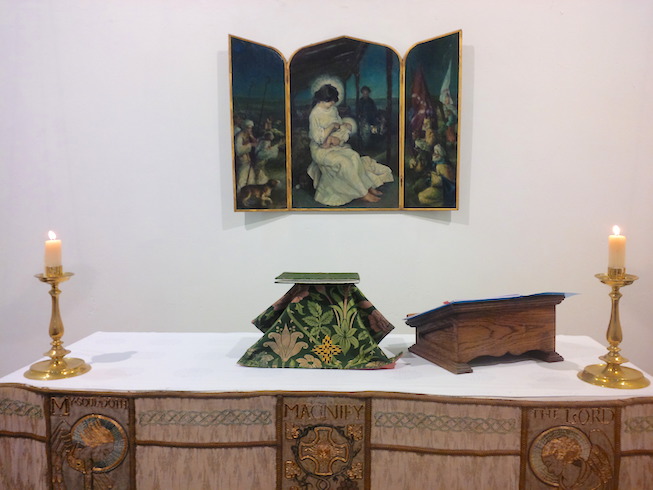
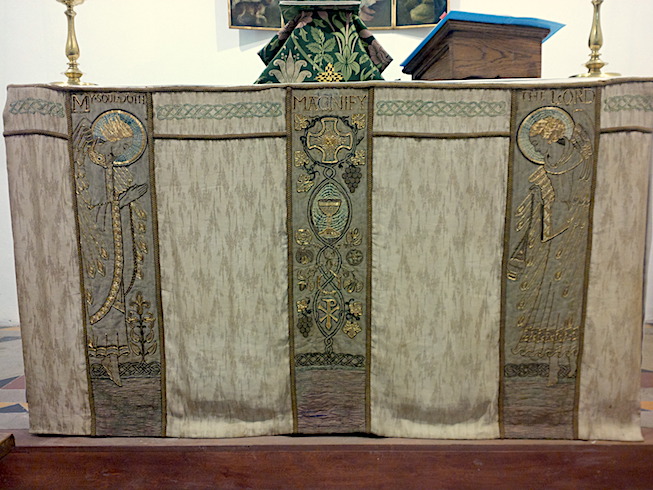
Today we honour Mary, the mother of Jesus as part of our Advent preparation for Christmas.  In the Lady Chapel of the Cathedral of the Isles in Millport, there is a wonderful Altar Frontal with three Art Nouveau panels proclaiming “My Soul Doth Magnify the Lord“.

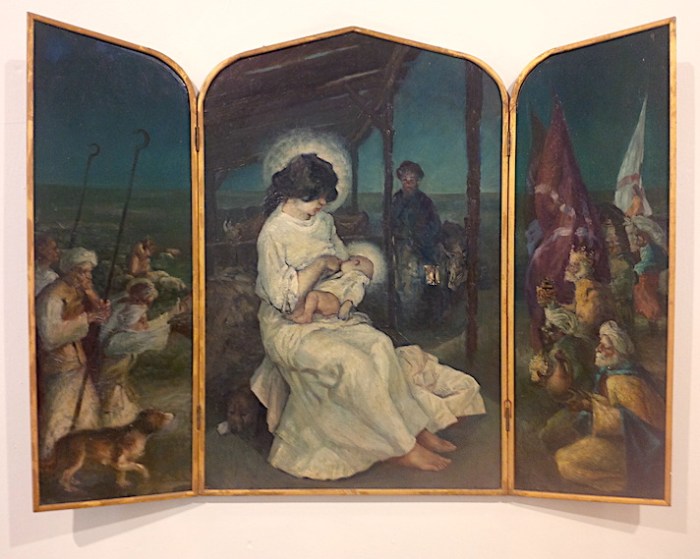
Behind the Altar is a Triptych by Donald Swan depicting, in the centre panel, a very real and very human Mary discretely feeding the Baby Jesus:

He hath filled the hungry with good things; and the rich he hath sent empty away.

A promise that we can trust

Usually by the beginning of December, there is a very obvious focus on what is often referred to as “The Run Up to Christmas”. I don’t know if it’s just me, but this year it feels as though several things have pushed that to one side. If the full power of the consumer bonanza that ‘preparation for Christmas’ represents is knocked out of kilter this year, then I suppose that I feel a sense of relief, but how heartfelt that is probably depends on why!!

Firstly, there’s the General Election, which is dominating the news agenda. Politicians from of all hues trying to woo us with promises, lots of promises. Now many of these promises are for things that we might feel might make our lives, our country and perhaps the world better; but I would have to say that you don’t have to be a financial genius to realise that some of these promises are perhaps rather more realistic than others and few stand much detailed scrutiny. Advent (the name we as Christians would give to this ‘run up to Christmas’) is also about a promise: the promise that God’s future and our future are entwined in Christ. Christ is coming into our world and our world never being the same again.

Secondly, there’s a growing call, encapsulated in protests across the world on what has come to be called ‘Black Friday’, to address the very serious and increasing problem of Climate Change. Black Friday is all about consumption about buying more and more ‘stuff’ by making it appear cheaper though at what environmental cost isn’t clear. The protesters argue that if we want to save the planet, Christmas shouldn’t be about excessive consumption – what’s needed is a serious change in the way that we live our lives. Well I’ll happily say “Alleluia” to that. In Christianity, we also have a name for a change in the way that we live our lives, and that’s ‘Repentance’ (which literally means ‘to turn around or to change the mind’) and surprise surprise, that’s also a theme of Advent.

The final theme of Advent is hope, and as we look forward to a time when the General Election will be over and the buying spree will be finished, there’ll be Christmas, when we celebrate God coming amongst us, as one of us. Now that’s a promise that we can trust and it won’t cost a penny or destroy the planet!!

Enjoy the waiting and the anticipation and I wish you all the Joy of Christmas when it arrives.

Blessings

James

We did this in Remembrance

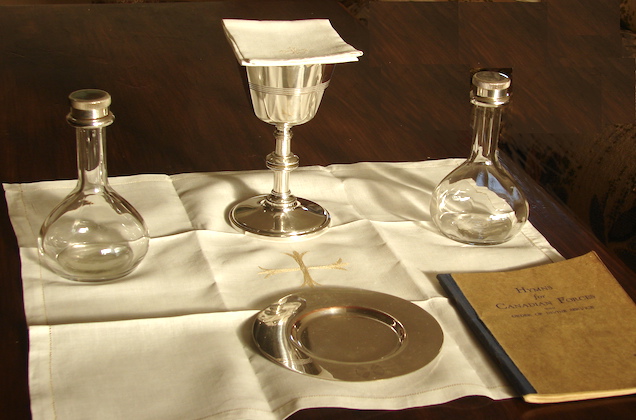
A few months ago, a neighbour of one of our Churches  arrived a short while before the Sunday Service and showed me small tan attache case. When we opened the case, it revealed a ‘Field Communion Set’ of the type issued to the Padres of our armed forces and those of many of our allies.This gentleman’s Father, who’d been a Minister in the Church in Canada, had enlisted as a Padre in the Canadian Army during the Second World War.

Amazingly the contents of this case was last used at Juno Beach, during the D-Day Landings of 6 June 1944. He’d been clearing out as he and his wife are planning to move into a smaller house and he felt that thecase and its contents would be more use in the Church than stuck at the back of his wardrobe.

This set me wondering about that day 75 years ago and it’s impact on us now. 21,000 troops landed on Juno Beach on D-Day, approximately 14,000 of them were Canadians from the Third Canadian Infantry Division and the Second Canadian Armoured Brigade, the remainder were British. Of the Canadians who landed: 340 were killed, 574 were wounded, and 47 were captured. Now D-Day is generally considered to be one of the allied ‘successes’ of WWII, but notwithstanding that, the allied casualties on D-Day are estimated at 10,000, including 4414 deaths with the remainder wounded or missing; a salutary reminder that wars bring much destruction, suffering and grief, whoever is considered to be the ‘winner’.

On or around 11th November each year, at War Memorials up and down the land, we remember those who’ve gone before us and what they’ve contributed to the way that we live our lives today. The previous Monday, we celebrated All Souls, remembering those that we’ve known, who’ve meant so much to us who have now died, and I always find that an extremely moving service.

It’s very difficult to judge at the time, what impact people or events today will have in the future. Will particular figures go down in history as visionary and inspiration leaders, who whilst not fully appreciated in their time have left a lasting and positive legacy, or as people whose ideology and poor judgement made them instigators of hard times? It’s much easier to judge in retrospect those who’ve been major influences on our lives, those who’ve made us the people that we are today.

During Holy Week we’re confronted with death more than during any other season of the liturgical year. We’re called to mediate not just on death in general or on our own death in particular, but on the death of Jesus Christ who is God and Man. We’re challenged to look at Him dying on a cross and to find there the meaning of our own life and death. What strikes me most in all that’s read and said during these days is that Jesus of Nazareth did not die for himself, but for us, and that in following Him we too are called to make our death a death for others.

What makes you and me Christians isn’t only our belief that He who was without sin died for our sake on the cross and thus opened for us the way to His heavenly Father, but also that through His death our death is transformed from a totally absurd end of all that gives life its meaning into an event that liberates us and those whom we love.

It’s because of the liberating death of Christ that I dare say to you that mother’s death isn’t simply an absurd end to a beautiful, altruistic life. Rather, her death is an event that allows her altruism to yield a rich harvest. Jesus died so that we might live, and everyone who dies in union with Him participates in the life-giving power of His death. I think that we need to start seeing the profound meaning of this dying for each other in and through the death of Christ in order to catch a glimpse of what eternal life might mean. Eternity is born in time, and every time someone dies whom we have loved dearly, eternity can break into our mortal existence a little bit more.”

At the time it must have seemed to many that Jesus Christ’s mission as Messiah was a total failure. He died mocked and ridiculed by Crucifixion, one or the cruelest execution methods ever devised, judged to be a dangerous revolutionary who broke all the rules, mixed with all sorts of undesirable people and had to be done away with. His ministry lasted only three short years, and when he died his disciples went back to whatever they were doing before he came along. You wouldn’t expect such a person to leave a lasting legacy. But he did. The movement that followed in the wake of his Resurrection is still very much alive and we are its heirs.

Over the two millennia since that Resurrection, the Christian Faith has motivated and inspired many people, and helped them through difficult times. The armed forces still value their Padres as an important part of providing support and maintaining morale amongst their personnel. These men and women, whilst remaining unarmed, go to war with the rest of the soldiers, sailors and aircrew and are there for them when they need someone to talk to.

On Remembrance Sunday, we used that Canadian Field Communion Set in our celebration of the Eucharist, a visible and very tangible connection to those who fought on the beaches of Normandy and in other places and in other wars. This wonderful gift has the effect of bringing some of those who we remember on Remembrance Sunday very close indeed. “Do this in Remembrance of Me” we say at the Eucharist and this year we “Did this in Remembrance of Them”.

The road to eternal freedom

We are now entering what some call the ‘Season of Remembrance’. It starts with All Saints on 1st November, followed by All Souls on 2nd and continues until Remembrance Sunday (this year on 10th) and Armistice Day on 11th. It’s a time when we remember the Saints of the Church, those men and women who are recognised as having an exceptional degree of holiness and who are felt to have a particular likeness or closeness to God. We remember also friends and family members, who we have loved but see no more. And of course we remember those who have given their lives in the armed conflicts of more than 100 years. In churches and communities across the United Kingdom, all of these events are marked with public acts of worship and of remembrance.

On April 5, 1943, Dietrich Bonhoeffer, a German pastor and teacher, was arrested by the Gestapo and thrown into prison; on April 9, 1945, he was executed. Whilst incarcerated, he wrote a collection of the letters, essays and poems. They were addressed to his parents and to a friend, and form an extraordinary picture of a sensitive man whose faith and dedication to service never wavered, whose spiritual depth enabled him to overcome the most trying of circumstances. He was a man of great faith, intelligence and compassion, who understood so well the problems of the modern world. Resisting ease and compromise, he was constantly ministering to his fellow prisoners right up to the time of his death. He was a saint, a friend to many and a casualty of war and therefore has a part in each element of our Season of Remembrance.

One of the short pieces that he wrote to his friend Eberhard Bethge is called “Stations on the Road to Freedom”. In it there’s a short verse on each of four ‘stations’ on that road: Discipline, Action, Suffering and Death. This last he described as “the supreme festival on the road to freedom”. The verse on Death reads as follows:

Come now, Queen of the feasts on the road to eternal freedom!
O death, cast off the grievous chains and lay low the
thick walls of our mortal body and our blinded soul,
that at last we may behold what here we have failed to see.
O freedom, long have we sought thee in discipline and in action and in suffering.
Dying, we behold thee now, and see thee in the face of God.

Blessings
James

He has charged me to build Him a house

After the 50 years of Exile in Babylon, the people of Israel are permitted to return to Jerusalem and rebuild the Temple, as a result of an edict of the Persian King Cyrus in 538 BCE.

Thus says King Cyrus of Persia: The Lord, the God of heaven, has given me all the kingdoms of the earth, and he has charged me to build him a house at Jerusalem in Judah. Any of those among you who are of his people—may their God be with them!—are now permitted to go up to Jerusalem in Judah, and rebuild the house of the Lord, the God of Israel—he is the God who is in Jerusalem; and let all survivors, in whatever place they reside, be assisted by the people of their place with silver and gold, with goods and with animals, besides freewill-offerings for the house of God in Jerusalem.” (Ezra 1:2-4)

King Cyrus asks everyone, whether or not they worship the same God, to assist in the effort and contribute gifts in kind. The return begins forthwith.  However the work of rebuilding is halted by the hostility of the Samaritans and doesn’t actually get going until the reign of King Darius I.  Darius orders a search of the archive and finds King Cyrus’s edict and not only silences all opposition, but also commands the rebel kings and governors to assist in every way.

Since April, when I became responsible to getting the repaired ‘tin tabernacle’ that is St Columba’s, ready for use again, I have been struck by the generosity of so many individuals and Churches in providing for us so much of what is needed for a Church to function. All this has happened much as indicated in the edicts of Cyrus and Darius, but without any edict – just sheer generosity and love.

I was reminded of the Return from Exile and the Edict of Cyrus, when I was visiting someone on Monday this week, who asked me to read a passage for her. I reached for the readings for the daily Eucharist. The Old Testament reading for Monday was Ezra 1:1-6 (the passage from which the quote above is taken).

Later on I reflected on how often passages proscribed in our lectionaries for particular days or occasions have an unnerving habit of speaking directly to a present situation or concern. For me this is one of the joys of using a lectionary, we don’t choose which passages to read, removing from us the temptation to read just the bits we like or want to preach on. This allows God to speak directly to us through the pages for Holy Scripture, guiding us to helpful or cautionary verses at exactly the time when we need to hear them.

Anyway back to the People of Israel and the People of Brora. Edict or no edict the various tribes and kingdoms in the Persian Empire did contribute to the rebuilding of the Temple in the years leading up to its reopening in 515 BCE and the People of Israel were very grateful for all the help they received. In the five months that I have been working with others to ready St Columba’s for its rededication this weekend, we have all been touched by the amazing generosity of individuals and fellow Christian communities of different denominations for the help they have given to re-equip our Tin Tabernacle, we like the people of Israel give hearty thanks (though animal sacrifices are not part of the rededication).

Blessings
James