For the whole of March we are in Lent, when we should be reflecting on our relationship with God and each other and striving for spiritual growth and improving those relationships.
In his writings on Belovedness, Henri Nouwen asks each of us the question “Who is the person that lives this little life?” He then identifies three of the most common answers to the question “who are you?” These answers aren’t always explicit, but let’s examine what’s implied by them.
“I am what I do” – I am my job, my role, my position. But when I retire or step down from a role or position, all that is lost and who I am becomes indeterminate, my very sense of myself is threatened.
“I am what I have.” – I am my education or qualifications, my stuff, my relationships, my looks, my health. If any of what I have is lost or can’t be achieved then who I am is called into question, my very sense of myself is threatened.
“I am what other people say about me.” – I am what other people think of me, say about me, respect in me admire in me. If others say good things about me, I feel good. If they say bad things, then I enter a dark place and my very sense of myself is threatened.
Anything familiar here? A response to “who am I” with “I am what I do”, “I am what I have” or “I am what other people say about me” is a response rooted in vice. In a nutshell these are the three temptations that Jesus faced in the wilderness. Turn stone into bread – define yourself by what you have. Jump off the pinnacle of the temple to wow the crowd – define yourself by what people say about you. Become the ruler of the world – define yourself by what you do.
“I am what I have” exposes us to the sin and vice of lust. It’s the desire for more and more. “I am what other people say about me” exposes us to the sin and vice of anger. It’s living with a high sensitivity to how others regard you, which leads to great inward and outward anger when others disregard or disrespect you. “I am what I do” exposes us to the sin and vice of pride. It’s the desire to be important, to have power over others. Nouwen points out that anger, pride and lust are the three vices that have been identified since the early church as the enemies of a spiritual life, barriers to experiencing and sharing the love of God.
So if I am not what I do, what I have or what people say about me, who am I? Here’s what Henri Nouwen says:
“I come, Jesus says, to reveal to you who you truly are. And who are you? You are a child of God. You are the one who I call my child. You are my son, you are my daughter, you are my beloved.”
Henri Nouwen “Here and Now: Living in the Spirit”
We would all do well to remember that as we journey through Lent.
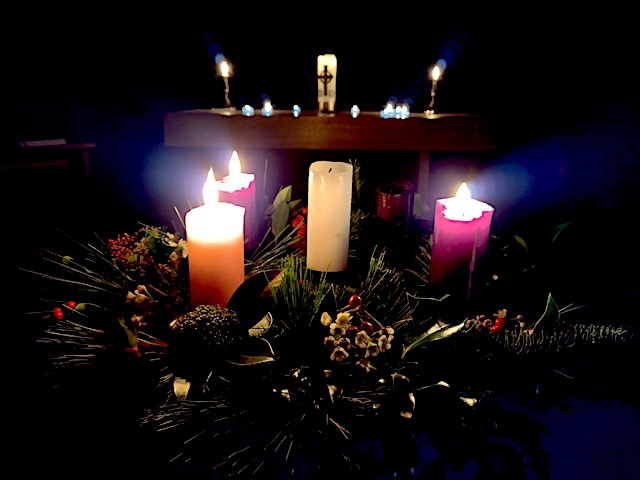
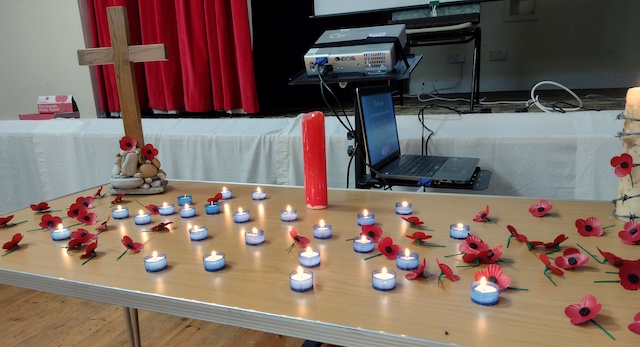
You probably don’t need any reminder that today marks the anniversary of the invasion of Ukraine by Vladimir Putin’s Russian forces. We have offered prayer and lit candles for the people of Ukraine over the past year and will continue to do so until this wasteful war comes to an end and the people of Ukraine in exile can return and all citizens can live without the threat of bombs and the fear of what the invaders may do.
Lord of all the earth, be present with the people of Ukraine at this time of danger, fear, and conflict. Grant that wise and peaceable counsels may yet prevail, and give to all suffering nations the freedom they desire and deserve. We ask this through Jesus Christ our Lord. Amen.
Holy God, We hold before you all who live close to war and conflict; and all who live close to the threat of war and violence. We remember especially at this time, people in Ukraine and Russia. We pray for nonviolence and peaceful resolutions of conflict. Give us hearts of hospitality and sanctuary, forgive us all our hostility and hatred. Bring all people to the humanity you give us, and to the reconciliation and healing for which you gave your life. Strengthen us all to work with you to build justice and peace, reconciliation and healing, in our hearts and homes, in our streets, in all communities, neighbourhoods and nations. Bless all who live lives for the peace and wellbeing of others, and make their service fruitful. In the name of Christ. Amen.
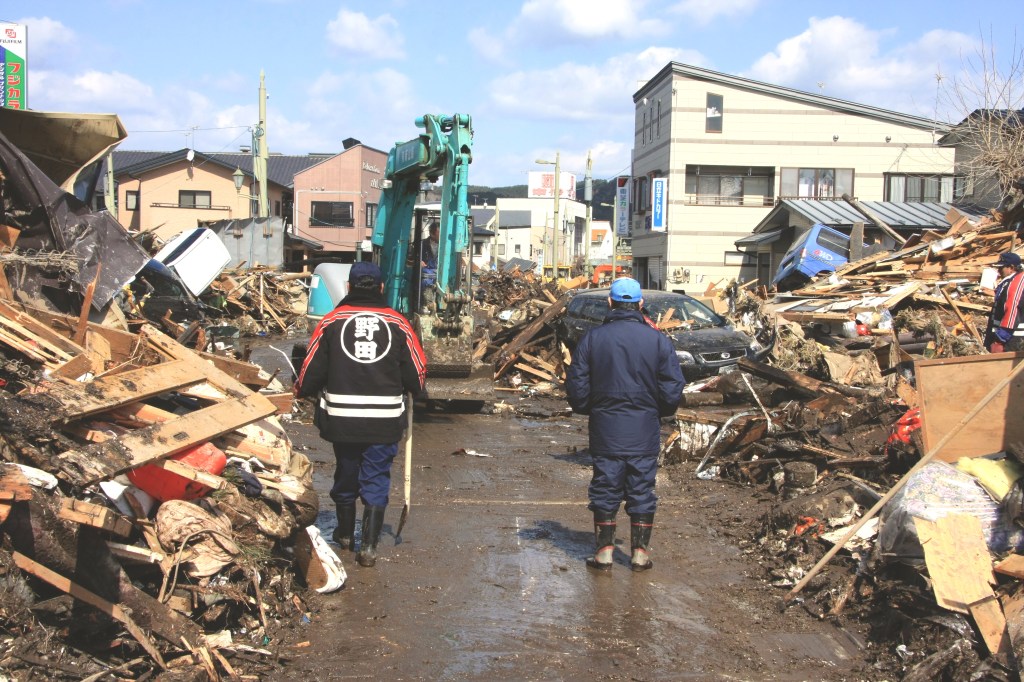
A Japanese Coastal Village after the 2011 Earthquake and Tsunami
In the past few months, we’ve seen and heard of events that have at times been quite difficult to take in. Major floods in Pakistan and Afghanistan, torrential rains in India and Nigeria, and recently: two major earthquakes in the Middle East.
The stories and images coming out of Turkey and Syria are devastating. In the aftermath of an earthquake of 7.8 on the Richter scale in southern Turkey and Northern Syria, buildings have been flattened, and many homes have been reduced to rubble. The death toll is already well on the way to 30,000 and in the days and weeks ahead, it’s expected to climb much higher.
Such disasters are bound to cause us to wonder ‘where God is in such things?’ So this is a good time to consider the gifts that God gives to help us in the difficulties of life and especially when our worlds are quite literally turned upside down.
Many people who’ve undergone adversity, experience a new sense of belonging to each other. There’s a remarkable sense of bonding between people who’ve experienced a particular disaster and who may’ve narrowly escaped death. There may be also a sense of guilt at having survived when friends and loved ones haven’t. God can give us the gift of a new sense of belonging and closeness to each other and also to God Himself.
Often, people deal with disaster by clinging to hope, expressed in phrases such as, “We’ll get through this together.” Such statements may be made through gritted teeth, in the anguish of physical and emotional pain. However, Hope has nothing to do with wishful thinking. Hope is the gift of openness to an unseen or unimagined future. It can keep us going, even when we can’t live and act in the ways we might normally be able to. The timing of the Japanese Earthquake and Tsunami in March 2011, just before the start of the Cherry Blossom season (the Sakura season) was very important in providing hope.
A crucial gift in God’s enabling is patience. It’s hope that enables waiting patiently for what is yet to be. Those of us, who can live active lives are accustomed to being more of less competent in what we do and can find patient waiting very difficult. Patience is the slow but definite practice of hope. It’s an active and loving holding on, perhaps without any other purpose than simply remaining; it’s “being” in the here and now.
With time, however, God also gives healing. It’s remarkable how there’s so a close relationship between time and healing. With time, we discover that in fact all along healing’s been taking place. There’s healing in the very nature of things, and of course there’s also the active work of healers, agents of God.
Experiences of suffering and distress are often also times of learning. Pain’s a great teacher. Many people say that’s at such times they learned the most valuable lessons of life. In particular, the value of things. That the things for which we spend so much time, money, and effort are worth almost nothing. When one’s experienced the loss of everything, all of one’s clothes and possessions swept away by an earthquake, tsunami, flooding or whatever, what remains is life itself, one’s family, and one’s relationship with God. In times of pain, illness and patient waiting, people come to reflect on the meaning of their lives, work, and priorities.
Flowing from these gifts, it’s both interesting and deeply moving to see something else emerge. In many contexts of disaster and distress, we see the depth of human caring. Those in ministry and in the caring professions often find that people in deep grief or pain reach out in concern for others. They want to be assured that some other person is being cared for. We may marvel at that, but it can be seen as a gift emerging from the very nature of our humanity. Our pain doesn’t destroy our better selves but rather brings them to the surface. Even as he suffered, Jesus prayed for those who crucified him. From the cross, he urged John to care for his mother.
Finally, the Suffering God enables faith. This isn’t a pre-condition of the other gifts. Rather, faith may be implied in those other gifts, but neither recognized nor acknowledged. Many people in their anguish call out to God, sometimes in accusing ways, just read the Psalms for examples. Sometimes, people, who say they don’t believe in God, call out to God. In contrast many, who’ve said they believe, find they can’t call out to God. Perhaps they imagined that their faith in God would mean that nothing like this could ever happen to them.
Faith emerges as the quiet, sometimes unrecognized gift that simply keeps us going. Faith isn’t the absence of struggle and doubt. Faith insists on dealing with the truth, with reality, with life and relationship; and through that keeping-on going, faith emerges in new forms.
It may be a new quality of prayer, or a new dimension of care, or a new commitment to reach out to those less fortunate. Such faith eventually finds its voice, to speak truth in the face of easy solutions or cheap grace. It speaks of the suffering God, who can and does help us in our hour of need.
The philosopher Charles Taylor has said that we must learn to understand what it means to have faith in our world. A world that isn’t a machine, controlled by a master manipulator of the levers. No, our task is to understand what it means to be with God and God with us, in a far less controlled, less predictable, but nonetheless, created world. In such a world, we must learn the meaning of belonging. We must learn to respect the earth, as many indigenous cultures have done since time immemorial and stop thinking that we can control everything for our own benefit.
We must learn also that the world isn’t just “our environment” but is rather the context in which we live with God. In so doing, we must learn see what God is doing in the world, and learn to live with and work with that, towards the unity with God seeks and the fulfilment of creation, in which all things come to their rest, in peace and harmony with God.
Our task, then, is to learn to see what God’s doing towards that redemption and to join God. That’s our theological and practical task—and what a privilege it is to be involved with God and God’s people in this way.
The Week of Prayer for Christian Unity ended on Wednesday. During the week, in many places, there were services where Christians from different denominations joined together to celebrate what they have in common, laying aside those things that divide them. Now, I’d be fairly certain that if any of us were to spell out the difference between our denomination and one of the others we’d make a reasonable job of describing the essential character of our own, but a less good job of the other. Such has been the case throughout Christian history. But these considerations don’t just apply to Christians or to religions, they apply whatever ‘groups’ or ‘tribes’ we belong to and the difference they have to other similar ‘groups’ or ‘tribes’.
Anna and I lived for 25 years in the West of Scotland, in Ayrshire, where sectarianism is still alive and well and where even today the chances of getting some jobs may depend on your denomination, which might be revealed simply by the name of the school you attended. But I’m not sure that sectarianism’s actually got anything to do with religion, with denomination or with belief. It’s more about prejudice and prejudice often arising from ignorance of the ‘others’.
What we seem to be missing in our increasingly polarised culture is a shared humanity. That person who you or I are yelling at (literally or metaphorically), who has a different political, social or religious opinion than us, they’re actually human too, and you or I are no better or worse than them.
When we can learn to admit that we’re not perfect, that we make mistakes all the time and that we constantly change and evolve our opinions and beliefs … then we can begin to have more compassion for ourselves and begin to see ourselves as someone that’s lovable and worthy of grace and compassion, even though we’re not perfect and not living up to our own ideals. At that point we begin to see others, with differing views or opinions, with that same grace and compassion, no matter how different they are or how many mistakes they’ve made. Why? Because we realise that they’re a person, just like us, with hopes and fears, struggling to do the best they can with the resources that they have, the situation that they find themselves in and what they believe to be true.
Irene Butter, who as a child survived not one, but two holocaust concentration camps, perfectly summarizes these ideas in a single sentence: “Enemies are people who’s story you haven’t heard, or who’s face you haven’t seen.” We need to remind ourselves of this whenever we come across another person who doesn’t see the world in exactly the same way that we do.
St Paul reminds us that human standards of judgment count for nothing in God’s eyes. The human standards that say for instance: that my way of being a Christian is better than your way, that my way of worship is better than yours. The scandal of the cross is that God chooses vulnerability, weakness, suffering, and death in order to bring new life. God places the greatest value on our service to others, even when service may mean suffering and rejection. In Christ we’re a new creation, even in (or perhaps because of) our weakness and vulnerability.
It great to hear people talking about unity, so long as they don’t mean simply that “we can all be united if you come over to my way of thinking”. That’s akin to my suggesting that the solution to Christian disunity is for them all to become Episcopalians – and you know what, I don’t think that would solve anything. We like most denominations can’t even agree amongst ourselves!
The key to the Week of Prayer for Christian Unity is the word ‘Prayer’. Unity is something that we should fervently pray for, we might never achieve it, but that doesn’t mean that we shouldn’t try, remembering that Unity isn’t Uniformity!!
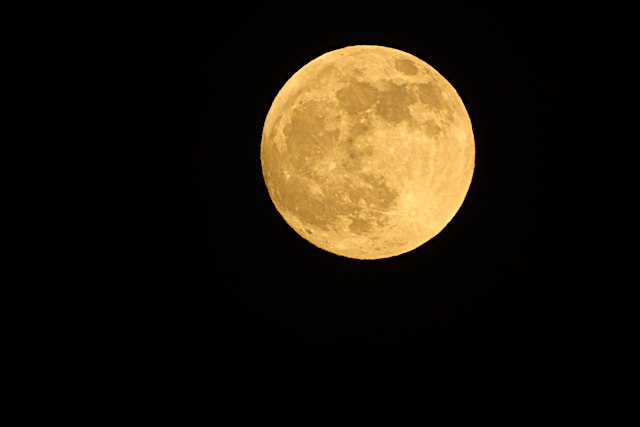
The 21st December was the shortest day and the longest night. Nature seems to have gone to sleep. The leaves have fallen off all but the most resolute of oak trees and the garden lacks life.
As early as the 2nd century, the Romans believed that the ‘Unconquered Sun’ would rise again and warm the earth and bring things back to life. Darkness and Light. Death and New Life. And they prayed to their god ‘Sol Invictus’ or ‘Helios’ if you prefer, that light would come again. It’s no accident that the Christian Church celebrates the birth of the ‘true light’ at the darkest time of the year. He is the light that darkness could not overcome.
There’ll always be a struggle between darkness and light.
We feel that at both a personal level and in the public world around us as well. Nowhere is this more graphically seen than in the destruction and war being waged in Ukraine, in parts of the Middle East and in parts of Africa. Bombs and bullets, terror and violence seem to be the only language being used in these parts of the world, including the lands of the Bible and the places that we hear about in the story of the Incarnation.
And, of course it’s the innocents who suffer and it always has been.
Who could fail but be shocked by the sheer terror on the faces of children and families as homes and schools, hospitals and clinics and essential parts of the infrastructure of towns and cities are destroyed in ways calculated to instil fear, misery and suffering into the largest number of innocents? Whether these images come from from Aleppo or Mosul, from Gaza or Nablus, from Kiev or Kherson and so many other places whose names we either don’t know or can’t remember, as we watch on our TV screens or read our newspapers, we are appalled.
The story of the birth of Jesus resonates with the story of humanity at it’s darkest hour.
These verses of Malcolm Guite’s poem ‘Refugee’ puts it so well:
We think of him as safe beneath the steeple, Or cosy in a crib beside the font, But he is with a million displaced people On the long road of weariness and want.
For even as we sing our final carol His family is up and on that road, Fleeing the wrath of someone else’s quarrel, Glancing behind and shouldering their load.
Malcolm Guite “Refugee”
At this time of year, as Christians we hear and proclaim the universal message of the need for peace on earth. Peace isn’t just the absence of conflict and war. Each of us has some responsibility to create at least some of that peace in our own life and community, not least by working for a more just society and world.
These are the ‘hopes and fears’ we focus on at Christmas and as we remember the Holy Innocents.
Let the joy of our faith light us up as we rejoice’
Glory to God in highest heaven, and on earth peace to all in whom God delights.
Those are the words sung by the angels as recorded in St Luke’s Gospel, as they proclaimed the birth of Jesus to the shepherds out in the fields near Bethlehem. Glory to God and peace to all. These words will be repeated at nativity plays, carol services and in many churches at the Midnight Eucharist. People will begin to feel the warmth generated by these familiar words as Christmas Day begins.
As a society we have created a remarkable product around Christmas Day. We have built expectations of happiness, good cheer and comfort, all set against a picturesque backdrop of gently falling snow. Unfortunately, those images are never real for a significant number of those we are called to serve. This year, for many it will be even harder than before to create any sense of warmth in either heart or body.
As I arrived at the Cathedral in Inverness for our carol service the other day, I passed the rolled-up sleeping bags in the porch, the large container for children’s gifts, and the pile of coats left for those who need something to keep the cold out. These have become the ever-present symbols of a society where an increasing number of people rely on kindness for basic support. I know some shake their heads at the “mess” but most accept that what we see is the reality of life for some people. They need our help.
We celebrate this Christmas at a time when war is taking place in Ukraine, there is famine in the Horn of Africa, and desperate people are crossing the sea in small boats to flee dire consequences in their own countries. We are also aware of the many people near us who will not have enough to pay for their heating or for their food. We think of those who will not be able to make Christmas the special time that it would normally be for their families, and will feel they have somehow failed their loved ones.
As we hear those pleas for support, help us to offer something of ourselves to look after others; teach us how to share and care for those who are struggling, and to allow our churches and congregations to be beacons of prayer, light and hope in this world. We have a wonderful message to proclaim, we have a glorious festival to celebrate, let the joy of our faith light us up as we rejoice in the wonder of the Christmas story.
Let the power of the incarnation lead to us to action, and the love of God cause us to sing with the angels.
Glory to God in highest heaven, and on earth peace to all in whom God delights.
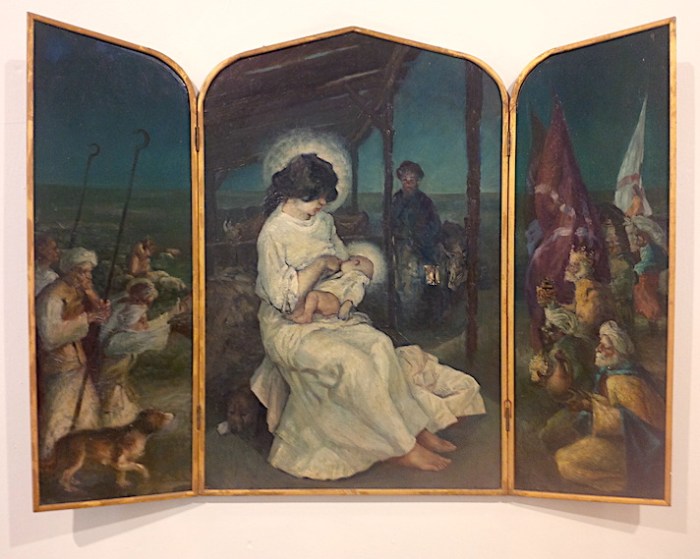
Donald Swan’s Tryptic of the Incarnation in he Lady Chapel of the Cathedral of the Isles in Millport
Perhaps we’ve a lot to learn from Joseph and Mary. Joseph, committing himself to listening humbly and attentively to God. And Mary welcoming into her heart, soul and body, the mystery of Emmanuel ‘God with us’.
We might also reflect on the part that discretion played in Joseph’s and in Mary’s life. Joseph always discretely there. And Mary, getting on with what needs to be done.
This is so beautifully captured in Donald Swan’s lovely tryptic in the Cathedral of the Isles in Millport, where I used to take services from time to time. In that, Mary is depicted in the stable, feeding her child so discretely that you’d hardly notice.
On this the Fourth Sunday of Advent, we should ask with them:
“What happens when we allow God to intrude into our nicely laid plans and decisions?”
Advent’s the season of waiting, and hoping, and wishing for some sign that God really loves us …
and that after all that’s been happening in the world recently, for some sign that God hasn’t abandoned us and is still there in our lives now and will be in the future.
Advent asks us to make room in our hearts and our busy lives for the coming of Jesus our Saviour.
Advent’s a time for us to make it possible for His coming by smoothing out some of the rough places that might be obstacles to His coming.
“O come to my heart, Lord Jesus, There is room in my heart for Thee”.
Are you someone who when you’re reading a book, tends to skip to the end to see what happens rather than sticking with the hero through thick and thin. When Andrew and Daniel were young, on long journeys they’d start asking if we were nearly there yet, before we were a couple of miles from home.
Part of the problem is a failure to be content with now. How much of your time do you spend thinking about the past? How much time do you spend worrying about or anticipating the future? How much time does that leave for living in the present?
The spiritual writer Anthony de Mello suggested in his writings that most of us spend far too much time anywhere but in the present. In Advent it’s so easy to think about Christmases past or to have already arrived at Christmas to come. C. S. Lewis wrote a story called “Xmas and Christmas: A Lost Chapter from Herodotus” about a land in which there are two festivals that overlap by just one day.
The first festival is called Exmas and for fifty days the people prepare for it, buying and sending cards and gifts, decorating trees and preparing food
“But when the day of the festival comes, most of the citizens being exhausted with the preparation, lie in bed till noon. But in the evening they eat five times as much supper as on other days and, crowning themselves with crowns of paper become intoxicated.”
The other festival, called Crissmas, starts on the day that Exmas finishes. But those who keep Crissmas, do the opposite, they
“rise early on that day with shining faces and go before sunrise to certain temples where they partake of a sacred feast.”
and then celebrate for several weeks afterwards.
For me Advent is about waiting for the unexpected. It’s a shame to miss all that by skipping ahead to what we think we know happens at the end of the season, on 25th December. To fail to engage with the now part of the story day by day and week by week. To fail to really listen to and reflect on the now part of the story. To have already moved on to the next part, because we know what happens next and it’s more exciting, more interesting, or perhaps more comforting.
This Advent how about really living in the present? Resisting that strong temptation to skip ahead, Enjoy the anticipation. Enjoy the state of not-knowing, because, if you enter into it, almost anything could happen. Enjoy the possibility that something truly amazing might come to pass. That God might just do something in your life that you didn’t expect, and that His coming into the world – your world – might mean that things are never the same again.
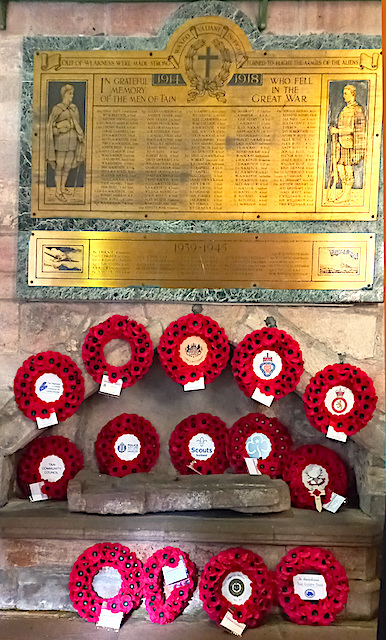
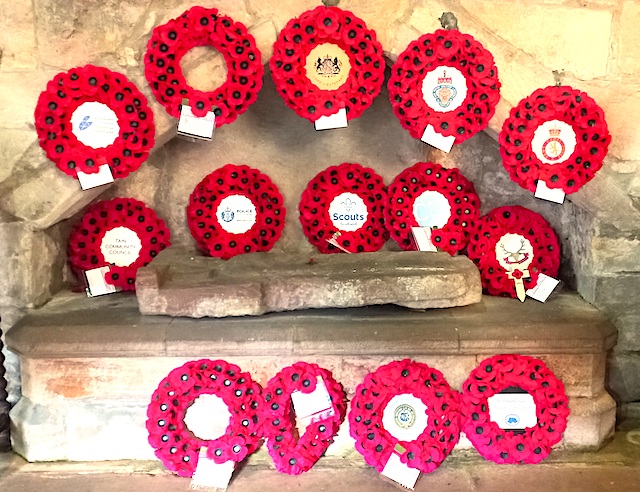
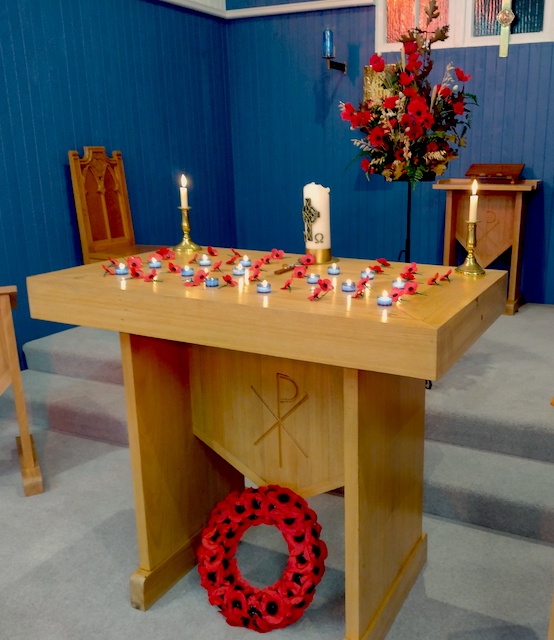
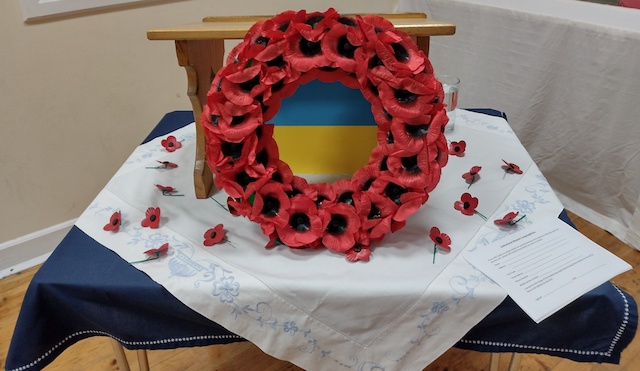
In Flanders fields the poppies blow Between the crosses, row on row, That mark our place; and in the sky The larks, still bravely singing, fly Scarce heard amid the guns below.
We are the Dead. Short days ago We lived, felt dawn, saw sunset glow, Loved and were loved, and now we lie, In Flanders fields.
Take up our quarrel with the foe: To you from failing hands we throw The torch; be yours to hold it high. If ye break faith with us who die We shall not sleep, though poppies grow In Flanders fields.










 Scottish Episcopal Church - Dornoch, Lairg, Brora, Tain & Tongue