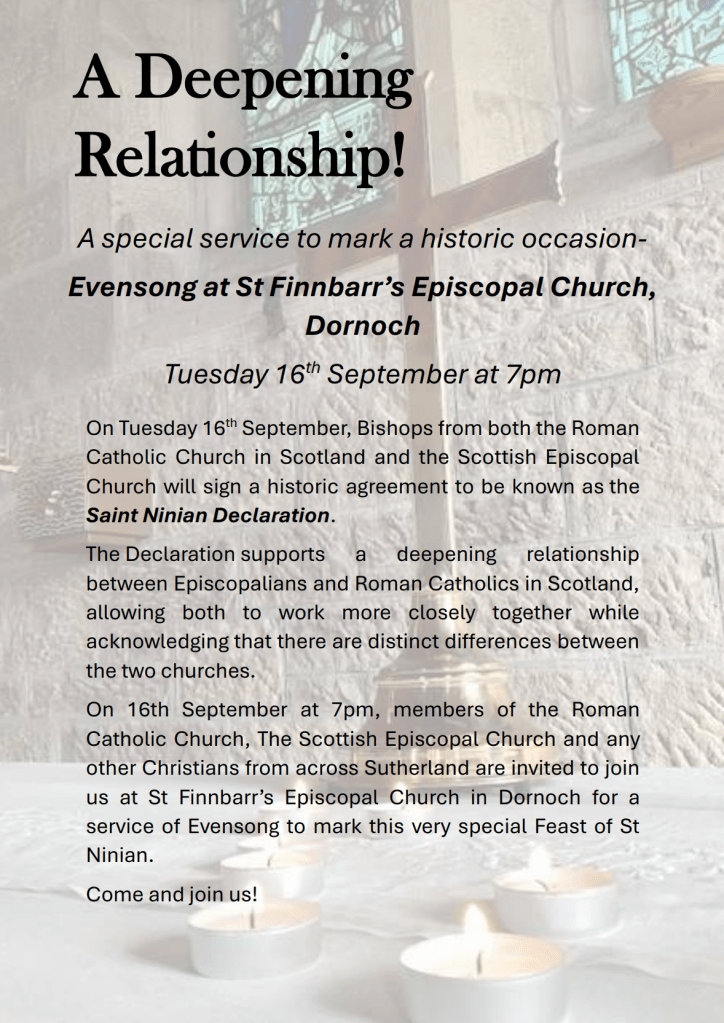
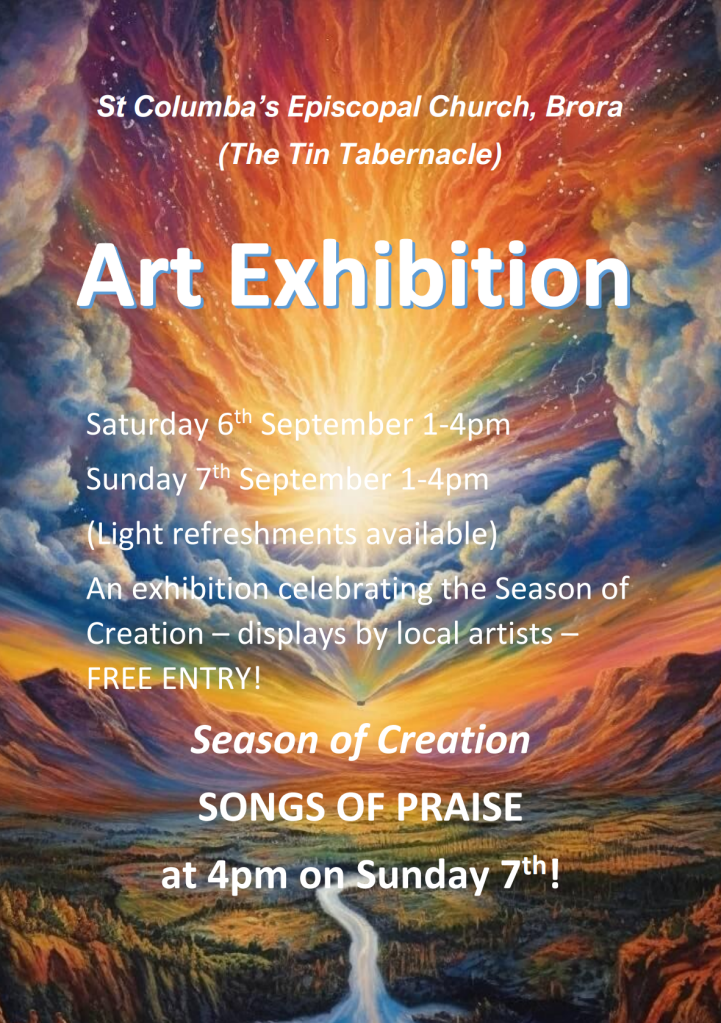
Season of Creation Art Exhibition – St Columba’s Brora

Most of you will know that I love reading and talking about the stories of the saints and our episcopalian tradition encourages us to reflect on and celebrate the lives of our dear sisters and brothers who have walked the journey of faith before us. Today , we remember St Bartholomew. But do you know, Bartholomew is rather a difficult saint to celebrate and that’s because we don’t really know very much about him.

The gospel set for the feast of St Bartholomew doesn’t even mention his name. He may or may not be the same person as Nathaniel – scholars argue the one way and the other. In Matthew, Mark and Luke, Bartholomew is listed as one of the twelve. John doesn’t mention Bartholomew but does mention someone called Nathaniel – so that leads some to conclude that these two men, Bartholomew and Nathaniel to be the same person.
Some ancient writers on the history of the Christian faith claim that Bartholomew was an apostle to India – possibly working in the region of Mumbai. Along with his fellow apostle Jude, Bartholomew is reputed to have brought Christianity to Armenia in the first century.
By tradition, Bartholomew is said to have been flayed alive, before being crucified upside down, and so became the patron saint of Leather-workers. In painting and sculpture, he is often represented as a rather gruesome image, holding a knife, with his own skin neatly draped over his arm. But Bartholomew has also always been associated with healing, so a number of hospitals are named after him.
He is also associated with the small Italian Island of Lipari, where its thought that he may have been buried. During World War II, the Fascist regime in Italy, looking for ways to finance its activities, ordered that a silver statue of Saint Bartholomew from the church should be melted down. But it is said when the statue was weighed it was found to be only a few grams and so worth very little, and so it was returned to its place in the Cathedral of Lipari. In reality, the statue is solid silver and is very heavy – a relatively recent miracle associated with St Bartholomew.
But about Bartholomew himself we know almost nothing, except that he was a disciple of Jesus.
Now, far from being a negative thing, I think that not knowing very much about him is actually the most important thing for us to hold on to when reflecting on the life of this rather mysterious man, because he teaches us that the call to serve is not really to do with our own fame or status.
When we look around us today we realise we are living under the reign of ego and of fame, perhaps media stars and the glitterati are the best known for this. An increasing number of children, when asked what they want to do when they grow up, say that they want to be famous – being famous for being famous has become a vocation. Some of our politicians seem rather the same and of course, the church is not exempt: evangelists on religious television stations, pastors of megachurches, and, unfortunately, some bishops and clergy appear to love being in the spotlight and have become artists of self-publicity. I once heard someone say that their church was OK, but it was hard to see God because the priest always got in the way. It’s a temptation most clergy are aware of and try to resist – our job is to point people to God, not to ourselves.
So Bartholomew’s anonymity shows us ‘it’s not all about me’. Our job as Christians is to get out of the way and to enable people to catch a glimpse of the God whom we serve.
And something all of us must realise, something that the life of this mysterious man teaches us, is that we actually don’t need to be famous, not because we should be humble or control our egos but because God loves us, and that’s all we need – we need no other adulation.
All of us here will join the great ranks of anonymous Christians who have served God through the ages. In 2000 year’s time – probably long before that – we will all have been forgotten, except perhaps by ancestor hunters who might still be digging our names out of archives and searching church registers for information.
That might seem rather disheartening, but it needn’t be, because we know we are creatures of God’s making and redeeming: we are each loved by God more than we could ever imagine – part of our job is to try to discover a little more of this love as we go about our lives. When we understand even a little of this love our anxieties about status, importance and fame, begin to lose their hold over us. In God’s love we have everything we need.
So often we see the lives of the rich and famous descend into tragedy or disaster. Wealth and fame often don’t bring happiness. The ordinariness of our lives is something to celebrate, if, like Bartholomew, our lives are built on the rock of faith and within us we have the knowledge of God’s love, like a hidden jewel, burning deep inside.
So Bartholomew is one of us: a follower, disciple and servant of Jesus Christ. An anonymous, unshowy person who gave of his best. Someone we don’t know much about, but whose soul is now hidden with God where that great love will, at last, be fully known.
That is all that is needed. All that matters. Amen
CALLING ALL SINGERS!
NEW – CHORAL EVENSONG CHOIR!!

Choral evensong is one of the jewels of Episcopalian worship. We want to introduce opportunities at various times in the year to take part in this type of service. The thing is, we need a good choir to help lead us. I am asking all those who might be interested in such a group to get in touch with me by email at episcopalpriestdornoch@gmail.com and/or to come along to a first meeting and ‘sing’ in St Finnbarr’s Church, Dornoch on Tuesday 19th August at 7pm. If you know anyone from outwith our regular congregations who might be interested – SPREAD the WORD and invite them along!


As part of the VJ day celebrations in Sutherland, St Finnbarr’s, Dornoch was filled with paper cranes surrounding a single kimono in memory of a girl called Sadako. Here’s why –
Up until the time Sadako was in the seventh grade (1955) she was a normal, happy girl. However, one day during a school race that she helped her team win, she felt extremely tired and dizzy. This got worse and worse, until one day Sadako became so dizzy that she fell down and was unable to get up. Her school-mates informed the teacher, and Sadako’s parents took her to the Red Cross Hospital to see what was wrong with her. Sadako found out that she had leukemia. At that time they called leukemia the “A-bomb disease”. There was a low survival rate for ‘A-bomb disease and Sadako was very scared.
During Sadako’s stay in the hospital, her best friend, Chizuko, came to visit her. Chizuko brought some origami (folding paper) and told Sadako of a legend. She explained that the crane, a sacred bird in Japan, lives for a hundred years, and if a sick person folds 1,000 paper cranes, then that person would soon get well. After hearing the legend, Sadako decided to fold 1,000 cranes and pray that she would get well again.
Sadako’s classmates had lost many of their friends to the A-bomb disease and were saddened by the loss of Sadako. They decided to form a unity club to honor her and stay in touch after they all left school, which grew as students from 3,100 schools and from 9 foreign countries gave money to get a statue built to recognise the many children who lost their lives because of the bomb. On May 5, 1958, almost 3 years after Sadako had died, enough money was collected to build a monument in her honour. It is now known as the Children’s Peace Monument and is located in the center of Hiroshima Peace Park, close to the spot where the atomic bomb was dropped.
The act of folding a crane started by Sadako and her classmates turned into a national, then an international, children’s peace movement. Children from all over the world still send folded paper cranes to be placed beneath Sadako’s statue. In so doing, they fulfill the wish engraved on the base of the statue:
This is our cry, This is our prayer, Peace in the world.
Our thanks to all those children and adults who made our peace cranes and to Monica who has worked so hard on displaying them so beautifully in our church. The peace cranes will remain throughout the season of creation to remind us that our actions as humans affect all of God’s creation. The use of atomic weapons not only devastated human life, but the lives of animals and plants for generations to come. Lord have mercy on us.
* Jeremiah 23:23-29 and Psalm 82 * Hebrews 11:29-12:2 * Luke 12:49-56
In today’s Epistle lesson, the writer of the Letter to the Hebrews encourages us to persevere in our life of faith, no matter what difficulties we face. “Since we are surrounded by so great a cloud of witnesses, let us also lay aside every weight that clings so closely, and let us run with perseverance the race that is set before us.”
The writer says, you have begun a good thing in becoming Christians. I want you to finish strong in what has been started in you.
Most of my academic training for the priesthood was done at the campus of the benedictine Community of the Resurrection in Mirfield, Yorkshire. One of the elderly monks there, had all his life enjoyed running and in his seventies at the time, still regularly took part in marathons, raising funds for various charities. I remember in one particular talk he gave to us ordinands he told us about his joy in running. “I like to run. I’m not fast, but I enjoy running. Participating in marathons has given me an experience I have enjoyed about running. In marathons, the best runners in the world and normal mortals like myself get to compete in the very same race. I think that’s something special. I will never find myself on the same tennis court with Serena Williams. If I were ever to kick a football, none of the Gunners (He was an Arsenal fan) would be there to receive it. But, when I ran the London marathon, I (and thousands of other runners) lined up at the same starting line as runners who held the best marathon times in the world. We ran the same course. We passed the same cheering crowds.”

“But I suppose it’s the finishing that really makes the difference. The elite runners were crossing the finish line when I was only about a third of a way through the course. They had about three hours to enjoy refreshments and rest, while I still had about thirteen miles of one foot in front of the other to reach my goal, and was wondering if I would really make it. But the beauty of the event is that for many of us, just finishing the race is the accomplishment, the goal.”
Very few have to run a marathon and participation is usually just for fun.
But today the author of the letter to the Hebrews asks us a related question: Will we finish the race that is our life with faith? Will we persevere? Or will we run off course, or give up?
And the race is hard.
In today’s gospel, Jesus tells us, if we follow him, if we stand up for what is right, we will experience conflict.
The writer of Hebrews, like a good sports coach, gives four pieces of advice about how to finish the race.
To finish the race: recall who surrounds us. Remove those things that weigh down on us. Rely on strength within us. Remember who goes before us.
Recall who surrounds us: “Therefore, since we are surrounded by so great a cloud of witnesses.” The epistle writer wants us to picture ourselves as athletes in an arena. As we strive toward our goal, to finish with faith, in peace and holiness, we run surrounded by people. The people in the stands are people who have demonstrated faith — faith that persevered, people who by the grace of God overcame great obstacles, and finished the race. These are people of the Bible, the men and women of the Church throughout the ages, people known personally by you and by me whose witness encourages us.
They are witnesses, not just spectators. There is a huge difference. A spectator watches you go through something. A witness is someone who has gone through something herself, and the root meaning of the word witness, from which we get the word “martyr,” is someone who may have given his life going through it. We have witnesses cheering us on, not just spectators, people who have gone through what we struggle with, people whose testimonies of the strength God gave them can, in turn, give us strength and courage. We have witnesses rooting for us, weeping with us when we stumble, calling to us when we wander, urging us to finish the race.
Our sports coach tells us also to remove what weighs down on us. Have you ever seen Olympic athletes running a race wearing winter parkas, or with weights tied to their ankles, or carrying a backpack full of bricks? “Let us lay aside every weight and the sin that clings so closely,” says our coach.
What attitudes and actions, what past behaviour and present entanglements weigh us down? What weights of sin and brokenness do we carry that cause us to stumble rather than sprint? We can put those weights down. God is ready to take them from us. God is ready to forgive and heal whatever we have allowed to get between us and God, whatever has come between us and other people, whatever wrongs we do to ourselves.
Our coach also tells us to rely on the strength within us. We are told to “run with perseverance the race that is set before us.” When the going gets tough, when the road is difficult, when the miles drag on, obstacles come up around every bend, when every stretch of the road seems like another steep hill to climb, we can rely on spiritual resources within us — spiritual resources we develop in training: in gathering with other Christians, in hearing and reading God’s word, in participating in the sacramental life of the church.
The word “perseverance” can also be translated as “patient endurance.” Endurance is one thing – we can endure and whinge and complain all at the same time. Patient endurance looks like praying without ceasing for ourselves and others. It looks like encouraging others even in the midst of difficulty. It looks like saying something kind, or saying nothing at all when something unkind comes more readily to mind. It looks like giving of ourselves generously, even when we’re not sure what’s ahead of us and our inclination may be to think of ourselves first.
Most importantly of all, remember who goes before us. We can look “to Jesus the pioneer and perfecter of our faith, who for the sake of the joy that was set before him endured the cross, disregarding its shame, and has taken his seat at the right hand of the throne of God.”
We can and will finish the race strong in faith if we look to Jesus, if we keep our eyes focused on him, not being distracted by other things along the way that can cause us to lose our direction or our footing, causing us to stumble. Jesus has gone before us, He has shown us the way that leads to victory. If we keep our eyes on Jesus and follow him, we will not only make a good beginning in faith we too will finish and win the race.
In the race of our life, we have people cheering us on. We have someone willing to take on our burdens. We can train for patient endurance. We have a guide who leads us and will not leave us.
I pray each one of us keeps on running until the prize is ours and we hear God say to us, “Well done!” and we too become a member of that great cloud of witnesses.
Amen.

Gathering together as we do this morning, to pay our respects to those who have given the ultimate sacrifice in the pursuit of freedom, justice and peace, even 80 years on, continues to be central to our life as a nation. The hundreds of thousands of names on war memorials across our country each remember someone’s child, someone’s sibling, someone’s parent, someone’s friend. And it’s often when we learn their individual stories that the great sacrifice made becomes more real to us, most of whom were not even born at the time of the second world war.
And so, this morning, as we consider the allied victory over Japan, I want to tell you about Eric Cordingly, a minister who joined up as a padre during the second world war, and was taken captive in Singapore in February 1942.
In a letter written to his wife from Changi, on 16 August 1945, just one day after the Japanese announced their surrender he writes: “Last Friday we first heard through a secret radio we have maintained that Japan might topple and since then we have lived on the edge of a precipice wondering whether negotiations would go through. . . No British troops have arrived. We wait and wonder with such impatience.
“We are still living in the gaol here in Singapore and have been for 15 months. Food is just impossible, rice and coarse green vegetables — but, Mary, I am very fit, very thin and at present have no energy but a few weeks of proper feeding and I’ll be terrific. I am wearing a patched pair of khaki shorts and wooden clogs and that has been our only dress for over two years.
“At 4 o’clock I go to give my final talk on Confirmation to a group of 30 officers I’ve prepared. I wonder how long it will be before we see the Union Jack flying instead of the hateful Japanese flag.”
His letters are very vivid, with assurances that, despite the privations, he is fit and well, and, above all, longing to return home. “I don’t think I could have kept going if you were not at home waiting for me — prayers do work don’t they darling!”
He tells his wife that he was able to work flat out as a padre with never less than three or four thousand to look after, both officers and men. “I have built five different churches here and have, except for a few exceptions, had a daily celebration of Holy Communion and this has been a terrific help. I have never had such a busy time as these past three-and-a-half years — all the time doing padre’s work in a way that was never possible before — so I have not gone to seed.
“Life has been pretty grim in patches, especially the year I spent in Thailand in the Jungle camps building the railway.”
In his war diary, he records that he buried over 600 young men who died from the brutal conditions working on the construction of the Thai-Burma railway.
Then, from Singapore on 6 Sept 1945, he writes his first letter as a free person, now safely in British hands and hoping shortly to be on his way home. His departure was chaotic, but, with an hour’s notice, he was told he could fly to Rangoon, where he joined thousands of other POWs from Thailand. To his enormous disappointment, he wasn’t able to take a flight back home immediately, but instead embarked on MV Empire Pride, bound for Liverpool.
As he drew closer to home, he began to plan for his return. “I have no kit, all was lost in 1942 except my haversack with my prayer book, robes, and communion kit. My watch was sold in order to keep alive in these last months; my ring was lost trudging through the Jungle in Thailand.” And he asks his wife if she could get his cassock and surplice cleaned “because I expect I shall appear in church on the first Sunday after I return”.
“I’m longing for the manse and you — the simple things — vegetables from the garden I’ve been dreaming about for years — and an egg — it’s years since I had one. Rationing won’t bother me much. I hope the apple trees have produced some fruit — I’m just longing to taste an apple again and some good simple dishes that I used to love.”
In A final letter written on 28 September, he reports that the little ship he is on is dashing along because the captain wants to beat the other ships to reach England first. “I don’t think I’ll get a chance to write so the next thing you’ll hear is my voice and better still I shall hear yours. . .”
And so began the return to “normal” life for thousands of ex-Far East POWs. Of course, so many of them were traumatised by their experiences suffering from PTSD and nightmares for the rest of their lives. That is why alongside those who died in conflict, we remember and give thanks to those who survived, those who returned home, but whose lives would never be the same.
I’d like to finish this reflection with the final words from Rev Cordingley’s first sermon in his church on his return –
“Our victory is won, but there is a long job ahead to make liberty available again to everybody. But can’t you see it is a job after God‘s own heart, since he himself is doing the same thing? If God is with us, in the fight, in the sorrow, in the victory, in the rejoicing, in the reconstruction – if God is with us, who can be against us?”
* Genesis 15:1-6 and Psalm 33:12-22 * Hebrews 11:1-3, 8-16 * Luke 12:32-40
A few years ago now, during my student days, I was a worship leader at a church summer camp for children in the Lake District. One of the themes of the camp was ‘Talking to God’. We set up a board with post it notes and challenged the children to make a response to this question ‘If you could ask God just one question – what would it be?’ These were a few of the responses we found on the board:
God – Can you read my mind? If you can then what am I thinking?
God – I know you made the world and everything on it, but who made you?
God – How can you listen to everyone at the same time?
God – Do you like me better than my brother?
God – Is there a shortcut to heaven?
God – Why did you make midges? All they do is bite me – why did you do that?

If we really had the opportunity to ask God just one question, I wonder what it might be?
There is a story of two Christians who were talking at the back of church. One said,
“I really want to ask God a question. I want to ask God, why He allows all this poverty and suffering in the world today.”
The other said, “Well, have you prayed, and asked Him why he allows it?”
“I’m too scared,” the first replied, “I worry that he’ll ask me the same question.”
Most of us want to live in a fair and just world for everyone: a world where there is peace and love. In short: We want the kingdom of God to come on earth, as it is in heaven. But I want to challenge us this morning by asking, “Do we want it enough?”
The words of Christ that we heard in our Gospel reading just now bring us some comfort.
“Do not be afraid, little flock, for it is your Father’s good pleasure to give you the kingdom”
I don’t know about you, but I need to hear those words because I am sometimes afraid! I am afraid that when I look honestly at my life, I treasure my comfort too much. If my heart is where my treasure is, I worry my heart is glued to my sofa at home escaping into films. I worry my heart is secure resting in the knowledge that I have money in the bank which would ensure I would stay comfortable even if the house was flooded (or at least, I’d be OK for a while).
I wonder if, like me, some of you worry that you are like the rich man we heard about last week, who builds himself a big barn and sits back and congratulates himself on being so secure – caring only a distant second for the poor and their discomfort.
Our gospels readings, both this morning and last week tell us that our security must not rest solely in our money, or in our family to take care of us. And we must not prioritise our desire for comfort over our desire for the kingdom of God.
Money, possessions, family and comfort are all good gifts from God.
And we should all be hugely grateful to Him for all the things that he has provided us with. But be sure that faith requires something from us, because of who God is and what his character is like.
God in Christ asks us ‘’’to sell our possessions and give alms’’’. He teaches us that there is a better city, a heavenly one, which we have been promised. However tempted we might be to stay put, tempted to say,
“Well, the kingdom of God might be nice, but actually I’m rather comfortable here at home. As things are. Let’s put down anchor here.”
If we do that, we’ll miss out on the Kingdom of God. Because Jesus was a poor, homeless refugee and chose to spend most of his time with the poor, the outcast and those who were distinctly uncomfortable. If we want to follow this Jesus, to live with him in his kingdom, we need to be prepared to go where he went.
I don’t want my sermon today to make anyone feel guilty about their comfort or wealth. Rather, I want to inspire us to dream dreams, and imagine visions of the coming Kingdom of God that are so beautiful that we refuse to lay anchor here in our material comfort. Because where our treasure is, there our hearts will be also.
There is an inspiring account of St. Lawrence whom the church remembers today, a Deacon in Rome who was eventually martyred by the Emperor Valerian. Lawrence was commanded to gather up the church’s treasures and to hand them over to the Roman authorities. This he did, but rather than gather up the silver and gold, he gathered up the poor of the city whom St. Lawrence had come to love. He presented them to the Roman authorities with the words, “these are the treasures of the church”.
We here in Dornoch have been gifted by God with beautiful churches like this one. We have been given a beautiful town, beautiful houses and surrounding countryside. And let us thank God for these things. But let us remember that our real treasure is not in the bricks and mortar of these places, or even in the flowers of the field.
Rather, our real treasure – where our hearts are called to be – is with the poor. The lonely, the outcast, those struggling with addiction, those that others have already written off. We are called by Christ to love these, and by doing so, we are loving him. By serving them, we are serving him. By sharing what we have and not claiming it as our exclusive private property, we will begin to allow God’s Kingdom to come on earth as it is already in heaven.
My prayer is that God would save us from making our money, our family, or our need for comfort into an idol. That way, we can have two free hands to grasp the promise God offers us – the promise of a coming Kingdom, a kingdom where everyone has a seat at the banquet table, and no one is left out in the cold. Let us put our faith in that promise, and hold only very lightly to the material blessings we have.
So, this week, think about and prepare the one question that you would ask God when you meet Him face to face, and maybe some day you will be given the chance to ask that question. But remember, you need to be prepared with your answer when He asks the same question of you.

Thank you, thank you, thank you to all those involved in the two most recent concerts at St Columba’s in Brora. We have been overwhelmed with the support we have received and the attendance numbers at both concerts, when, altogether we have raised over£3,500 for CLAN Cancer Support Charity. Special thanks to all our performers (pictured above), to those who helped prepare the building, those who prepared and served refreshments and of course, to the wonderful Alistair Risk (pictured in the white jacket) whose idea these concerts were in the first place. Super effort team – God Bless you for sharing your gifts and talents in this way!

For those who could not make it, or those who would like to hear the music again, this is a repeat of the concert that was held at the Tin Tabernacle in July!