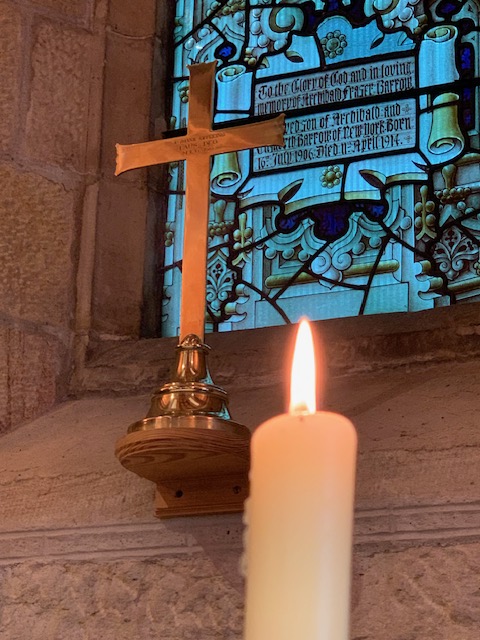
Reflection for Remembrance Sunday

I wonder if you have ever played that game where you try to remember objects on a tray? A feat of memory! Memory yes, but not really remembering. If you have ever played this game, I bet you are now remembering it. The fun, the laughter, the people you played it with. This is Remembering. Mentally and emotionally placing yourself back into a moment.

Remembering thoughts, feelings, smells, relationships. The difference between memory and remembering. One is simple factual recall, the other forms us as human beings.

Remembering connects us individually and collectively: telling us who we are, where we come from, and linking us to our community, our friends, and our families.  

The loss of life in the Great War was dramatic, traumatic, and affected every community across our country and beyond. After the Armistice in 1918, many didn’t talk about it for years, but collectively the nation needed to remember.

The trauma and loss of life were so significant that remembering became vital. Not simply recalling a list of battles fought and campaigns won or lost, but a re-membering, of people, of lives, of relationships. The importance of lost individuals as members of the community.

Remembering each individual within a collective remembering of millions. Because those who died had value, they had innate worth. For all it is the overwhelming numbers we recall in history books, grief was for the individual.

So why do we still fall silent? In 2014 I went to see the Sea of Poppies Installation at the Tower of London. I eavesdropped on the crowds’ conversations and many of them were remembering a specific family member. A family member of whom they have no ‘memory’ and yet, re-membering was still important. 100 years later a Great Niece or a Great Grandson was there, moved to tears. A treasured moment, not because of memory, but because that individual mattered within their family story. It is through remembering that generations and their stories interweave and matter. Sadly, this ‘war to end all wars’ did not end conflicts, so we also remember many who have died in conflicts since. Generations past, and indeed present, whose stories of war and its impact are remembered.

When we are in despair, we can feel that God has forgotten us. That we have been abandoned. Even Jesus on the Cross shouted out ‘My God, my God, why have you Forsaken me?’ (Mark 15.34b).

This heartfelt cry of the deep human fear of being forgotten certainly found an echo in the trenches of the First World War, and for many who have known armed conflict. The Old testament prophet, Isaiah speaks into this space. ‘Can a mother forget the babe at her breast, and have no compassion on the child she has borne? Though she may forget, I will not forget you. See I have engraved you on the palms of my hands’ (Isaiah 49: 15-16).

In the middle of desolation, forsakenness, the isolation of being forgotten, it is being remembered which gives us back our humanity, evidenced on the engraved palms of God. Remembering is a human action that helps us to feel valued. God tells us that remembering is even more a divine action that gives value to humanity.

Today is our opportunity to remember and grieve personally and collectively for the individuals from our community. Giving back our humanity in the worst of circumstances. God tells us that we matter more to him than a baby does to its mother, that remembering us is a divine action that gives value to humanity, that he is prepared to sacrifice himself for us.

Today we remember those who have also followed that command; that greater love hath no one than this, that they lay down their life for their friends. We, their friends, will remember them, and their innate worth as human beings, both to us and to God.
Sermon for All Saints’ Sunday 2025

Is it easy to be a Saint? I wonder if any of us could do it?

Take St Notburga – could you do what she did? She was a cook in the household of Henry and Ottilia of Rattenberg, living in the Tyrol around the turn of the fourteenth century. She was so devout that she would give the leftovers to the poor rather than to pigs as Ottilia had commanded her to do. One day Henry became suspicious of her and ordered that a bag she was carrying when she was leaving the cast should be searched. Miraculously the leftover food in the bag had turned into sawdust, but nevertheless she was sacked by Ottilia anyway. Would you risk losing your job to do the right thing?

Or could you be like St Marcella. She was a high born roman noble woman who converted Christianity at the end of the fourth century. Following the death of her husband, she was pursued by a number of wealthy influential suitors, but turned them all down and gave away her entire fortune to the poor before committing herself to an austere life in the service of Christ. Could you give away everything you have and forsake your closest relationships for your faith?

Or how about St Richard Gwyn of Wrexham. He was a catholic at the time of the reformation and was threatened with ghastliness if he did not conform to the Church of England. He took to making up rude, comic songs about the vicar for which he was clapped in irons. He then rattled his chains during sermons which so annoyed everyone that he was convicted of high treason and was hung, drawn and quartered in Wrexham’s beast market. Whether you agreed with St Richard or not, could you stand up so strongly for what you thought was right?

Most Episcopalians are familiar with the church year: that great cycle of prayer and liturgy that takes us from Advent, through Christmas and Epiphany, on to Lent and Easter, and into the long stretch of Sundays after Pentecost. Fewer among us might be familiar with the cycle of the saints’ calendar. While most of the saints and great lights of the Church have a special feast day or celebration assigned to them, it is rare that they get a mention in church on Sundays for the simple reason that the assigned Sunday liturgy nearly always takes precedence, though here in East Sutherland we have had a few saints days kept on a Sunday when permissible – some of you might recall that we remembered St Bartholomew back in August, and later this month we’ll learn more about St Margaret of Scotland. But as I said, there aren’t many Sundays where we are able to ‘keep’ the particular saint’s day.

It is, in some ways, a pity, because there is always much we can learn from the lives of the saints. Some were great scholars; others were illiterate. Some were ancient; others modern. But what is particularly striking about the calendar of the saints is that it is a bit of hodge-podge – messy and unpredictable. In the calendar of the blessed, saints come and go in no particular order. Ninth-century saint follows twentieth; European, Far East; young, old; and so on.

Just this month, for instance, ancient Willibrord, whose feast is kept on the seventh of November, hobnobs with Reformation-era, Richard Hooker, of November third, and medieval Hugh of Lincoln, of November seventeenth. It must make for some very interesting conversations in high places.

The calendar of the saints mirrors our own lives in many ways. People come to us in no particular order. We probably did not choose the particular members of our church community, for example. Friends and future spouses appear seemingly out of nowhere, and we do not get to choose the people without whom we would not be here: our own parents.

Those described as blessed, or saints, in our gospel text today are also a pretty diverse range of characters,  perhaps an unfortunate and desperate one. They are not particularly popular, or well-off, or prosperous. They are the poor, the hungry, the weeping, and the despised. If they have anything in common, it is perhaps that they are those people who are not in control of things. They are those who are often described as ‘victims’ or ‘vulnerable’.

I’m not sure that there are many of us, including martyrs and saints, who actively want to be victimised, used, manipulated, cheated, or made to look a fool. And certainly, our scriptures do not require that of us. We read the daily papers and we shake our heads as we learn about all the evil things our fellow human beings are capable of, including the shedding of innocent blood. I imagine that we certainly do not want such things to happen to us – no matter how committed we are to the Gospel.

But somewhere in our fear of being hurt or made a victim we may, if we are not careful, also lose our ability to be vulnerable; to take a chance on another human being, on life, on God. Because if we dare to open ourselves to others it is quite possible, some might say likely, that we will get hurt. But, you know, unless we are willing to take that risk, we may find ourselves living lives of fear and loneliness -in other words, lives that can be devoid of human warmth and caring and love.

So, the saints do have something in common, in spite of their variety and age and culture. They have learned to become vulnerable, to be fully human, and to take chances on others, even when it may seem to go against common sense or their own self-interest. And like it or not, each of us will also be given plenty of opportunity to experience this vulnerability in our own lives – at work, at home, among friends, and sometimes at church as well.

So what about being blessed? What about being a saint? We can determine our state of saintliness and blessing by our willingness to be open to the needs of others. Sainthood becomes not so much some unattainable goal of moral excellence as it does a way of life marked by commitment to others and their needs.

We will not always be good. We will not always get it right first time. We will fail. We will have plenty of reasons to witness and to accept our own vulnerability. But then we are in good company. After all, what words other than ‘vulnerable’ and ‘committed’ should we use to describe a God willing to become one of us with all the messiness of our self-doubts, and strings of failures, and hurts, and even death?

It probably does not take much effort to be poor, grief-stricken, or hungry. But being blessed – well that is something else. That involves a radically different way of seeing the world. It requires a worldview that embraces the poor, and the exiled, and the remnant, and the refugee. Not just because our Lord asks us to do this in the gospel, but because we should recognise ourselves in the very least of those we know. We should recognise that our saintliness and blessing comes only in embracing wholeheartedly and without reservation all those others in need of God’s blessing.

Is it easy being a saint? I am afraid it is more difficult than we ever thought. Difficult, that is, if we try to do it through our own power and with our own wisdom and cleverness and effort. But it is paradoxically easy when we hold on to the blessed cross of Christ that forever committed God to the world; the cross that consecrates us in the blood of the Lamb, who gave himself that we might live. Blessed be God in all His saints, both living and departed!

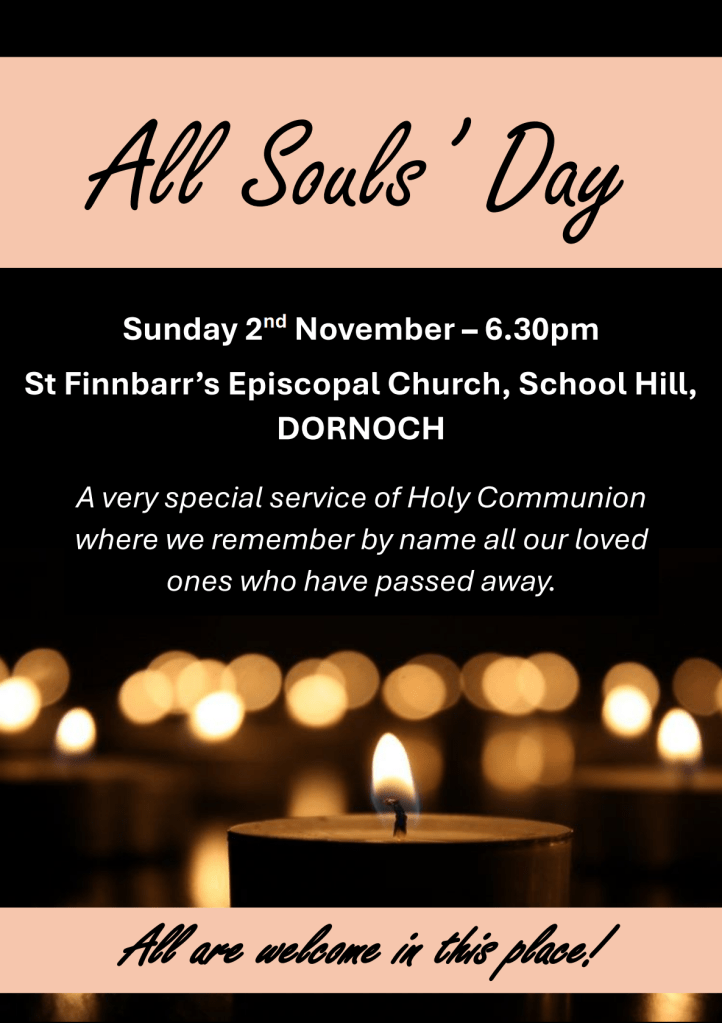
Service for All Souls Day – Sunday 2nd November at 6.30pm, St Finnbarr’s Dornoch

If you cannot make the service but would like someone’s name to be remembered before the altar of God, please do email Canon Simon at ihssimonscott@gmail.com

Sermon for Sunday 26th October 2025

Luke 18.9-14

“The Pharisee and the Tax collector” — that’s the traditional name of the parable we read today.

We’re in Luke 18 — If you’ve noticed, we’re on a long trip through Luke’s gospel, a trip we always take in Year C in the season after Pentecost

And over these these past few Sundays in Luke — well, it’s like being at an Elton John concert. Peter and I went to see Elton John a few years ago, and it was two solid hours of well-known hits. No warm up acts, no obscure songs – All killer, no filler, if you know what I mean? Hit after hit after hit!

Well, Jesus rattles off hit after hit in Luke — the Good Samaritan (Luke 10); the Wedding Feast (Luke 12); the Lost Sheep, the Lost Coin, and the Lost Son (Luke 15); last week, the Persistent Widow, and now today — hit, hit, hit, hit; no warm ups, no covers, no B sides.

I want to look at this latest of Jesus’ greatest hits, the Parable of the Pharisee and the Tax Collector, under three headings — players, point, and power:

  • The players in the parable (who are they? why does it matter?); (2) the point of the parable (what it teaches us); and (3) the power of the parable (how can it change our lives?).

First then, the Players:

Two men went into the temple to pray, one a Pharisee and the other a tax collector. Two men; two very different identities. Identity is at the heart of this parable, as it is very much at the heart of Twenty first century life. It sometimes feels that we are in the middle of a great cultural identity migration. Gender roles are merging. Racial identities are being shed. In the last few years we’ve been made to see how trans and bi and poly-ambi-omni we are.

Everything touches on identity, even our very own selves  that some of us mediate through online social platforms like Facebook, Instagram and Snapchat, images of how we want the world to identify us.

If you asked the players in the parable “Who are you? What defines you?” you’d get two very different answers.

Who was the Pharisee? Even the name of this group is about identity — the Hebrew word it comes from, perushin, literally means “separated ones.”

Pharisees claimed their identity by being separate, set apart, holier than everybody else. So, this Pharisee prays: “God, I thank you that I’m not like other people: thieves, rogues, adulterers, not even like this tax collector.”

Now put the question of identity to the tax collector.

Remember Rome was a long way from Palestine. It would take a

huge bureaucracy to collect taxes there, so Rome sub-contracted the job.

Some Jews became “tax farmers,” private citizens who collected taxes for Rome, and the system was set up so they had to collect more than Rome demanded to make their own profit. Nobody in Jewish society was more despised than tax collectors.

The identities of these two men couldn’t have been more different. Just think about how they prayed.

The Pharisee stands confidently before God, but away from the others in the temple.

He knew he was righteous, and his prayer was completely self-directed:“I thank God that I . . . I don’t steal or commit adultery; the law says fast once a week, I fast two; it says give ten percent of what you earn, I tithe even on what I buy.”

The tax collector prayed differently — He beat his breast, which some of us do at mass sometimes — it’s a sign of penitence. He looked down, a sign of humility. Rather than “God, look how righteous I am,” he said “God, have mercy on me because of how righteous I’m not.”

Two men; two prayers; two different identities. Those are the players.

So what about The Purpose of the Parable: Jesus says “I tell you, this man (the tax collector) went home justified rather than the other (the Pharisee) . . . .” This parable is answering a particular question. That’s its purpose. “Who is qualified to enter God’s kingdom?” And the answer was shocking — because It’s not the religious chap, the one who tithes and fasts.

May I just say something that probably should be clear but maybe isn’t? Fasting — is good. Jesus assumed his followers would fast. Tithing, sharing our blessings with the poor, serving others with our wealth — is good. Giving’s hard — but it’s good.

It’s not the Pharisee’s practice of tithing he has to change; it’s not his commitment to the religious practice of fasting he has to lay aside; it’s thinking that those things make him righteous. They don’t!

The one person who gets into heaven is the one who knows he doesn’t have to pay a price of admission. The purpose of the parable is to drive home one truth: Good works won’t buy a place in Gods Kingdom; His merciful Grace is the only game in town.

So, what about The Power of the Parable:

Almost every biblical commentator will tell you to watch out for a trap.

The story is dangerous because we could just adopt different criteria for righteousness before God.

“Ok, maybe I can’t keep all the commandments like the Pharisee, but . . . what if I look down my nose at all the religious types and flip the situation?” Still trying to justify ourselves, this time by our great humility, we find our mouths praying the words: “God, I thank thee that I am not like the Pharisee!” And that’s a sure sign that actually our hearts haven’t changed at all.

Who is the hero of the story? It’s not the Pharisee, and it’s not even the Tax Collector with the heart of gold — it’s God.

God saves not because we keep the law or even because know we can’t. Our God saves for one reason: He loves us.

And that, my friends, is the power of this parable. Power to change.

Understand that God knows you completely, but he loves you completely. God knows us — he knows how much we want to buy him off, how lots of times pride lies underneath our religion — he knows us to our depths, but he loves us to the skies. And that changes hearts.

As I end my sermon this morning, please just take a moment to close your eyes and listen.

Who are you? What is your identity?

You are not your CV and the jobs and roles you have held in the past.

You are not your online social media account.

You are not the rules you keep or what other people think of you.

You are not your sexuality or the relationships you have.

You are not your brokenness.

You are, quite simply, God’s beloved child.

God already knows all about us — our failures, how sometimes we’re unhappy, how we can feel awkward or out of place or alone. And he loves us. Love like that changes us — in fact, it’s the only thing that ever does. That’s the gospel — a God who won’t be distant. Who knows us to our very depths, but loves us to the skies — and he’ll call us home fully justified, if we will just let him.

Sermon for Sunday 12th October 2025

2 Kg 5.1-3, 7-15             Psalm 111                        2 T 2.8-15                         Luke 17.11-19

Throughout the chapters of the Gospel of Luke previous to today’s reading, the Evangelist again and again and again presents the Good News through telling stories. He illustrates a series of personal encounters between Jesus and others – sometimes with his followers, sometimes his opponents, sometimes strangers. There were crowds of the curious and hopeful and various individuals – a tax collector, a centurion, a grieving mother, a sinful woman, a man inflicted with demons. As Luke relates these stories, he shows Jesus responding with love and grace and using the occasions to teach the values of God, while challenging the contrasting and distorted ways of the world.

Now, having reached Chapter 17 in the liturgical calendar, we find Luke recalling an episode in which Jesus was engaged by 10 lepers begging for mercy. These unfortunates suffered from what we now call Hanson’s disease. This malady, known among humans for thousands of years, went untreated in biblical times and caused permanent damage to skin, nerves, limbs and eyes, compromised the immune system, and hastened death. Though it is now known to be only mildly infectious, the ancients considered it highly contagious and forced lepers to stay away from others, identifying their condition by announcing, “Unclean. Unclean,” when approached.

As a result, they were excluded from the general society and forced to make their own communities, not unlike leper colonies that still exist in some parts of the world. They became dead men walking – at the mercy of others, ostracised, alienated from the richness of family life and the comfort of communal religious practices.

Like others, the lepers in today’s gospel were outcasts who bound themselves to one another out of necessity and because no one else would touch them. All that mattered was their disease, as evidenced by the inclusion among them of a Samaritan who would have been a hated and shunned foreigner in mainline Jewish society.

This band of 10 had nothing to offer others; nothing to offer Jesus when they saw him coming. But they recognized him, perhaps by his reputation as a holy man, and approached within shouting distance the one they knew by name. They cried out: “Jesus, Master, have mercy on us!” Possessing enough inspiration, or maybe just a sense of desperation, they reached out to Jesus with an appeal for healing that went beyond all conventional expectations.

Jesus did not hesitate in his response. He did not back off or require the lepers to confess faith in God. He did not inquire about whether they were worthy. He did not ask anything of them. Jesus saw them and said simply, “Go and show yourselves to the priests.”

According to Jewish law, a cured leper had to appear before the priests, who would conduct a series of elaborate ritual actions in order to declare them cleansed. The lepers, who had hoped in Jesus, now displayed enough faith to obey him. They immediately left his presence to go to the priests as required and to begin the new lives Jesus made possible.

What Jesus did for them, of course, bore remarkable significance. Not only were they cured of a horrendous, disabling disease, but the cleansing also enabled them to overcome what was perhaps the greater affliction. Now they could return to the community, to become a part of the body that had cast them out. Now they could participate in life fully, restored physically and socially, and surely, experiencing the beginnings of emotional healing.

Yet, we might ask, did they gain everything Jesus hoped for? Did they achieve spiritual healing, as well? We will never know about all of them, but we have assurance that one did – the Samaritan who returned to give thanks. If we wonder what led to his distinguishing himself by praising God and falling at Jesus’ feet in gratitude, we might speculate that it was easier for him – as a double outcast – to see clearly the remarkable nature of what had happened. More likely, however, it was due to his greater maturity and deeper strength of character.

Whatever the reason, Jesus was saddened that he was the only one who turned back, and he used the one and the nine to teach his disciples another lesson about the values of God. He was clearly disappointed by the behavior of the nine, and in earshot of his followers, he said to the now-cleansed Samaritan leper, “Your faith has made you well.”

In place of the word “well,” some translations use “made whole” or “saved.” There is ambiguity about the Greek meaning, but its use by Jesus surely implies more than simply being cured from a disease. “Your faith has made you whole,” seems closer to the way Jesus used this episode to provide a new teaching. The Samaritan was not simply cured like the others, but experienced something more important.

His response to being cleansed demonstrated that his view of God was closer to what Jesus came to reveal. He acted not out of selfishness to gain certification of his cure, not rushing to the priests without reflection, but paused to put his cleansing in a wider perspective, seeing God as the centre of the personal miracle he was experiencing. Before anything else, the Samaritan gave thanks for the chance to renew his life. This was the beginning of his transformation, and it provided a fitting model for Jesus to honour. He was not only cured physically, but he also gained spiritual wholeness.

There are a number of “take aways” from today’s gospel – community, inclusivity and wholeness in the life of the world and in Christianity. Think about the Eucharist. The moment we experience among our fellow Christians, in prayer and at the altar rail, is unity in its purest form. Receiving the sacrament of bread and wine, the body and blood of Christ, all else is shut out but the holy context. We are at one with God and one another, in a sublime moment of grace.

In this moment we are made whole. Even if we lose this reality as we go back to our seats, we know it as a deep truth on which to draw on our journeys of faith. In that moment, we know that everyone is like the Samaritan, freed from alienation and separation from others in a realm of God that includes a circle of universal inclusion.

Luke’s story of this encounter between Jesus and the lepers allows him to teach us about the disappointment Jesus felt because the nine failed to give thanks and the joy he experienced in discovering that the Samaritan recognised the deeper truths of God. When Jesus reflects on the difference, he speaks no less to us than the disciples of old. Today we are reminded of the sadness of our Lord when we, like the nine, fail to follow him, but we also are led to emulate the Samaritan. We can take joy in committing ourselves anew to respond in love and gratitude to the grace, forgiveness and wholeness of God that we all can have simply by accepting this freely offered gift.

October 7th – The Second Anniversary

Today marks the second anniversary of the events that triggered the current war in Gaza. We encourage all our members to make time today to pray for peace and justice.

God of peace and justice, 
we pray for the people of the Holy Land 
Israeli and Palestinian,  
Jew, Christian and Muslim. 
We pray for an end to acts of violence and terror. 
We lift to you all who are fearful and hurting.  
We ask for wisdom and compassion for those in leadership.  
Above all, we ask that Jesus the Prince of Peace,  
would bring lasting reconciliation and justice for all. 
Amen. 

Below you can find a link to Justice and Peace Scotland which has more ideas about what you might be urged to do.

https://www.justiceandpeacescotland.org.uk/Campaigns/Peace-making/Light-a-Prayer-for-Peace