Made for Goodness

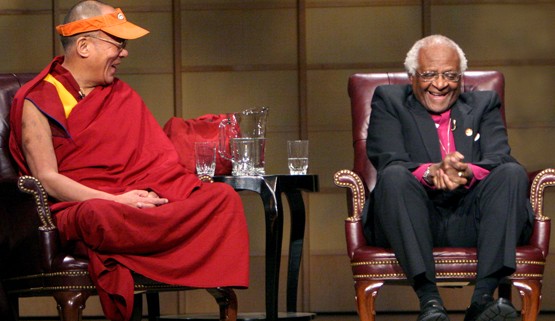
The 14th Dalai Lama with Desmond Tutu in 2004 – photo by Carey Linde

The start of a New Year and whilst that’s often a time for celebration, there’s also a tinge of sadness as we say goodbye to 2021, with all its highs and lows and all the things that have happened in each of our lives, in the lives of those around us and in the life of our Church and our nation.

Today in St. George’s Cathedral in Cape Town, the funeral is being held of Archbishop Desmond Mpilo Tutu, who died last Sunday. For those gathered and for all the people of South Africa, there’ll be sadness at the death of the man who for many years was a very passionate and effective leader in the peaceful struggle to end apartheid, but there’ll also be a joyful celebration of his life and what he did for his nation, his family and for the Anglican Church.

Desmond Tutu will always be remembered as the clergyman who won the Nobel Peace Prize, who helped bring down apartheid and who served as a beacon of light in a divided nation, when everything seemed rather bleak. Yet for some reason he always seemed to be joyful and his cackling laugh was infectious. He was also an insightful observer of the human condition and almost always started his sermons with an amusing story, of which he seemed to have an endless supply.

When speaking to audiences around the world, the man who they called ‘Tata’ (father) who led the Truth and Reconciliation Commission and spoke out against corruption in the post-apartheid government just as he had against the apartheid one, was frequently asked the same questions:

Why are you so joyful?” “How do you keep your faith in people when you see so much injustice, oppression and cruelty?” “What makes you so certain that the world is going to get better?”.

In the preface of his book “Made for Goodness”, he asks:

What these questioners want to know is, What do I see that they’re missing? How do I see the world and my role in it? How do I see God? What is the faith that drives me? What are the spiritual practices that uphold me?  What do I see in the heart of humanity and the sweep of history that confirms my conviction that goodness will triumph?

“Made for Goodness” Desmond and Mpho Tutu

Questions that might be useful for each one of us to reflect on as we start 2022. Desmond Tutu’s answer is to be found in the stories of the goodness of ordinary people that he and his daughter Mpho have encountered in their lives and ministries and which they share in the book.

In the last couple of years, most of us have faced dark days as the Covid pandemic has waxed and waned repeatedly. But what’s really struck me is the stories of the goodness of ordinary people that I’ve heard from friends, neighbours, relatives and in the news. People who’ve given their time as volunteers in food banks and vaccination centres; people who’ve made sure that their elderly or vulnerable neighbours are kept supplied with the essentials that they need; all those doctors, nurses, pharmacists, workers in care homes and those visiting people at home, who’ve gone much further than just an extra mile and also those who’ve given generously whenever there was need.

Along the way new friendships have been formed, for example between people who’ve lived near each other for years but never really done more than say good morning. Yes there’ve been acts of selfishness and some people who’ve sought to exploit others, but to derive our view of the human condition from these would be to miss what Desmond Tutu calls the inherent goodness of people. He writes:

As we allow ourselves to accept God’s acceptance, we begin to accept our own goodness and beauty as God does.  With each glimpse of our own beauty, we can begin to see the goodness and beauty in others

“Made for Goodness” Desmond and Mpho Tutu

A happy New Year and may you face 2022 with acceptance, joy and laughter and perhaps see more of the inherent goodness in everyone, as both Jesus who called His Father Abba and Archbishop Tutu who South Africans often called ‘Tata’ did.

Blessings
James

A Thought for Advent

This coming Sunday is the First Sunday of Advent. There is little doubt what most of us will be doing in the next four weeks – the Christmas rush to get everything organised – cards written, gifts bought and sent, the preparation of food, plans about whose turn it is to go visiting and anxieties about who’ll be offended if we don’t pay them enough attention etc etc…. The rush is on and it’s not surprising that there’s often a hint of panic in people’s conversations – “I’ll never be ready!”

In four weeks, it will all be over, in five a new year will have brought us another set of resolutions, in six the decorations will have come down, the furniture of life will be back in place and we’ll be back to – well, back to what?

Will life be just the same, or will we be changed?

If we take Advent seriously, there is a chance we will be changed because we will have had an opportunity to reflect again on what it means to say that God came into the world in the humility of the birth at Bethlehem and that he still comes into the world in all its mess and pain and joy, longing for us to recognise Him.

Advent is a godsend, a gift which stops us in our tracks and makes us realise that we hold dual citizenship (of this world and His kingdom) in awkward tension. We are all part of the scene – Christians sometimes appear to be rather superior about what we call ‘commercialisation’ and say that the real Christmas isn’t about that. But actually, if you think about it, the real Christmas is about precisely that: it’s about God coming into the real world. Not to a sanitised stable as we portray it in carols and on Christmas cards, but to a world that needed, and still needs, mucking out! Advent reminds us that the kingdom has other themes to add to the celebration, themes that are there in our scripture readings for the season: Repent, be ready, keep awake, He comes!

Advent reminds us that not only do we live in two worlds – the one that appears to be going mad all around us and the one that lives by the kingdom of God’s values, but that we operate in two different timescales, in chronological time and beyond it. And the point of intersection – where these two worlds meet is now. Scripture readings and prayers which are often used during Advent, remind us that now is the time when we have to cast away the works of darkness and put on the armour of light. Now is when we meet God, because we have no other time.

At whatever level we operate, it’s a time for preparation – a time to put things right – to repair broken relationships or reach out to those with whom you have grown distant – and that might include working on your relationship with God.

Whatever else we have to do, there are only so many praying days to Christmas. It is prayer that gives us the opportunity to focus our recognition of God in every part of our lives. Prayer is not just what we do in what we call our prayer time. Prayer is how we give our relationship with God a chance to grow and develop and, just like any other relationship, it needs time. We don’t stop being related when we are not with the person concerned. We don’t stop being a partner, a wife, husband, child, parent or friend when that person is out of sight or when we are concentrating on something else. But we do become less of a related person if we never give them time.

So, Advent says, make time, create space so that our understanding of God’s love for us (and our love for God in response) can grow. The world is saying “Get on with it – don’t wait for Christmas to hold the celebrations”. Advent says, “Wait, be still, alert and expectant.”

The shopping days will come to an end – there will come a moment when we really can’t do any more. The point of praying or making a space is that we get into the habit of remembering God who comes to us every day and longs for us to respond with our love and service. Why not re-start your relationship with God by joining us at Dornoch Cathedral on Advent Sunday (28th November) at 6pm for a special Advent Carol Service? – Repent, be ready, keep awake, He comes!

Fr Simon

We will remember them

May the memory of two World Wars
strengthen our efforts for peace,

May the memory of those who died
inspire our service to the living,

May the memory of a past destruction
move us to build for the future,

May the first two atomic bombs
be the last two also,

May the first two World Wars
be the last two world wars.

O God of peace,
O Father of souls,
O builder of the Kingdom of Love.
Amen.

George Appleton – 1902-1993

Those who have gone before

Hallowe’en marks the start of the Season of Remembrance. The word Hallowe’en is a contraction of ‘the eve of all Hallows’, and All Hallows is the Feast of All Saints, or All Saints Day’. This year we are celebrating All Saints Sunday on Hallowe’en, a day when we think particularly of those who even in this life, kindled a light for us in ours. Although it might be more accurate to say that what they actually did was to reflect for us, the light of Christ. 

All Saints Day (November 1st) is followed on November 2nd by All Souls Day, the day that we remember all the ‘souls’ of those that we have known and loved who have gone before us into the light of Heaven. Our celebration of All Saints and All Souls’ stems from a belief that there is a powerful spiritual bond between those in heaven (the ‘Church triumphant’), and the living (the ‘Church militant’).

In Arthur C Clarke’s classic book, “2001: A Space Odyssey” he makes the assertion: “Behind every man now alive stand 30 ghosts, for that is the ratio by which the dead outnumber the living.” Currently there are about 7.7 billion people alive and it is estimated that there have been 117 billion people born since 190,000 BCE, so we are among 7% of the people that have ever lived 14 ghosts each. However Arthur C Clarke was making his statement in 1968 when there were about 3.5 billion people living on earth so that would be one living person for each 29.

It’s therefore right and fitting that we should have a season of the year for remembrance when we recognise the connection between the living and the dead. I always feel that this is a time when perhaps the veil between time and eternity is thinner and get a sense of the greater and wider communion of saints to which we belong and who I feel a connection with every time I come into a church building.

Of course we also remember, on the Sunday closest to 11th November, those who have lost their lives in wars and conflicts around the world. In gatherings at war memorials and in church services we unite across faiths, cultures and backgrounds to remember their service and sacrifice.

It seems appropriate that the Church celebrates these things as the days shorten at the turning of the year . This is of course also the time when the pre-Christian Celtic religions were accustomed to think of and make offerings for the dead.

As Christians, we recognise that the greatest and only offering, to redeem both the living and the dead, has been made by Jesus Christ our Lord and Saviour.

Blessings
James

Wrath of God

For we know the one who said, ‘Vengeance is mine, I will repay.’ And again, ‘The Lord will judge his people.’ It is a fearful thing to fall into the hands of the living God.

Hebrews 10:30-31

The concept of ‘the wrath of God’, is one which we find many times especially in the Old Testament, but also as the quote above suggests, in the New Testament. My reflections on matters relating to climate change and climate injustice during the Season of Creation have led me to think that we need to revisit the concept and reframe it for the 21st century and the ‘scientific’ age.

The the whole of creation works according to what we sometimes refer to as the Laws of Nature and the Laws of Physics, etc. These are how things are and how the world works and we cannot change them. We can of course work within them to achieve particular goals. The trouble is that if we change something, then because these laws continue to operate, something else unexpected might change as a result.

There is a complex interconnectedness between things, which we cannot hope to fully understand, even if we build very sophisticated computer models of what is going on and continue to increase our knowledge across a wide range of disciplines. For example, over the years, the computer models used for weather forecasting have grown ever larger and more complex,as computing power has grown. However the accuracy of the predictions still often isn’t particularly good.

You may recall King Canute (or Cnut), who was king of Denmark, Norway and England in the 10th and 11th centuries. The well known story of King Canute trying to hold back the tide to show how powerful he was is an apocryphal anecdote, recorded in the 12th century by Henry of Huntingdon. In the story, Canute actually demonstrates to his courtiers that he has no control over the incoming tide, he actually explains that secular power is vain compared to the supreme power of God.

The episode is frequently alluded to in contexts where the futility of trying to “hold back the tide” of an inexorable event is pointed out, but often misrepresents Canute as believing he has supernatural powers, when Huntingdon’s story in fact indicates the opposite, illustrating the piety and humility of King Canute.

There is no doubt that humanity has invented and discovered many things and that we all benefit for a myriad of scientific and technological advances, however, we have to recognise that what we actually know is a mere fraction of the way that creation is and we all need to have Canute’s humility in all that we do to avoid being caught out by unexpected consequences.

If we act as though we are masters of the universe then we should not be surprised if the laws of physics or nature produce those unexpected consequences. We might see this as unfortunate or being unlucky and that we just need to be a bit cleverer to fix it.

Alternatively in humility, we could accept that because we fail to fully understand what we are doing, then when we are caught out by physics and nature ‘reacting’ and ‘re-balancing’ things, this might reasonably be described as the wrath of God.

We are not God, we cannot control everything and we are not masters of everything around us – that role belongs to the creator of the universe who set the laws of physics and nature in motion and gave us the wonderful world that we live in and which in some form we will hand on to our children and grandchildren.

Blessings
James

Diocesan Prayer Cycle for October


Until 4th October
The Season of Creation
For our World, all of God’s Creation and for Climate Justice

1 October 2021
On the International Day of Older Persons, for the elderly who struggle with their health or loneliness.

2 October 2021
For Mark, our Bishop.

3 October 2021
Thanksgiving for Harvest and Pentecost 19
For the congregation of St. Margaret of Scotland, Aberlour

4 October 2021
For our link Diocese of Quebec.

5 October 2021
For couples who have lost a child through miscarriage or stillbirth.

6 October 2021
In Challenge Poverty Week, for those in Scotland who struggle to make ends meet.

7 October 2021
For the 5 million people in Tigray, Ethiopia in need of humanitarian assistance.

8 October 2021
For Diocesan staff.

9 October 2021
On World Hospice and Palliative Care Day, for medics offering end of life care.

10 October 2021
Pentecost 20
For the congregations of Holy Trinity, Elgin; Burghead Mission; St. Margaret, Lossiemouth: Tembu Rongong, Jenny Sclater.

11 October 2021
For preparations for the UN climate conference to take place in Glasgow in November.

12 October 2021
For those who live and work in local prisons.

13 October 2021
For the 702,200 children who attend 2476 schools in Scotland.

14 October 2021
For our local politicians and councillors.

15 October 2021
For retired clergy assisting in the Diocese.

16 October 2021
On World Food Day, for those who today will go hungry.

17 October 2021
Pentecost 21
For the congregation of St. John, Forres: Hamilton Inbadas, Anthony Matchwick.

18 October 2021
Luke, Evangelist
For surgeons and anaesthetists trying to catch up with surgery waiting lists.

19 October 2021
For bold steps to reduce emissions in response to the climate emergency.

20 October 2021
For economists and bankers.

21 October 2021
For children who have additional support needs.

22 October 2021
For those who suffer domestic abuse.

23 October 2021
James of Jerusalem, Martyr
For those who are persecuted for their faith.

24 October 2021
Pentecost 22
For the congregations of St. John, Rothiemurchus; St Columba, Grantown on Spey: Richard Gillings, Jenny Jones, Alison Hart, Tony Sparham. Lay Readers: Deborah Munday, Judith Page and Christine Burry.

25 October 2021
For the people and leaders of Afghanistan.

26 October 2021
For the 37,000 young carers in Scotland looking after dependent family members.

27 October 2021
For those responsible for growing our food.

28 October 2021
Simon and Jude, Apostles
For those pioneering new evangelism initiatives.

29 October 2021
For the Queen and members of the Royal Family.

30 October 2021
For those who are overworked and exhausted.

31 October 2021
Pentecost 23
For the congregation of St. Ninian, Glenurquhart.

Canticle of the Creatures

Most High, All-powerful, All-Good, Lord! 
All praise is Yours, 
all glory, all honour 
And all blessing. 

To You alone, Most High, do they belong. 
No mortal lips are worthy 
To pronounce your name. 

All praise be Yours, my Lord, through all that You have made, 
And first my lord Brother Sun, 
Who brings the day; and light you give to us through him. 
How beautiful is he, how radiant in all his splendour! 
Of You, Most High, he bears the likeness. 

All praise be Yours, my Lord, through Sister Moon and Stars; 
In the heavens You have made them, bright 
And precious and fair. 

All praise be Yours, my Lord, through Brothers Wind and Air, 
And fair and stormy, all the weather’s moods, 
By which You cherish all that You have made. 

All praise be Yours, my Lord, through Sister Water, 
So useful, lowly, 
precious, and pure. 

All praise be Yours, my Lord, through Brother Fire, 
Through whom You brighten up the night. 
How beautiful he is, how gay! 
Full of power and strength. 

All praise be Yours, my Lord, through Sister Earth, our mother, 
Who feeds us in her sovereignty and produces 
Various fruits and coloured flowers and herbs. 

All praise be Yours, my Lord, 
through those who grant pardon 
For love of You; 
through those who endure 
Sickness and trial.

Happy those who endure in peace, 
By You, Most High, 
they will be crowned. 

All praise be Yours, my Lord, 
through Sister Death-of-the-Body, 
From whose embrace 
no mortal can escape. 
Woe to those who die 
in mortal sin, 
Happy those She finds 
doing Your holy will! 
The second death can do 
no harm to them. 

Praise and bless my Lord, 
and give Him thanks, 
And serve Him with great humility. 

Amen.

Attributed to Saint Francis of Assisi

Bread for Lammas

Greetings to you dear sisters and brothers in Christ. The month of August is upon us and in some quarters the very first day of this month is celebrated as Lammas Day (or Loaf Mass Day) – when a loaf baked with flour from newly harvested corn is brought into church and blessed. To be honest this tradition is not so commonplace as it used to be in the past. Lammas Day was one of the oldest points of contact between the agricultural world and the Church and the introduction of the Harvest Festival in the Victorian era has kind of replaced many of such agricultural celebrations.

A couple of weeks ago we were on holiday visiting old friends and neighbours in Yorkshire. One of the people we met up with was Anita (Our next door neighbour). Now Anita is a world class specialist in Food Education and has been instrumental in a number of national food education initiatives. One of her greatest challenges though was to teach me to make bread. Those of you who have any idea of my skills in the kitchen will realise just what a challenge this was! Anita persevered and I have to say I did find the hands on process of bread making very satisfying.

One of the fascinating things about it is the yeast: that unprepossessing lump of putty-like substance, or even more unlikely looking granules of dried yeast. Give yeast warmth and sugar and liquid, and miraculously it grows before your very eyes. And then it makes the dough rise and double its size. It seems irrepressible. Knock the dough down and leave it to its own devices, and it will double its size again. 

In the Middle Ages, one of the names for yeast was ‘goddisgoode’ – written as one word as though it were God’s email address. No one understood its chemistry and it was seen as gift from God. A pure gift. God is Good – that’s what lies at the heart of bread.

Jesus said that he is the Bread of Life, embodied for us now in the Eucharist. He offers himself as a gift that is fundamental to meeting our inner needs as bread is to meeting our physical needs. Through feeding on him, God gives us himself, and that is what we need.

When Jesus gave himself as bread, he said it was for the life of the world. At Lammastide let’s remember that when we come to the altar we share God’s life so that we can be the truth that God is good. Our task is to share the news of God’s goodness and invite others to share the Bread of Life too!

Blessings
Fr Simon

Climate and Justice

The climate crisis, which has been creeping up on us for years, is a reflection and also a cause, of deep injustice in our world. This crisis arises from the abuse of God’s creation, and our broken relationship with our neighbours worldwide and especially the poor and those in less developed parts of the world who are already suffering most from its consequences. 

Climate change and other forms of environmental degradation are caused by over-consumption, primarily in the developed world, and so any solution has to be underpinned by reduced consumption. Consumption is something for which we are all responsible. Everything we buy has a carbon footprint, everything we use has a carbon footprint and everything we consume has a carbon footprint. The earth doesn’t belong to any of us, each of us lives on it for a while and during that time, we’ve a duty to be good stewards of what we inherited.

Since the root of the problem is that the population of the developed world vastly over-consume the resources of the world, that means us. The only real solution is a reduction in consumption for each of us individually and for us collectively. How we do that depends very much on our individual circumstances and it’s for that reason that prayer and reflection must lie at the heart of our approach.

This problem isn’t simply about Carbon Budgets or Environmental Degradation, this problem is about Justice. Those most affected by these matters are the poor, the disadvantaged, those who live in the Third World and less developed nations. We should therefore refer to this matter as Climate Justice, which helps us to think of it not only in scientific/technological terms. We need to reflect on how our decisions affect others in our society and our brothers and sisters around the world and also how they will affect our children and grandchildren.

During the UN General Assembly’s High-level Meeting on the Protection of the Global Climate for Present and Future Generations back in March 2019, Mary Robinson, the former President of Ireland spoke about Climate Justice.

Climate justice insists on a shift from a discourse on greenhouse gases and melting ice caps into a civil rights movement with the people and communities most vulnerable to climate impacts at its heart,” … “Now, thanks to the recent marches, strikes and protests by hundreds of thousands of schoolchildren, we have begun to understand the intergenerational injustice of climate change,”

Mary Robinson 2019

The Young Christian Climate Network are staging a relay from the G7 meeting in St Ives to Glasgow to coincide with the start of COP26 at the end of October, when heads of state, climate experts and negotiators meet to discuss action to address the climate emergency. It’s clear that this group of young Christians care deeply about Climate Justice and the care of creation and they want to see systematic change on a global and a local scale. After all it’s the world that they and our children and grandchildren will have to live in for rather longer than most of us. The least we can do is to pray for them on their pilgrimage – may God bless them.

Blessings
James

Grasping and Comprehending

The Passion, Resurrection, Ascension, Pentecost – we’ve travelled a long way in our journey with Christ since Palm Sunday on 28th March. Back then we were in lockdown, now the restrictions are easing and joy of joys, we were able to have our first wedding in church last week after a gap of nearly two years.

In many ways, living under restrictions is ‘easy’ You have a long list of things that you can’t do and also a list of things you must do and, as we’ve all done over the last 15 months, you learn to live your life doing what you must and trying not to do what’s not permitted. So at one level, it’s ‘easy’ but at a deeper level it’s very hard indeed. Not being able to see loved ones, not being able to do things that have been part of our lives for years and apparently small, but very significant things like being able to sit where you want in church or shake someone’s hand when you meet them.

Under the Old Covenant of Moses, the people of Israel lived under ‘The Law’. So in Exodus, we have 10 Commandments but there are 613 statements and principles of law, ethics, and spiritual practice (or Mitzvot) contained in the Torah (mostly Deuteronomy, Numbers and Leviticus) (248 of these are positive – things that one should do – and 365 negative – things that one shouldn’t do).

The purpose of these ‘rules’ is however to try to help people to find God through encounters with the holy. In a sense the summary of the Law, that we use at some times of year in our liturgy, is a pointer to the underlying principles, which is why Jesus came not to abolish the rules rather it refocus people on those principles.

Our Lord Jesus Christ said:

The first commandment is this:
“Hear, O Israel, the Lord our God is the only Lord.
You shall love the Lord your God with all your heart,
with all your soul,with all your mind and with all your strength.”

The second is this:

“Love your neighbour as yourself.”

There is no other commandment greater than these.

SEC 1982 Liturgy

Living by rules, as opposed to something closer to the essence of things, has a tendency to separate the observer of rule from the real purpose of the rule, which in itself althoughrecognisable, is much more difficult to define. The practices that Jesus was reacting against, were a set of rules which, although they may have at some time had a role in helping people to approach the holy, had long since become somewhat divorced from that purpose and an end in themselves.

As Covid restrictions are relaxed, we’ll have to make more decisions for ourselves as to what to do and what not to do, without as rigid a framework as we’ve had. That means that we’ll have to understand the purpose or ‘spirit’ of the rules we’ve been used to and the likely effect of deviating from them. To use religious language, we’ll have to ‘discern’ what we should do in order to continue to keep ourselves and others safe, rather than be told what to do. There’ll still be rules, just fewer of them and we’ll have to continue to live our lives within them. However, just because a politician says that you’re allowed to hug other people, that doesn’t mean that you must or even that most of the time you should. The careful and judicious use of new and very welcome freedoms is what discernment is about.

Perhaps the simplest definition discernment is that it’s nothing more than the ability to decide between truth and error, right and wrong. Discernment is the quality of being able to grasp and comprehend what is obscure, it’s the ability to judge people and situations well. In the religious context however it’s no more or less than knowing or attempting to know the mind of God.

Under the New Covenant of Jesus, it’s not the rules that are important, it’s this seeking to know the mind of God. Religious practice isn’t in itself a route to the holy, but may help to get us to a place where an encounter with the holy may happen. Not the only route and absolutely no guarantees. We use practices that have traditionally been helpful, rather than trying to conjure up encounters with the holy all on our own.

Our joint task in ministry is to walk with others as they try to encounter something that neither they or we can ever fully understand – the Mystery of God, that unseen and unknowable force at the very centre of our being. That’s always going to be a pretty tricky task, just as is trying to protect ourselves and those that we care for, from an unseen and ultimately unknowable danger!

Blessings
James