Lights in the World

This week there have been lots of candles:

Firstly there have been single candles, signifying Christ – Light of the World, reminding us of who’s we are and who we serve.

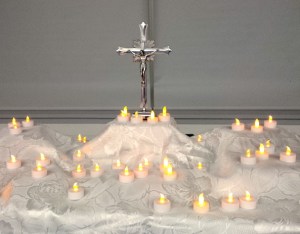
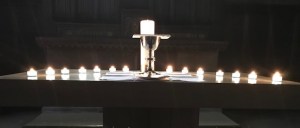
At the Hub service we meditated on Light, surrounded by many candles and were each individually blessed with a candle to take as a symbol of our calling to be a light in the world and to share Christ’s light.


At Candlemas services today in Lairg, Dornoch, Tain and Brora we reflected on the same theme, blessed the candles that we will use this year and were each blessed as we held our own individual candle and then took it home a Light to dispel darkness and fear from our lives, a light to enlighten our minds, a light to brighten dull days and show each of us the path we must travel.

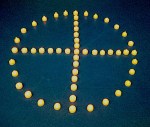
(NB – if these candles arranged on the floor at the Hub resemble the flag of any group of nations, it’s entirely unintended)


Be Still and Know that I am God

Whilst reflecting on how we might structure our Lent Study on Prayer, I came across this quote by one of my favourite spiritual writers Henri Nouwen:

Deep silence leads us to realize that prayer is, above all, acceptance. When we pray, we are standing with our hands open to the world. We know that God will become known to us in the nature around us, in people we meet, and in situations we run into. We trust that the world holds God’s secret within and we expect that secret to be shown to us. Prayer creates that openness in which God is given to us. Indeed, God wants to be admitted into the human heart, received with open hands, and loved with the same love with which we have been created.

I remember that school prayers were always things with words and not much silence. Also we had to put our hands together and close our eyes tight shut, and woe betide anyone who tried to peek, because strangely teachers seemed to be able to pray with their eyes wide open. Looking round our congregations on a Sunday, I get the impression that most people must have been taught about prayer in much the same way and, of course, old habits die hard. So it comes as rather refreshing to read an article by another of my favourite spiritual writers Eugene Peterson who in writing about a third favourite writer says:

Annie Dillard prays with her eyes open. She says, Spread out your hands, lift up your head, open your eyes, and we’ll pray… She gets us into the theater that Calvin told us about, and we find ourselves in the solid biblical companionship of psalmists and prophets who watched the ‘hills skip like lambs’ and heard the ‘trees clap their hands,’ alert to God everywhere.

When we celebrate the Eucharist together, our celebration is part of entering into the mystery of God. Rudolf Otto, a German theologian, wrote: We experience God as Mysterium tremendum et fascinans. Basically, the unfathomable Mystery before whom we’re awestruck and stand trembling, yet find ourselves inexorably drawn into a relationship that’s also gracious and loving; attracting and fascinating us in ways we can’t fully explain.

It’s quite beyond us to have a loving relationship with the mysterious invisible God, through our own efforts. But because God wants to relate to us individually in love He’s given us the perfect helper in His Son Jesus Christ. Through Him God invites us into the love that we see demonstrated in the relationship between Father, Son and Holy Spirit in the Holy Trinity. The Son shows us the way to the Father through the power of the Spirit. God however remains a mystery.

Prayer is the mechanism through which we try to enter into that mystery. Prayer works through the power of the Spirit, rather than anything that we could possible achieve on our own. In prayer, the Spirit calls and we respond rather than prayer being something that we initiate. As St Paul says in his letter to the Romans:

The Spirit helps us in our weakness; for we do not know how to pray as we ought, but that very Spirit intercedes with sighs too deep for words. And God, who searches the heart, knows what is the mind of the Spirit, because the Spirit intercedes for the saints according to the will of God.” Romans 8:26-27

Come and explore these things in our Lent Study Groups on Prayer.

Blessings
James

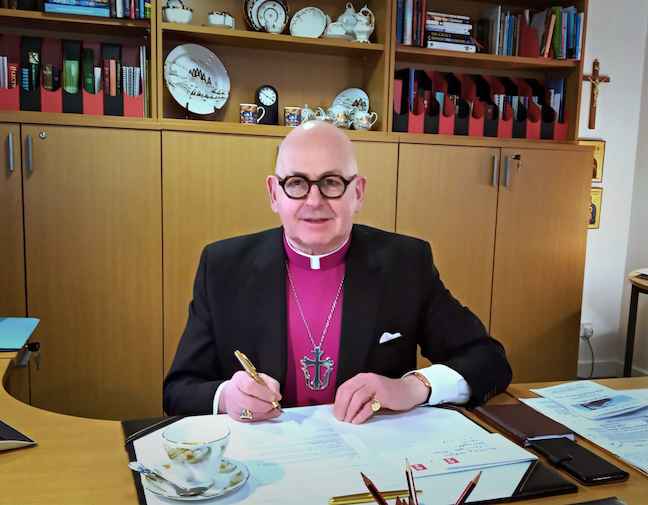
New Bishop for Glasgow and Galloway

Earlier this week, the Right Reverend Kevin Pearson was elected as the new Bishop of Glasgow and Galloway. Bishop Kevin is currently the Bishop of Argyll and The Isles and his election to Glasgow and Galloway represents a historic “translation” of a Bishop from one See to another. The See of Glasgow and Galloway became vacant in 2018 following the retirement of the Rt Rev Dr Gregor Duncan who had served the diocese as Bishop for eight years. Bishop Kevin will take up his new post at a service of installation later in the year, on a date to be announced in due course.

Bishop Kevin has served as Bishop of Argyll and The Isles since February 2011 and before that was Rector of St Michael & All Saints Church in Edinburgh, Canon of St Mary’s Cathedral, Edinburgh, Dean of the Diocese of Edinburgh and the Provincial Director of Ordinands (responsible for the discernment and selection process for candidates for ministry). He is also currently the Convener of the Council of the Scottish Episcopal Institute (responsible for the training of those entering authorised ministry) and serves on the provincial Standing Committee of the Scottish Episcopal Church.

Bishop Kevin was elected to Glasgow and Galloway by the Episcopal Synod, a body comprising the Diocesan Bishops of the Scottish Episcopal Church. In accordance with the Church’s canonical process, the right of election had passed to the Episcopal Synod, following previous processes of vocational discernment within the Diocese of Glasgow and Galloway.

Following the election at St Mary’s Cathedral, Glasgow, Chair of the Episcopal Synod, the Most Rev Mark Strange, Bishop of Moray, Ross and Caithness and Primus of the Scottish Episcopal Church said:-

I warmly welcome the unanimous election by the Episcopal Synod of Bishop Kevin as Bishop-elect of the Diocese of Glasgow and Galloway. The election follows a period of vacancy and since the right of election passed to the Episcopal Synod during the summer of 2019, the Bishops have continued to listen carefully to the views of the Diocese and to engage in a process of ongoing prayer and discernment throughout the autumn.”

“Bishop Kevin will bring his wealth of experience as a Bishop to his new role in Glasgow and Galloway as well as his deep love, knowledge and understanding of the Episcopal Church. As he prepares for this new ministry, we hold him and his wife Elspeth in our prayers.”

“The Bishops are aware that, in electing Bishop Kevin, this will in due course create a new episcopal vacancy in Argyll and The Isles and we will look forward to supporting that Diocese as it seeks a new Bishop.

Bishop Kevin said:-

I am delighted, excited and humbled to be elected as the new Bishop of Glasgow and Galloway. I am looking forward enormously to entering this new phase of ministry and serving the people of Glasgow and Galloway. My wife Elspeth and I already know many in the Diocese but are also looking forward to living there and getting to know the people and the area better. We shall be very sad to be leaving the people of Argyll and The Isles which we have grown to love deeply over nine years of ministry there.”

Bishop Kevin is married to Dr Elspeth Atkinson who is Chief Operating Officer for the Roman Catholic Archdiocese of St Andrews & Edinburgh. Prior to that Elspeth was Director of MacMillan Cancer Support in Scotland, Northern Ireland and Wales and for most of her career held senior roles in Economic Development in Scotland.

Believing that we Believe

Advent, Christmas, Lent, Holy Week, Easter, each year the same, but somehow different. Yes we do many of the same things, have similar services and study groups, etc. but somehow it doesn’t ever feel the same as any previous year. That’s because it isn’t. We aren’t the same people, our circumstances aren’t the same and we may no longer be surrounded by exactly the same people: family, neighbours and friends.

The Italian title of a book by the philosopher Gianni Vattimo was ‘Credere di Credere’ – ‘believing that one believes’. This was the answer that he gave to a friend who asked him if he still believed in God. His answer sounds rather paradoxical (in Italian as it does in English) but then of course he’s a philosopher. However, we do use the word believe to mean: having faith, conviction or certainty in something, but also to mean: to be of the opinion that, which implies a degree of uncertainty. In his title Vattimo is implying this second meaning to the first ‘Credere’ and the first meaning to the second ‘Credere’. We might therefore render his title ‘I like to think that I believe’, a statement with which many people would feel comfortable.

This brings me back to the major seasons of the Church Year and particularly to the current Christmas Season now coming to a close. In any season there are the physical manifestations: services, readings and carols, decorations, mince pies and all the particular food and drink, but none of these is the essence of the season. There’s a slogan, much loved in some parts of the Christian Church – “Jesus is the Reason for the Season”. Well I’ve been thinking about it and I don’t agree with it. I think that the Reason for the Season is something else – SIN and EVIL. It was Dietrich Bonhoeffer that put me on to it:

We have become so accustomed to the idea of divine love and of God’s coming at Christmas that we no longer feel the shiver of fear that God’s coming should arouse in us. We are indifferent to the message, taking only the pleasant and agreeable out of it and forgetting the serious aspect, that the God of the world draws near to the people of our little earth and lays claim to us. The coming of God is truly not only glad tidings, but first of all frightening news for everyone who has a conscience.

Why did God send His only begotten Son into our world? Not because he wanted us to build a festival around shepherds, angels and magi, but because of the sin and evil that abounded. And when that baby boy was born, violence and hatred didn’t stop. Tragic events didn’t stop. Man’s inhumanity to man didn’t stop. God sent his Son to us in the world as it was (and still is). To do otherwise would have rendered the incarnation meaningless and changed the whole working of creation and salvation. He had to hold up a mirror to the world so that humanity could see what was really going on, and in the story of the slaughter of the Holy Innocents we see the dark side of our world being reflected right back at us.

We live in a broken world as flawed human beings, that’s the reality, and God sent His only begotten Son into that world as it is, to show us that in spite of everything it can be different. He came to give us hope and to make it possible for us to believe that we believe in a loving and just God who sticks with us no matter what is going on in our lives and the lives of those close to us.

What we hear as we listen to the seasonal readings and carols and how we feel about the Christmas preparation and festivities, is dependent on what else is going on in our lives and the lives of those we love. As a result each Christmas feels different because what it’s really all about is experiencing the Incarnation of God in our lives, and that changes from day to day and from year to year. How could it be otherwise with a relational God? We don’t have to rely on other people to tells us how we should feel. As the writer of the Letter to the Hebrews wrote:

Long ago God spoke to our ancestors in many and various ways by the prophets, but in these last days he has spoken to us by a Son, whom he appointed heir of all things, through whom he also created the worlds.” Hebrews 1:1-2

Now that’s something I can believe that I believe. Happy New Year.

Blessings
James
Sharing of Gifts

It is wonderful that the period of waiting for repairs to be completed and worship to be reestablished is over and that St Columba’s in Brora was able to celebrate Advent and the Feast of the Incarnation again this year.  There have been Sunday Services throughout Advent, a Carol Service and a Joyous Celebration on Christmas Day.

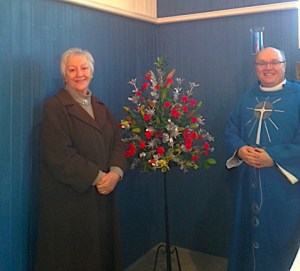
A huge thanks to all those involved: Simon and Don for ministry, Janet for flowers, Chris for musical accompaniment and all those who have worshipped with us.

Janet, Simon and Christmas Flowers

Carols at the Crask

Thirty five people crammed into the bar at the Crask for the annual Crask Carol Service on Saturday.  They enjoyed a wonderful selection of Carols and Readings and afterwards lovely refreshments.  Thanks to Kai and Mike for the service and to Douglas, Denise, John and Michael for the refreshments and to the readers and everyone who came and sang so well.

This slideshow requires JavaScript.

No midweek services over New Year

Folks,

There are no midweek services on Wednesday 1st January at 10:30am in St Finnbarr’s or Thursday 2nd January at 6:00pm in St Andrew’s.  There is also no Crask service on Saturday 4th January at 5:00pm.  Normal service will be resumed thereafter.

Blessings
James