I will enter His gates with thanksgiving in my heart!

Our thanks go to the workers at Jedan Joinery for completing significant restoration work to the entrance porch at St Finnbarr’s Episcopal Church in Dornoch. The porch looks great and thanks too to all those involved in the process to find contractors and to the Wickham family for a generous financial contribution. Much of the wooden structure has been replaced, as have the foundations to the porch. You’ll see in the pictures below that we have also been gifted two planters which now stand either side of the porch. These were made for us by Dornoch Men’s Shed. A very smart looking porch, which will hopefully stand for years to come! Thanks everyone!

Sermon for Sunday 3rd August 2025

* Ecclesiastes 1:2, 12-14 * 2:18-23 and Psalm 49:1-12 * Colossians 3:1-11 * Luke 12:13-21

Have you ever bought new things to organise and hold your old things in order to make room for more things?

Do you sometimes find and bring home “good boxes” knowing that someday you’ll probably have some stuff to put in those boxes?

Lots of shops that sell storage containers and storage businesses thrive on that kind of thinking.

“Take care! Be on your guard against all kinds of greed.”

Have you ever been so envious of another’s life that you were unable or unwilling to celebrate his or her successes, abilities, or good fortune? Have you ever looked at others and said to yourself, “What about me? That’s not fair. Why isn’t that me?”

“Take care! Be on your guard against all kinds of greed.”

Has the grammar of your life ever been predominately in the first person singular, I? I want, I need, I did, I hope, I achieved, I accomplished, I will. I, I, I.

“Take care! Be on your guard against all kinds of greed.”

Have you ever bought something to make yourself feel better? Maybe because you were sad, lonely, angry, scared. You wanted a new life or a new feeling more than a new thing, but you bought it anyway.

“Take care! Be on your guard against all kinds of greed.”

If any of this sounds familiar, or if you answered yes, or even if you didn’t but you understand what I am talking about, then you just might know something about greed in your own life.

I say that not as a judgment or a criticism but in recognition that I, and maybe you too, can be as much a barn builder as the man in the parable Jesus tells in today’s gospel (Luke 12:13-21).

A few years ago, Betty, a priest who was a friend of mine, was about to retire. She invited me to come and look through the shelves of books in her study that she needed to get rid of because she was moving out of the rectory into her own much smaller house.

I was quite excited because I knew she had some great books. After a couple of hours of pouring over the shelves I had filled six boxes of books and loaded them into the back of the car.

When I arrived home with my new books I was thrilled. When Peter came out to help me unload he was not so thrilled. “Where will we put them all?” he asked. I began telling him my plans for more bookshelves, more shelves in the office and more shelves in the music room. “There is another option,” he said. I interrupted. “No,” I said, “I’m not getting rid of any of my books. I need them all!”

“Take care! Be on your guard against all kinds of greed.”

As Jesus warns, there are all kinds of greed. It might be books, shoes, or some other tangible thing.

It might be amassing money, land, or other form of wealth.

But greed can also be about time, attention, approval, love, knowledge, power, control, being right, being in charge, or a thousand other things.

Ultimately, though, greed is not really about any of these things. They are just the symptoms or pointers to a deeper issue.

The issue is not about quantity, but a condition of the heart.

Greed is really just a way of dealing with our own feelings of deficit and emptiness. It’s not so much about having enough but about being enough.

When we believe ourselves to be deficient, when we lose belief in ourselves, when we feel we are not enough, then we can become greedy. We use things and other people to fill the hole inside us.

Greed deceives and convinces us that if we just have more ________ then we’ll be ________. Fill in the blanks with whatever it might be for you.

For example:

If I have more money than I will have a more secure future. The real issue, however, might be fear, uncertainty, or the unpredictably of life.

If I get more books then I’ll have more knowledge and answers. People will see me as studious and intelligent.

If I can get more of your time and attention then I’ll feel accepted, important, and relevant.

If I can gain more power and control then I’ll be safe and respected. No one can hurt me.

Greed uses external things to deal with internal matters and it rarely works.

It leaves us wanting more, always seeking the next pound, the next book, the next word of approval. The thing is that greed steals and deprives us of what we most want. Greed robs us of our lives.

That doesn’t mean that possessions are inherently bad or wrong.

The antidote to greed is not necessarily in clearing out the cupboards, throwing away our books, or giving away our belongings, though in some cases that might be a necessary starting point.

The real work is interior work. Greed shows us to be living in poverty towards God. The antidote to greed then is to live in richness towards God.

That means that we must invest in ourselves, in each other, and the world in the same ways in which Jesus invested himself in us; through love, mercy, compassion, justice, hope, courage, acceptance, truth, beauty, generosity.

This is the wealth of God. This is the life God shares and invests in us through Jesus Christ. So to live in richness towards God begins with knowing that we already are God’s beloved treasure.

There is freedom in that. It is the freedom to live richly towards others and the world. It reveals that there is enough. It declares my life to be as important and valuable as yours. It eliminates the need for comparison with and judgment of myself and others. Being takes precedence over having.

I can’t help but wonder if greed might not be at the core of the political vitriol, the violence in today’s world, and the disfunction and hurt in so many of our relationships.

When greed is present in our lives, it robs us of God’s wealth. The boxes, shelves, and cupboards of our lives are already full. We have no need, no desire, no room for God. It isolates us from self, others, and God. Greed works its deception and turns us back on ourselves and the grammar of our life soon becomes first person singular.

I know what I will do.

I will pull down my barns.

I will build larger barns.

I will store my things in my new barns.

I will relax.

I will eat.

I will drink.

I will be merry.

When that happens greed has robbed me of you and the possibility of us. There is no second or third person. There is only me, a “fool” Jesus says in the parable; a fool who closes the barn door after the thief has escaped with my life.

“Life does not consist in the abundance of possessions,” Jesus says. Somewhere deep within we already know this. We really do. This is not a new message for us. Here’s why I say that.

Just think for a moment about a child you have known. If you are a parent, just think about the day you held your child or grandchild for the very first time. Think about the times you pulled him or her close and whispered your dreams into tiny ears. For those of us who are not parents, just recall the last child you saw baptised. Recall the day a friend introduced you to his or her newborn child. Recall the faces of school children on the playground. Do you remember that day? Can you picture their faces?

What were your greatest hopes and dreams for that child? What were your sincerest prayers for his or her life? What did you desire more than anything else for that little one?

Was it a big fancy house? A shelf full of books? A wardrobe full of shoes and handbags? Did you pray that they would always be on the winning team, that they would be rich and wealthy? Did you hope they would be number one in their class, or that they would be more powerful, important, and successful than everyone else? No, that’s probably not what you hoped and prayed for that child.

Why weren’t those your first concerns? Because something in you already knew that “life does not consist in the abundance of possessions.” And if you know that to be true for them you know it to be true for yourselves. You wanted more for that child.

I’m betting you prayed that child would find meaning and purpose in their life. You hoped their life would be filled with joy. You wished them a world of peace. You prayed they would look in the mirror and see their own beauty, that they would trust their own goodness, and that they discover their own holiness. You prayed they would find that special one and know what it is like to love and be loved unconditionally. You wished them to imagine all the possibilities for their life.

The reason those things were your prayers, hopes, and wishes is because somewhere deep within, you know and want those same things for your life. You touched your own richness towards God. You caught a glimpse of the treasure that you are and want to be, the treasure God knows you to be already.

Can you imagine if we lived that way? How different our lives could be? What possibilities that would create in our relationships?

“Take care! Be on your guard against all kinds of greed.” Remember that you are Gods treasure and so, each and every day – live in richness towards Him.


Sermon for Sunday 27th July 2025

Genesis 18:20-32 and Psalm 138 * Colossians 2:6-15, (16-19) * Luke 11:1-13

“What’s in a name?”

A question that many of us will have heard many times. But I wonder, do you know where that question was first asked – or at least first written down?

Of course, you may guess when we add the words that follow –

“What’s in a name? That which we call a rose, by any other name would smell as sweet”.

The well known line, spoken by William Shakespeare’s character Juliet when expressing her view that the feud between her family and that of her Romeo (the Montagues and the Capulets) should not prevent their love for one another.

But for some people, their family name proudly identifies who they are, which tribe they belong to and can even hint at the values that they will most probably uphold.

Family names such as Baker, Taylor and Smith hint at a profession in a family’s history, whereas Windsor, Thornton or Stanford claim a historic family connection with a great estate.

But what does talking about being part of a particular family have to do with today’s Gospel?

If we look at the Gospel only literally – well, probably not very much.

If we read it only literally, we’ll be tempted to say that this Gospel gives us two things. It gives us the exact words of a prayer to say, and then it tells us that all we have to do is pray hard enough and long enough and we can get God to give us what we want. But reading those few verses of this Gospel literally can lead to real frustration and heartbreak when we come up against hard things in life. “I asked, but I didn’t receive what I wanted. I knocked but that door wasn’t opened.”

But we should realise that this reading is not actually a “how-to” reading. It’s not intended to give us a recipe of sayings that we can call on when we want or need something. We need to look deeper, to take a look at these few verses in the context of this whole section of Luke’s Gospel, and then we’ll see that we’re actually getting a whole lot more.

These few verses are part of a whole picture given to us in Luke, a picture that tells us something very important about what it means to be a part of God’s family, to be the people of God. Just think back to the last two Sundays’ Gospels? First, we heard the parable of the Good Samaritan. That story reminded us that it’s through our actions, our works, the way we treat others, that we show we understand we’re living in the kingdom of God. We do things in a certain way because we understand the lessons Jesus taught about how those who claim to be his followers ought to act.

Then last week we heard again the story of Martha and Mary. Jesus was not putting one sister above the other. He was reminding us that we must support our actions by prayer. We must also constantly renew and strengthen ourselves to do God’s will by listening to God’s word and sharing together in prayer.

In today’s Gospel, Jesus is continuing his teaching about what it means to be his disciples. These disciples have heard Jesus teach others; they may have heard him speak to Martha and Mary. Now they want Jesus to teach them to pray, too. And here’s where things get interesting. Our English translation says, “When you pray, say . . .. ” But remember that what we read this morning is a translation of the original Greek text. If we go back to it, we find that this verse could be translated, “When you pray, you are saying . . .. ” And that gives us something more to think about.

Remember that Jesus was talking to Jews, to his own people. The prayer that we have come to call “the Lord’s Prayer” is not an exclusively Christian prayer. It’s certainly not a “me-and-Jesus” prayer. Any devout Jew could pray these same words today, and many did pray exactly this way in Jesus’ time. Jesus was reminding his listeners that they already knew how to pray; they’d been doing it all their lives. He was making them conscious again of the outline or the form of a prayer that maybe had become too familiar.

Then he went on to give them an example of how prayer ought to affect us. We mustn’t make the mistake of turning the story of the neighbour and the bread into an allegory. We can’t make God the neighbour and us the person who needs some food in the middle of the night. That’s not the point of the story. The point is that, if we are members of God’s family, we’re bound to act in a certain way.

Take a good look at the verses we’ve turned into contemporary hymns. The Gospel says, “Ask and it will be given to you.” Ask whom? “Seek, and you will find.” Seek where? “Knock and it will be opened.” Knock where? Too often we say, “God is the answer,” and then we try to set things up as a me-and-Jesus vertical line.

What would it be like if we all realised that we have to be a part of this prayer, that if we’re part of this family then we need to be the ones who are asked, and we are going to be the ones who are sought out by the needy, and we are the ones who must open our doors. What would it be like if we really opened our hearts and our doors not only to people in need outside the church, but to each other, inside the church, giving and receiving the same kind of love Jesus modelled for us? If we can say that this really is who we are, then we’re working out what this Gospel means for us as people of God who happen to be Christians, who happen to be Episcopalians, living and working in this place.

So this Gospel may be doing for you what it was doing for those who were gathered listening to Jesus. It may be reminding you that yes, this is how we pray. We don’t need to be doing anything outlandish or extraordinary. But we do need to keep our prayer in front of our eyes, as it were. We need to remember that God is the holy One. That means that we need to remember that, while God does provide for us, we need to reach out to others and mirror God to them. We need to forgive and be forgiven. We need to remember that, however good we are, we still fail, we are still sinners, all of us, but that God forgives us. If God forgives us, and we are God’s people, then shouldn’t we forgive each other? When we are open to the unconditional forgiveness of God, then we will come to be known as a group of people who welcome the stranger and the sinner.

So it’s exciting, really! We belong to the whole of the Gospel of Luke. We might see ourselves sometimes as Samaritans, sometimes as Marthas or Marys, even sometimes as priests and Levites, but above all we should see that we’re a community of faith together. We’re people of prayer living in the kingdom of God.

This kingdom, as Jesus constantly taught, is here and now. By our baptism, we’ve promised to live a different life – the type of life God would live, the kind of life God did live in Jesus. A life that looks to God through praying together and reading the Scriptures, through our liturgies, and through our sharing in the Eucharist. It’s not an easy life, but as Paul said in Colossians, “As you have received Christ Jesus the Lord, continue to live your lives in him, rooted and built up in him and established in the faith, just as you were taught, abounding in thanksgiving.”

Sermon for Sunday 20th July 2025

* Genesis 18:1-10a and Psalm 15 * Colossians 1:15-28 * Luke 10:38-42

We start with a trick question for you today: Are you a Mary or a Martha?

If you have ever spent time reading or listening to interpretations of today’s gospel passage, you probably understand the dichotomy implicit in the question. Martha, we often say, is the “active” one, rushing around, busying herself with the demanding practicalities of life. Mary, on the other hand, is the “contemplative” one, resting attentively at Jesus’ feet, engaged in a more conventionally prayerful, intellectual encounter with her Lord.

Two sisters, two followers of Jesus, and, we are told, two diverging possibilities for discipleship, with Mary’s prayerful receptiveness being “the better part” and, therefore, the one to which we are usually taught to aspire.

It’s not surprising that we tend to engage with the story in this way, as a sort of spiritual personality test. And don’t we love personality tests. Consider the enduring popularity of frameworks and tools that measure and compare our dispositions, from astrological signs to the Enneagram to those random Facebook quizzes that reveal which dog breed or Disney Princess you resemble. (And by the way, I am both a Papillon and Princess Elsa from Frozen).

We are and always have been—in ways both meaningful and absurd—people desperately seeking a glimpse of ourselves. We sift through our habits and tendencies for some definitive indicator of who we are, some solid thing at our core, a name by which we might be distinguishable in this increasingly crowded and confusing world.

And so, when we hear Luke’s Gospel today, we might ask ourselves: which one are you? Martha or Mary? Busy or mindful? Striving or tranquil? Perhaps, as you hear the question right now, you can already feel the pressure of having the right answer, of measuring up, of choosing that “better part.”

But before you get too lost in all of that, remember what was said at the outset: it’s a trick question. It is a false choice.

It is false, quite simply, because it is not the choice that Jesus, by way of this text, asks us to make. Jesus is not setting the sisters against one another, nor is he creating a hierarchy of models of discipleship. The dichotomies that we read into the text are in fact our own fabrications, borne of our own desire to render the world understandable through categories and labels. We do this all the time!

This is not Jesus’ agenda.

When he tells Martha that Mary has “chosen the better part” he is not challenging Martha’s “personality,” nor is he even rejecting Martha’s present busyness, but is instead gently calling her back to the fullness of herself, reminding her of both the ground of her being and the telos, the purposeful endpoint, of all of this good, hard, and necessary work: namely, himself.

Martha lives and serves, as we all do, in the name of Jesus, the One who has knocked upon her door and who now lives in the midst of her activities. It is his holy name that imbues her practical work with luminous significance. The cooking and the cleaning and the mending and the tending of small, daily things—all of this holds the possibility of divine service, but only when those things are done in mindfulness of God’s ever-present love. That mindfulness is what we must bring to the table as disciples, and so Jesus simply wants Martha not to lose sight of him, knowing, as he does, how easy it is to become “worried and distracted by many things.”

What he offers, then, is not a competition between Mary and Martha as archetypes of greater and lesser discipleship, nor a distinction between the relative virtues of being and doing, but instead the continuous and crucial choice that each of us must make, in all that we do, between remembering Jesus or forgetting him. This is a Gospel story that calls us to remember. This is a Gospel story in which Martha is asked—as we are—to do this—all of this, everything—in remembrance of him.

And how badly we need that reminder, especially now, caught up as we are in the continuous maelstrom of those “many things” that trouble the world around us. How tempting it can be to look at the state of the world, or even the state of the Church, and to feel a slow panic begin rise within, repeating to ourselves like a mantra, or a plea: more to be done, more to be done, more to be done.

Of course, there is more to be done. Much more, and much of it will be different from what we have done before in our lives and who we have been before. The Kingdom requires us to roll up our sleeves. But as we do so, as we make our lists and tend to the cracks and the spills and the dusty corners of our days, we cannot forget that we do not act by ourselves or for ourselves. We do so in the name of Jesus. We do so in and through the power of his peace.

This is what Martha needed to remember, and it is a necessary reminder whenever we sit down, as individuals or as a community, to consider who we are and where we are going. We must ask ourselves not only what to do, but why, and for whom? Why do we work so hard to try keep our churches healthy? Why do we persist with our traditions in the midst of widespread apathy and violence? Why do we dare to dream of a world that is guided by love and justice when too often we see a world burdened by fear and inequality? The answer cannot simply be, as Episcopalians love to say, “because we’ve always done it that way.” The answer must be Jesus. We work hard because of Jesus. We persist because of Jesus. We dare to dream because of Jesus. We cannot and must not forget this; we cannot forget him, no matter what we do.

We are not given, in the text, Martha’s response to the Lord. It would not really make much sense, though, to infer that she suddenly dropped all of her work at that moment and sat alongside her sister. After all, there were still mouths to feed, still places to be set at the table, still broken fragments of this or that to be gathered up and repaired. There still are all of these things to be done, and there always will be, and thanks be to God for the grace we are each given to do the necessary, unglamorous work that sustains us. It is holy work, done upon the holy ground that is, in fact, everywhere, once we remember to look for it.

So no, you are not a Martha. You are not a Mary. All of us are both of them, and neither, for love requires us sometimes to strive and other times to be still. They are not separate paths, but merely the varied landscape of the single Way back home.

You are a follower of Jesus. A servant of Jesus. A lover of Jesus.

Will you follow him back to yourself?

Will you not forget him, for as long as you live?

Those are not trick questions!

Sermon for Sunday 13th July 2025

Deuteronomy 30:9-14 and Psalm 25:1-10 * Colossians 1:1-14 * Luke 10:25-37

There was once a run-down Cafe in a neighbourhood that was known for being quite dangerous and in the charge of local gangs.

One day, an Episcopal priest came in to get some a cup of tea on his way to church. He sat down to wait, busying himself with the paper, not paying attention to a man in the opposite corner who was clearly the worse for wear and crying silently.

Just as the priest’s order was ready, in walked a member of the vestry. The two shared a lively greeting and conversation as they waited for the vestry member’s coffee, with no acknowledgement of the man in the corner who had put his head down in his arms and was heaving with sobs. In fact, as they were leaving, they commented to one another, “What on Earth does that man think he is doing?” – just as the next customer was coming up to the door.

The customer was a young woman with short, spiky hair dyed in a rainbow of colours. She had heavy black make-up on her eyes and lips, and she was wearing all black clothes, with piercings in her eyebrow, lip, and several in her ears. The priest and the warden gave her a wide berth and both thought to themselves, “What’s with young people these days?” as they left the café and went on their separate ways.

The young woman went in and immediately noticed the man sobbing in the corner. And she was moved with compassion. He didn’t look good – he had a black eye and what seemed like blood matted in his hair. There was no one else around. The café owner was doing something in the back and the priest and the vestry member had departed. She sat down across from the man and stated the obvious, “It looks like you’re having a hard time,” and added, “Can I buy you a cup of coffee?”

The man looked up with bloodshot eyes and saw a face looking at him with care and concern, nothing else. She was the only person that had spoken to him in all the time he had been there that morning. She got some paper towels from the bathroom and a cup of water from the café owner, as well as the man’s coffee, and cleaned off his wound while he drank and told her his story. The young woman realised quickly that he had been mugged and so  helped him contact the police, as well as buy him a gift certificate for the cafe so that he could order whatever he wanted for the next couple of meals.

As we hear this modern re-telling of the Good Samaritan story, it can cut us to the quick. Yes, of course, it’s full of stereotypes, but there is a grain of truth to each caricature, and we have all been in each character’s shoes in one way or another. We have all been asked by God through circumstance to expand our vision of what it means to be neighbourly. Like the people who would have heard today’s gospel story in Luke’s community, all of us have boundaries and rules that we live by. In the Jewish culture of that time, there were rules about how men should treat women, parents should treat children, Jews should treat foreigners, Jews should treat gentiles and Samaritans, and so forth. These systems set up a social order where certain positions of power and privilege were well maintained. And if you think about it, their society was not so different than ours now, over 2,000 years later. We have such systems in place, and they can be so, so difficult to escape or transcend.

Yet, this is precisely what Jesus was calling the people of his time to do, and it’s what he calls us to do today.

Inheritance meant tangible goods back then – land, wealth, herds. It was the promised reward to Abraham and his descendants who belonged to God’s covenant. The Israelites were a covenanted people, and over time, the message of inheritance also included a future age to come.

But Jesus has a different message. Eternal life was congruent to living a life in God’s kingdom, with its boundaries and not societal ones. Jesus turns the lawyer’s challenge around to show that God’s sovereignty is over our whole lives. Reading and knowing the law is not enough. Loving God, your neighbour and yourself characterises someone who is already living life in the kingdom. The promise of inheritance is now attached to a demand: “Go and do likewise.”

The lawyer told Jesus that the one who showed mercy was the injured man’s neighbour. How do we go about showing that kind of mercy in our own lives? The kind of mercy that does not expect any kind of reward or repayment. The kind of mercy that has no boundaries, as Jesus so cleverly identifies in his parable. The kind of mercy that often has a steep price: being beaten for defending a defenceless person; losing money to help someone else get back on their feet; losing a job because you stood up for a colleague who was being treated unfairly; being the victim of vandalism after standing up to neighbourhood bullies on behalf of an elderly neighbour.  The list can go on.

We all know these types of stories and must ask ourselves if we are willing to pay the price of mercy or just walk on by.

Being a true neighbour means that we are living actively and not passively in the kingdom of God.

In today’s new testament reading, Paul tells the Colossians that he and Timothy are praying for them so that they “may lead lives worthy of the Lord … as you bear fruit in every good work and as you grow in the knowledge of God.”

Our faith journeys take a lifetime.

We are asked at our baptism, “Will you proclaim by word and example the good News of God in Christ? Will you seek and serve Christ in all persons, loving your neighbour as yourself? Will you strive for justice and peace among all people, and respect the dignity of every human being?” The answer is always, “I will, with God’s help.”

We cannot do this alone, and it is clear our work is never done. We continue to ask Jesus, “Who is my neighbour?” and Jesus continues to answer with results that should not surprise us, knowing how Jesus works, but they always do: the marginalised one, the different-coloured one, the one with a different culture, the old one, the young one, the one missing all her teeth, the one with the flashy car, the one who is us.

What is surprising is how difficult it is to show mercy to those who do not fit into our boundaries, despite what we know Jesus is asking of us.

Living a merciful life is not defined as helping someone once. Instead, it is a life in which a person’s character is formed by the basic premise that they love God, love their neighbour, and love themselves. To put it another way, Mahatma Gandhi was once quoted as saying:

“Your beliefs become your thoughts,
Your thoughts become your words,
Your words become your actions,
Your actions become your habits,
Your habits become your values,
Your values become your destiny.”

The call to go and do likewise is challenging and transforming. Living out mercy changes us as a people. May we be blessed with God’s own mercy and grace as we strive to walk worthy of God’s calling in our own lives and communities.

Sermon for the Feast of St Benedict – 11th July 2025

The idea of a Rule of Life does not sit easily in the vocabulary of many people today. But we probably all have one. There are things we do as a rule which keep us healthy; we eat, drink and wash. We work (taking that in its broadest sense, not just the gainful employment aspect) and we know that for the sake of our health and sanity we need recreation and holidays, and an appropriate amount of sleep. So, as a rule, we have meals at regular times, we go to bed at a similar time most days, and get up at a similar time most mornings. This rule does not imprison us – if we need to be up very early one day, we might got to bed a bit earlier the night before. If we have a late night, we sleep in the next day. If we’re camping in the wilds perhaps we don’t wash as often as when we have water on tap. Our pattern of life can be flexible, but we are mostly glad of a routine which sustains us. The decisions we make about the routine mean that we don’t have to waste energy deciding every day about things which we know are necessary to our health.

The same principle applies in our spiritual life too. We know that for our spiritual health there are things we need to do and the language is important. We perhaps began doing things because we were told we ought to, but until we recognise the need, we don’t take them on for ourselves. We had to learn when we were little, about eating sensibly, about washing regularly and about adequate rest. As we grew up these things became natural, even desirable. I often think when I hear one of the boys protesting about bedtime, that it won’t be long before, like me and like many adults, they will be thankful to be able to go to bed!

We seem to take a little longer to get to spiritual maturity. We need a reminder to help us to live a balanced life. And that’s where a Rule of Life comes in. We decide what the essential elements of life are, and how we are going to give them proper attention. Making a decision about personal prayer, joining in public worship, a simple lifestyle, use of money, recreation, proper time with family and friends, saves having to reinvent our plan every day, helps us to prioritise what we need, and ensures that we don’t leave important elements of our inner life to chance.

St Benedict, who lived in the sixth century, was responsible for the Rule which became the foundation of monastic life in its various forms. Prayer was at the centre of his Rule: the monks and nuns met seven times a day for corporate worship. The rest of the time was divided between work, study and rest. His Rule provided for an ordered and balanced life, where all people from the apparently most important to the seemingly unimportant were to be treated with respect; where food and drink were to be provided so that no one was in want; where all tools and clothing were to be looked after, and all in the context of learning to find God in all things. Prefer nothing to the love of Christ is the requirement at the heart of the Rule. But it is not a straitjacket, it’s a guide.

A Rule of Life helps us to keep our balance amid all the demands made on us. It reminds us that prayer is the foundation of the whole of our life, it is our relationship with God in action. So our commitment to God is worked out in the way we live, how we love our neighbour and how we love ourselves. Paying attention to our need for rest and recreation will make us more available to others, and including in our care for others concern for the resources of the created world will ensure that we reflect God’s delight in all that is.

St Benedict encouraged discipline, but he required it to be practised with a certain lightness of touch. Monks were enjoined quietly (for this was during the Greater Silence) to encourage one another as they arose for the Night office ‘for the sleepy like to make excuses’. All were expected to be in their places in chapel at the latest by the end of the opening Psalm, but Benedict ordered that the first Psalm at Lauds, the early morning Office, should always be said slowly, so that everyone stood a chance of getting there.

What we do ‘as a rule’ must not be a burden, but a framework which frees us to grow in love. Rooted in paying attention to God, like the Celts who had a prayer for every occasion, we learn to make the connections, and live every part of our lives to God’s praise and glory.

Eucharist on the Feast of St Benedict – St Finnbarr’s Episcopal Church, Dornoch – TOMORROW, Friday 11th July at 11am!

St Benedict – Abbot of Monte Cassino, Father of Western Monasticism and great Patron of Europe! Our priest, Fr Simon, is also an Anglican Benedictine monk (aka Br Nicholas). Come along to St Finnbarr’s tomorrow at 11am to find out more about Benedict and how his ‘Rule of Life’ can help us in our journey of faith today!!

Sermon for Sunday 6th July 2025

Isaiah 66:10-14 and Psalm 66:1-9 * Galatians 6:(1-6), 7-16 * Luke 10:1-11, 16-20

Most of you here this morning will know that for most of my working life I have been a primary school Head Teacher and I have absolutely loved being in the classroom and supporting children to become the best they can be in so many different ways. The bright little sparks who know everything there is to know, the shy retiring types who need coaxing out of their shells and the rambunctious attention seekers who simply must have your full attention – they are all just fantastic!

As your skills develop as a teacher you learn many different strategies to help individuals focus on what they need to be doing and to regulate their more ‘exuberant’ behaviours – and sometimes these strategies can result in unexpected surprises. Let me tell you about little Lewis. A little stick of dynamite with freckles and shock of bright red hair – full of energy and enthusiasm – a happy-go-lucky chap who, when he needed to tell you something, just could not wait for others to finish their conversations with you.

I remember one day when I was talking to Lewis’ teacher and he shot towards us across the classroom obviously eager to tell me something. He tried to interrupt the teacher as she was talking to me. Now one of the strategies that you learn is to acknowledge the presence of such a pupil without directly speaking to them – letting them know you are present with them, but that they need to wait until you are finished to get your full attention.

As Lewis was blurting out something about his dad’s cows, I placed my hand gently on top of his head, but continued to listen to the teacher. Lewis, knowing that I was coming to him next, stopped talking and waited. After the teacher had finished, I turned to Lewis and he told me all about his dad’s latest calf. I took my hand away from Lewis’ head to find it covered in a sticky, thick liquid. “Oh goodness Lewis” I said, “I’ve got your hair gel all over my hand”. “That’s not ‘air gel” Lewis corrected, “It’s nit shampoo…. mi mam drowned me in it this mornin’ – me ‘eads crawlin’!    

Teachers know that being close to a pupil holds a lot of power. Good teachers move around the room a lot, getting close to pupils as they work. The teacher’s nearness does two things: it raises a child’s level of concern enough to encourage them to pay closer attention to what they are doing, but more importantly it also makes the teacher more available to answer questions and offer children encouragement and support.

Closeness to the teacher offers safety, and at the same time it holds children accountable for what they are doing. Closeness to the teacher increases the probability that the pupil will learn. And maybe this is why we almost always see the disciples staying really close to Jesus. He holds them accountable, but at the same time he offers them safety.

But of course, at some point, pupils have to leave the safety of the school they know. P7s and High school leavers across our Highlands have done that this week. They have to take the lessons they’ve learned on into the next stage of their lives and practice those lessons on their own. The safety net of the school and people they know is gone.

Last week, the gospel reading set for the Sunday, saw Jesus beginning his long journey to Jerusalem. His face was set with determination to accomplish his mission. We saw his disciples, James and John, fail in their first attempt as the advance team for that mission. Instead of reaching out to the Samaritan village effectively, they were ready to call down fire from heaven to destroy it.

So, you’d think Jesus might want to change his strategy because maybe his pupils aren’t quite ready to leave the classroom. But instead of having a re-think, rather Jesus expands the same strategy. Instead of a couple of disciples, he sends seventy (or in some translations 72) ahead on the road to announce that the kingdom of God is near.

So here we are in our gospel this week, traveling toward Jerusalem as Jesus sends an advance party to the places he plans to go. He tells them to offer healing and peace, and to announce that the Kingdom of God had come near.

It sounds like a contradiction: Jesus sending his followers … ahead of him. You’d think he’d have them working as the clean-up crew, but instead, he sends his followers out ahead, to heal and offer peace.

Would it not be better for Jesus to go first and for the others to follow? Wouldn’t the disciples be more readily welcomed if Jesus had gone on ahead, performed a few miracles and explained that he’d deputised them to do likewise? Wouldn’t a showier display of power get people’s attention and move the cause of salvation ahead with greater speed and efficiency?

It seems a little bit backwards, but this is the order of things that Jesus chooses: sending an advance team of 70 or so followers. This is how the disciples become the apostles – 70 or so people who are given the task of spreading peace, healing the sick and announcing the Kingdom of God.

Each Sunday, I usually welcome you to worship with the Apostle Paul’s words, “Grace and peace to you from God our Father and the Lord Jesus Christ.” This kind of greeting or peace is exactly what Jesus taught his disciples to offer. But notice that this kind of peace is never wasted. It rests where it is welcome. If it isn’t welcome, it returns to the one who offers it. God’s peace means wholeness is constant.

When Jesus sent out the seventy, he warned them that the work they were to do, this Kingdom work, might not always be easy. We might consider that he made it even more difficult with the instructions he gave: take nothing with you, accept whatever hospitality is shown to you, and don’t go looking for the softest bed or the best cook in town.

In other words, allow yourselves to become vulnerable and trust in God to provide for your needs. When people welcome you, receive their hospitality with grace. And isn’t it interesting that Jesus expects hospitality from the same people who will be the recipients of the disciples’ ministry?

Instead of thinking of themselves as the givers of grace, Jesus is telling the disciples to receive grace from the very people to whom they will offer God’s peace and healing. Vulnerability and humility are to be the marks of true discipleship and apostleship.

And therefore such vulnerability is important to Christ’s mission: opposition to that mission is a given. Not everyone is going to want to hear this good news.

“Sometimes,” Jesus tells them, “your message will not be received very well. When people don’t welcome you, move on. But whether they welcome you or not, the Kingdom of God has come near, and there’s nothing you can do to stop it.”

When Jesus tells us that the Kingdom of God has come near, he says “near,” not “soon.” You can reach out and touch it, it’s so close to you.

This is the power of closeness: When the kingdom of God is near, you get a front row seat to watch it at work. When the kingdom of God is near, you are empowered to be the kingdom to others. When the kingdom of God is near, your own weakness and vulnerability are exposed. But Jesus says, “Go anyway. Heal and proclaim the nearness of the kingdom.

But my friends, we need each other to fulfil Christ’s call on our lives. Jesus sent out his followers two-by-two because he knew how important it is to have others around you on who you can depend.

Being ‘church’ together holds us accountable for keeping the work going – just by being present with one another.

We must offer encouragement when other’s need it most, when we recognise that they are feeling weary, and when we feel rejected and that our work is in vain. Being church together helps us to stay focused on our mission: to offer healing, to spread peace and to share the good news that the Kingdom of God has come near.

Jesus sends us out into the world like sheep in the midst of wolves, making ourselves vulnerable, allowing ourselves to be touched by the need around us. He gives us authority to act in his name, encouraging one another, rejoicing that our names are written in heaven, where we will feast at Our Lord’s Table in the company of all the saints. As we anticipate that joy, Jesus invites you to his table.

Come to this sacred table, not because you must, but because you may; come to testify not that you are righteous, but that you sincerely love our Lord Jesus Christ and desire to be his true disciples; come not because you are strong, but because you are weak; not because you have any claim on the grace of God, but because in your weakness and sin you stand in constant need of God’s mercy and help; come, not to express an opinion, but to seek God’s presence and pray for his Spirit.

Come, for the Kingdom of God has come near to you, and Our Lord Jesus Christ invites you to be part of it.

Kyiv Accordion Duo a HUGE success!

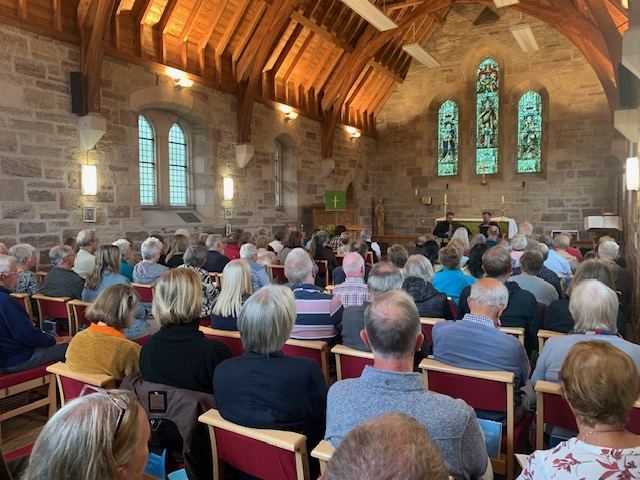
Yesterday evening, our dear friends Igor and Oleksii from Ukraine joined us again at St Finnbarr’s Episcopal Church in Dornoch. This time on their 20th anniversary tour, the accordion duo delighted the crowd of 99 gathered in St Finnbarr’s with a varied programme – from Bach to Waxman, the audience enjoyed every minute. The total of donations on the night exceeded £1300 and the money goes to Hippocrat – a charity which supports families who continue to be affected by the infamous Chernobyl disaster which happened in 1986.

On the night, prayers for peace and for the liberation of all territories of Ukraine were offered.

Join us in prayer –

Almighty God, Maker of all that is and that is to come,

We pray for the lasting peace among the nations of this world

and at this time we especially pray for the liberation of all territories of Ukraine,

For those who have died and those who mourn them,

For those who have been injured and those who care for them.

We pray for the leaders of the nations, that they may act with honesty and integrity

to bring about a lasting peace to all the peoples of this world.

Through you most blessed Son, Jesus Christ Our Lord.

Amen