Sermon for Sunday 26th October 2025

Luke 18.9-14

“The Pharisee and the Tax collector” — that’s the traditional name of the parable we read today.

We’re in Luke 18 — If you’ve noticed, we’re on a long trip through Luke’s gospel, a trip we always take in Year C in the season after Pentecost

And over these these past few Sundays in Luke — well, it’s like being at an Elton John concert. Peter and I went to see Elton John a few years ago, and it was two solid hours of well-known hits. No warm up acts, no obscure songs – All killer, no filler, if you know what I mean? Hit after hit after hit!

Well, Jesus rattles off hit after hit in Luke — the Good Samaritan (Luke 10); the Wedding Feast (Luke 12); the Lost Sheep, the Lost Coin, and the Lost Son (Luke 15); last week, the Persistent Widow, and now today — hit, hit, hit, hit; no warm ups, no covers, no B sides.

I want to look at this latest of Jesus’ greatest hits, the Parable of the Pharisee and the Tax Collector, under three headings — players, point, and power:

  • The players in the parable (who are they? why does it matter?); (2) the point of the parable (what it teaches us); and (3) the power of the parable (how can it change our lives?).

First then, the Players:

Two men went into the temple to pray, one a Pharisee and the other a tax collector. Two men; two very different identities. Identity is at the heart of this parable, as it is very much at the heart of Twenty first century life. It sometimes feels that we are in the middle of a great cultural identity migration. Gender roles are merging. Racial identities are being shed. In the last few years we’ve been made to see how trans and bi and poly-ambi-omni we are.

Everything touches on identity, even our very own selves  that some of us mediate through online social platforms like Facebook, Instagram and Snapchat, images of how we want the world to identify us.

If you asked the players in the parable “Who are you? What defines you?” you’d get two very different answers.

Who was the Pharisee? Even the name of this group is about identity — the Hebrew word it comes from, perushin, literally means “separated ones.”

Pharisees claimed their identity by being separate, set apart, holier than everybody else. So, this Pharisee prays: “God, I thank you that I’m not like other people: thieves, rogues, adulterers, not even like this tax collector.”

Now put the question of identity to the tax collector.

Remember Rome was a long way from Palestine. It would take a

huge bureaucracy to collect taxes there, so Rome sub-contracted the job.

Some Jews became “tax farmers,” private citizens who collected taxes for Rome, and the system was set up so they had to collect more than Rome demanded to make their own profit. Nobody in Jewish society was more despised than tax collectors.

The identities of these two men couldn’t have been more different. Just think about how they prayed.

The Pharisee stands confidently before God, but away from the others in the temple.

He knew he was righteous, and his prayer was completely self-directed:“I thank God that I . . . I don’t steal or commit adultery; the law says fast once a week, I fast two; it says give ten percent of what you earn, I tithe even on what I buy.”

The tax collector prayed differently — He beat his breast, which some of us do at mass sometimes — it’s a sign of penitence. He looked down, a sign of humility. Rather than “God, look how righteous I am,” he said “God, have mercy on me because of how righteous I’m not.”

Two men; two prayers; two different identities. Those are the players.

So what about The Purpose of the Parable: Jesus says “I tell you, this man (the tax collector) went home justified rather than the other (the Pharisee) . . . .” This parable is answering a particular question. That’s its purpose. “Who is qualified to enter God’s kingdom?” And the answer was shocking — because It’s not the religious chap, the one who tithes and fasts.

May I just say something that probably should be clear but maybe isn’t? Fasting — is good. Jesus assumed his followers would fast. Tithing, sharing our blessings with the poor, serving others with our wealth — is good. Giving’s hard — but it’s good.

It’s not the Pharisee’s practice of tithing he has to change; it’s not his commitment to the religious practice of fasting he has to lay aside; it’s thinking that those things make him righteous. They don’t!

The one person who gets into heaven is the one who knows he doesn’t have to pay a price of admission. The purpose of the parable is to drive home one truth: Good works won’t buy a place in Gods Kingdom; His merciful Grace is the only game in town.

So, what about The Power of the Parable:

Almost every biblical commentator will tell you to watch out for a trap.

The story is dangerous because we could just adopt different criteria for righteousness before God.

“Ok, maybe I can’t keep all the commandments like the Pharisee, but . . . what if I look down my nose at all the religious types and flip the situation?” Still trying to justify ourselves, this time by our great humility, we find our mouths praying the words: “God, I thank thee that I am not like the Pharisee!” And that’s a sure sign that actually our hearts haven’t changed at all.

Who is the hero of the story? It’s not the Pharisee, and it’s not even the Tax Collector with the heart of gold — it’s God.

God saves not because we keep the law or even because know we can’t. Our God saves for one reason: He loves us.

And that, my friends, is the power of this parable. Power to change.

Understand that God knows you completely, but he loves you completely. God knows us — he knows how much we want to buy him off, how lots of times pride lies underneath our religion — he knows us to our depths, but he loves us to the skies. And that changes hearts.

As I end my sermon this morning, please just take a moment to close your eyes and listen.

Who are you? What is your identity?

You are not your CV and the jobs and roles you have held in the past.

You are not your online social media account.

You are not the rules you keep or what other people think of you.

You are not your sexuality or the relationships you have.

You are not your brokenness.

You are, quite simply, God’s beloved child.

God already knows all about us — our failures, how sometimes we’re unhappy, how we can feel awkward or out of place or alone. And he loves us. Love like that changes us — in fact, it’s the only thing that ever does. That’s the gospel — a God who won’t be distant. Who knows us to our very depths, but loves us to the skies — and he’ll call us home fully justified, if we will just let him.

Sermon for Sunday 12th October 2025

2 Kg 5.1-3, 7-15             Psalm 111                        2 T 2.8-15                         Luke 17.11-19

Throughout the chapters of the Gospel of Luke previous to today’s reading, the Evangelist again and again and again presents the Good News through telling stories. He illustrates a series of personal encounters between Jesus and others – sometimes with his followers, sometimes his opponents, sometimes strangers. There were crowds of the curious and hopeful and various individuals – a tax collector, a centurion, a grieving mother, a sinful woman, a man inflicted with demons. As Luke relates these stories, he shows Jesus responding with love and grace and using the occasions to teach the values of God, while challenging the contrasting and distorted ways of the world.

Now, having reached Chapter 17 in the liturgical calendar, we find Luke recalling an episode in which Jesus was engaged by 10 lepers begging for mercy. These unfortunates suffered from what we now call Hanson’s disease. This malady, known among humans for thousands of years, went untreated in biblical times and caused permanent damage to skin, nerves, limbs and eyes, compromised the immune system, and hastened death. Though it is now known to be only mildly infectious, the ancients considered it highly contagious and forced lepers to stay away from others, identifying their condition by announcing, “Unclean. Unclean,” when approached.

As a result, they were excluded from the general society and forced to make their own communities, not unlike leper colonies that still exist in some parts of the world. They became dead men walking – at the mercy of others, ostracised, alienated from the richness of family life and the comfort of communal religious practices.

Like others, the lepers in today’s gospel were outcasts who bound themselves to one another out of necessity and because no one else would touch them. All that mattered was their disease, as evidenced by the inclusion among them of a Samaritan who would have been a hated and shunned foreigner in mainline Jewish society.

This band of 10 had nothing to offer others; nothing to offer Jesus when they saw him coming. But they recognized him, perhaps by his reputation as a holy man, and approached within shouting distance the one they knew by name. They cried out: “Jesus, Master, have mercy on us!” Possessing enough inspiration, or maybe just a sense of desperation, they reached out to Jesus with an appeal for healing that went beyond all conventional expectations.

Jesus did not hesitate in his response. He did not back off or require the lepers to confess faith in God. He did not inquire about whether they were worthy. He did not ask anything of them. Jesus saw them and said simply, “Go and show yourselves to the priests.”

According to Jewish law, a cured leper had to appear before the priests, who would conduct a series of elaborate ritual actions in order to declare them cleansed. The lepers, who had hoped in Jesus, now displayed enough faith to obey him. They immediately left his presence to go to the priests as required and to begin the new lives Jesus made possible.

What Jesus did for them, of course, bore remarkable significance. Not only were they cured of a horrendous, disabling disease, but the cleansing also enabled them to overcome what was perhaps the greater affliction. Now they could return to the community, to become a part of the body that had cast them out. Now they could participate in life fully, restored physically and socially, and surely, experiencing the beginnings of emotional healing.

Yet, we might ask, did they gain everything Jesus hoped for? Did they achieve spiritual healing, as well? We will never know about all of them, but we have assurance that one did – the Samaritan who returned to give thanks. If we wonder what led to his distinguishing himself by praising God and falling at Jesus’ feet in gratitude, we might speculate that it was easier for him – as a double outcast – to see clearly the remarkable nature of what had happened. More likely, however, it was due to his greater maturity and deeper strength of character.

Whatever the reason, Jesus was saddened that he was the only one who turned back, and he used the one and the nine to teach his disciples another lesson about the values of God. He was clearly disappointed by the behavior of the nine, and in earshot of his followers, he said to the now-cleansed Samaritan leper, “Your faith has made you well.”

In place of the word “well,” some translations use “made whole” or “saved.” There is ambiguity about the Greek meaning, but its use by Jesus surely implies more than simply being cured from a disease. “Your faith has made you whole,” seems closer to the way Jesus used this episode to provide a new teaching. The Samaritan was not simply cured like the others, but experienced something more important.

His response to being cleansed demonstrated that his view of God was closer to what Jesus came to reveal. He acted not out of selfishness to gain certification of his cure, not rushing to the priests without reflection, but paused to put his cleansing in a wider perspective, seeing God as the centre of the personal miracle he was experiencing. Before anything else, the Samaritan gave thanks for the chance to renew his life. This was the beginning of his transformation, and it provided a fitting model for Jesus to honour. He was not only cured physically, but he also gained spiritual wholeness.

There are a number of “take aways” from today’s gospel – community, inclusivity and wholeness in the life of the world and in Christianity. Think about the Eucharist. The moment we experience among our fellow Christians, in prayer and at the altar rail, is unity in its purest form. Receiving the sacrament of bread and wine, the body and blood of Christ, all else is shut out but the holy context. We are at one with God and one another, in a sublime moment of grace.

In this moment we are made whole. Even if we lose this reality as we go back to our seats, we know it as a deep truth on which to draw on our journeys of faith. In that moment, we know that everyone is like the Samaritan, freed from alienation and separation from others in a realm of God that includes a circle of universal inclusion.

Luke’s story of this encounter between Jesus and the lepers allows him to teach us about the disappointment Jesus felt because the nine failed to give thanks and the joy he experienced in discovering that the Samaritan recognised the deeper truths of God. When Jesus reflects on the difference, he speaks no less to us than the disciples of old. Today we are reminded of the sadness of our Lord when we, like the nine, fail to follow him, but we also are led to emulate the Samaritan. We can take joy in committing ourselves anew to respond in love and gratitude to the grace, forgiveness and wholeness of God that we all can have simply by accepting this freely offered gift.

October 7th – The Second Anniversary

Today marks the second anniversary of the events that triggered the current war in Gaza. We encourage all our members to make time today to pray for peace and justice.

God of peace and justice, 
we pray for the people of the Holy Land 
Israeli and Palestinian,  
Jew, Christian and Muslim. 
We pray for an end to acts of violence and terror. 
We lift to you all who are fearful and hurting.  
We ask for wisdom and compassion for those in leadership.  
Above all, we ask that Jesus the Prince of Peace,  
would bring lasting reconciliation and justice for all. 
Amen. 

Below you can find a link to Justice and Peace Scotland which has more ideas about what you might be urged to do.

https://www.justiceandpeacescotland.org.uk/Campaigns/Peace-making/Light-a-Prayer-for-Peace

Joyful Autumn Concert at St Columba’s!

Last Thursday, an audience gathered at St Columba’s Episcopal Church (affectionately known locally as The Tin Tabernacle) in Brora to enjoy a selection of music and songs performed by talented local musicians. Following on from a very successful Midsummer Concert and a well attended art exhibition, the folk at St Columba’s decided to hold a concert in late September with an Autumn Theme. The concert was compered by Alistair risk and performers included harpist Jennifer Port, Monica Maclean’s Gold Star Band, and a number of singers, including the priest at St Columba’s, Canon Simon Scott. The programme was wide and varied, ranging from traditional Scottish tunes to sixteenth century madrigals and finished with the ever popular community sing-a-long. Entry was free, but voluntary donations totalling £425 were collected in aid of CLAN Cancer Support charity. For some audience members this was the first time they had been in the Tin Tabernacle and they appreciated the warm, friendly and intimate surroundings. St Columba’s will hold their next concert at 4pm on Sunday 4th January 2026 – the theme will be Christmas and The New Year! Put it in your diary now!

A Deepening Relationship

Earlier in September,  members of the Roman Catholic Church, The Scottish Episcopal Church and other Christian denominations from across Sutherland met together for a service of Choral Evensong at St Finnbarr’s Episcopal Church in Dornoch to celebrate a very special Feast of St Ninian. On the same day, Bishops from both the Roman Catholic Church in Scotland and the Scottish Episcopal Church signed a historic agreement to be known as the Saint Ninian Declaration. The Declaration supports a deepening relationship between Episcopalians and Roman Catholics in Scotland, allowing both to work more closely together while acknowledging that there are distinct differences between the two churches. Canon Simon Scott (the episcopal priest in charge across East Sutherland) rejoiced at the coming together of these two denominations. “There is one Lord, one faith, one baptism to which we are all called. This historic agreement is another joyful step on the path to the worldwide Christian family walking together hand in hand as we seek to follow Jesus Christ and to serve our communities in His name – Gloria in Excelsis Deo”. 

Sermon for Harvest Thanksgiving 2025

It was Harvest time at a small village church in rural Scotland and the priest was organising the annual harvest service where people would bring their home-grown plants and vegetables to the service.

But this year was a little bit different. The local village cricket team has just won their league and the village was in a celebratory mood so the priest decided to do something special – they would combine the normal harvest service with a cricket theme.

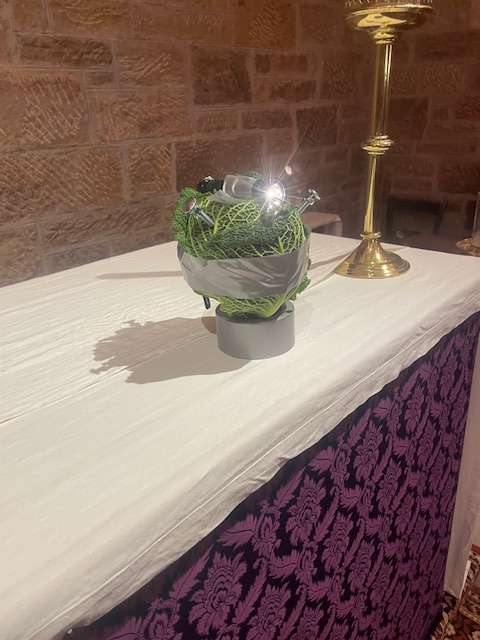
Now, the day of the service arrived and the church was filled with flowers. People were bringing in their offerings of vegetables, and in the middle of the display was a cricket wicket, a strip of turf with a set of wooden stumps at each end, and people were laying their offerings on the wicket. Everything was going fine until one lady went up to the front of the church and placed a bag of frozen peas among the other vegetables. She was stopped by the priest who quietly asked her to return to her seat still clutching her peas.

“What happened?” asked the lady she was sitting next to.

She shrugged her shoulders and said wearily, “There’s just no peas for the wicket.”

(No peace for the wicked – get it? – I can hear you groan from here)!

Celebrating harvest goes very deep in us – it seems to stir in us a sense of our country roots, memories of a land that lived by agriculture before the Industrial revolution turned most of us into townies. Some of us don’t have to go very far back to find our farming connections. Although very few of us have probably actually done it, we sing “We plough the fields and scatter the good seed on the land”, and it doesn’t seem in the least odd, even though farmers are much more efficient in their methods now. Harvest marks the end of a sequence in the church and country calendar. Plough Sunday in January, when the farm implements were blessed; Rogation days, just before Ascension Day in May, when prayers were made for favourable weather for the growing crops; Lammas Day at the beginning of August, when the first loaf made with flour from the new crop was offered in token thanks, and coming full circle (though it was introduced much later on the liturgical scene, in the nineteenth century) Harvest. Time for a pause before it all starts again. Time to be thankful, to remember God’s mercy and goodness, enjoying the sight of full storehouses and barns, pantry shelves and freezers. Time to feel secure against the coming winter. It is good to be thankful and we come gladly, enjoying the colour and smells, the readings and hymns that we have so long associated with this time of year.

But there’s something uncomfortable about Harvest too, especially now that we can see on our television screens that there are people who haven’t got a harvest to celebrate – in fact some who haven’t had a harvest for years, perhaps because the rains have failed, perhaps because war and conflict have made it impossible to cultivate the land.

Way back in time, God’s people faced the same situation on a smaller scale. Reading the instructions in Deuteronomy we are reminded that God’s people have always been told to be generous and help the poor to share our fortune. Deuteronomy speaks of very different farming methods than we use nowadays, but the message is clear: don’t keep it all to yourself.

And the New Testament warns us against taking things for granted, being pleased with out achievement. Remember that man who pulled down his barn and built a bigger one, who stuffed it full and sat back feeling pleased with himself – Remember that he got a sharp reminder – “You fool! This very night your life is being demanded of you. And the things you have prepared, whose will they be?” That ‘s the question that Harvest asks us too.

In the Bible, harvest and judgement often go together – the parable of the wheat and the tares puts the point very starkly (Matthew 13.24-30). So, it’s right and good to be thankful, but we have to ask ourselves how our thankfulness can find expression in making it possible for all humankind to be thankful. We can’t ever sit back and say we’ve done enough – not while there are still all those children stick thin limbs and swollen tummies looking at us hopelessly from our screens.

It we are going to be on the side of the angels, we have to work for the elimination of hunger, and the inhumanity which locks most of the world’s food away from those who need it most. We have to support the agencies who work to improve farming methods, but we also need to put our political will behind the removal of world debt, an issue which keeps on being pushed  down the agenda by scandals and atrocities across the world. We must keep asking the questions and seeking action. Harvest is the point where, far from sitting back and thinking how fortunate we are, we have to prepare to sow the seeds and encourage the growth for the harvest to come, when the will of God will be done on earth as it is in heaven.

Harvest Thanksgiving at St Finnbarr’s, Dornoch

Don’t forget, this Sunday is a service of Thanksgiving for Harvest at St Finnbarr’s, Dornoch – come along at the usual time of 11am and join in the Harvest classics like We Plough the Fields and Scatter. There will be a special collection for the fuel poverty fund managed by Tain Foodbank – Come, Ye Thankful People Come, Raise the Song of Harvest Home!

Sermon for Sunday 28th September 2025

Amos 6.1, 4-7 Psalm 146 1 Timothy 6.6-19 Luke 16.19-31

In our readings today, we heard one of Jesus’ famous parables, about a beggar named Lazarus and a rich man without a name.

Before we consider this parable, I want to set the stage for us. Too often, we read Jesus’ parables in isolation from their contexts. If we’re not careful, we might start imagining that Jesus was in the habit of rushing into places, telling some parables, and taking off again – leaving everyone either delighted, because it was such a nice story he told, or angry, because the story insulted them, or scratching their heads, because they had no idea what he was talking about.

That’s not how Jesus operated. His parables were always part of a larger discussion or controversy. And he usually told these stories to challenge people’s thinking. To try and broaden their horizons, to see things from a different angle, or maybe notice something they hadn’t before.

That’s what we saw a couple of weeks ago. Remember? The scribes and Pharisees complained—for the second time in Luke’s Gospel—that Jesus was eating with tax collectors and sinners. So Jesus told the Pharisees and scribes a few parables to justify his table ministry. The stories were about something that was lost being found.

A shepherd loses a sheep, and searches until he finds it.

A poor woman loses a coin, and frantically sweeps every nook and cranny of the house until she finds it.

In these stories, those who find what had been lost invite their friends and neighbours to celebrate with them.

Jesus wants the Pharisees and scribes to see him and his disciples eating with tax collectors and sinners differently. Jesus has been out seeking the lost sheep of Israel. The tax collectors and sinners are lost sons and daughters who have come back home. When he opens his fellowship to them, he’s celebrating their return—just as the shepherd and the poor woman celebrated when they found what had been lost.

Like any other story, parables do their best work when we find ourselves in them. When something in them resonates with our experience. Whenever, for good or bad, we see something about our own lives reflected in them. But the parables can only do this profound and powerful work in us when we understand who Jesus told them to, and why he told them.

So let’s talk about the context of this week’s reading. Who was Jesus telling this story to, and why was he telling it?

The parable about the rich man and Lazarus we heard today is part of the same conversation we heard last week. Jesus and the Pharisees have been going ‘round and ‘round for a few chapters now. There’s a three-way conversation that’s going on between Jesus, the Pharisees, and his disciples. Jesus is saying things to the Pharisees that he also wants his disciples to hear. And he’s saying things to his disciples that he wants the Pharisees to hear.

Jesus begins his story this morning: There was a certain rich man. This rich man is anonymous. Like the rich man in the parable in Luke 12, who had a bumper crop and wanted to build bigger barns. Jesus said this rich man clothed himself in purple and fine linen. These were very expensive clothes—the kind royalty might wear.

Not only did the rich man dress like a king, he lived like one, too. Jesus said he feasted luxuriously every day.

By contrast, Jesus tells us, at the rich man’s gate lay a certain poor man named Lazarus. A few details here. First, it’s not enough to say poor Lazarus laid at the gate. The verb suggests he was tossed there by someone – like rubbish.

Second, while Jesus refuses to name the rich man—indeed, he never names anyone in his other parables—he tells us the poor man’s name: Lazarus. The name Lazarus means: God is my helper.

It might not look right now like God is on this poor man’s side. But we must stay and listen for the rest of the story.

Third, the rich man’s home has a gate. So he doesn’t just have a house; he owns a gated compound. Keep that detail pinned to your mind. It will come up again.

While the rich man covered himself with the finest, whitest linen and a purple robe, Lazarus was covered with sores. Someone covered with open sores would have been considered ritually unclean by other Jews. Those who saw him may have believed he was being punished by God.

After all, Deut. 28.35 threatens the wicked with this judgment: The Lord will strike you … with grievous boils of which you cannot be healed, from the sole of your foot to the crown of your head. So people who passed by this poor, suffering man probably thought he deserved his suffering. Maybe the rich man even thought so. And we wouldn’t want to interfere with God’s justice, would we?

But then Jesus piles on even more pathetic details. While the rich man feasted every day; just outside his gate, Lazarus longed to eat the crumbs that fell from the rich man’s table.

Instead, Jesus says, dogs would come and lick his sores. This is not a sentimental scene of dogs trying to comfort this sick and suffering man. Dogs were not pets in those days. They were wild scavengers, like a jackal or hyena. And they were ritually unclean.

You’re supposed to imagine poor Lazarus trying to fight with dogs over table scraps. Meanwhile, they’re scavenging off his flesh.

Lazarus means, God is my helper. God better help him, because no one else is. Jesus dignified him with a name, because he represents all the poor outcasts—the homeless, the chronically ill, the refugees; and, in the eyes of the Pharisees, the tax collectors and sinners—tossed like rubbish outside the gate of polite society. All the wretched people we’d rather pretend don’t exist.

Maybe the rich man thought to himself sometimes: I’m so glad I’ve got this big wall to keep that Lazarus out! Perhaps even when he prayed, he thanked God for all the blessings God had given him, so he didn’t have to wallow with the dogs like poor Lazarus.

If he did, maybe God answered, You just wait! But the rich man was so deaf to anything outside his own thoughts, he never heard it.

Jesus continues his story: The poor man died and was carried by angels to Abraham’s side. The rich man also died and was buried. The rich man got a proper burial. Notice that Jesus doesn’t say the same for Lazarus. Even in death, that basic dignity was denied him. Just as someone had dumped him like rubbish in front of the rich man’s gate; his body was probably also tossed without ceremony in a hole somewhere.

But that’s where the story begins to turn. The rich man was buried, I’m sure with honours and mourning.

But Lazarus was carried by angels to Abraham’s side. Not only that, the rich man awakens to find himself tormented in Hades; meanwhile, in the distance, he can see Lazarus, being welcomed and comforted by father Abraham himself.

In life, the rich man had feasted in luxury every day, while Lazarus’ hungry belly was never filled. Now the rich man suffers awful thirst, and there’s not a drop of water to quench it. In life, the dogs had licked the sores on Lazarus’ body. Now, scorching tongues of flame lick at the rich man in the land of the dead.

He begs: Father Abraham, have mercy on me. Send Lazarus to dip the tip of his finger in water and cool my tongue, because I’m suffering in this flame.

Obviously, he was used to being served during life; and still expects this in death.

But Abraham speaks up, telling the rich man: Child, remember that during your lifetime you received good things, whereas Lazarus received terrible things. Now Lazarus is being comforted and you are in great pain. Back in Luke 6.2, Jesus had warned:

Happy are you who are poor,

    because God’s kingdom is yours.

But how terrible for you who are rich,

    because you have already received your comfort.

And near the beginning of Luke’s Gospel, Jesus’ mother Mary sang that God:

He has pulled the powerful down from their thrones

        and lifted up the lowly.

He has filled the hungry with good things

    and sent the rich away empty-handed. (Luke 1.52-53)

That’s just what’s happened: the great reversal. Notice that Abraham doesn’t say: Lazarus was good and pious in life, so he’s in heaven; but you were wicked, so you’re in hell.

No—it’s that Lazarus never got justice in life, and so he gets justice, finally, in death. God helped him. Meanwhile, we aren’t told the rich man was particularly wicked. He was just so self-absorbed that he let Lazarus suffer and starve to death just outside his walls.

And he’s still self-absorbed. He doesn’t confess how blind his privilege made him to Lazarus’ suffering. He doesn’t ask Lazarus to forgive him. He’s consumed by his own discomfort, and trying to boss Lazarus around.

C. S. Lewis liked to say, “the doors of hell are locked on the inside.” And the rich man in Jesus’ parable shows that to be a fact.

As if to remind the rich man what led him to be tormented and thirsty in the flames of Hades, Abraham says: Moreover, a great chasm has been fixed between us and you. Those who wish to cross over from here to you cannot. Neither can anyone cross from there to us.

Remember, the rich man had lived in a gated compound. And Lazarus suffered just outside his gate. The rich man could see him, and he could see the rich man. But the rich man never crossed through that gate to comfort poor Lazarus. In death, they can still see each other, the rich man and Lazarus. It’s like Father Abraham is telling the rich man: Sorry, but Lazarus lives in a gated compound, now. You never invited him into your home before. And he certainly isn’t coming to your home now.

Only in the end does the rich man begin to think about anyone beside himself. He begs Father Abraham to send Lazarus to his five living brothers: He needs to warn them so that they don’t come to this place of agony. Even in the land of the dead, the rich man thinks he’s in a position to call the shots. He wants to order Lazarus away from the joy of Abraham’s side, to serve his five living brothers.

He’s still not moved by what Lazarus, and those like him, have suffered in life. The rich man is only concerned that his family, his friends, the people in his little circle, should not suffer.

Father Abraham puts him in his place. He will not send Lazarus to the rich man’s brothers: They have Moses and the Prophets, Abraham reminds him. They must listen to them.

Just before Jesus told this parable, he’d told the Pharisees: What is highly valued by people—wealth, status, influence—is deeply offensive to God. And then he reminded them: It’s easier for heaven and earth to pass away than for the smallest stroke of a pen in the Law to drop out (Luke 16.15, 17). Nearly every page of the Torah and Prophets commanded them to care for people like Lazarus—the poor, the sick, the vulnerable, the widows, orphans, and immigrants. If they listened to Moses and the Prophets, they would surely not let the Lazaruses of the world starve to death in front of their gate.

But the rich man—who I’m sure was used to getting his way—wouldn’t give up. No, Father Abraham!, he argued. But if someone from the dead goes to them, they will change their hearts and lives. Abraham said, “If they don’t listen to Moses and the Prophets, then neither will they be persuaded if someone rises from the dead.”

And that gives the story a new twist. Because we know Jesus, the one telling the story, would himself rise from the dead later. But even that wouldn’t convince a lot of people. When you invest yourself in getting more stuff, gaining more status, and winning at any cost—like the Pharisees—you become blind to many things.

Like actual human suffering just outside your gate.

And even a miracle may not change that.

Robert Frost’s famous poem, “Mending Wall,” challenges the popular proverb, “Good fences make good neighbours.”

Instead, Frost asks:

“Why do they make good neighbours? …

Before I built a wall I’d ask to know

What I was walling in or walling out,

And to whom I was like to give offense.

Something there is that doesn’t love a wall,

That wants it down.”

Jesus wanted the Pharisees to see that their focus on being right, being pure, being safe, combined with their love of money, popularity, and comfort, had built a great wall around them. Just like the rich man’s gated compound in the parable. And the Lazaruses suffering and dying outside that wall weren’t just the poor and the sick and the widow and orphan and immigrant. But the social and religious outcasts like the tax collectors and sinners Jesus ministered to. They were sick and dying emotionally and spiritually. Lonely. Needy. Neglected. Hungry and thirsty for connection. Eaten up with toxic shame. Vulnerable to attacks from predators and scavengers.

And they hadn’t just walled out the undesirables—the tax collectors and sinners. They’d also walled themselves in. They had put up thick barriers to love, grace, and mercy. Their wall also kept God out, making them blind and deaf to the Good News of God’s salvation.

Like C. S. Lewis said: “the doors of hell are locked on the inside.”

Those who would follow Jesus don’t build bigger, thicker walls to keep others out. They build bigger, longer tables, to bring more people in.