Author: Simon Scott
Reflection for Maundy Thursday
On Maundy Thursday the stage is being set for the final drama of Jesus’ mission. Judas has gone to the chief priests to make a deal in which he will hand Jesus over to them. This term, this ‘handing over’ is something of a refrain that appears throughout the Gospel and reaches a climax here. Remember, John the Baptist was ‘handed over’ and now we see Jesus being handed over – the term occurs three times in today’s passage. Later, the followers of Jesus will also be handed over into the hands of those who want to put an end to their mission.
We all know that Judas sells his master, hands him over, for thirty pieces of silver, though only the gospel writer Matthew mentions the actual sum given to Judas.
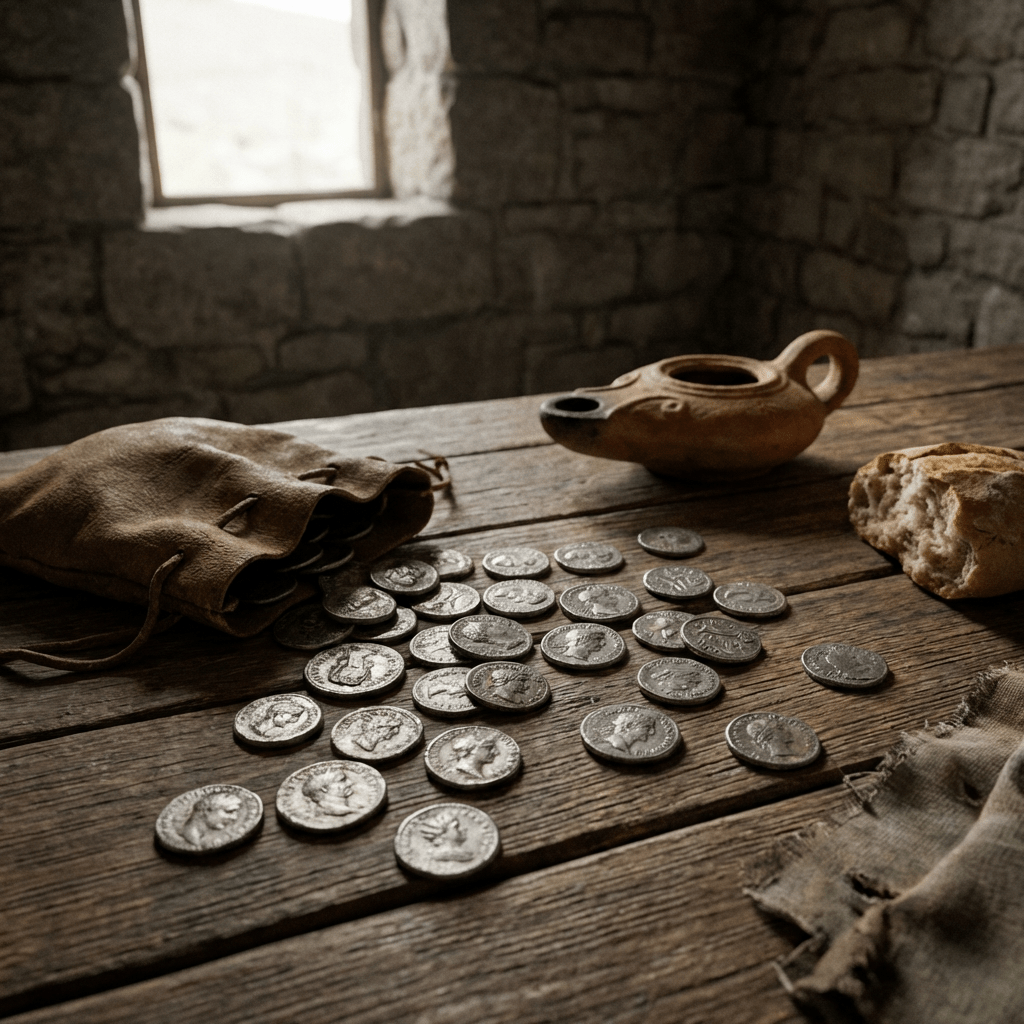
What people will do for money!
And Judas is not alone. What he did is happening every day. Perhaps in some way we, too, have betrayed and handed over Jesus more than once. Maybe not in such an explicit way as Judas, but perhaps much more subtly. Think about the last time you bought a particular item for example, and you chose a less costly version of the product to save some money. Did you explore how that particular item was made so cheaply? Was everyone involved in the process treated fairly and justly? Not quite like the betrayal of Jesus as Judas did, but it’s still worth thinking about.
On the first day of the Feast of Unleavened Bread, Jesus’ disciples ask him where he wants to celebrate the Passover. Little do they know the significance of this Passover for Jesus – and for them.
The Feast of Unleavened Bread and the Passover are closely linked, but there is a distinction between them. The Passover was the commemoration of the Israelites being liberated from slavery in Egypt, their escape through the Red Sea, and the beginning of their long journey to the Promised Land. The feast began at sunset after the Passover lamb had been sacrificed in the temple on the afternoon of the 14th day of the month Nisan. Associated with this, on the same evening was the eating of unleavened bread – the bread that Jesus would lift up, saying over it “This is my Body”. The eating of this bread continued for a whole week as a reminder of the sufferings the Israelites underwent and the hastiness of their departure. It was a celebration of thanks to God for the past and to bring hope for the future.
And during the meal with his followers, Jesus drops the bombshell: “One of you is about to betray me (in the Greek, ‘hand me over’). It is revealing that none of them points a finger at someone else. “Is it I, Lord?” Each one realises that he is a potential betrayer of Jesus. And, in fact, at some point during this crisis they will all abandon him.
And of course it isn’t one of his many enemies who will hand Jesus over. No, it is one of the Twelve, it is someone who has dipped his hand into the same dish with Jesus, as a sign of friendship and solidarity.
All of this has been foretold in the Scriptures but how sad it is for the person who has to take this role, even though it is a role he has deliberately chosen. There is a certain cynicism when Judas asks with an air of injured innocence, “Not I, Rabbi, surely?” “They are your words,” is Jesus’ brief reply.
The whole approaching drama is now set in motion.
And so, over the coming three days, let us watch carefully not just as spectators but as participants. We too have so often betrayed Jesus, we too have so often broken bread with Jesus and perhaps have sold him for money, out of ambition, out of greed, out of anger, hatred, revenge or even sometimes out of willful ignorance for our own personal gain.
Each day we face a choice. We can, like Judas, either abandon him in despair or, like Peter, come back to him with tears of repentance.
Sermon for the fifth Sunday in Lent 2026
John 11.1-45
Our gospel reading today, like the whole of Lent, is a sort of dress rehearsal for what is coming.
This story appears only in John’s gospel, and it’s the action of Jesus that sets in motion his death and resurrection. And, appropriately, it’s about the death of his good friend Lazarus, and Jesus’ bringing him back into earthly life.
Now if you Google ‘Lazarus tomb’ you will probably get a photo of the place in Bethany where tradition tells us that this miracle – this last of John’s seven signs – happened. It’s a hole in a rock wall, down about knee level, and just big enough for a person to get through. You have to bend down about double to get in, and I understand that coming out of it requires almost gymnastic ability. You have to come out head first, maneuvering along the rocks, trying not to scrape your back as you look up and emerge. If tradition is right and it really is the tomb of Lazarus, then he didn’t walk out like a man released from prison. He came out like a baby being born again, first his poor wrapped face, then his bandaged hands, and finally his feet.

And isn’t this a great image for how we can all sometimes feel? All wrapped up in the issues that life throws our way – just wishing to break free?
Lazarus was the brother of Martha and Mary, some of Jesus’ closest friends. When Lazarus became ill, they sent word to Jesus, but he waited for two days before he came to them. Of course, he knew what was going to happen, but for Martha and Mary his delay must have caused great hurt. ‘Lord, if you would have been here our brother would not have died.’ These words contain faith in the power of Jesus, and love of their brother, and blame, too. How many of us do the same when a loved one dies, second guessing or even blaming ourselves. If only we’d acted differently – called the doctor sooner, taken them to a different hospital, made a different decision about treatment; maybe we even harbour some blame for the medical team.
For Martha and Mary, Jesus would have been the difference. After Martha says this to Jesus, there’s an exchange about resurrection. Jesus says ‘I am the resurrection and the life; he who believes in me shall not die, but have everlasting life.’
Or, perhaps, ‘I am the resurrection and the life; he who believes in me will come to life, and everyone who is alive and believes in me shall never die at all.’ Martha speaks of resurrection as something that will happen in the future – we’ve heard this idea so often. Most of us were taught that taught that believing in Jesus is like some sort of coupon for eternal life. Later on, when we need it, it will get us into heaven.
But, you know, Jesus didn’t speak of the future here. Not ‘I will give you eternal life.’ He spoke in the present. ‘I AM the resurrection and the life.’ Those who trust in him begin their eternal lives now.
Martha and Mary and all the rest are crying, wailing, in grief. ‘Jesus wept’ – or ‘Jesus began to cry’ – and at first those around Jesus say ‘see how much he loved him.’ But Jesus already knew he’d bring Lazarus back. The Greek word used for what Jesus did is different. The others were wailing, but Jesus teared up and wept. Jesus wept that Mary and Martha and all the rest who were wailing didn’t get it.
Here it was the end of Jesus ministry – they were some of his closest friends – and they still didn’t get it.
So Jesus went to the tomb.
Now, I don’t use the King James Version of the Bible often, But I read recently about how it translates the raising of Lazarus. Jesus, after weeping and being emotionally moved, commands those around him to open Lazarus’ tomb. There’s instant protest. Lazarus had been dead for a few days, and everyone knew that rolling that stone away wouldn’t be pretty. As the King James version puts it, Martha calls out: But Lord, he stinketh! I love that.
Anyway, then, Jesus showed them what he meant. He said: ‘Lazarus, come out!’ Lazarus had most certainly gone on, in those four days he’d been dead, into the bright light of God’s heart. Yet, he came back when his friend Jesus asked him. He crawled through that small, dark, rough hole and stumbled out into the light of Jesus.
Perhaps this raising of Lazarus isn’t something that Jesus did to Lazarus; perhaps he did it with him. To show the others that life and death in Christ’s eternal time aren’t as separate as we might think.
That those boundaries are indeed permeable. That faith moves us through the dark tunnels of our lives into the light. Over and over again.
Interviews with people who have been resuscitated after being pronounced clinically dead often reveal that, first, they may evidently get a glance of a figure of light waiting for them on the other side, and then they note that they are very reluctant to be brought back again to this one. On the other hand, when Lazarus opened his eyes to see the figure of Jesus standing there in the daylight beside him, he couldn’t for the life of him tell which side he was on.
Christ is our light; eternal light, both now and forever. And, isn’t this story about Lazarus actually what the whole of Lent is about? It’s a short time of darkness before the light of Easter. We act out the truth of life, seen through the lens of our faith. Year after year, we experience this rebirth.
And, it doesn’t always have to be dark. Sometimes, it can be full of inspiration that isn’t quiet or sombre. Rather, the hope that’s ours in faith is a constant. It’s a re-focusing, re-energizing and re-directing our life. It carries us through life’s tunnels as light that isn’t just the beacon at the end, but as illumination that’s always here, with us.
The good news here is not that miracles happen. The good news in such stories is that vitality, new life, is possible for us, promised to us in fact, even now, in face of our private doubts and fears and the reality of our public world, a world enthralled with the ways of war and death. It happens all the time. Any time we have a loss – illness, death, divorce, the end of a relationship, a job, we notice wrinkles and know that we can never look the way we once did – life is absolutely full of losses of every type and size – we heal and renew ourselves as someone more complete, more whole, closer to God. We emerge from the tunnel of darkness and chaos reborn.
This episode in John’s gospel is a metaphor for life itself. It’s about trust in what God can and does do for us, over and over. The hope that isn’t naïve, passive, wishful thinking, but hearty, robust, joyful confidence in God’s presence.
It’s about eternal life now. Amen.
Sermon for Mothering Sunday 2026
Return – Remember – Reach Out
Our message today on Mothering Sunday.
- Return to the source of love.
- Remember the people and communities who have shaped you.
- Reach out with that same nurture to others, especially those who feel forgotten or excluded.
A few years ago, I met a young woman who told me that she had “three mothers.” One was her birth mother, who gave her life. Another was her godmother, who guided her faith. And the third was an older neighbour, who taught her how to cook, how to plant flowers, and how to stand tall in the world.
She told me, “Each one mothered me in a different way — and without them, I wouldn’t be who I am.”
Today, on Mothering Sunday, we celebrate not only biological mothers, but all who have mothered us — in love, in faith, in courage, and in hope.
In our holy scriptures, God’s love is often described in motherly terms. Remember in Isaiah 66:13, God says, “As a mother comforts her child, so I will comfort you.” AndJesus, in Matthew 23:37, laments over Jerusalem, longing to gather its people “as a hen gathers her chicks under her wings.”
On this special day, these images remind us that mothering is not limited to gender or biology — it is a divine quality, a way of being that reflects God’s own nature.
Mothering is something that you do, not just something that you are.
And so, today we recognise and encourage mothers who are fathers – men who have nurtured with tenderness, mothers who are friends – companions who have stood by us in hard times, mothers who are communities — churches, schools, and neighbourhoods that have given us roots to grow and wings to fly.
We remember the teacher who notices the child who always sits alone and draws them into the circle, the neighbour who cooks a meal for someone who is grieving, the congregation that welcomes the refugee family and calls them “ours”.
These, and so many more, are acts of mothering — and they are holy.
Way back in the middle ages, Mothering Sunday was the day when traditionally, you returned to your ‘mother church’ – the church in which you had been baptised, where you had been nurtured in faith and from where you were sent out into the world. Over time the tradition of keeping mothering Sunday in the UK had almost died out when, in 1913, a woman called Constance Penswick Smith led a call for its revival. Constance was the daughter of a clergyman and she wrote a play about Mothering Sunday and a History of Mothering Sunday. By the time of her death in 1938, Mothering Sunday was again celebrated all over what was then called the British Empire. Constance advocated for Mothering Sunday as a day for recognising Mother Church, ‘mothers of earthly homes’, Mary, mother of Jesus, and Mother Nature. So, in the UK, in church at least we try to retain a sense that ‘mother’ is a verb, as well as a noun.
And that’s so important because for a lot of people, Mothers’ Day can be a very painful day in the year.
Some people grieve that they are not mothers and that was not by choice. Some are grieving the loss of a mother, some are reminded of mothers who were less than ideal, some are reminded of their own shortcomings as parents or mothers. Constance Smith never married or had any children. She was never a mother. So, this morning let’s remind ourselves that you don’t have to be a mother to mother.
You may have heard of Mother Julian of Norwich – she thought of Jesus as our mother. She was the first woman (that we know of) to write a book in English –The Revelations of Divine Love, which is an account of the ‘shewings’ or visions that she had while seriously ill in 1373.

Mother Julian lived through the Black Death and the Peasants’ Revolt and spent much of her life as an anchoress – she was sealed up in a cell attached to a church in Norwich and her life was devoted to prayer. Her texts remained obscure until the 19th century and then, once they had been translated into readable, modern English, she was given the recognition that she deserved.
In her writings, Mother Julian reflects on the Holy Trinity and the visions she had of Jesus’ passion and she describes Jesus as Mother.
Nowadays people have strong views about the gender and pronouns we use when talking about God and Jesus, but Julian was describing Jesus as our mother back in the fourteenth century.
But what did she mean by that?
She uses images of breastfeeding and birth. Jesus births us into our spiritual or eternal life: in the same way that mothers suffer the pain of childbirth to bring a baby into the world, Jesus suffers to bring us into his kingdom. The blood of his wounds nourishes us like a mother’s milk.
Jesus mothers us by allowing us to learn from our mistakes but he is always there to love and protect. Julian writes, ‘If we fall, he catches us lovingly in his gracious embrace and swiftly raises us.’
Jesus wants us to do as a child does: ‘When it is in trouble or scared, it runs to mother as fast as it can.’ God’s love for us encompasses all the joys, heartache, pain and hope that we associate with mothering.
One of Julian’s most well-known revelations is that of the hazelnut.
“…a little thing, the size of a hazelnut, in the palm of my hand and round like a ball. I looked at it thoughtfully and wondered, ‘What is this?’
And the answer came, ‘It is all that is made… It exists, both now and forever, because God loves it. …everything owes its existence to the love of God. In this ‘little thing’ I saw three truths. The first is that God made it; the second is that God loves it; and the third is that God sustains it.”
Think of the vastness of the universe. Compared to the vastness of God’s love, it’s like a little nut in the palm of your hand.
Today is an opportunity to give thanks to the people in our lives who have mothered us in our faith, whoever they were and are. But also to reflect on our own calling to be mothers of faith to the next generation.
And so,
Return – Remember – Reach Out
- Return to the source of love.
- Remember the people and communities who have shaped you.
- Reach out with that same nurture to others, especially those who feel forgotten or excluded.
If God’s love is like a mother’s love, then our calling as we live in Her light is clear:
- To comfort those who are hurting.
- To protect those who are vulnerable.
- To nurture the gifts in others until they flourish.
And so who, in your life right now, needs to be mothered?
Who needs your patience or your encouragement?
Who is it that needs your fierce protection?
Return – Remember – Reach out!
Sermon for 3rd Sunday in Lent 2026
Sermon John 4.5-42
When it comes to affairs of the heart and adherence to ‘accepted moral codes’, it’s very easy to see that throughout history women have been judged far more harshly than men by those around them. Sometimes when a man has moved on from relationship to relationship he is considered a ‘jack-the-lad’ or a bit of a cheeky rogue, but if a woman acts in the same way – well – we can be all too ready to label her a harlot, a jezebel or even worse!
Thankfully, attitudes seem to be changing, but there are times when judgement and condemnation still rear their ugly heads.
Sometimes there are people who seem to relish in the gossip about the breakdown of someone’s relationship.
“Well, what can you expect?”
“You know she’s been married before!”
“She put herself about a bit before she was wed you know!”
You can just hear the voices, can’t you!
And don’t we especially love it when it’s involves someone rich and famous!
Joan Collins – married five times, Elizabeth Taylor – married eight times (though twice to the same man of course), Zsa Zsa Gabor – married nine times!
Shocking we say, but what can you expect of women with their track record! Oh how we love to be able to judge and condemn the lives of others.

In our gospel today Jesus meets another woman.
She has a history. Things done and left undone, some good some not so good. Guilts and regrets. Fears. Wounds and sorrows. Secrets too. She is a woman with a past.
If you study the history of this passage, if you read the commentaries and listen to the interpretations, you will learn that her past is generally seen as one of promiscuity. The evidence base for this being that we are told she had five husbands and is now living unmarried with a sixth man. What a scandalous woman!
But how easily we forget that women of her day had very little choice or control over their own lives. If she is divorced it is because the men divorced her. She had no right of divorce. That was exclusively the man’s right. Of course, maybe it wasn’t divorce. If she’s not divorced then she has suffered the death of five husbands. Five times she has been left alone, five times nameless, faceless and of no value – five times having to start over again. Maybe some divorced her. Maybe some died. We don’t know. Either one, divorce or death, is a tragedy for her life.
So, let’s not be too quick to judge. We don’t know the details of her past. Maybe we don’t need to. Maybe it is enough that she mirrors for us our own lives. We too are people with a past, people with a history. We are all in some sense the Samaritan woman.
People like her, people like us, people with a past, often live in fear of being found out. It is not just the fear that another will know the truth, the facts about us but that they will do so without ever really seeing us and without ever really knowing us.
We all thirst to be seen and to be known at a deep intimate level. We all want to pour our lives out to one who knows us, to let them drink from the depths of our very being. That is exactly what Jesus is asking of this woman with a past when he says, “Give me a drink.” It is the invitation to let herself be known. To be known is to be loved and to be loved is to be known.
To be found out, however, without being known leaves us dry and desolate. It leaves us to live a dehydrated life thirsting for something more, something different, but always returning to the same old wells.
We all go down to some well or another. For some, like the Samaritan woman, it is the well of marriage. For others it is the well of perfectionism. Some go to the well of hiding and isolation. Others will draw from the well of power and control. Too many will drink from the wells of addiction. Many live at the well of busyness and denial.
We could each name the wells from which we drink. Day after day, month after month, year after year we go to the same well to drink. We arrive hoping our thirst will be quenched. We leave as thirsty as when we arrived only to return the next day. For too long we have drunk from the well that never satisfies, the well that can never satisfy.
Husband after husband – this is the well to which the Samaritan woman has returned.
But of course, there is another well – the well of Jesus Christ. It is the well that washes us clean of our past. This is the well from which new life and new possibilities spring forth. It is the well that frees us from the patterns and habits that keep us living as thirsty people.
That is the well the Samaritan woman in today’s gospel has found. She intended to go to the same old well she had gone to for years, the well that her ancestors and their flocks drank from. Today is different. Jesus holds before her two realities of her life; the reality of what is and the reality of what might be. He brings her past to the light of the noon day. “You have had five husbands,” he says, “and the one you have now is not your husband.” It is not a statement of condemnation but simply a statement of what is. He tells her everything she has ever done. She has been found out.
But of course it doesn’t end there. Jesus is more interested in her future than her past. He wants to satisfy her thirst more than judge her history. Jesus knows her. He looks beyond her past and sees a woman dying of thirst; a woman thirsting to be loved, to be seen, to be accepted, to be included, to be forgiven, to be known. Her thirst will never be quenched by the external wells of life. Nor will ours. Jesus says so.
“Everyone who drinks of this water will be thirsty again, but those who drink of the water that I will give them will never be thirsty.” This is the living water of new life, new possibilities, and freedom from the past. This living water is Jesus’ own life. It became in the Samaritan woman “a spring of water gushing up to eternal life.” She discovered within herself the interior well and left her water jar behind. She had now become the well in which Christ’s life flows.
It’s not enough, however, to hear her story or even believe her testimony.
Until we come to the well of Christ’s life within us, we will continue returning to the dry wells of our life. We will continue to live forever thirsty. We will continue to live in fear of being found out.
So, I wonder, from what wells do you drink? How much longer will you carry your water jars? There is another well, one that promises life, one by which we are known and loved. Come to a new well. Come to the well of Christ’s life, Christ’s love, Christ’s presence that is already in you. Come to the well that is Christ himself and then drink deeply. Drink deeply until you become one with the one you have drunk.
Amen
Sermon for the Second Sunday in Lent 2026
John 3.1-17
During the season of Lent, one of my favourite musical works to listen to (or even better to join in with) is John Stainer’s Crucifixion – a meditation on the sacred passion of Our Lord. Holy Redeemer. Some of you may not think you know any of it, but I’m sure you will recall at least the most well-known chorus – God, So loved the world.
God so loved the world, that He gave His only begotten Son, that who so believeth in Him should not perish but have everlasting life.
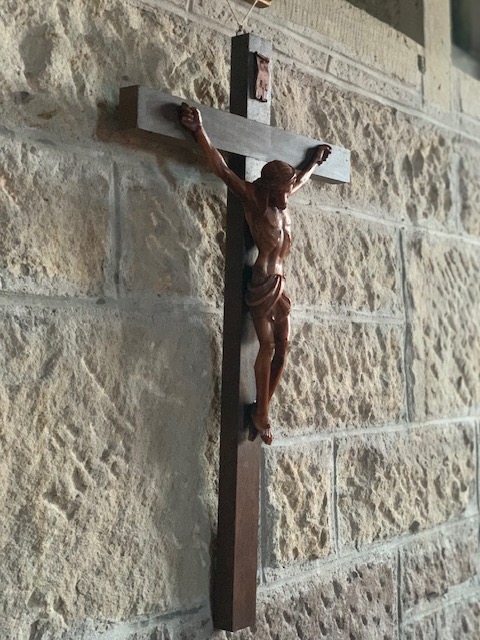
It’s a most beautiful piece of music through which Stainer cleverly captures the mood of these words of scripture.
The great Martin Luther called John 3:16 “the Gospel in a nutshell.”
John 3:16 is well-known and often-quoted, you can find it on posters and billboards, printed on T-shirts and hats, and even on car window stickers. But I wonder, how many of us could go on to quote John 3:17?
Who among us knows Nicodemus’ backstory by heart? And if we’re being honest, how many of us could have identified Nicodemus as the one to whom Jesus is speaking in John chapter 3?
While John 3:16 has rightly earned its place among the most memorable and hopeful verses in the New Testament, its larger context is actually a powerful witness to the love of the God we meet in Jesus.
Nicodemus, says John’s Gospel, was a leader among the Jews. In public, his loyalties were clearly devoted to the Jewish establishment. But in private, Nicodemus had his doubts. And so, he visits Jesus under the cover of nightfall. “Rabbi,” Nicodemus says, “we know that you are a teacher who has come from God; for no one can do these signs that you do apart from the presence of God.”
To put it another way, Nicodemus saw that Jesus was a good teacher and a knowledgeable interpreter of Torah, but Jesus was also filled with God’s life-giving Spirit, and Nicodemus wanted that kind of relationship with God, too.
Then, as Jesus so often does, he says something that utterly astounds everyone: “Very truly, I tell you, no one can see the kingdom of God without being born from above.” In other words, glimpsing the Kingdom of God isn’t a matter of praying a certain way or believing a certain way or following a certain set of liturgical customs; it’s about a complete rebirth of our entire existence!
On hearing this, Nicodemus asks an honest question that seems almost laughably quaint and naïve to our 21st-century ears: “How can anyone be born after having grown old? Can one enter a second time into the mother’s womb and be born?”
But for as off-the-mark as Nicodemus’ question might seem to us, might it not also demonstrate something important about the way God tends to work?
Just think about Abraham and Sarah for example. God promises them a son. The ancient scribe matter-of-factly cues us into the dramatic irony surrounding this promise, writing flatly, “It had ceased to be with Sarah after the manner of women.” In fact, when she heard about the absurd promise of a child, Sarah laughed! Even the name of the promised child—Isaac—means “he laughs.”
And what about Moses? God speaks to him through a burning bush, proclaiming that he would be God’s agent in delivering the Hebrew people. Moses’ response: “Who, me? You must have the wrong guy! I don’t even know your name!”
Perhaps most astonishing of all is the moment God decided to convert the Apostle Paul. The Book of Acts recalls that Paul was “still breathing threats and murder against the disciples of the Lord” when God sent a dazzling bolt of light and called him to become an apostle.
The same dynamic is at play here with Jesus and Nicodemus.
God is once again working around the edges, making possible what was long thought impossible. Nicodemus comes to Jesus under the cover of nightfall – the gospel writer’s code for uncertainty and apprehension. He’s well aware that Jesus is a capable, insightful teacher, and he’s demonstrated his knowledge of Torah. But there’s something else about him, something Nicodemus can’t quite put his finger on, so he takes a chance and asks Jesus about it face-to-face: “Rabbi, we know that you are a teacher who has come from God; for no one can do these signs that you do apart from the presence of God.”
Jesus tells Nicodemus that in order to see the kingdom of God, we have to give our whole selves over to an entirely different way of being. We have to be “born from above.” Jesus is inviting Nicodemus into a deeper relationship with the Living God, and what’s Nicodemus’ response? Is it “Yes! Sign me up! What do I do first?”
No. He says, “So let me get the mechanics of this straight. I’m born from my mother, and you’re saying I have to be born again. That’s impossible!”
We can almost hear Sarah’s laughter and Moses’ hesitation and Paul’s seething rippling through the background. But the truth is, this happens all the time among people of faith, doesn’t it?
Jesus says, “Do unto others,” and we say, “Okay, as long as I know who they are and I get along okay with them.”
Jesus says, “Give your life to the work of the Kingdom,” and we say, “How about a monthly standing order?”
Jesus says, “Love one another and forgive one another as you are loved and forgiven,” and we say, “Well, define love. Set some ground rules for us around this whole forgiveness thing.”
And yet, Sarah gave birth to her son anyway, Moses found the grace to accept God’s call, Paul put away his old life and devoted himself to the Risen Christ.
The same is true for Nicodemus.
After he leaves Jesus, he returns to his position among the Jewish establishment. His conversion doesn’t happen with a bolt or a flash; there’s no really memorable story that gets passed down through the ages. But deep down, and ever so slightly, something begins to turn.
Nicodemus’ rebirth happens over the course of a long journey, which began under the cover of darkness when he took a chance on Jesus. He was an uncertain, fly-by-night sceptic. And the truth is, with the exception of one brief mention in John chapter 7, we never hear from Nicodemus again – that is, until the end of John’s Gospel. And it is here that Nicodemus’ birth from above is laid bare.
As Jesus hangs crucified, after all of the other disciples had fled for fear of persecution, there stands Nicodemus at the foot of the cross, armed with myrrh and aloes and the other provisions for Jewish burial, ready to bear the broken and lifeless body of the crucified Lord to its grave.
Jesus said, “For God so loved the world that he gave his only Son, so that everyone who believes in him may not perish but may have eternal life.”
We can never fully know what Nicodemus was thinking as he departed Jesus’ company after hearing these words. But we can be sure that something within him was changed. And little by little, his heart was broken open and he was born anew, finding his way through darkness and doubt, to the cross. I pray that we would be willing to meet him there.
Amen.
Sermon for the First Sunday in Lent – 22.02.26
Sermon Matthew 4.1-11
One day when Jesus was relaxing in Heaven, He happened to notice a familiar-looking old man. Wondering if the old man was His earthly father Joseph, Jesus asked him, “Did you, by any chance, ever have a son?”
“Yes,” said the old man, “but he wasn’t my biological son. He was born by a miracle, through the intervention of a magical being from the heavens.”
“Very interesting,” said Jesus. “Did this boy ever have to fight temptation?”
“Oh, yes, many times,” answered the old man. “But he eventually won. Sadly, he died heroically at one point, but he came back to life shortly afterwards.”
Jesus couldn’t believe it. Could this actually be HIS father? “One last question,” He said. “Were you a carpenter?”
“Why yes,” replied the old man. “Yes I was!”
Jesus rubbed His eyes and said, “Dad?”
The old man rubbed tears from his eyes and said, “Pinocchio?”
I do apologise for making such a jokey start to our sermon this week, but I just could not resist the temptation!
It’s not very often that our lectionary provides us with such richness in scripture on the same day. Two of the most powerful and evocative stories in the Bible all about temptation.
And when it comes to stories about temptation, the readings we’ve heard cover just about everything.
Firstly, we have the wonderful account of Adam and Eve and their problems in the garden. There they are, in paradise; everything’s going just great, and along comes this snake with a smooth tongue and some new ideas. The next thing you know, temptation triumphs, paradise is history, all is lost and the man and the woman are left with shame, regret and a couple of fig leaves!

Then, in a powerful contrast, our gospel reading describes Jesus being driven from his baptism into the wilderness – which is just about as far from paradise as you can get. There, unlike Adam and Eve who were surrounded by ease and plenty, Jesus becomes exhausted – starving and alone as he struggles with his time of temptation and challenge.
The two stories form such an obvious contrast that it’s impossible not to compare them and to look for what emerges when they are taken together.
On one level, it looks simple enough – Jesus is the winner and Adam and Eve are the losers; they are weak and he is strong. So, we learn that it’s better to be like Jesus than like Adam and Eve.
What’s more, since today is the First Sunday in Lent, there is the added point that Lent is supposed to make us stronger so that we will be more like Jesus than like Adam and Eve, at least as far as such things as temptations are concerned.
And all of this is almost right.
Now some of you might remember the Green Goddess or perhaps Mr Motivator – two television fitness fanatics that tried to encourage us up from our armchairs and help us get in shape.
Well, as well as being physically in shape, there really is such a thing as being more or less ‘in shape’ spiritually – as being more or less prepared to handle the demands of a serious Christian life.
This has to do with our Christian character and with the development of particular virtues or habits. Getting into shape spiritually has some clear parallels with getting into shape physically or intellectually. There is no doubt that the disciplined rigour of a holy Lent can take us several important steps in the right direction, and the spiritual muscles or habits we develop with disciplines like a Lenten rule are exactly the same ones we use in real life – when the decisions we make can have vastly more important and immediate consequences.
Over the years many learned scholars and worthy theologians have debated whether or not the story of Adam and Eve in the garden is true. But what makes the story of Adam and Eve a true story for me is not that it describes accurately something that happened somewhere else a long time ago but that it describes exactly what life is like here and now – it tells the truth, not just about them, but about us.
Over and over again, we find ourselves just like them – forced to decide what to do with something which, on the one hand, looks really good, seems useful and popular, and that just might teach us a thing or two – but which, on the other hand, we strongly suspect is not what God thinks best for us.
And we have to choose. When that happens, it’s better to be stronger and to have developed some of our spiritual habits. So, there is a real value to the notion that we need to ‘buff up a bit’, and that Lent is a good opportunity to do a bit more of this – or at least to begin doing it.
But how exactly do we go about getting in shape? Well let’s just take a closer look at what was happening with Jesus in the wilderness.
He has fasted and prayed for a long time – for as long as it takes – that’s what “40 days” means – and he’s famished. He’s absolutely exhausted and just think of the loneliness and the effort it takes to sustain something like this. He’s not at his best. He’s not bursting with physical or spiritual or any other sort of strength. He’s used all that up in just making it to where he is – in just being faithful to the fast.
This is when the temptations hit Jesus.
Now, I suspect that if the tempter had caught him on a good day, Jesus would have had all sorts of answers of his own to the questions – to the temptations – he was given. He might have told wonderful parables or asked clever and insightful questions right back at him and put the devil on the spot.
But strength and energy and cleverness were all gone – there wasn’t anything left. And we know about this, too – this is a different sort of temptation from the one Adam and Eve faced.
This is when we face strong, or compelling, or addicting, or beautiful, or just plain hard temptations and we have run out of resources. No matter how strong we were to start with, we simply can’t any longer move in the direction we have chosen to move, and we are pulled instead along lines that are against our will but defined by our appetites and our ego.
Sometimes it’s not a matter of not being strong enough, it’s a matter of being empty. That’s where Jesus was – he was out of energy, out of fuel and he was tempted, really tempted.
But just look at what happens. Jesus does not say one word of his own. Instead, he quotes scripture in a simple and straightforward way that is unlike how he uses scripture virtually anywhere else in the Gospels. Jesus has no words, no resistance, no strength of his own – he’s simply holding on to the Father, and letting the Father’s words and the Father’s mind come through him. Jesus’ response to the tempter is not a victory of personal, spiritual strength in some sort of holy temptation-lifting Olympics. Instead, his victory is the gift that comes from surrender.
There is no doubt that his time in the wilderness gave Jesus a stronger and more disciplined relationship with the Father; and as a fully-human being, he had to pay attention to such matters, just like we do. But it also gave him something else, something more, something we see in his story of temptations. His time in the wilderness gave Jesus the insight and the courage to surrender, and so to depend, not on his own best efforts, but on an emptiness that can only be filled by the Father, and that can only be filled by a gift of grace.
Several months after this all happened, Jesus said to his disciples: when you are handed over to your enemies, “Do not worry about how you are to speak or what you are to say, for what you are to say will be given to you at that time.” Imagine that Jesus could taste the dust of the desert and hear again the voice of the tempter and remember that hunger that reached out even to the stones around him. He knew what he was talking about. At the end of the day, the spiritual life is never about us, about what we can and cannot do. At the end of the day, it is always about God and about God’s gifts – gifts of grace, gifts that do not fail.
Ash Wednesday – 18th February
Tomorrow we enter the solemn season of Lent. It would be lovely to see you at one of our Ash Wednesday services.
 Scottish Episcopal Church - Dornoch, Lairg, Brora, Tain & Tongue