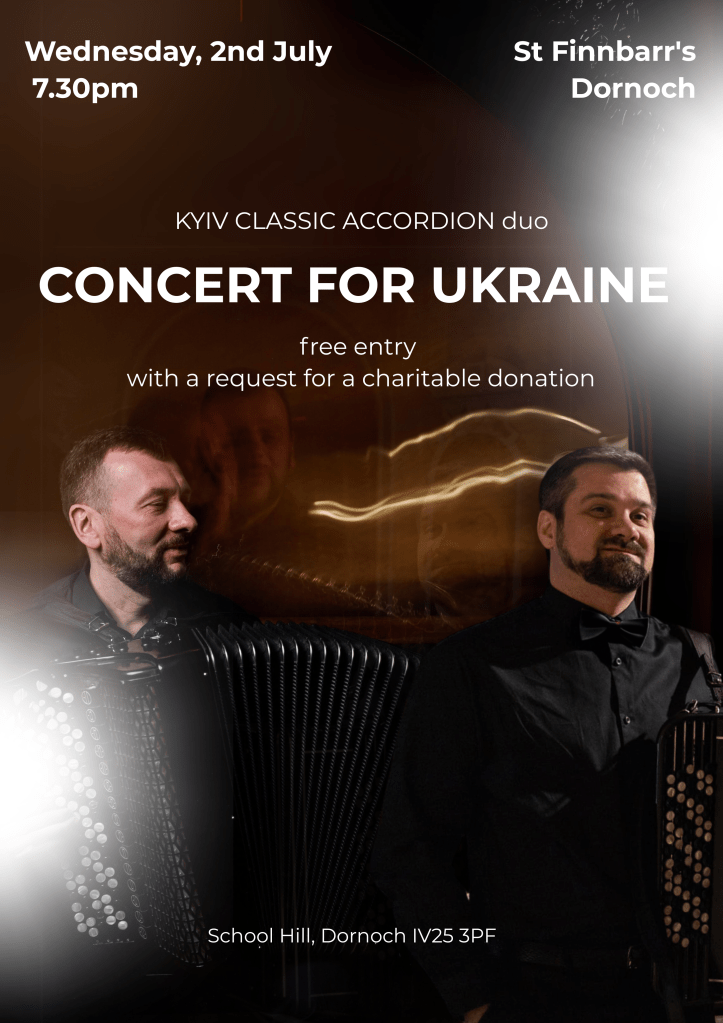
KYIV ACCORDION CONCERT – 2nd July 2025
* 1 Kings 19:1-4, (5-7), 8-15a and Psalm 42 and 43 *Galatians 3:23-29 * Luke 8:26-39
Miss MacLeod was the boss of a big company and she needed to call one of her employees about an urgent problem with one of the main computers. She dialled the employee’s home phone number and was greeted with a child’s whispered, “Hello?”
Rather put out at the inconvenience of having to talk to a youngster, Miss MacLeod asked, “Is your Daddy home?” “Yes”, whispered the small voice. “Can I talk to him?” she asked.
To Miss MacLeod’s surprise, the small voice whispered, “No.”
Wanting to talk with an adult, the boss asked, “Is your Mummy there?” “Yes”, came the answer. “Can I talk with her?” Again the small voice whispered, “No.”
Knowing that it was not likely that a young child would be left at home all alone, Miss MacLeod decided she would just leave a message with the person who should be there watching over the child. “Is there any one there besides you?” she asked the child.
“Yes” whispered the child, “a policeman.” Wondering what on earth the police were doing there, Miss MacLeod asked, “Can I talk to the policeman?” “No, he’s busy,” whispered the child. “Busy doing what?” “Talking to Daddy and Mummy and the Fireman”, came the whispered answer.
Growing concerned and even worried as she heard what sounded like a helicopter through the ear piece on the phone, Miss MacLeod asked, “What is that noise?” “A hello-copper” answered the whispering voice. “What on earth is going on there?” asked the now rather worried employer.

In a voice full of awe the child whispered, “The search team just landed the hello-copper.” Alarmed, concerned, and more than just a little frustrated the boss asked, “What are they searching for?” Still whispering, the young voice replied along with a muffled giggle: “hee hee, they’re all looking for Me!”
Hide and seek is one of those games that will never be superseded by an electronic games console. It’s impossible because it’s a game that needs both people and a good sized house or other location.
Do you remember playing Hide and Seek as a child? Were you one of those who preferred to be a hider or a seeker? Did you find a place to hide which meant you were really difficult to find, or did you always choose a pretty obvious hiding place so that you would be one of the first to be discovered?
When I was at school I once tried to organise a professional Hide and Seek tournament – but it didn’t work – good players are just too hard to find!
Though hide and seek is just a game, how we feel about it, says a lot about the kind of person we are. Do we need to be found or are we content to be lost?
These questions are brought to mind by the Gospel for today.
In it, a man who wears no clothes, lives out in the tombs and describes himself as ‘Legion’ because of the ‘many demons’ that had ‘entered him’ is saved by Jesus.
The reading is a mysterious passage and some of the words can seem strange to our modern minds. Yet central to it is the sense that Jesus seeks to bring wholeness and healing to those who call upon him. Even those who hide amongst the dead.
The man tormented by the demons possessing his life, asks Jesus, who had already commanded the ‘unclean spirit’ to leave him, ‘What have you to do with me Jesus, son of the Most High God?’ He was lost and though some might have given up on him Jesus seeks, finds and restores him to life.
What about us, though we’re here at church this morning, do we too sometimes feel a bit lost and do we need to be found again by Christ?
If so, then we need to ask, what would he find hiding in our lives? What demons have possessed and frustrated God’s loving purpose in us?
Most of us struggle with the word ‘demons’ yet few of us would doubt that there are things that can undermine the fullness of life to which we’re all called. They cannot be ignored if we’re to be constantly transformed by our faith.
This morning’s Gospel describes a life changing transformation for that man, from being a lost outcast, he is restored ‘clothed and in his right mind’.
Yet, like him, if we’re to be, in St. Paul’s words, ‘clothed with Christ’ we need to always be open enough to let Christ find us, let him touch the depth of our souls and transform us.
But we do have to want to be found, we have to want his love to come and continually transform us. It’s so easy to stand still, to reach a certain point in our journey of faith and then not to move, to decide that the change around us in society and the church is all too much and not seek to engage with it.
It’s a bit like what was happening in Galatia, described in our Epistle. They had found Christ, yet it was too much, they wanted to hide and Paul speaks to those who found certainty in the easy security of the law.
Paul knew that any law which divides, separates and frustrates doesn’t speak of the God of transformation and he reminds them that in Christ there is ‘no longer Jew or Greek, slave or free, male or female; for all are one in Christ Jesus’.
The radical freedom Jesus brought changed their world. Likewise the living Christ in us, can be frightening, for he challenges everything in which we find security. For some, then as now, it can be too much.
In our Gospel those who witnessed the man’s transformation were ‘seized with great fear’ and they asked Jesus to leave. It was easier to send him away, to hide, than to live in his life changing love.
We might draw a parallel with life for so many today; they don’t wish to be found and they probably don’t even think they’re lost. Yet Jesus seeks them too.
When a child first plays hide and seek they need to be encouraged to overcome their caution and fear and to hide. Sometimes an adult will need to go with them, to reassure them that they won’t be lost forever.
What we do in this building this morning may not be Hide and Seek but we do need each other’s encouragement and help to find Jesus in our midst. Whilst society has changed and the church has struggled to keep up, that doesn’t mean people no longer need the redeeming love of Christ.
Having been found, we’re called to go and be his people amongst our neighbours. So a challenge for each one of us this week is to not be afraid, to leave this service, like the demon possessed man his life now transformed, ‘proclaiming the good news’ of just how much ‘Jesus has done for’ you. Go from here and in the strength of the Holy Spirit seek those who are hiding and waiting to be found.
Greetings to you on this Trinity Sunday!
I’m sure it will come as no surprise that when priests and other ministers are preparing their sermons, homilies or talks they use a wide variety of resources to guide and structure the message they want to share – and this can be really useful when the ‘topic’ or theme is a difficult one to try to explain. From great theological tomes by learned fathers and mothers, to snippets of thought in an online blog – all can find their way into a Sunday sermon.
Today, The Feast of the Holy Trinity, is often a day thought to be particularly challenging and in preparing for this sermon I was doing a bit of research and came across an article: ‘The Top 10 ways to explain the Holy Trinity’.
Now I won’t bother you with all 10, but here are the top 3.
At number 3 – The Holy Trinity is likened to Battery, Wire and Electricity. God is the power source, the battery. The Son is the mediator, the wire which conducts God’s love to us and The Spirit is the power itself, the love of God which comes to us through Jesus.
Now this explanation has some strength in that it differentiates the three persons of The Trinity and puts them in relationship with one another BUT the downside is that it uses inanimate objects to try to explain something that should be something fundamentally living and dynamic.
So to the 2nd most popular way to explain The Trinity – a Dance. God is the dance, the energy, the movement at the centre of creation and the trinity is our way of saying God does the dance perfectly with all of the dancers in harmony.
Now this explanation is better at describing a living, moving relationship, but it is a bit abstract and isn’t great at helping us identify the three persons of the Trinity.
Finally at Number 1 – the most popular way of explaining the Holy Trinity comes from Ireland and good old St Patrick himself – The 3-leaved clover. Each leaf on the plant appears whole and independent, but they are indivisibly part of a single stem. But then questions like ‘Is the stem then a different source from which the three persons of the trinity emerge?’ spring into the mind.
And so on and so on.
I haven’t been able to find any explanation or representation of the Holy Trinity that doesn’t conjure up a raft of questions.
So what I am about to say to you on this Feast of the Holy Trinity may sound a bit strange. It might even sound as if I am being unfaithful and even inappropriate. But I think it’s important and maybe even necessary.
Are you ready?
Stop thinking about God.
You probably didn’t expect to be reading a sermon that told you to stop thinking about God, but before you pick up the hotline to the Bishop, let me explain what I mean.
I suspect that many of us spend too much time and effort thinking about God. Now that’s not just an observation, it is also a confession of one who loves thinking about God. But maybe, just maybe we should spend a little bit less time thinking about God and instead simply be with Him. Here’s what I mean. Would you rather be with the one you love or think about the one you love? Would you prefer your relationships to be defined by love for another or information about another?
There is a sense in which thinking about God keeps us from being present with Him. In some way thinking about God can distance us from Him and set up a kind of ‘subject – object’ duality and that is actually the very opposite of trinitarian life!
We think about other people when we are not with them. Some of us think about our children who have grown up and moved out. Some think about our partners when we are away from each other. We think about our friends when we are apart. We think about our loved ones who have died. But in that moment when we are really present, when we have truly shown up and offered all that we are and all that we have, we’re not thinking about the other person, we are one with them. It is a moment of love, intimacy, and union. It’s not defined by life or death, distance or geography. It is defined and made possible for us by the eternal life and love shared by the Father, the Son, and the Holy Spirit.
Who is the person with whom you have or had the closest, deepest, most intimate relationship? Picture him or her and your relationship. When you are with that person you are not thinking about him or her. In moments of ecstatic love, you look at him or her and see yourself in his or her life and he or she does the same with you. We open ourselves to each other. We give ourselves to the other and receive the other into ourselves. That is the trinitarian life. It is the choreography of love and it’s happening all the time.
In the midst of an honest, real, and meaningful conversation we’re not thinking about the other person. We are with them and they are with us. A single life envelops and flows between us. We don’t make that happen, it just does. That’s trinitarian life.
When we are rolling on the floor, laughing, and playing with our child or grandchild we are not thinking about them, we are completely open and present to their life and they to ours. The line between their life and our life gets blurry and there is only love. That’s trinitarian life.
Sometimes we see the world through another’s eyes and their joys or sorrows take root in us as if they were our own. When that happens we are not receiving news or information about another, we are sharing a common life. We are loving our neighbour as our self. That’s trinitarian life.
Every now and then we are immersed in prayer and no longer conscious that we are praying. We no longer see ourselves talking to or thinking about God. Rather, our life is one with His and we are participating in the life of the Holy Trinity.
Each of these are moments when we can honestly say, “I love, therefore I am.” These and a thousand others just like them are trinitarian moments. Love for one another and faith in the Holy Trinity are integrally related. You cannot have one without the other.
The Holy Trinity is not a concept to be explained, numbers to be calculated, or a problem to be solved. It is a life to be lived, a love to be shared, and a beauty to be revealed.
Stop thinking about God. Live the life, share the love, reveal the beauty. Amen.
God bless you and those you hold dear this coming week.
Fr Simon
There is a beautiful traditional analogy that describes worship in the Episcopal Church as that of a symphony orchestra. The members of the congregation are the players in the orchestra, with many different instruments represented among them. The musical score is the particular liturgy we are using and the conductor is the celebrant or officiant, who leads and helps tie everything together. And who is the audience at this joyous performance? Well, the audience is God!
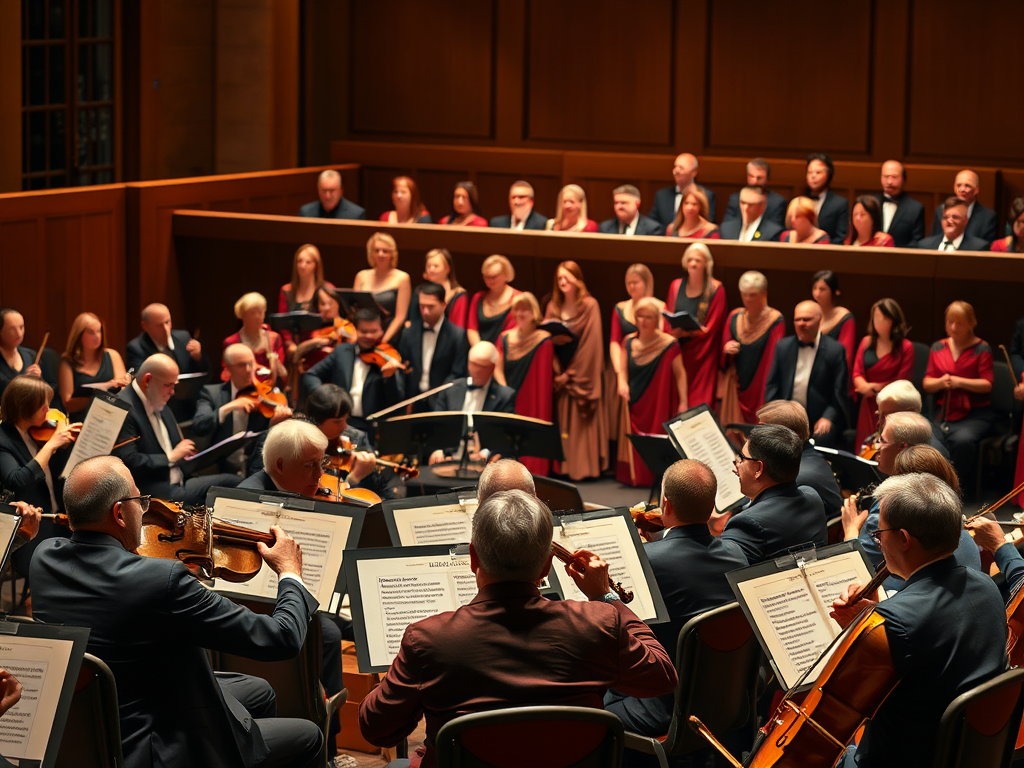
This analogy illustrates the basic truth that our worship in the Episcopal tradition is participatory. There is a lot of action on the part of the congregation making them active participants in what is going on. I think this musical image is also a helpful one for understanding the church’s mission. The ideal of our working together in unity can also benefit from an illustration from classical music.
My own favourite metaphor for the church at its best, is the 4th movement of Beethoven’s Ninth Symphony. It is beautiful and stirring. Everyone knows the central melody, the “Ode to Joy.”
Anyone who has experienced the great pleasure of attending a live performance of this wonderful work might agree that it can indeed provide a symbolic vision of what the church can be at its best.
The Ninth Symphony builds magnificently toward its final, 4th movement. Beethoven’s masterpiece grows, with gradually unfolding themes of deep beauty. Finally, having gone through every form of instrumental expression, the composer calls forth the human voice. Singing is required to bring ultimate expression to the composer’s vision.
As the symphony ends in a spectacular climax, the conductor, the orchestra, the quartet of lead singers, and the full chorus are all working feverishly. Every orchestra member is playing with inspired fervour. The quartet of soloists and the chorus are singing at full volume. The conductor, beating time with baton in hand, works exhaustively to tie the pieces of the musical whole together into one intricate, moving entity. She urges forth every last ounce of spirit left in the performers. All work exuberantly together to bring about a great piece of musical love.
Yes, the final movement of Beethoven’s Ninth Symphony may well be an ideal expression of God’s kingdom. It is certainly my own vision of how the church can act — that is, with everybody working together to produce the greatest expression of love, and with no one standing idly by:
with everyone involved, doing his or her part
without discord
with no in-fighting
with everyone focused on one purpose
with everyone inspired, exuberant,
working feverishly to love God
with all their being and to love God’s
children as themselves
with everyone following the will of the leader.
This is the example set by Jesus. His whole life was one continual effort to work to produce love, healing, happiness, and salvation among all people. Certainly, that was the example the early church sought to emulate.
Remembering the first Pentecost Day, the day when the disciples were set on fire with the Holy Spirit, it is natural to think of the finale of Beethoven’s great symphony. The glory of the finale is my idea of what that first Pentecost was like. That first day of the church’s reaching out to the world, spreading the joy of the good news of God.
On that day, the early followers of Jesus received the power of the Holy Spirit and were enabled to go out working together, pooling their resources, caring for the community and the common goal, providing generously for the needy, following the lead of their Lord.
On this Pentecost Sunday, we find ourselves emphasising our responsibilities as members of the Body of Christ to go beyond this service and beyond our community to act out the truths of our faith: to work together; to make our best effort to follow the direction of our Lord Jesus Christ; and to do so with the same feeling of commitment as that of the participants in a fine performance of Beethoven’s Ninth.
For thirty years Beethoven thought about, worked on, and developed an idea to use a chorus based on a work by the German poet Johann Schiller. Near the end of his life, in the maturity of his artistic expression, Beethoven finally made use of the Schiller poem in the incomparable fourth movement of the Ninth Symphony.
The poem used in the chorus, often called the “Ode to Joy,” is based on the theme of joy, love, and, perhaps above all else, the unity of humankind.
One of the central stanzas reads this way:
Let thy magic bring together
all whom earth born laws divide.
All mankind shall be as brothers.
Indeed, all humanity shall be as brothers and sisters, because of God’s action in Christ.
I don’t know about you, but this week I have been worried by the ‘preparing for war’ rhetoric spread across our media outlets. We need to pray fervently for peace, for the Holy Spirit to breathe into the hearts of world leaders.
The great vision of Beethoven, revealed in the final movement of his final symphony, is one with our vision of the Kingdom of God. The vision that is the same as the goal of our faith in God that all humankind will live in harmony – impossible as that might seem right now.
So, let us dedicate ourselves on this Sunday of Pentecost, to live into this vision — to begin anew acting in concert, in harmony, and with love, so that we may treat all those around us as sisters and brothers, so that, together, following the lead of our Lord, we can produce a great act of Christian love, bringing peace to this world in a time of fear and growing tensions.
Come Holy Spirit, and lead us into peace.
Amen
* Acts 16:16-34 * Psalm 97 * Revelation 22:12-14, 16-17, 20-21 * John 17:20-26
I wonder if you are able to identify where these well known phrases come from?
i) “Frankly my dear, I don’t give a damn”
ii) “We’ll always have Paris”
iii) “Kiss me Hardy”
iv) “How lucky I am to have someone that makes saying goodbye so hard”
(See the end of this sermon for the answers)
Saying goodbye –
Be good. Take care of yourself. Have fun. Mind your manners. Work hard. Make good decisions. Learn a lot. Be careful. Call me if you need something. Remember, I love you.
Those are the kind of things we say when we are leaving, when we are departing. We often give our last minute instructions for what the other should do after we have left. When I was growing up I heard some of these from my parents. I have said some of these to other people and I suspect each of you has said or heard these or similar words. They are our departing instructions to one we love. With those words we entrust the future well-being of that loved one to himself or herself.
It would be easy to hear today’s gospel as Jesus’ departing instructions to his disciples. It would make sense. After all, we are back at the night of the last supper. Jesus knows he is leaving. He will soon be crucified and the disciples will have to find their own way without his physical presence. So why not give some last minute instructions about how to act, what to do and the way they should treat each other? That’s what we might do, but that is not what Jesus is doing. That is a misinterpretation of the text.
Jesus is not entrusting the future of the disciples to themselves. He is entrusting their future to God. His words are not departing instructions but a departing prayer. The disciples are God-entrusted not self-entrusted.
Today’s gospel is not a conversation between Jesus and the disciples, but a prayer from Jesus to his Father, and our Father. Today we overhear Jesus’ prayer for us. His prayer isn’t for our benefit only, but for the life of the world, so that the world may believe the Father sent Jesus. Our unity becomes the sacramental presence of God in the world. Our oneness continues the embodiment of God in human flesh and life.
But this unity is not something that we do or create. Jesus does not tell the disciples to be nice to each other, to get along, to eliminate their differences or to agree upon a common plan or purpose. He doesn’t prescribe tolerance, uniformity, unanimity, or consensus. We are not the recipients of instructions but the subject and beneficiary of Jesus’ prayer.
Jesus prays three times for oneness. “That they may all be one.” “That they may be one.” “That they may become completely one.” The oneness for which he prays is modelled on the unity of the Father and Jesus, their shared life. He prays that we would be completely one as he and the Father are one. Jesus’ prayer echoes the ancient Jewish prayer, Shema Yisrael, “Hear, O Israel: the LORD is our God, the LORD is one (Deut. 6:4).
That Jesus is praying to the Father for our oneness, rather than giving instructions, means that unity is of and from God. It is not something we do or create. It is the very life and being of God. We do not establish unity, we participate in and manifest to the world the already existing oneness that is God.
Now this doesn’t mean we can just sit back and wait for God to answer Jesus’ prayer. We too have a part to play. Our oneness must take tangible and visible form if it is to show the world the invisible and spiritual life and presence of God. In some way our lives in relationship to God and one another become the answer to Jesus’ prayer.
Our lives and relationships are to be outward and visible signs of God’s inward and invisible presence. But we can only become and live this when we know ourselves to be God-entrusted rather than self-entrusted. That means our life comes not from ourselves but from God. That’s what allowed Jesus to choose the cross. That’s why he prayed rather than instructed. It’s how we become one as Jesus and the Father are one.
Right about now some instructions would be really helpful but I don’t have any. Jesus didn’t give any. There is no list. I can’t tell you what to do but I can tell you where to begin looking. This oneness exists at the intersection of our love for God and our love for each other. It is the intersection of the vertical axis and the horizontal axis. Unity is cross shaped. That point of intersection is, according to St. John’s account of the gospel, the hour of Christ’s glory, his death and resurrection. That is the preeminent image of a God-entrusted life. That’s where we find our oneness. That’s what we show the world.
Each time we live with a God-entrusted understanding of ourselves, boundaries soften, divisions are not as deep and broken relationships are reconciled. Each time we take a step toward a God-entrusted understanding of ourselves and let go of a self-entrusted life we move towards oneness.
When, in love for God and each other, we surrender our self-entrusted life to a God-entrusted life we embody the Father’s answer to Jesus’ prayer and we are one as Jesus and the Father are one. In that moment we have, “met the glory of God and that glory shines in us.”
i) (Gone with the wind)
ii) (Casablanca)
iii) (Admiral Lord Nelson)
iv) (Winnie the pooh)

Imagine being the woman called upon by God to bear the Messiah – to birth him and to raise him – to be his mother. What kind of woman must you be in order to do this?
We have inherited all sorts of stories about Mary’s purity. Stories about her submissiveness, her meekness, her daintiness and even her freedom from sin. The overall idea is that she must have been pretty special in order for the divine Son of God to have lived in her womb for nine months. And for him to have been raised by her and to call her mother, well surely she must have been a woman of great wisdom and virtue.
But actually, don’t all these things we are told about Mary run contrary to our basic understanding of the incarnation? Remember, Christ did not enter the world to find the most unsullied, sinless corner of it. He came because God loves all of it – all the nasty parts as well as the lovely ones.
Mary was probably no different from every other mother on the planet: sometimes a bit grumpy, at other times, fierce in her love. She was most likely prone to envy, anger, greed, pride, sloth, gluttony or lust just like the rest of us. She probably worked on improving all those attitudes, struggling not to fall short, but like the rest of us, falling short anyway. I’m sure there were times when she said the wrong things, punished instead of encouraging, succumbed to hurt feelings and acted rashly. No doubt she had lots of regrets.
The thing that set Mary apart is that she believed what God told her, and she said yes.
Every single one of us is called to do the same. God is always looking for vessels for God’s mercy. Each of us was created to be just that – a holy urn of God’s astonishing love – each in our own unique way. It doesn’t take a special, purer you to take on the ministry God intends for you. It only takes believing in the nudges that call to you and saying yes. Saying yes we can pursue that most human journey: trying, failing, repenting, acknowledging God’s forgiveness and trying again.
On this day of celebration of Mary’s visit to her cousin Elizabeth, let’s pray for the guidance that will allow us to discover how it is that we are called to birth the holy into this world. Let us pray for the courage to say yes. And may our yes inspire all our moments, so that we keep working to become clear vessels of God’s holy love, in the belief that what is spoken to us will be fulfilled through us, no matter what.

One of the more touching moments in the Christmas narrative comes after Mary, miraculously pregnant with the baby Jesus, journeys to visit her cousin, Elizabeth, who is also miraculously pregnant. Together, the two women recognise this honor and rejoice at the role they play in God’s plan. This event is highly significant in our own journeys, Come along to St Columba’s, Brora on Saturday 31st May at 11am to find out why!
Our service will be followed by a light lunch in our church building.
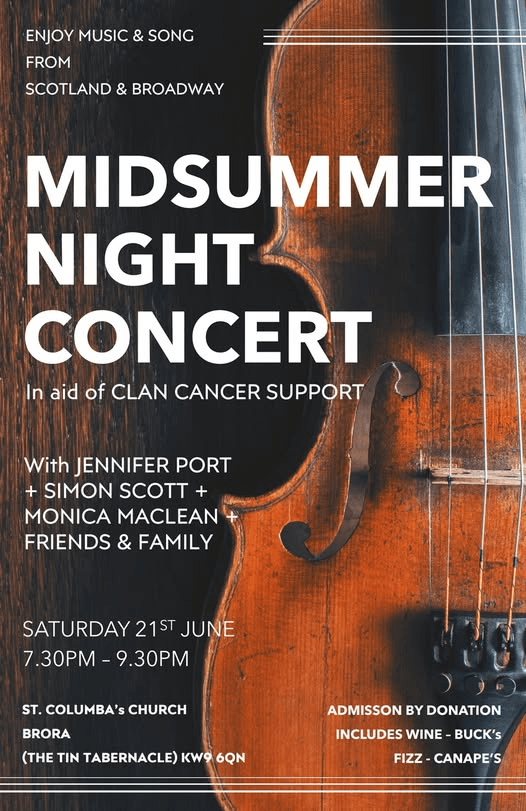

 Scottish Episcopal Church - Dornoch, Lairg, Brora, Tain & Tongue