Sermon for the First Sunday after Christmas 2025

Sermon Matthew 2.13-23

The very last hour of the school term before the Christmas Holidays can for many Head Teachers be a little bit sad. Just before the children and staff go home full of festive cheer, it is our job to walk around school to check that all signs of Christmas have been removed. No tinsel, no trees, no pictures of santa, no cards pinned to notice boards – everything must come down, ready for the beginning of the new term when we return in January.

I know the big day was only a few days ago, but I wonder if anyone in church this morning has already taken down their Christmas decorations at home, or at least started thinking about doing so?  We haven’t.  We leave them up as long as possible. In fact, for us the Christmas decs stay up until at least the feast of the Epiphany – twelve days after Christmas.

It’s really important to appreciate these twelve days of Christmas and we can understand this short span of time as a sort of bridge between the birth of Jesus and his presentation to the world as its Saviour.  We know so little about the years between Bethlehem and Jesus’ appearance at the Jordan River, asking to be baptised by John and so it seems entirely appropriate that we should pause here, on the first Sunday of the season of Christmas, to consider how Jesus got from the manger to Nazareth, the village where he would grow to adulthood.

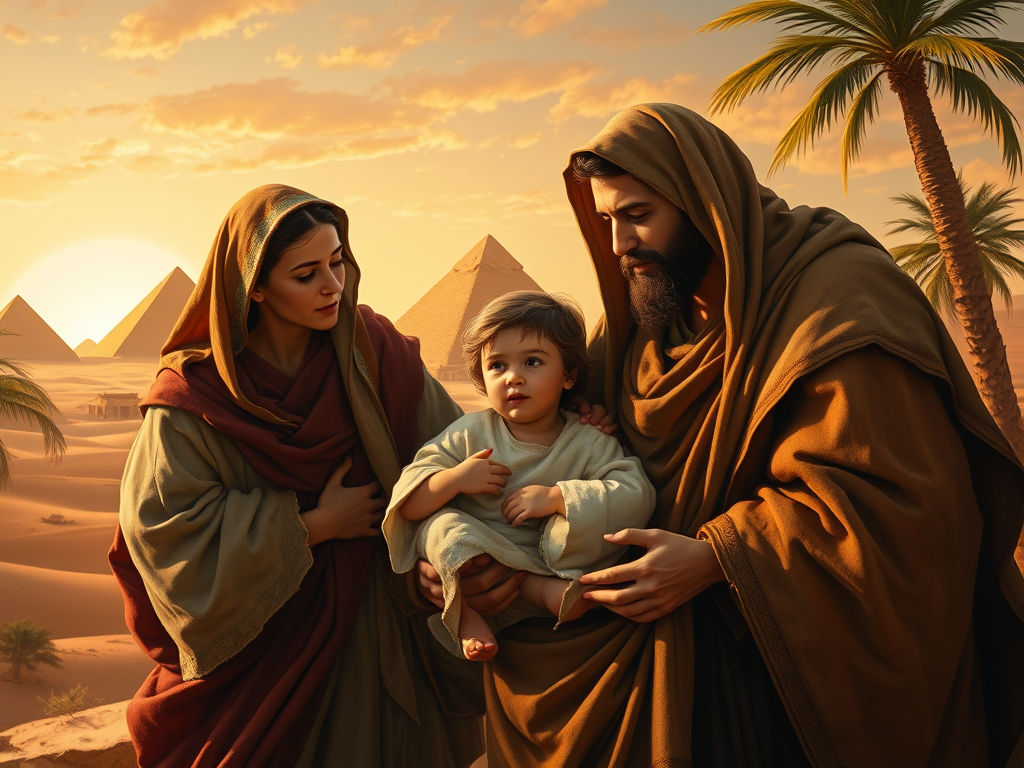
St Matthew follows a clear pattern to tell us this story in our gospel today.  He uses three dreams, three “obediences,” and three geographic locations to describe how prophecies about the Messiah are fulfilled in the birth of Jesus.  Today’s reading picks up the tale where we left off on Christmas Eve.  The magi have come to pay homage to a king.  On their way, they have stopped to ask Herod where to find him.  Herod tries to smooth-talk the magi into letting him know how their quest turns out, but an angel of the Lord warns them to go home by a different way than the one by which they came, and they follow this advice.  The main character in this story is not the magi who have just left, and it is not Mary who gave birth to Jesus. It is not Herod, the evil and paranoid king.  This is Joseph’s story. 

Our gospel passage falls neatly into three sections: God’s call into Egypt, what happens in a kind of “meanwhile, back at the ranch,” sort of section and God’s call back from Egypt, to a final destination in Galilee.  While the writing may be tidy and well-organised, the story Matthew tells is certainly not.  This young family did a lot of travelling, and many who preach on the story choose to focus on Jesus the Refugee as the main point.

Such a focus offers plenty of material. We could talk about the obvious parallels in Matthew’s Gospel with Old Testament writings.  We could consider how Joseph’s flight into Egypt recalls another Joseph, back in Genesis, who went to Egypt against his will, but who became Pharaoh’s right-hand man and made it possible for the nation of Israel to survive, grow, and thrive, even under the hardship of slavery.  Matthew reminds us of the story of the baby Moses, hidden in the bulrushes to protect him from Pharaoh’s slaughter of newborn Hebrew boys in Egypt.  It is clear that Matthew draws a connection between the return of Moses to Egypt after Pharaoh’s death, and Joseph’s sudden return when he learns through a dream that Herod is dead.  The young family’s trip back home to Israel reminds us of the journey Moses led through the wilderness, as the Israelites escaped their captivity in Egypt and headed toward the Promised Land.  Matthew connects the story of Jesus’ early travels to God’s call, protection, and provision for his people throughout history.  It’s a powerful connection.  And there are certainly strong connections between Jesus the Refugee and the plight of refugees throughout the world right now.  Refugees who have been displaced by politics, war, and the struggle with poverty – those who have the same fears and anxiety that Joseph and Mary must have experienced, as they did whatever they could to protect the young child, Jesus.

But nagging in the back of my mind, and perhaps in the back of yours, is the horror of what happens “meanwhile, back at the ranch.”  While it’s important to see how the greater story of God’s activity among his people is connected to, and completed in, the story of Jesus, we cannot ignore those middle verses, the ones that speak of an unspeakable tragedy.

When Herod saw that he had been tricked by the wise men, he was infuriated, and he sent and killed all the children in and around Bethlehem who were two years old or under, according to the time that he had learned from the wise men. Then was fulfilled what had been spoken through the prophet Jeremiah: “A voice was heard in Ramah, wailing and loud lamentation, Rachel weeping for her children; she refused to be consoled, because they are no more.”

The question has been bothering us since the beginning of human history:  How can a just and loving God allow evil to exist?  How can God let innocent people suffer, while evil people thrive and prosper?  The book of Job is filled with this question.  In priest training school, they even give us a name for the problem: theodicy.  But giving it a name, and even knowing that brilliant theologians have been struggling to find an answer for as long as we can imagine, doesn’t help when it becomes personal.  When it’s your child being put to the sword, the question is no longer hypothetical.  The pain is real, and the only question we can raise is “Why, God?”

Make no mistake: the slaughter of those children in Bethlehem was not God’s idea.  It was Herod’s.  Herod the Great never felt his position was secure, and he was known for his paranoia and brutality.  He even had his favourite wife and some of his sons murdered when he suspected them of treachery.  He decreed that forty Jewish nobles should be brought to Jericho to be killed when he died, so that there would be abundant mourning throughout the land at his death.  Thankfully, the son who succeeded him decided not to carry out this final wish.

Matthew is the only source to describe Herod’s murder of the children in Bethlehem.  Some scholars think the event wasn’t noteworthy for first century historians to record, partly because it was only one of many atrocities committed by Herod, and partly because the number of children affected was probably no more than twenty, given that Bethlehem was such a small village.  Such violence against innocent children may have been unremarkable by first century standards, given that children were considered to be little more than property at that time.  They were expendable.  But Matthew names it as an atrocity.  Matthew tells us that God cares that children are massacred.  Misuse and abuse of children was common then, but Matthew explicitly calls that out as being wrong.  Misuse and abuse of children is far too common now, and so we, in our day, must also call that out as being wrong.

We hear of the children in our own country who are victims of human trafficking.  In our nation, the number of Child abuse cases continues to increase year on year. Atrocities against children are just as real now as they were in Bethlehem in 4 BC.

Some amongst us have suffered the terrible loss of their own children.  Maybe they did not die violent deaths, but the loss is still real, and the pain is still acute.  Some know, as others may not, what it means to weep with Rachel, who will not be consoled, because her children are no more.

So, when we ask, “Why, God?  How is this Good News?” it may not help to know that Matthew is painting a bigger picture of God’s providence and protection for his people.  Being reminded that God is not willing for any to perish, but wants to give each of us eternal life might seem like an empty promise.  Knowing that bad things happening to innocent people has more to do with our sinful condition than God’s will for us might be difficult to explain.  We can’t just shrug off the sorrow.  We can’t diminish the pain of the here and now.

It’s a dangerous thing to be human, to be vulnerable, to face the fact of our own mortality. The Good News is not always sweetness and light. That pretty baby in the manger grows up to die on a cross. God has to watch his own Son, his only Son, die a horrible death. And God grieves.

God grieves over all the Herods and the Pharaohs and the murderers and abusers of innocent children. God grieves over us when we turn away from him. God grieves as only a bereft parent can grieve.  That is exactly why this story is part of the Christmas story.  Christ came to be God With Us – Immanuel.  He came to be God with us in our sorrow, God with us in our fear, God with us in our wandering, God with us.  Always.

The world is filled with darkness, with evil evident in every corner.  But God is with us.  The violence that surrounded Christ’s birth was the same violence that would eventually lead to his crucifixion.  Christ went into every dark place we humans must go, even into the darkness of the grave.  But he rose again.  There is no darkness that can frighten God.  God is with us.

Christmas is a dangerous season.  It’s dangerous to be human, to admit our mortality, to hold in tension both this awareness of our vulnerability, and the awareness of God’s great gift to us in the person of Jesus Christ, who made himself vulnerable to the power of evil, and yet conquered it.  The joy of Christmas depends on the joy of the resurrection at Easter.

There’s a little detail in this story, Joseph’s story, which we need to notice. Every time an angel of the Lord appeared to Joseph in a dream, Joseph immediately did what he was told to do.  He did not ask, as the weeping mothers of Bethlehem must have asked, “Why, God?”  He got up in the night, packed his family’s belongings, and he went where he was told to go.  Even when he was afraid, he obeyed.

Only Joseph saw the angel.  Only Joseph had the dreams.  Only Joseph knew the magnitude of his task, to protect the Messiah from the danger of Herod’s henchmen.  Just as Mary did not argue with the angel who told her she would give birth to the Saviour of the World, Joseph did not argue with the angel who said, “Go!”  He just went.  He answered God’s call with action.

God is calling us, today.  He is calling us to be a voice for peace, justice, and grace.  He is calling us to challenge the way things are in the world, to stand against evil when we see it, to be the presence of God for those who suffer violence and abuse, to let them know that God is with us, Immanuel.

When we challenge the world, we make enemies.  Herods and Pharaohs will try to crush us.  But our job is to connect the human story with Christ’s story, to rescue our history from being reduced to a timeline, and allow it to be converted into God’s event.  That event is the breaking into our sin-filled world of the kingdom of God.  As we become aware of God’s constant working in our lives, we are called to participate in that work.  Whether we are sent to Egypt or Nazareth, whether we are called to feed the hungry or clothe the naked or heal the sick, whether we are tasked with comforting the bereaved or spreading hope to those who have lost it, God calls us. May we, like Joseph, answer that call without hesitation, knowing that God is with us, Immanuel.  Amen.

Sermon for Christmas Day 2025

Bill and Ben (our dallies) wish you a very Merry Christmas!

Most of you will know that for many years I have been a Primary Headteacher and the run up to Christmas, especially the Nativity Play has always been my favourite time in school. Watching the children act out this timeless story so confidently, makes me feel so proud of them all and I’ve been involved with many versions over the years. Most have gone smoothly with doting parents ‘ooing’ and ‘aahing’ at all the right moments, but we have had the occasional hiccup.

I remember one year in a school in Bolton, when I had cast the part of Innkeeper number 3 to a five year old called Kyle. Now Kyle was not very happy about this because he wanted to be Joseph and what made it even worse, was that his seven year old brother Sam had been given the part!

However, Innkeeper Kyle learned his lines and rehearsals went well. On the afternoon of the performance, the parents all filed in and there was a buzz of excitement as the children took their places for the start of the show.

The narrator began to read her words beautifully and Mary and Joseph went from door to door trying to find a place to stay. They knocked at the first door – Joseph spoke “I am Joseph and this is my wife Mary. She is going to have a baby and we need a place to stay”. Innkeeper 1 delivered his line perfectly – “Sorry but we have no room”. Joseph and Mary moved on to the door of the next inn.

Now it was at this point that from the side of the stage I could see Innkeeper Kyle stood behind door number three and he had a face like thunder!

Joseph knocked on door number 2. “I am Joseph and this is  my wife Mary. She is going to have a baby and we need a place to stay”. “Sorry, but we have no room” the second innkeeper responded.

So, Mary and Joseph approached door number three and knocked. The door was opened by Innkeeper Kyle with his arms folded across his chest! Kyle’s older brother delivered his line. “I am Joseph and this is my wife Mary. She is going to have a baby and we need a place to stay”. At the top of his voice, Innkeeper Kyle replied – “She can come in, but you can beggar off!”

The school nativity play has become one of the traditional ways that we celebrate Christmas in today’s society.

And We celebrate the coming of God into the world in so many ways: every household has its own habits, every church its own patterns of services, every nation and community its own traditions.

In our own, and many other western nations, the preparations for Christmas involve an awful lot of shopping, food and presents.

In the words of John Betjeman:

We raise the price of things in shops,

We give plain boxes fancy tops

And lines which traders cannot sell

Thus parcell’d go extremely well.

Some ways indeed are very odd

By which we hail the birth of God.

But this is not going to be one of those sermons that tells everyone off for bowing to the commercial pressure of Christmas and missing the heart of it.  Why not?

For one thing I love presents, and I think they are a really important part of Christmas,

But really, it’s because you’re here.  Because it’s taken you time, will, energy, and in some cases, real courage to step through that door just to be here. You’ve pressed pause on the conveyer belt of Christmas so that you can truly enjoy the moment, you’ve made your way here just as the shepherds did, answering the call of the carolling angels.

And because you’ve brought tributes – gifts (not gold, frankincense and myrrh, and I’m not talking about what you’re intending to put in the collection plate either, though that’s part of it, too) – you’ve brought the finest tribute that you can, that of your very selves, together with all the ‘stuff’ that you carry with you, your motivations, your thoughts, the hopes and fears of all your years, as you come to meet the Christ child this morning. You have brought who you really are, and that is the greatest gift any of us has to offer.

But mostly it’s because Christmas isn’t primarily about what we have done, it’s about what God has done. Because Christmas is the great divine ambush, the ultimate proof that it is not so much that we seek God, but that he seeks us.

He is not the precious pearl or the buried treasure that we spend a lifetime seeking, we are the precious pearls and buried treasure that spend a lifetime being found by God.

The epic journey of the Magi, and the chaotic scrambling of the shepherds down the dark Bethlehem hillside are only possible because God had already made the leap from heaven to earth to come among them.  The first move is God’s, and always was.

Our being here in church today – however long and arduous, or short and effortless our journey – is only possible because God had already got here ahead of us, reaching out all over again so that heaven could touch earth for us, right here. ‘The Word became flesh and dwelt among us’.

Because Christmas is the ultimate proof God can find his way into anything and everything, and if we are alert to it, we can see the heart of what Christmas is about wherever we look.  For the heart of Christmas is Emmanuel: God with us. The heart of Christmas is Light in darkness. The heart of Christmas is heaven touching earth.

Yes, indeed, some ways are very odd by which we hail the birth of God, but even in the glitz and bling he is there.  In every shiny Christmas bauble we see the reflection of our own face – and it is a reflection of someone who is made in the very image of God – a human being, the crown of God’s creation, in which he is pleased to dwell.

And if we look a little deeper in that reflection, we see not only ourselves, but those around us, our little corner of God’s world. We do not have to look beyond the material world to catch a glimpse of heaven: because of heaven touching earth we can find those glimpses of heaven right here and right now, everywhere we look. For when God came to earth over 2000 years ago, he never left.

Yes, if we look for him, we can see Christ even in the shiny stuff and in the trimmings.

And even in the darkest corners of the world, God is already there. Jesus called himself the Light of the World, and if you’re the light of the world, you go first to the places that need light the most: the places of deepest darkness. If you enjoy the sight of the candles and the tree lights then you know something about light in darkness, that no matter how dark a place is, even the smallest light brings such hope and warmth.

If you’ve ever been blessed with the miracle of forgiveness, or an act of unexpected kindness, or a much-needed word of comfort or guidance, then you also know something of what it means for heaven to touch earth.  If you’ve ever found the grace to offer those words, or that kindness, or that forgiveness, to someone else, then you know something of heaven touching earth. If you’ve ever sung ‘Be near me Lord Jesus, I ask thee to stay close by me for ever’ and meant every word, then you know something of heaven touching earth.

God is not just here.  Here, in church, that is. God is wherever we find ourselves, God is where the angels sing with joy, and we join in; God is where it is dark, and difficult, and dangerous.  God is here, and God is in our hospitals and hospices, our prisons, and on our streets. And God is in every dark and battered street in Ukraine and Gaza and in every conflict zone in this  war weary world.  For there is no place on earth that’s too dark for the light of God to shine there.

So as heaven reaches out to us this Christmas, along with so many others, scattered across the globe, let us dare to grasp the hand of the tiny child in the manger, and so find that our little bit of earth has been touched, and changed, by a little bit of heaven.

Sermon for Christmas Eve 2025

Well doesn’t our church look absolutely beautiful! Special thanks from all of us to those of you who have decorated our building for the Christmas Season. Between you, you’ve created a scene that brings a smile to our lips and lifts our hearts to heaven.

You’ll have to forgive me for my slightly croaky voice this evening – when putting up our tree at home I accidentally swallowed some of the decorations and now I’ve ended up with a bad case of tinselitus!

Seriously though, our church tree looks so pretty and I’d like us to think a bit about it this evening.

D and J just four years ago – my how they have grown!!

You know, it’s not long ago that having Christmas trees in church was rather frowned upon by some congregations who considered its origins to be connected with pagan practices, and indeed we know that evergreen trees have been used in a variety of religious rites throughout history – the Vikings connected to their great sun god Balder through the worship of the pine tree for example.

But whatever you think about it, the Christmas tree has become one of the main symbols for the Christmas season and it would be a shame to see a wonderful resource go to waste.

Whilst preparing for this evening’s sermon, I’ve been exploring the story of how the evergreen tree first became associated with Christianity and I came across this legend.

Back in the eighth century, St. Boniface was working as a missionary among the Hessian people (who lived in part of the country we now call Germany). One night he came upon a pagan ritual of human sacrifice to Thor, the thunder God. The hessians believed the presence of Thor was in a large oak tree and were preparing the sacrifice in the form of a young man underneath the tree.

We are told that Boniface was a large man with a commanding presence, and just as the youth was about to be killed he stormed into the gathering and ordered that the ceremony be stopped.

As the group stood in fear of this large stranger he challenged their god and ordered the tree chopped down. As the majestic tree fell to the ground, legend says that it revealed for the first time a young fir tree growing between the broken branches of the fallen oak. The people were in awe of the presence of the young tree inside the old one and before they could claim the miracle for Thor, Boniface claimed it for Christ.

He said to them, “This little tree, a young child of the forest, shall be your holy tree tonight. It is the wood of peace, for your houses are built of fir. It is the sign of endless life, for its leaves are ever green. See how it points straight to heaven. Let this be called the tree of the Christ Child; gather around it, not in the wild woods, but in your homes. There it will shelter no deeds of blood, but loving gifts and rites of kindness.”

I don’t know how much of that legend is based in fact. But I do know that the attitude of Boniface in the story represents the true attitude of faith.

Faith is not learning about which symbols are sacred and deciding whether or not they truly represent God. Faith is looking at everything in a new way and seeing God everywhere you look. Faith is looking at your dining table tomorrow and every day and seeing an altar spread with the love of God. Faith is looking at a person that others look down their noses at and seeing in them the possibilities for beauty and restoration. Faith is receiving a hug from a friend and feeling the arms of God wrapped around you. Faith is not seeing different things…faith is seeing things differently.

The Christmas tree is a symbol of joy to people both inside and outside the church. Entire cities gather for the lighting of the town tree, and children in homes across the world take delight in the sparkling lights and bright decorations.

The Christmas tree is no respecter of persons. All nations, races, classes…even all faiths often put up a tree. And to me, that’s what the Christian faith is all about.

From the very beginning in the Hebrew Scriptures when God called Abraham, the intent was that the Word of God be spread to all people and that it be a blessing to all nations.

God is the God of all and the salvation we proclaim in Jesus is offered to all.

The Christmas tree may well be the only symbol we have left that can represent faith to the entire world, exactly because it is common to our experience. And isn’t that what Jesus did so often? What did Jesus choose as the symbols for himself? Bread and wine…nothing exclusive to this group or that…but things that were common and fundamental to the experience of everyone — basic food…a loaf of bread, a cup of wine.

Our beautiful Christmas tree is a reminder that our calling is not to be separated from the world, but simply to live in it and look at it differently. It’s the same physical world…out there and in here. This is not the place to see different things. The church is the place to see things differently. It is the place where those trapped in a cycle of addiction are welcomed and loved as children of God. This is the place where death is seen as the beginning of life, where giving is seen to be receiving, and where becoming a servant of others is proclaimed to be the true foundation of leadership. This is the place where the commonplace is seen as a miracle and where ordinary people realise that they are capable of the most extraordinary things. It is here that water becomes wine, and that wine becomes the life of Christ poured out for us. This is not the place to see different things. This is the place to see things differently. It is the place of transformation.

Once a year, evergreen trees across the globe are transformed. They sparkle with lights and shelter gifts of love beneath their branches. Everybody understands it, everyone has access to it. The Christmas tree turns no one away. So it is with the God we proclaim. God is the God of all. God is the light that shines in the darkness, sheltering gifts of love beneath ever-living branches. The tree stands here, reminding us that our God transforms the ordinary. God takes the secular and makes it sacred…the meaningless suddenly has purpose, the aimless have vision, and the people that walked in darkness have seen a great light.

So my dear friends, don’t come to Christ expecting to see different things. Come to Him expecting to see things differently!

Sermon for the Fourth Sunday of Advent 2025

Matthew 1.18 – 25

On this the fourth Sunday of Advent, the main character in our gospel reading is St Joseph. Now this poor fellow that appears in the nativity scene, unlike Jesus’ mother Mary, doesn’t get to feature in many other places in the gospels.

So, I wonder what you know about St Joseph?

a) What was his job?

b) Where was he born?

c) Who was he married to?

d) Where did he die?

e) Who is he the patron saint for?

f) What was his father called?

(See the answers at the end of this sermon)

This all sounds very respectable, but what a scandal we hear about Joseph and Mary this morning!

An unmarried woman. An unplanned pregnancy. An implausible explanation. It’s not hard to imagine what others were saying and thinking.

If Cissy and Ada (those two hilarious comic characters played by the late Les Dawson and Roy Barraclough) had been around at that time, the conversation over the back wall might have gone something like this:

Cissy: “Ey chuck, did you hear? That Mary from number 26 – she’s pregnant.”

Ada: “Well, I never would have thought it. Mind you, her mother had her later in life you know. But that Mary and Joseph should know better. I mean they aren’t even married yet.”

Cissy: “Well, I heard tell that Joseph’s not even the father”.

Ada: “Yer what – How could she do that to him? He’s such a good and just man.” Well, Who is the father?”

Cissy: “You know, I’m not sure, but that Hezekiah up at the Donkey stable put’s himself about a bit so I here. Anyhow, they say Joseph still intends to take her as his wife”

Ada: “He’s going to marry her after all this?”

Cissy: “The whole things a disgrace”.

Ada: “Her and her love child should be stoned”.

Cissy: “Ooo – that’s a bit harsh”

Ada: “Not at all – the law requires it. I do love a good stoning.”

Cissy: “I suppose your right – it is her own fault after all.”

Now I am sure Joseph heard the whispers and saw the looks, if not in the village, then certainly in his own imagination. Joseph knows this is a scandal. He knows there are questions of faithfulness. The love child in Mary’s womb proves that. By the light of day, it all seems pretty clear. Joseph will awake in the morning and do what he has to do. He will quietly send Mary away. But what appears to be one thing in the light of public scrutiny, becomes another in the night of silence, listening, and waiting.

Yes, this a scandal. But it is not a scandal of immorality. The real scandal is that God is with us. We thought God was up there, or out there, maybe somewhere in the future. But then Mary became pregnant. The scandal of that pregnancy is that God is intimately present. God’s holy spirit fills the womb of Mary. The wind of God is blowing through her life. The breath of God in her is so real that she begins to show like the pregnant woman she is. The scandal is that humanity can become pregnant with God.

Yes, Mary’s pregnancy raises questions of faithfulness. But it is not the usual question or accusation of betrayal and infidelity. Rather, this pregnancy is a statement of God’s faithfulness and commitment to God’s people. In this pregnancy God renews all the covenants of history and again chooses us to be his people. God’s continuing promise to show up and live in the midst of our lives is fulfilled in Mary’s pregnancy. This pregnancy is fleshly faithfulness.

Yes, the child within Mary is a love child. That is not, however, a euphemism for being illegitimate, a child born to unmarried parents. No, this child is the revelation of God’s love for humanity. Love that can be seen, heard and touched. This embodied love of God will feed and nourish God’s people.

Joseph’s daytime resolution to quietly dismiss Mary has given way to a night of dreaming, pondering, and wrestling. Joseph’s view of Mary, her pregnancy, even himself has been enlarged and opened. He has begun to see this situation, this scandalous pregnancy, through the eyes of faith rather than the stares of the villagers. Mary’s story and the angel’s words now speak louder than the villagers’ voices.

The only reason this could happen is because Joseph entrusted himself to the night, to the inner world where angels appear, guide, and speak God’s word. The night of faith shows reality to be more than the daytime drama with which we often live. It is the place where God speaks the truth about us and sees more than we sometimes see for ourselves. It is the night of Emmanuel. Joseph experienced God with him. He found holiness hidden, where it has always been hidden, in plain sight amongst the scandals, the talk, the looks, the questions and doubts.

So Joseph awoke in the morning and did what he had to do. He began emptying himself. He let go of fear. He let go of the villagers’ voices and stares. He let go of his doubts and questions. He let go of his own reputation and standing in the community. He let go of his ideas and hopes for what his marriage to Mary could have been. He let go of the law and punishment. With each letting go Joseph emptied himself so that, by God’s grace and mercy, he might become the womb that would protect, nourish, and provide security to Mary and her child.

He would be the womb that sheltered Mary and Jesus from Herod’s rage and the slaughter of the innocents. He would be the womb that safely took Mary and Jesus to Egypt. He would be the womb that sustained their lives in that land. He would be the womb that brought them back to Nazareth when the time was right.

Isn’t that what wombs do? They are the place where life is created and sustained, nourished and grown. They offer security and protection. They are that deep interior place where God’s life and breath meet and unite with ours to create something beautiful and sacred. The womb Joseph offered was as important as the one Mary offered. Even as God was acting in Mary’s womb to create new life, divine-human life, so God was acting in Joseph’s to sustain that life.

At one level today’s gospel is about Mary and Joseph but at another level it is about you and me. It is about us becoming more open and receptive, more womb-like in this final week of Advent so that we all might give birth to God’s Son in our time and our culture.

Joseph guides us to Christmas reminding us that before a womb can be filled it must first be empty. He invites us to enter the night of faith and to begin emptying ourselves of all that keeps our womb closed. We must let go of all those things that make our womb inaccessible. Things like fear, guilt, resentment and anger, the villagers’ voices and stares, the thoughts that say we are not enough, the doubts of God’s presence, the isolation and loneliness of loss and sorrow. Letting go creates space, openness, and opportunity for God.

Over and over we let go, emptying ourselves until we find that we are nothing and have nothing. That nothingness is our empty womb offered with scandalous faith that it will be filled with God, we will be re-created, the world will hear good news, and once again we will discover God is with us.

What do you know about St Joseph? (Answers)

a) Carpenter

b) Bethlehem

c) Mary

d) Nazareth – (Traditionally thought to be around AD18)

e) Fathers, pregnant women, Those looking for work, immigrants and estate agents!

f) Jacob (according to St Matthew) or Heli (according to St Luke)

Sermon for 3rd Sunday of Advent

Sermon  11.2-11

Each year in the UK over 154 million Christmas crackers are pulled (and just as many bad jokes are read)!

Between us, we Brits eat 308 million slices of turkey, we listen to Christmas songs 460 million times and around a billion Christmas Cards are bought each year.

The British people spend around £4.9m on Christmas nights out during the festive season and over £19 million on presents with each UK household spending an average extra £500 every December – all these big numbers, all the excitement building up.

You can almost feel it – you can almost taste it – you can almost touch it. Christmas Day is less than a fortnight away!

For most people Christmas is a time for excitement in some form or another. Whether the excitement is because we can’t wait to celebrate – or we’ve got some friends or family coming to visit that we haven’t seen in a while – or like me, you get a bit of time off work. There is usually some reason for joy and excitement.

But what happens after Christmas is over? It’s back to normal – sort of.

Some of us step on the scales and realise how much we’ve overindulged. We look at our credit card statements and realise how much it’s all cost and we wonder was it worth it? Did it meet our expectations? Did Jesus coming at Christmas match the excitement? Do the benefits outweigh the costs?

That’s the question before John the Baptist today. Did Jesus’ coming to earth match the excitement that John had built up?

Did the cost of following Jesus outweigh the benefits? Jesus, you know – the one who John claimed would come after him and that would baptise with fire. The one coming after him whose sandals he said he was not worthy to tie – the Lamb of God who takes away the sin of the world. Who is so important and exciting that “I must decrease so he may increase”.

But now in our gospel reading today – we find John languishing in prison and he starts to reflect on what it’s all cost him. Not his credit card – not his waistline – but his freedom.

 And so, from jail, John sends some of his disciples to ask Jesus – “Are you the one who is to come, or should we wait for another?

Now why would John ask that?  Well, it’s because Jesus didn’t turn out to be all John expected him to be. John had become so bold believing Jesus would “cover his back”. He called the Pharisees and Sadducees a “brood of vipers”. He seemed to insult Abraham – remember he said “don’t think just because you’re Abraham’s children”.

But then he goes too far and criticises the King, Herod for marrying his brother’s wife and for that he finds himself in prison.

And Jesus? Well, Jesus was not following John’s expectations.  Remember, John said that the chaff would burn with unquenchable fire.  But Jesus didn’t seem to be pointing the finger of judgment against the evil doers.  This was a disappointment for John sitting in prison, awaiting his own judgment instead of his enemy’s.  Instead, Jesus is proclaiming forgiveness, healing the sick, bringing Good News to the poor.

 Was this really what Jesus was supposed to be doing?  Couldn’t anybody just do that? Are you the one who is to come? Or should I hope for someone else?

Sometimes Jesus said and did things that weren’t what people hoped for.  Like riding into Jerusalem on a donkey instead of in a chariot drawn by horses.

Sometimes Jesus says and does things that aren’t what we hope for.  Maybe at times we are tempted to ask, “Are you the one who is to come, or should we look for someone else?” And, certainly, many have done just that- looked for someone or something else.

Each of us has expectations about the kind of Saviour we want.  Some want a judgmental Messiah who points out where everyone else is going wrong.  To punish the evil doers by locking them up and throwing away the key – with no second chances. Some of us want Jesus to back our favourite cause, a Messiah who will assure us that God is on our side on a particular issue. Or maybe we want a gentle shepherd who will not demand anything of us, but only tell us that he loves us.

Jesus will at times upset our expectations. But that’s when we have to remember to trust His words – “your will be done, not mine”.

John wondered if Jesus was really the one in whom he should hope.  Maybe Jesus wasn’t exactly what John was expecting: He did bring fire – but it was the fire of the Holy Spirit. He did seek out  sinners – but forgave them. He confronted the unworthy– but he confronted them with grace – like Zacchaeus – like the woman caught in adultery – like the Samaritan leper – like the demon possessed man called Legion – even an undeserving dog, the Canaanite woman begging for crumbs from his table.  Grace upon grace.

John the Baptist couldn’t see that grace for himself being locked away in his prison cell. And maybe, at times, it is hard for us to see God’s grace in our times of suffering. But it is there. It’s always there. Paul struggled too with his thorn in the flesh – praying three times to have his suffering removed with the response from God: My grace is all you need – my grace is sufficient.

There will be times when we feel let down by God, like John did. There will be times when we may feel like looking for another Saviour. But Jesus is the only one in whom we can put our hope. As Luke says in Acts 4 – there is salvation in no one else; for there is no other name under heaven that has been given among people by which we must be saved. Jesus Himself says in John 14 – I am the way and the truth and the life. No one comes to the Father except through me.

Jesus is the one who was promised by God. But it’s the mystery of God we don’t always understand.

Jesus himself struggled with this when he cried out from the cross – My God, my God, why have you forsaken me? He was repeating the very words of King David – God’s most loyal subject who cried out words that John the Baptist could also have cried out: My God, my God, why have you forsaken me? Why are you so far from saving me, so far from my cries of anguish? My God, I cry out by day, but you do not answer, by night, but I find no rest.

Words that maybe you have cried out at times expecting more from God. But we heed the words of James today – Be patient, therefore, beloved, until the coming of the Lord. Strengthen your hearts, for the coming of the Lord is near.

 Just as Christmas Day is near, so too is the return of our Lord, as St Paul reminded us recently: Salvation is nearer to us now than when we became believers;

So, friends, you don’t need to look for another saviour. Trust and have patience. Patience in a God who does not want anyone to perish, but loves you as His dear child. Jesus is the one we have been waiting for – Jesus is the one we continue waiting for. And in the words of St Paul: May the God of hope fill you with all joy and peace in believing, so that you may abound in hope by the power of the Holy Spirit.

Sermon for the Second Sunday of Advent 2025

Matthew 3.1-12

Did you hear what John said? The wrath of God is coming. It doesn’t matter who you are or who your family is. The axe is out and ready. Right now the blade is against the tree. And the chopping is about to begin. Every tree that doesn’t produce good fruit is being cut down and burned.

The unquenchable fire is raging, waiting to be fed the chaff. And that’s just the beginning. He said a greater one is coming, one more powerful than himself is on the way.

After listening to John it’s tempting to look at the advent wreath, with its two lit candles, and see the season of Advent as merely the countdown to Christmas.

It’s tempting to leave this wild man behind. We know Christmas came last year. It will come again this year just like it has for over 2000 years. It’s only a few more weeks away.

So maybe we can dismiss John’s message as allegory, metaphor, or symbolism. Maybe it’s the rambling of a man who’s spent too much time by himself in the desert eating grasshoppers.

Or perhaps we hear the message and think about all those other people to whom it applies. You know, the Pharisees and the Sadducees; someone other than us.

But do you know what? We can’t do that. The Church says this viper sermon of John’s is the gospel, the good news of our Lord Jesus Christ according to Matthew. For most of us, though, threats, anger, and judgment are not good news.

We would rather hear and think about the sweet baby Jesus.

But John is not preaching a Christmas sermon. John doesn’t mention a beautiful night with a bright shining star to guide us. There are no humble and gentle shepherds guarding their flocks by night. No wise men bearing gifts from afar. John’s not looking at a manger scene where the little Lord Jesus lays down his sweet head. He seems to have forgotten the innocent and faithful Virgin Mary. And the name Jesus isn’t even mentioned in today’s gospel. This is Advent, the season when wrath, axes, and unquenchable fire are talked about as good news.

John is looking for God to do something drastic right now. John’s message is quite literally, “Repent – turn or burn!” His refrain is, “Wrath, axes, and fire. Wrath, axes, and fire.” God’s coming and He’s going to get you.

I suspect that part of our discomfort with John and his name-calling, his preaching of wrath, axes, and fire is, or at least should be, that at some level we know he’s right.

When we look around our world, read the newspapers, watch the evening news, or examine our own lives we’re confronted with the reality of John’s sermon.

Our world and our lives are not as they should be, as they can be, as God wills them to be. We could each name the sinful or broken places of our lives and our world: anger, violence, greed, poverty, homelessness, war, lives controlled by fear, years of guilt that have crippled us. The list could go on and on.

There’s only one sin worse than the evil itself and that is indifference to that evil. Indifference is more insidious; more universal, more contagious, and more dangerous.

Often we live such busy, exhausted lives that we have become indifferent to what is happening in the world, indifferent to the needs of another human being.

Maybe our world view, even our church view, is so small that if something does not directly affect our lives or the lives of those we love then it is of no consequence to us.

Sometimes the pain and fear in our lives causes us to be indifferent to those relationships that need forgiveness and reconciliation. Maybe you have become indifferent to yourself and can no longer see the original beauty with which God created you. Perhaps indifference has convinced you that your life is meaningless. Indifference comes in many different forms. It is always sneaky, often disguising itself as freedom or independence.

John’s cry of repentance is the call to turn away from our indifference to engage, at a life-changing level, with the coming kingdom and the way that kingdom reorders our relationships and priorities. John’s words are words of interrogation. Do we care enough to change our lives and the world in which we live? Do we love enough to get angry about the suffering and plight of other human beings – even if we’ve never met them?

God does. That’s why divine wrath, axes, and fire are good news. God loves enough to get angry. The good news is that our God is not indifferent. God is not indifferent to creation. God is not indifferent to the evil and suffering in this world. God is not indifferent to His people. God is not indifferent to your life or my life.

God’s concern and love for creation are the source of His anger and Anger is not the opposite of love. Indifference is the opposite of love.

God’s anger is the rejection of indifference. God is paying attention and is present in our lives. The anger of God is a form of His presence and love in this world. God’s anger is not offered as a punishment but as an encouragement to change, to turn our lives around. That can be frightening and even painful. But there is an agony even more excruciating. That is the agony of being forsaken, discarded, rejected, and abandoned. It is the agony of being the object of indifference.

God’s anger is never the goal. The goal of divine anger is not punishment and retribution. Divine anger is the means, the instrument. The goal is love and relationship. Divine anger recognises and celebrates the existence, the sacredness, and the value of every human life.

Divine wrath is God’s expression of longing for us. It is God saying to you and me, “You are worthy of my time and attention. Your lives are worthy of being judged. I care for and love you enough to get angry when you settle for less than I am giving you, when you accept being less than you are called to be.”

Wrath, fire, and axes are God calling us to turn away from, to repent of, our indifference. Where does indifference rule our lives? How have we become indifferent to ourselves, to others, even to God? In what ways does indifference deny you the Kingdom of Heaven?

Wrath, fire and axes are not about destruction or punishment. They are about life, love, and relationship. The unquenchable fire of God’s love burns away our indifference. The healing axe of God cuts away all indifference. The wrath of God reminds us that God cares and that we matter.

To name the places and ways of our indifference is the beginning of repentance and the Kingdom of Heaven has come just a bit nearer than it was before.

“Repent, for the kingdom of heaven has come near.”

Reflection for Advent Sunday 2025

As we journey through Advent, towards the Nativity, there is little doubt what many of us will be doing  – there is the rush to get everything organised for Christmas – cards written, gifts bought and sent, the preparation of food, plans about whose turn it is to go visiting and anxieties about who’ll be offended if we don’t pay them enough attention etc etc…. The rush is on and it’s not surprising that there’s often a hint of panic in people’s conversations – “I’ll never be ready!”

But pretty soon, it will all be over! In a few weeks a new year will have brought us another set of resolutions, in a few more the decorations will have come down, the furniture of life will be back in place and we’ll be back to – well, back to what?

Will life be just the same, or will we be changed?

If we take Advent seriously, there is a chance we will be changed because we will have had an opportunity to reflect again on what it means to say that God came into the world in the humility of the birth at Bethlehem and that he still comes into the world in all its mess and pain and joy, longing for us to recognise Him.

Advent is a godsend, a gift which stops us in our tracks and makes us realise that we hold dual citizenship (of this world and His kingdom) in awkward tension. We are all part of the scene – as Christians we can sometimes appear to be rather superior about what we call ‘commercialisation’ and say that the real Christmas isn’t about that. But actually, if you think about it, the real Christmas is about precisely that: it’s about God coming into the real world. Not to a sanitised stable as we portray it in carols and on Christmas cards, but to a world that needed, and still needs, mucking out! Advent reminds us that the kingdom has other themes to add to the celebration, themes that are there in our scripture readings for the season: Repent, be ready, keep awake, He comes!

Advent reminds us that not only do we live in two worlds – the one that appears to be going mad all around us and the one that lives by the kingdom of God’s values, but that we operate in two different timescales, in chronological time and beyond it. And the point of intersection – where these two worlds meet is now. Scripture readings and prayers which are often used during Advent, remind us that now is the time when we have to cast away the works of darkness and put on the armour of light. Now is when we meet God, because we have no other time.

At whatever level we operate, it’s a time for preparation – a time to put things right – to repair broken relationships or reach out to those with whom you have grown distant – and that might include working on your relationship with God.

Whatever else we have to do, there are only so many praying days to Christmas. It is prayer that gives us the opportunity to focus our recognition of God in every part of our lives. Prayer is not just what we do in what we call our prayer time. Prayer is how we give our relationship with God a chance to grow and develop and, just like any other relationship, it needs time. We don’t stop being related when we are not with the person concerned. We don’t stop being a partner, a wife, husband, child, parent or friend when that person is out of sight or when we are concentrating on something else. But we do become less of a related person if we never give them time.

So, Advent says, make time, create space so that our understanding of God’s love for us (and our love for God in response) can grow. The world is saying “Get on with it – don’t wait for Christmas to hold the celebrations”. Advent says, “Wait, be still, alert and expectant.”

The shopping days will come to an end – there will come a moment when we really can’t do any more. The point of praying or making a space is that we get into the habit of remembering God who comes to us every day and longs for us to respond with our love and service. And so, my dear friends, Heed the voice of St Finnbarr and those like him, “Repent, be ready, keep awake, He comes!”

Sermon for the Feast of Christ the King

When I was a child, back in the late 1970s and early 1980s,  growing up on a council estate in Rotherham in South Yorkshire, I remember that my friends and I used to play all sorts of games in some rather dangerous places.

One of my particular memories is of us running wild on a building site when the estate was being expanded – no security fences in those days of course – those golden days of yesteryear when we didn’t  feel it was necessary to keep the estate kids safely away from the piles of bricks, rickety scaffolding, rusting machinery and half completed buildings.

One of the games we loved playing involved finding a huge  heap of sand or half completed wall – anything we could climb up on. The first one to the top of the heap or wall would claim the kingdom and shout, “I’m king of the castle and you’re the dirty rascal.” The rest of us would charge the kingdom. Some tried pulling the king down. Others tried pushing the king off the castle. We all wanted to take over the kingdom.

Each attack on the king was in some way an unspoken demand for proof. “If you’re really the king, prove it. Defend yourself. Show us your power and strength. Save yourself and your kingdom. Because if you don’t I’ll take it for myself.” Each one of us wanted to climb the heap of sand and proclaim that we were king (or queen of course) of all that we surveyed!

It was a great game. We had a lot of fun and I’m sure many of you played very similar games, if not the same!

But when we look back and reflect on how we played, I wonder if it did begin to nurture in us an outlook that has become a bit of a problem.

You see from being children we have grown up – but many of us have never stopped playing the game. We have become adults and ‘King of the Castle’ has become a way of life.

Our heaps of sand or half built walls, our high places are now made up of our personal success and money, power and control or reputation and popularity.

For some of us, the heaps of sand have become our families, our children, or the fairy tale of living happily ever after. Others have climbed the walls of being right, holy, or respectable.

Often our kingdoms have become ways of thinking, political parties, or social groups. Our nation and even our church have become king of the castle playgrounds.

There are all sorts of kingdoms. Each one of us can probably name the sand heaps of our lives, the sand heaps on which we have played king or queen of the castle.

The adult version of king of the castle has become about filling our emptiness, fighting our fear, and ultimately establishing some type of order and control.

What began as a child’s game has become the reality of our adult lives.

For many of us life is a constant scrambling to establish and maintain our little kingdoms, to convince ourselves as much as anyone else that we are okay, we are enough, we are the king or queen. And isn’t that a hard way to live?

Today, the Feast of Christ the King, celebrates and reminds us that playing king of the castle does not have to be the final reality of our lives.

Life can be different. We do not have to spend our lives trying to get to the top of a three-foot heap of sand. We do not have to spend our lives trying to keep our balance on top of a half-built wall as others try to push us off.

Christ the King invites us to stop playing the game. Life does not have to be, was never intended to be, an ongoing game of king of the castle.

If we choose to stop playing the game, it means we must give up our little kingdoms. We cannot celebrate Christ the King if we continue fighting our way up the sand heap.

We can have one or the other but not both.

Today in our service we will again pray, “your kingdom come.” It rolls off our tongues with ease and familiarity.  But I wonder if we really know what we’re asking for and do we really mean it? Implicit in that prayer is the request, “my kingdom go.” “Your kingdom come, my kingdom go.”

It’s one thing to pray for God’s kingdom to come. It’s another to let our kingdom go. After all we’ve been kings and queens of our own castles for a long time. Or at least we’ve convinced ourselves that we have.

It’s not easy to let go of our kingdoms and more often than not I think we try to negotiate a deal with God. “Ok God. Prove you are the king and then I’ll step down. Show me evidence of your kingdom and then I’ll let go of mine.”

The leaders, the soldiers, one of the criminals – they all want the same thing. They want to see proof that Christ is the king. They want to see evidence of his kingdom. We all do. After all, if Jesus is really the king, the one to rule our lives, and we are supposed to believe that – then let him prove it. “Save yourself if you are the Messiah of God. Save yourself if you are the King of the Jews. Aren’t you the Messiah? Then prove it. Save yourself and me.”

At one level I think we want to see Jesus come down from the cross. We want to see his wounds disappear. We want to see a well-dressed king – one with physical strength, military might, and political power. We want to see something spectacular, something beyond the realities of our ordinary lives.

At a much deeper level, however, these demands are about more than just Jesus saving himself from death, from physical pain, from political defeat.  At this deeper level we are crying out: “Save yourself and us from our own unbelief. Save yourself and us from our need to control. Save yourself and us from the fear that this little heap of sand I call my kingdom is all that there is to my life. Show me. Right now. Prove who you are.”

But you know what – he won’t do it – at least not in the way we usually want. Jesus will not offer us proof of his kingship. Instead he offers us the kingdom. He invites us to share in his kingship.

That happens in the silence of the deepest love.

The leaders are scoffing at Jesus. He responds with silence. The soldiers are mocking him. He responds with silence. One of the criminals derides him. He responds with silence. All are demanding proof. None are getting what they ask for. Jesus does not take himself or the criminals off the cross. He doesn’t answer the leaders. He refuses to respond to the soldiers. He is silent.

In that silence the other criminal begins to understand. It’s not about getting proof of Christ’s kingship – it’s about letting go of our own kingship. It’s about coming down from our little heaps of sand and realising that we already are, and always have been, royal members of God’s holy kingdom.

This realisation underlies the criminal’s cry, “Jesus remember me. Remember me not because of what I have done or left undone. Remember me in spite of those things. Remember me not because of who I am, but because of who you are.” His cry to be remembered is the cry of one who has emptied himself of everything, has let go of every last kingdom, and whose very life and existence are entrusted to the God who remembers. That is the reign of Christ.

The reign of Christ does not mean we now have all the answers, that everything is fixed, that there is no more pain, or that every problem has been eliminated. Jesus will not take us off our crosses. Instead, he gets up there with us. He does not fix our lives. Instead, he enters into the reality of our ordinary existence. We are remembered – and right here today, in the reality of our everyday lives, in the midst of our pain, in the midst of our dying, in the midst of our brokenness, in the midst of our guilt – Christ the King says to us, “Truly, I tell you, today you will be with me in Paradise.”

Sermon for St Margaret of Scotland – 16.11.25

Who was Margaret of Scotland? I wonder what you already know about her – or what you think you know about her?

It’s strange to start at the end, but Margaret died on 16th November in the year 1093 and that’s the reason that her feast day is on this day.

She’s not one of particularly well-known saints, especially outside of Scotland and many people don’t have any idea about who she was or what she did, but as we learn about her today and we get to know her story better, I’m sure most of us will come to admire her, and maybe even see her as a role model for ourselves and for our lives as followers of Jesus.

So let’s take a brief look at her life. Margaret was the granddaughter of the English king Edmund Ironside, but because of dynastic disputes she was born in Hungary, in the year 1047. She had one brother, Edgar, and a sister, Christian, and many people in England saw her father Edward Ætheling as the rightful heir to the throne of England. Those of you who know your history  will confirm that Edward the Confessor became King of England in 1042, but that he never had children, and in 1054 the parliament of Anglo-Saxon England decided to bring Margaret’s family back from Hungary so that her father could inherit the throne when King Edward died. So, the three siblings were brought up at the Anglo-Saxon court under the supervision of Benedictine monks and nuns, who trained them according to the Benedictine ideal of a life of work and prayer.

It’s hard to overstate the influence of those Benedictines in Margaret’s life. From them she learned the importance of balancing times of prayer and times of working for the good of others.

Margaret’s father died in 1057, and her brother Edgar became heir to the throne. But his succession was not to be – King Edward the Confessor died in 1066, and we all know what happened in that year? Of course, William the Conqueror invaded England and claimed the throne for himself. Edgar and his sisters were advised to go back to Hungary for their own safety, but on the way their ship was blown far off course by a fierce gale. They spent some time in northern England and then sailed up the coast to the Firth of Forth in Scotland, where King Malcolm gave them a warm welcome to his kingdom.

Margaret was now about twenty years old; Malcolm was forty, and unmarried, and he soon became attracted to her. But she took a lot of persuading because she herself wanted to become a Benedictine nun, and besides which Malcolm had a very stormy temperament! It was only after a very long time of reflection that she finally agreed to marry him, and their wedding took place in the year 1070, when she was twenty-three. In the end, although she was much younger than him, she was the one who changed him; under her influence, he became a much wiser and godlier king.

Of course, Margaret was now in a high position in Scottish society, and was very wealthy according to the standard of the day. But she continued to live in the spirit of inward poverty. She saw nothing she possessed as belonging to her; everything was to be used for the purposes of God. As Queen, she continued to live the ordered life of prayer and work that she had learned from the Benedictines. In a very male-dominated society she was only the wife of the king, but nevertheless, mainly because of her husband’s deep devotion and respect for her, and because of her own personal integrity, she came to have the leading voice in making changes that affected the social and spiritual life of Scotland.

Margaret would begin each day with a prolonged time of prayer, especially singing the psalms. In this she was following the example of the Benedictine nuns; the Rule of St. Benedict prescribes seven prayer services a day, and in this way the whole book of one hundred and fifty psalms would be prayed through once a week!

After her prayer time, we’re told that orphaned children would be brought to her, and she would prepare their food herself and serve it to them. It also became the custom that any destitute, poor people would come every morning to the royal hall; when they were seated around it, the King and Queen would enter and ‘serve Christ in the person of his poor’. Before they did this, it was their custom to send out of the room all other spectators except for the chaplains and a few attendants because it was important to Margaret that what they did was done for the love of God and the poor, not to win spiritual brownie points from admiring onlookers.

The church in Scotland had been formed in the Celtic way of Christianity. But Margaret had been raised in the way of Rome, and she was keen to bring Scotland into unity with the rest of the world. However, she didn’t do it in a domineering or authoritarian way. She often visited the Celtic hermits in their lonely cells, offering them gifts and caring for their churches. But she also held many conferences with the leaders of the Church, putting forward the Roman point of view about things like the date of Lent and the proper customs for celebrating the liturgy and so on. In the end she convinced them—not so much because of the strength of her arguments, but by the power of her holy life.

In those days many people in Scotland used to go on pilgrimages to see the relics of St. Andrew at the place now called ‘St. Andrew’s’. Margaret wanted to help the pilgrims, so she had little houses built on either shore of the sea that divided Lothian from Scotland, so that poor people and pilgrims could shelter there and rest after their journeys. She also provided ships to transport them across the water. And interestingly enough, that place in eastern Scotland is still called ‘Queensferry’!

I think it’s fair to say that most people from the past who are recognised as saints were monks and nuns who lived lives of celibacy, far removed from the demands of the world and the pressures of family life. But Margaret is remembered as having a happy family life. She had eight children—six sons and two daughters and her three youngest, Edgar, Alexander, and David, are remembered as among the best kings Scotland has ever had.

I love hearing about the lives of the saints, not just because of their intrinsic value as stories about people who have gone before us in our lives of faith, but because there is always something we can take, reflect on and use to shape our own lives as followers of Jesus.

Like Margaret, we’re all busy people. Many of us work long hours at demanding jobs. Some of us are retired of course, but so many times I hear retirees claiming they’ve never been so busy and wondering how they had time to work!

So, how are we to avoid becoming burnt out? Where can we find strength from God to deal with the everyday challenges that life sends our way?

Surely our answer as Christians is that we need to stay in touch with God so that we come to know his presence in our daily lives – God loves us and wants each of us to experience his love. One of the best ways of staying in touch with him is prayer. In prayer, we can lay down our burdens in God’s presence. We can bring our requests—for others and ourselves—to the one who’s best able to deal with them. We can thank God for the blessings we receive and ask God’s forgiveness for our wrongdoings and shortcomings. We can listen to the voice of God in Scripture and in silence and seek a word from God to guide us through our day.

Now praying seven times a day, as Margaret did, might be a bit much for some of us! But maybe we could manage once or twice? Perhaps at the beginning and end of the day, we can turn to God for strength and peace.

‘Love God with all your heart and love your neighbour as yourself’.

Jesus’ vision is a life of loving relationship with God and our neighbour. Many of us are getting better at doing a lot to help our neighbour, but my friends,  let’s not forget about our relationship with God. Margaret of Scotland was a very busy person, but she never forgot her daily time with God in prayer. Let’s follow her example, and be people of prayer as well as people of good deeds. The two belong together, and when we combine them, like St Margaret, we’ll find richness in the life for which we were made.

Reflection for Remembrance Sunday

I wonder if you have ever played that game where you try to remember objects on a tray? A feat of memory! Memory yes, but not really remembering. If you have ever played this game, I bet you are now remembering it. The fun, the laughter, the people you played it with. This is Remembering. Mentally and emotionally placing yourself back into a moment.

Remembering thoughts, feelings, smells, relationships. The difference between memory and remembering. One is simple factual recall, the other forms us as human beings.

Remembering connects us individually and collectively: telling us who we are, where we come from, and linking us to our community, our friends, and our families.  

The loss of life in the Great War was dramatic, traumatic, and affected every community across our country and beyond. After the Armistice in 1918, many didn’t talk about it for years, but collectively the nation needed to remember.

The trauma and loss of life were so significant that remembering became vital. Not simply recalling a list of battles fought and campaigns won or lost, but a re-membering, of people, of lives, of relationships. The importance of lost individuals as members of the community.

Remembering each individual within a collective remembering of millions. Because those who died had value, they had innate worth. For all it is the overwhelming numbers we recall in history books, grief was for the individual.

So why do we still fall silent? In 2014 I went to see the Sea of Poppies Installation at the Tower of London. I eavesdropped on the crowds’ conversations and many of them were remembering a specific family member. A family member of whom they have no ‘memory’ and yet, re-membering was still important. 100 years later a Great Niece or a Great Grandson was there, moved to tears. A treasured moment, not because of memory, but because that individual mattered within their family story. It is through remembering that generations and their stories interweave and matter. Sadly, this ‘war to end all wars’ did not end conflicts, so we also remember many who have died in conflicts since. Generations past, and indeed present, whose stories of war and its impact are remembered.

When we are in despair, we can feel that God has forgotten us. That we have been abandoned. Even Jesus on the Cross shouted out ‘My God, my God, why have you Forsaken me?’ (Mark 15.34b).

This heartfelt cry of the deep human fear of being forgotten certainly found an echo in the trenches of the First World War, and for many who have known armed conflict. The Old testament prophet, Isaiah speaks into this space. ‘Can a mother forget the babe at her breast, and have no compassion on the child she has borne? Though she may forget, I will not forget you. See I have engraved you on the palms of my hands’ (Isaiah 49: 15-16).

In the middle of desolation, forsakenness, the isolation of being forgotten, it is being remembered which gives us back our humanity, evidenced on the engraved palms of God. Remembering is a human action that helps us to feel valued. God tells us that remembering is even more a divine action that gives value to humanity.

Today is our opportunity to remember and grieve personally and collectively for the individuals from our community. Giving back our humanity in the worst of circumstances. God tells us that we matter more to him than a baby does to its mother, that remembering us is a divine action that gives value to humanity, that he is prepared to sacrifice himself for us.

Today we remember those who have also followed that command; that greater love hath no one than this, that they lay down their life for their friends. We, their friends, will remember them, and their innate worth as human beings, both to us and to God.