And who is my Neighbour?

The Week of Prayer for Christian Unity runs each year from 18th until 25th January. Now you might be wondering why it’s these particular dates.

The 18th January is when we mark the Confession of Peter when he was led by God’s grace to acknowledge Jesus as the Christ when Jesus asked his disciples, “Who do people say that the Son of Man is?” getting a variety of answers and then “But who do you say that I am?” and Simon Peter answered, “You are the Messiah, the Son of the living God.” You can read the full exchange in Matthew 16:13-20. 

The 25th January is when we celebrate the conversion of Paul the Apostle and what happened on the ‘Road to Damascus’ when Saul who had been persecuting the early Christians became a follower of Jesus and was renamed Paul.

The theme of Christian Unity is reflected in the fact that Peter was Apostle to the Jewish Christians and Paul Apostle to the Gentile Christians. Aspects of this will be discussed in our Lent Study when we will be studying Paul’s Letter to the Galatians which was written to address divisions over such matters. Outline details of the Lent Study can be found later in the Newsletter.

Back to the week of Prayer for Christian Unity. Each year the Christian’s from a particular country prepare service and daily reflection materials and this year’s service was prepared by an ecumenical team from the West African state of Burkina Faso (formerly French Upper Volta and then on independence the Republic of Upper Volta). The theme chosen was ‘You shall love the Lord your God… and your neighbour as yourself’ (Lk 10:27) the material being based on the Parable of the Good Samaritan.

This parable is of course one of the best known passages of Scripture, yet one that never seems to lose its power to challenge indifference to suffering and to inspire solidarity with those who are marginalised or outcast. It’s a story about crossing boundaries and emphasises the bonds that unite the whole human family regardless of race, creed, religion, ethnicity and so forth.

In choosing this passage for the Week of Prayer for Christian Unity, the churches of Burkina Faso invited us to join with them in self-reflection as they (and we) consider what it means to love our neighbour in a world riven with war and conflict, where there are many people displaced or persecuted. Communities in the UK may be less vulnerable to the sort of acts of mass violence that there have been recently in Burkina Faso, but there are still many living with the memory and/or the threat of serious violence, centred on issues of identity and belonging. 

Ecumenical services were held in St Finnbarr’s on Monday 22nd and in St Andrew’s on Wednesday 24th January, prayerful events that demonstrated a visible unity of local Christians. In these services people from across denominational boundaries reflected on the fact that there are also groups within our own communities, including people from ethnic minority backgrounds, people seeking asylum and others who for one reason or another are marginalised and who feel particularly vulnerable to misunderstanding, hostility and even violence.

Loving our neighbours as ourselves is something that we should all reflect on regularly, especially during Lent and in particular the question: “and who is my neighbour?

Blessings
James

Bishop Mark’s Christmas Message 2023

Glory to God in highest heaven, and on earth, peace to all in whom God delights.

So sang the angels as they told the shepherds of the birth of Jesus.  Across the world those words are proclaimed in nativity plays and carol services; in places filled with joyful worshippers, excited by the festivities past and yet to come. But they are also proclaimed on battlefields and in refugee camps. They are heard in Israel and Palestine, in Russia and Ukraine and in the darkest places in our own communities. They are heard by people who have little to be excited about or to look forward to.

Yet in all these places it is the same message: the message of Peace, the Christmas message of Peace on Earth. Many of those who gather to listen to the Christmas story are seeking the same thing, a place and time of peace.

Too often those same people find themselves caught up in conflict, poverty and loneliness, yet all are those in whom God delights for God delights in creation, in us and in the wonders that we perform.

So I ask that we consider what we do this Christmastide. Do we hear the angels cry, then smile and drop off back to sleep around the campfire, or do we get up and go to find the Christ child? Do we put the call for peace into action? Do we gather with Jesus and demand justice and security for all? For let me assure you, God delights in all of us, God reveals that in his love for us through the life, death and resurrection of the child we gather to celebrate Christmas.

Last Christmas we prayed for those caught in conflict in Ukraine, and one year on, we pray for them again, and this time they are joined in our prayers by those whose lives are under constant threat as war wreaks its terrible toll in the Middle East; in the Holy Land. We pray for a permanent ceasefire there, and call on our leaders to see that peace is the only way forward, while the war they pursue or facilitate will only deepen the wounds.

Against that backdrop, how can we rejoice at this time, when there is so much suffering? But rejoice we must, as we retell the story of the love that came down to us, and all the time remembering that we are called not simply to listen to the angels but to respond, to be the peacemakers, in our homes, in our communities and in our hearts.

God bless you and may you rejoice this Christmastide wherever you are.

Blessings
+Mark

In the season of expectant waiting …

The are many deeply troubling events and situations in our world just now. Over the past year or two many of the old certainties, both political and personal, seem to have been swept away. And so it was for Jesus’s Disciples after His death and resurrection and for His followers ever since, but if our faith means anything, it must speak to us in troubling times as well as times of joy and celebration.

At such times, we need to choose either to live by the ways of the world or by the ways of God. That doesn’t mean separating ourselves off as a holy huddle focussed in on ourselves, hiding away from a world of dubious motives and evil actions and having anything to do with the other people living in it. No, we’re called to be in the world but not living by many of its cherished values; to be God-centred rather than self-centred.  In Advent, as we start a new church year, we have a few weeks to pause and reflect on what Jesus the Christ really means in our lives; and how we might respond to that realisation.

In our tradition, we re-tell the story of Jesus each year. I find that leaving the old year behind at the end of November and starting a new year on the first Sunday of Advent gives me a boost, just when I need it, when the days are short and winter is really beginning to take hold. It’s that sense of anticipation, that waiting to see what’s going to happen, that pause before the busyness of the festive season.

However, once things have started, most of us want to get to the conclusion as quickly as possible, preferring things to happen at once if not before. However waiting is an important discipline in our lives. The scriptures remind us that “those who wait on the Lord will renew their strength”. In fact, patience is a wonderful gift of the Holy Spirit, allowing us to take our time and live in the moment rather than always wanting to have arrived at some point in the future.

In Jesus’ time, people had waited a long time for the coming of the Messiah.  We all might long to see more decisive action from God; bringing justice and peace to our world and some stability and certainty, not least in the Holy Land where such appalling things are happening. In the Christ Child there is a clear sign of God’s commitment to us, in spite of our waywardness. In Jesus, God is with us, as one of us, a mystery “which passes all understanding” and one that we need time to reflect on. God’s gift to us in this season of expectant waiting, is the space to prepare ourselves to be able to sense and accept all that God longs to give us.

Let us keep a watchful Advent, so that when the time comes, we may celebrate with joy the one who came, the one who will come again, the one who promises to accompany us each step of our life’s pilgrimage, however uncertain the times.

Blessings
James

Love your neighbour as yourself

I’ve been away this past week or two in Cheshire staying with my sister who is convalescing after sustaining a number of fractures. It has been a very frustrating time for her as she is not able to do much and is largely immobile. I have in the course of this also spent quite a lot of time on trains, which to my surprise ran largely to time.

As I travelled, a quite appalling situation has been unfolding in the Middle East. We have seen just how low humanity can stoop in the way that people treat other people. The history of conflict teaches us that increasing the level of violence rarely achieves anything except escalation, until eventually there has to be a sitting down to talk about it and resolving things through negotiation. Along the way there is generally an appalling loss of life and often many of those killed and maimed are not ‘combatants’ but innocent men, women and children.

Contrasting with some of the worse aspects of the human condition, I have witnesses many acts of kindness during my time away. Random acts of kindness to strangers on trains and at stations as well as the kindness of friends and neighbours of my sister who have brought round cakes, meals, flowers and those who have just dropped by for a bit of a chat.

Whilst I was in Cheshire, the rains from Storm Babet struck. This was of course a day or two before they arrived in Angus and Aberdeenshire then coming on to Sutherland and Easter Ross. Massive amounts of rain running off fields and overwhelming the culverts and brooks resulted in a great deal of flooding around my sister’s village and I spent a happy day bailing out a cellar until someone kindly lent us a pump to keep the water below ground floor level!!

We watched as cars and lorries rushed at the flood waters outside the house and every so often one would stop, the engine overwhelmed by the 18 inches of water. On one occasion a lorry driver was very abusive to a driver whose car was stranded in the middle of the flood, using language that I wouldn’t dare repeat here, because his progress was being obstructed, but one or two of those who passed by stopped to offer advice or see if they could help. Sadly we were marooned and couldn’t get out without letting water into the house – perhaps I should have taken a pair of waders:-)

In the Gospel this Sunday, Jesus says:

“‘You shall love the Lord your God with all your heart, and with all your soul, and with all your mind.’ This is the greatest and first commandment. And a second is like it: ‘You shall love your neighbour as yourself.’ On these two commandments hang all the law and the prophets.

I give grateful thanks that many of the people that I encountered during my time away seem to embody that message and I hope and pray that others will see their example and do likewise.  Our world and particularly the Middle East so desperately needs that.

Blessings
James

Who is running this show?

I have recently been reviewing a book for the Church Times. The author is Annie Worsley who was an academic – a physical geographer whose specialism was landform. She and her family had visited the Highlands of Scotland for many years and in particular the more remote parts of Wester Ross. A decade ago she and her husband decided to trade in their busy lives in the North West of England and settle on a couple of old crofts in South Erradale to the West of the Torridon Mountains. They were both fond of walking and climbing and looked forward to getting better acquainted with this remote area. 

However as in many things in life, the best laid plans … Annie developed a debilitating autoimmune condition as a result of Lyme disease which reduced her to what she describes as “muddleheadedness and painful hobbling”. As so often happens, the plans we make are rendered worthless by events beyond our control. This was the case for Annie and her husband who were not able to tramp the Western Highlands together.

However Annie was a keen photographer and observer of the natural world.  She was able to get out for short slow walks and also observe the world around by looking out of the windows. So for several years she recorded what was happening in the vicinity of their home at Red River Croft in pictures and copious notes.  The book “Windswept”, that I was sent to review, was the result of her observations, reflections and recollections.  Annie adapted to her changed circumstances and her delightful book is testament to that.

Well that set me thinking about the extent to which God controls what happens in theworld. While Scripture affirms the sovereignty and power of God, it also provides examples when God doesn’t seem to be able to accomplish something. For example in Matthew’s Gospel, Jesus seems to be unable gather Israel because they were unwilling –

Jerusalem, Jerusalem, the city that kills the prophets and stones those who are sent to it! How often have I desired to gather your children together as a hen gathers her brood under her wings, and you were not willing!

Matthew 23:37-38

or in the second letter of Peter we read –

But do not ignore this one fact, beloved, that with the Lord one day is like a thousand years, and a thousand years are like one day. The Lord is not slow about his promise, as some think of slowness, but is patient with you, not wanting any to perish, but all to come to repentance.

2 Peter 3:8-10

Of course many in our world will never come to God or to repentance. But even so God’s will isn’t simply imposed on us.  Without ‘free will’, we’d just be robots not free agents, able to respond to those around us and to the the God who loves us. As Peter says in his first letter –

For it is God’s will that by doing right you should silence the ignorance of the foolish. As servants of God, live as free people, yet do not use your freedom as a pretext for evil. Honour everyone. Love the family of believers. Fear God. Honour the emperor.

1 Peter 2:15-17

In Mark’s Gospel we read –

 “And looking at those who sat around him, he said, ‘Here are my mother and my brothers! Whoever does the will of God is my brother and sister and mother.’

Mark 3:34-35

Well brothers and sisters, through prayer and reflection we can endeavour to discern the will of God for us in our lives and make the most of the opportunities that open up, even if they may not be what we initially desired, hoped for or planned.

Blessings
James

The Business of Creation

It seems to me that sometimes in church we seem to see creation as something that happened. It’s as though God ‘did creation’ in under a week, rested a while and that’s it. There are of course subsequently instances of God’s revelation but it’s always revelation that happened ‘way back then’ and is recorded in Scripture. From time to time in the Hebrew Scriptures God appeared through the odd burning bush a few smitings and getting the people of Israel out of a jam occasionally, such as out of the hands of the Egyptians. God also sent various prophets to try to get the message across, to no avail, the people just killed them.

Finally, rather fed up, God sent his only begotten son to show sinful humanity how it should be done, even to the extent of laying down His life. God knew that most people wouldn’t get it, but that the penny would drop for a minority and that would make all thedifference. Christ’s ministry was then written up in the Gospels and added to by revelation to the Apostle Paul and to St John the Divine and then that was it. There’s nothing further to be said except continuous praise and thanksgiving to God.

Now I stress that this is only how it sometimes seems.  That’s not what I believe and for me that understanding of things just doesn’t work. God may have rested on the Sabbath, but come Monday morning, was back in the office continuing the work of creation as part of continuing revelation. God’s revelation occurs not only in what was created but also in the ways of creation, in it’s development and evolution, but also in the lives of individuals, communities and cosmically. 

The evidence is all around us, if we only have eyes to see and ears to hear, but sometimes it’s revealed in living ‘parables’ that many neither see nor hear, what is all around them if they only stopped to look and listen. None of this denies the truth of Scripture, it’s just that it doesn’t end there. If one believes, as I do, that God’s continuing revelation is a part of who/what God is then it follows as night follows day that creation must be continuing because that’s a fundamental part of the nature of God.

I find it awesome how God’s creation can so often adapt and change no matter what humanity does to it: spoil heaps, poisoned ground, polluted air and contaminated seas and waterways, creation has considerable in-built ability to bring forth organisms and communities that can colonise and ameliorate.  However the problem is that it’s not always on a timescale that’s helpful to humanity. That of course is why we have a climate crisis.Now that is something to reflect on this month, in this the Season of Creation.

Blessings
James

Thankfulness

I suppose that as I have got older, I have come to appreciate more the simple, ordinary, everyday, things of life – the sunrise, the dew on the grass, the spring flowers, the laughter of children and so on. It is not hard to make supplications to God when things are not going well and we feel that we need divine intervention, but it’s much easier to forget to give thanks to God for all the simple gifts that God gives us and without which we would not be able to survive.

A few years ago when I was travelling back from Edinburgh, our train was delayed just before Perth, to allow the train from Glasgow to go on ahead of us. Now those of you that travel this route will perhaps have guessed that we were supposed to join that train from Glasgow, for the journey from Perth to Inverness, but we arrived in Perth just as it pulled out. By this point the next train to Inverness had been cancelled on account of the weather. Some of our group got a little bit upset, but as a lovely lady said very movingly, after you have had a phone call from the back of an ambulance to tell you that your only daughter is being rushed to hospital in a critical condition having been seriously injured in a road accident, little inconveniences like missed connections never seem quite so important again.

This week I listened to a number of people grumbling about ruined holidays because of high temperatures and wild fires on the news and moaning that the authorities or airlines of tour operators had not done enough to help them, in contrast to those who expressed their gratitude for what had been done for them and that they, their fellow holiday-makers and their hosts had all escaped uninjured and alive.  Of course I have sympathy for people who suffer the disappointment of disrupted holidays, postponed operations and all the other things that don’t go according to plan, but it just goes to show that we can never be in complete control of our lives and have to rely on the grace of a God who “moves in mysterious ways His wonders to perform”.

The ancient Eucharistic liturgies began their Eucharistic prayer with thanksgiving for creation and only afterwards for redemption through Christ. One of the earliest, “The Liturgy of St James” used in the Church of Jerusalem, which was used as a basis for the 1764 Scottish Communion Office by Thomas Rattray, Bishop of Dunkeld. 

In the Preface at the start of the eucharistic prayer we find the words:

It is very meet, right and our bounden duty to praise Thee, to bless Thee, to worship Thee, to glorify Thee, to give thanks unto thee, the maker of all creatures visible and invisible, the treasure of all good things; the fountain of life and immortality; the God and Governor of the universe: to whom the Heaven and the Heaven of Heavens sing praise, with all their hosts: the Sun and Moon, and the wholes choir of Stars: the Earth and Sea and all things that are in them

Liturgy of St James

Later on in the Eucharistic Prayer we find:

Remember, O Lord, to grant us temperate weather, moderate showers, pleasant dews, and plenty of the fruits of the earth, and to bless the whole circle of the year with thy goodness. For the eyes of all hope in Thee, and thou givest them food in due season; thou opened thy hand and fillest every living creature with thy gracious bounty.”

Liturgy of St James

I wonder whether we should not return to such wide-ranging and expressive offerings of thanksgiving, as I feel that our current Eucharist is focussed too narrowly on thanksgiving for bread and wine and the sacrifice of Christ, when we have all so much more to be thankful to God for.

Perhaps a greater appreciation of all that we take for granted might make us more sensitive to what our over-consumption is doing to “the Earth and Sea and all things that are in them” … and that wouldn’t be a bad thing.

Blessings
James

The “Two-Book” Approach to Revelation

Yesterday, when I was out walking our Collie, Moss, in a generally fairly uniform patch of managed pinewoods, I saw a single rather striking white foxglove. Now most of the foxgloves around us are purple, but there weren’t even any of those in the vicinity either. I found this discovery a very moving spiritual experience and it set me thinking about the revelation of God. 

One view is that God’s Revelation is more or less circumscribed by Scripture and that any consideration of God in Creation is confined to a literal interpretation of Genesis 1 and 2, which themselves contain two quite different accounts of Creation. It would seem that at that point all creatures had been designed and given their place on earth and nothing much has changed in that regard since. God of course also revealed himself in Jesus Christ in ways narrated by the Gospels and attested to in the Epistles.

This view seems to suggest to me that God did Creation and then retired for a while, popping up in the lives of the people of Israel for about 6000 years before deciding to do something decisive about these rebellious folk who had played fast and loose with the Covenant that He entered into with Moses on Mount Sinai and which we know as the Ten Commandments. He decided to enter into a New Covenant through the life and ministry, death and resurrection of His only begotten Son Jesus Christ. Then having sorted things out and inspired a number of folk to write it all up for our instruction, He retired and stopped revealing Himself.

Well you won’t be surprised to hear that I don’t buy that rather reductionist view of God and Revelation. Do we not see the face of God in each other and in the whole of the created world revealing itself anew every day? Of course I am not the first to suggest such a radical thing.  It seems to me that it’s exactly what St Francis’ life and work revolved around and The Patristic theologian Maximus the Confessor claimed that “Creation is the accuser of the ungodly” and even went as far as to say “that by means of the visible [natural] world we should understand whence we came, what we are, for what purpose we were made and where we are going

Pope John Paul II picked up the theme in January 2000 when he said:

In beholding the glory of the Trinity in creation, man must contemplate, sing and rediscover wonder. In contemporary society people become indifferent ‘not for lack of wonders, but for lack of wonder’ (G. K. Chesterton). For the believer, to contemplate creation is also to hear a message, to listen to a paradoxical and silent voice, as the ‘Psalm of the sun’ suggests: ‘The heavens are telling the glory of God; and the firmament proclaims his handiwork. Day to day pours forth speech, and night to night declares knowledge. There is no speech, nor are there words; their voice is not heard; yet their voice goes out through all the earth, and their words to the end of the world’ (Ps 19: 1-5).

JOHN PAUL II – GENERAL AUDIENCE – Wednesday 26 January 2000

Nor is this only a recent idea, Article II of the Belgic Confession of the Reformed Churches of the Netherlands from 1561 asks: 

By What Means God is Made Known unto Us”.

Article II of the Belgic Confession

The answer:

We know Him by two means: First, by the creation, preservation, and government of the universe; which is before our eyes as a most elegant book, wherein all creatures, great and small, are as so many characters leading us to see clearly the invisible things of God, even his everlasting power and divinity, as the apostle Paul says (Rom. 1:20). ‘All which things are sufficient to convince men and leave them without excuse’. Second, He makes Himself more clearly and fully known to us by His holy and divine Word, that is to say, as far as is necessary for us to know in this life, to His glory and our salvation.

Article II of the Belgic Confession

So as you enjoy the summer weather (whatever form that may take), I urge you to rejoice in God’s continuing revelation in all of His Creation and in everyone that you meet and treat both with the care and respect that they deserve as beloved creations of their Creator.

Blessings
James

It’s always the innocent who suffer most

For the first half of the 20th century, present-day Sudan was a colony of the British Empire. Sudan achieved independence from Britain in 1956 but civil war was already brewing between the north and the south. Part of the problem is the clash of cultures, religions and ethnicities of sub-Saharan Africa with those of the Arab Islamic world. Since 1956 there have been only 11 years of peace and so more than 50 years of civil war at one level or another. 

Sudan is the largest country in Africa and borders nine other countries, including Egypt, Chad, Kenya and Ethiopia. The capital of Sudan, Khartoum, sits where the White Nile and the Blue Nile join together to form the Nile which flows north to Egypt and into the Mediterranean. Now Sudan has a population estimated to be about 40 million, of which 52 percent of which are African, and 40 percent Arab. Over two thirds of the population is Muslim while Animists and Christians, who for the most part live in southern Sudan, account for a third. Arabic is the official language, and the government has attempted to impose Islamic sharia law on the whole country since 1983, which led to Sudan’s longest civil war, from 1983 to 2005 and involved not just southern Sudan but the people of the Nuba mountains, Blue Nile and eastern Sudan as well, and the peace agreement in 2005 left those other conflicts unresolved.

The Darfur conflict erupted 20 year ago in April 2003 when the Sudan Liberation Movement attacked Sudanese military forces at the al-Fashir airport in North Darfur. In the years that followed, hundreds of thousands of people were killed, and millions more displaced in the war between rebel forces and the military.

Recently our news media have been awash with the rapid escalation in violence in Sudan. Intense clashes between Sudan’s military and the country’s main paramilitary force have killed hundreds of people and sent thousands fleeing for safety, and this latest civil war threatens to destabilise the wider region.

There is currently a power struggle between the two main factions of the military. The Sudanese Armed Forces (SAF), broadly loyal to Gen Abdel Fattah al-Burhan, the country’s de facto ruler, are pitted against the paramilitaries of the Rapid Support Forces (RSF), a collection of militia who follow a former warlord Gen Mohamed Hamdan Dagalo, known as Hemedti.

As well as a tussle for power, at the root of much of the conflict are the economic and political disparities in the regions, and since no government, civilian or military, has seriously addressed these, it was only a matter of time before the violence in specific regions like Darfur expanded to engulf the centre and has led to the rapid exodus from Khartoum and ordinary people try to escape the fighting.

For civilians in Sudan at the moment, simply holding on to hope is a huge challenge. Those stepping out of their front doors don’t know whether they’ll return alive. As Christian’s we need to pray for the safety of those living in fear. We need to pray for justice and healing, and for an outcome that doesn’t open the way to more radicalisation and tension. And we need to pray that the Sudanese people may in due course be ruled by a government that respects human rights, freedom of worship, equality and dignity for all of whatever race or religion.

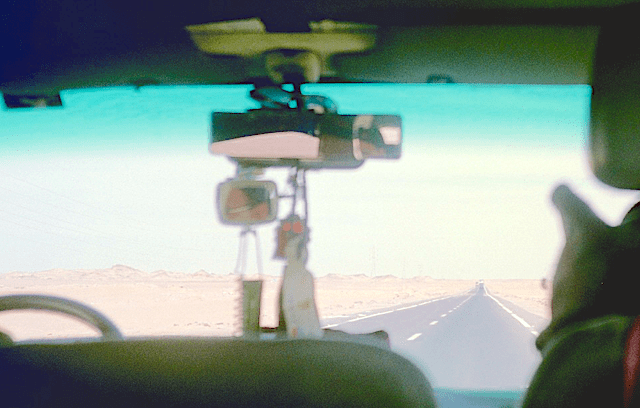
Driving the long desert road in Southern Egypt towards the Sudanese border in 2004

Blessings
James

Engaging with Christ’s Passion

Festividad de San José – Triana

As many of you know, Anna and I have just returned from a break in Andalusia in southern Spain. We arrived in Triana, a small village in the hills, on the day that they were celebrating the Festividad de San José (the festival of St Joseph) sensibly transferred to Saturday so that everyone could enjoy a good party then a four hour procession and then another party (all this of course after starting with a Festal Mass at 12 noon).

According to those in the know, there are such events regularly in towns and villages around the region mark particular saints’ days but of course everywhere has a full programme of events to mark Semana Santa (Holy Week). In Velez-Malaga (the nearest large town to where we were) the celebration of Semana Santa is recognised as one of the most impressive in the whole of Spain.

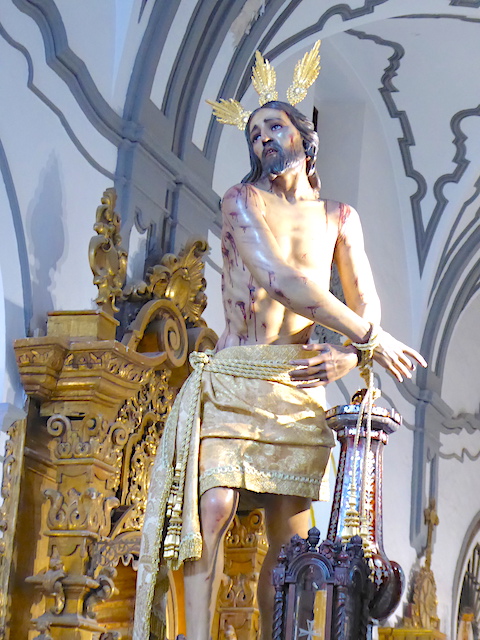
Along with everything you would expect of a fiesta (including amazing food and drink), there are processions, much like the one we witnessed in Triana, which become ever more grand throughout the week – starting on Palm Sunday and culminating with the Resurrection procession on Easter Day. The processions are accompanied by bands with crowds carrying candles. There are also huge floats (tronos) weighing up to 5,000kg, carried by large numbers of people, that depict scenes from the events in the week leading to Christ’s death and Resurrection.

Good Friday trono – Malaga

From time to time the crowd are become silence and the procession pauses while a saeta is sung. A saeta is an acoustic religious song (often in Flamenco style) sung from a balcony accompanied by wonderful guitar playing. After the saeta, the band start up again and theprocession moves forward. These processions seem to be able to blend celebration with sombre reflection and at the same time are also incredibly beautiful and moving.

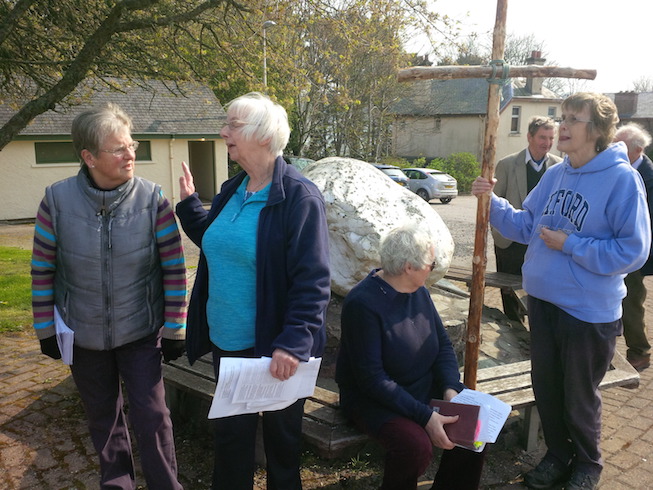
This year along with other local churches we are once again holding a Walk of Witness from Kincardine Church in Ardgay to Creich Church in Bonar Bridge. There will be no huge tronos (just a rough wooden cross carried by one person), nor a band (just the voices of the pilgrims), but just like the people of Velez we will be marking the events of Christ’s last week, in Scripture, in prayer and in song (though maybe not in a flamenco style), as we pause from time to time along the road. When we arrive at Creich Church we will also be ‘partying’ with hot cross buns and coffee!! You are all of course welcome to join us and to bring your friends (we start at Kincardine Church in Ardgay at 10:15am).

Walk of Witness – Ardgay/Bonar

It is interesting to experience and reflect on how different cultures mark the milestones of our faith. We all start with the triumphant entry of Jesus into Jerusalem on Palm Sunday and throughout Holy Week we engage with a number of important events as we reflect on our faith and on the life of Christ, before finally emerging blinking into the light of Easter. Although the Resurrection is a fundamental part of our Christian belief, there can be no Resurrection without all that precedes it, including of course the brutal execution. Conversely without the Resurrection, Jesus was just a good man who was unjustly put to death in a brutal, inhumane and horrendous manner – something that sadly happens daily around the world.

I would therefore encourage you all to engage with some of the events and services during Holy Week – Stations of the Cross in Dornoch on Monday or Tain on Wednesday, our service in Dornoch on Maundy Thursday with its reliving of Jesus washing the feet of his disciples, sharing the last supper with them and then retiring to the Garden of Gethsemane to pray and our moving reading of the Passion from John’s Gospel in our service of Tenebrae or Walk of Witness on Good Friday all tell the story of what happens between Palm Sunday and Easter Day and help us to really understand what our faith is about.

Blessings
James

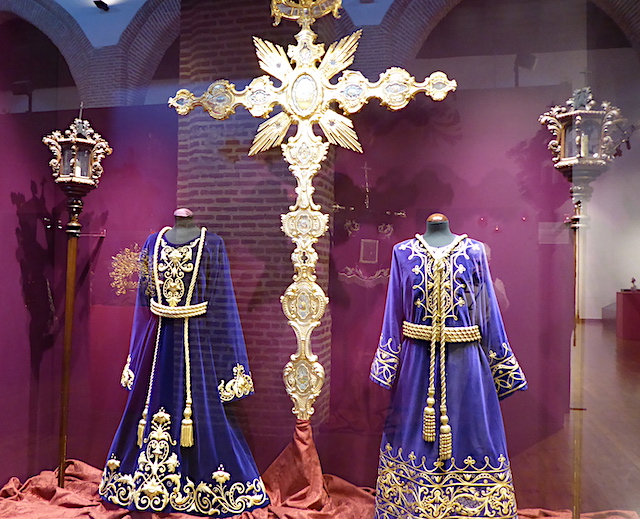
procession costumes – Velez-Malaga