By Our Wounds we are Healed

The church is the people. It isn’t grand buildings, though of course we have one or two of those and in passing on our heritage, we have to look after them. It isn’t administrative structures, though of course some element of that is necessary to stop the whole thing descending into chaos, even though we can find that sort of thing both distracting and irritating.

The Body of Christ is people, and most importantly the relationship between them. When Anna and I joined the East Sutherland and Tain churches nearly ten years ago now, each of our congregations was, in various ways, different to how it is now, ten years later. The main difference is that there were people who are no longer with us and the relationships between members of the congregations and with their clergy were also different.

So quite a lot has changed. Sadly we’ve lost some very dear friends from our midst. Our congregations are all growing both in numbers, in faith and in the relationships that have been built, often in adversity. There’s an atmosphere of positivity, hope and optimism across our congregations, with so many bringing their many and varied gifts to bear for the benefit of all.

As the Apostle Paul reminds the Christians in Corinth:

Now there are varieties of gifts, but the same Spirit; and there are varieties of services, but the same Lord; and there are varieties of activities, but it is the same God who activates all of them in everyone. To each is given the manifestation of the Spirit for the common good. To one is given through the Spirit the utterance of wisdom, and to another the utterance of knowledge according to the same Spirit, to another faith by the same Spirit, to another gifts of healing by the one Spirit, to another the working of miracles, to another prophecy, to another the discernment of spirits, to another various kinds of tongues, to another the interpretation of tongues. All these are activated by one and the same Spirit, who allots to each one individually just as the Spirit chooses. For just as the body is one and has many members, and all the members of the body, though many, are one body, so it is with Christ.

1 Corinthians 12.4-12

I’m sure that none of us are as perfect as we’d wish to be. However it’s all the flaws, weakness and failings that make us the people that we are, not just the striving to be better. Looking back over the last ten years, I realise that many of you have ministered a special grace to me and to Anna, as well as to each other, and that grace wasn’t unconnected with those characteristics that you may be less than satisfied with, in both your personality and abilities. It’s precisely such things that give each of us a profound sympathy for the waywardness and self-hatred of the human heart and through that we can minister effectively to each other in all the messiness and imperfection of our lives. God works in many ways.

As Richard Holloway writes:

The word becomes flesh in all its uncertainty and awkwardness. Grace comes to us through weakness. Grace uses every available weakness to pull down our might. It undermines the cruelty of our strength by throwing us on the mercy of our weakness. It is by our sin that we are saved, because through it we reach for the grace that alone sustains us.

As Christians we should refuse to collude with the conspiracy of success and uniformity that characterises so much of the world around us and sadly has even started to invade parts of the Christian Church. To do this we need to reject the lie of human perfectibility and learned to live with only two certainties. By grace we all minister to others. By our wounds we are healed and bring healing to others. Clergy come and go, but the Church is it’s people in relationship.

God bless you all and may you rejoice in God’s presence this Christmastide and throughout 2025 wherever you are.

Blessings
James

They are at Peace

The first half of November is a season of remembrance. All Saints Day on the 1st, All Souls on the 2nd and Remembrance Sunday on 10th. The Book of Wisdom, leaves us in no doubt that death isn’t the end.

But the souls of the righteous are in the hand of God,
and no torment will ever touch them.
In the eyes of the foolish they seemed to have died,
and their departure was thought to be a disaster,
and their going from us to be their destruction;
but they are at peace”. 

Wisdom 3:1-3

It tells of three powerful and connected truths: one, the souls of the righteous are in the hand of God; two, they are safe, and three, they are at peace.

Think of that for a moment, in terms of all those who we have loved but see no more. Thistext says: “They are safe”. In terms of those killed in war, both in the past and also in wars being fought at the moment, many died earlier than they should have. 

But now, says Wisdom, “no torment will ever touch them”, because “they are in the hand of God”. As the Book of Revelation, puts it, “God will wipe away every tear from their eyes…mourning and crying and pain will be no more”.

Wisdom goes on to say that they are “at peace”; there’s no more worry, no more anxiety, no more struggle, pain or suffering. Wisdom tells us that the faithful departed are safe in the hand of God, and are at peace.

A life of faith in Christ and his Way is possible only through a life of love – love for God, love for others, love for oneself. In death the faithful will truly know and be taken up into the God who is Love itself.

So for those of us that are left behind, it’s for us to ready ourselves, so that our death will be the way to perfect happiness and union with God and to make ready for that time by seeking and finding each day s the God of love, in every person we meet and in every experience we have. 

Blessings
James

It’s Harvest Time

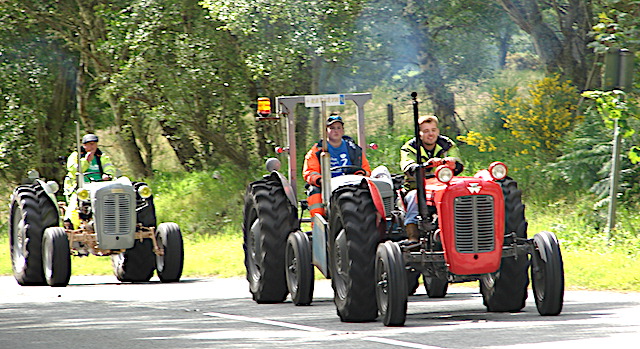
Hoorah!! It is harvest time again!! There you are, hurtling along the A9 in your car on some mission of huge importance, muttering venomously at cyclists in helmets shaped like wasps’ bottoms, inconsiderate enough to want a bit of your road (you of course hoping they can’t lip-read) and cursing that you’ve already been caught behind yet another camper van, supermarket wagon or log lorry.

Rounding a bend you come up behind the ponderous majesty of a slow-moving tractor and trailer. On closer inspection over the next ten minutes, you realise that it’s not a single tractor and trailer, but is actually a convoy of three tractors and two trailers, and the glory of the aforementioned ponderous majesty begins to lose it’s shine!

Hoorah. It’s harvest time again. And I’d bet that sitting in that queue of cars, most of you don’t start singing hymns, psalms and songs of everlasting thanks and praise to our great God for his generous provision, or bless the farmers or the shop and factory workers or thelorry drivers for the work they do to put food on our plates!

So here’s the challenge for harvest and beyond. If you get stuck behind a tractor or a combine or a plough or any mysteriously shaped implement or a delivery wagon or a log lorry, take it as an opportunity for reflection, for thanksgiving and for praise to the God who lies behind all of it and give us so much that we often take for granted.

So let us make a start but praying a rather lovely prayer for the harvest of God’s love which is ultimately what gives us the all the wonderful things that we enjoy from day to day.

Lord, your harvest is the harvest of love;
love sown in the hearts of people;
love that spreads out like the branches of a great tree
covering all who seek its shelter;
love that inspires and re-creates;
love that is planted in the weak and the weary, 
the sick and dying.

The harvest of your love 
is the life that reaches through
the weeds of sin and death
to the sunlight of resurrection.

Lord, nurture my days with your love,
water my soul with the dew of forgiveness,
that the harvest of my life might be your joy.

Frank Topping

Blessings
James

A little Wisdom every day

From time to time in this season after Pentecost, we have a reading from the Wisdom literature in the Hebrew Bible. For instance a couple of weeks ago we had a reading from Proverbs and in a couple of weeks time we have another from the Wisdom of Solomon. In that latter there is a verse concerning reason:

For they reasoned unsoundly, saying to themselves, ‘Short and sorrowful is our life, and there is no remedy when a life comes to its end, and no one has been known to return from Hades.’

Just by chance I had read that Andrew Carnegie had this carved above the fireplace in his library at Skibo “He that cannot reason is a fool, He that will not a bigot, He that dare not a slave.” Having checked with someone that this was indeed the case, I set about trying to discover where the quote comes from.  In his autobiography Andrew Carnegie described a visit he made to the house of a Major Stokes who was the chief counsel of the Pennsylvania Railroad. Carnegie was deeply impressed by a passage he read displayed in Stokes’s residence:

The grandeur of Mr. Stokes’s home impressed me, but the one feature of it that eclipsed all else was a marble mantel in his library. In the center of the arch, carved in the marble, was an open book with this inscription:

He that cannot reason is a fool,
He that will not a bigot,
He that dare not a slave.

These noble words thrilled me. I said to myself, ‘Some day, some day, I’ll have a library and these words shall grace the mantel as here.’ And so they do in New York and Skibo to-day.”

I wondered who had actually written it in the first place and in what context.  Eventually I found the answer.  Sir William Drummond the late eighteenth and early nineteenth century Scottish poet and writer wrote a philosophical treatise published in 1805 called ‘Academical Questions’, which contains this passage: 

Prejudice may be trusted to guard the outworks for a short space of time, while Reason slumbers in the citadel; but if the latter sink into a lethargy, the former will quickly erect a standard for herself. Philosophy, wisdom, and liberty, support each other: he who will not reason is a bigot; he who cannot is a fool; and he who dares not, is a slave.

Now does that tendency to suspend reason and instead rely simply on prejudice, apply to so much that has happened recently and is still happening in our world today and is it not something that we should all guard against?

The Reverend Billy Graham apparently suggested as a discipline reading the chapter of Proverbs which matched the number of the day the month. Now it’s possible that perhaps it’s for no better reason than there are 31 chapters in Proverbs though of course reading a bit of Solomon’s Wisdom each day is probably a good thing anyway.

Blessings
James

Unless you change and become like little children

On 13 March 1996, 43-year-old Thomas Hamilton arrived at Dunblane Primary School and murdered sixteen children and their teacher. The Dunblane massacre as it became known, remains the deadliest mass shooting in British history.  He entered the school gym, in which a Primary One class were preparing for a PE lesson and started shooting.  Within four minutes he had killed sixteen children, as well as their teacher, Gwen Mayor, injuring fifteen others. He then turned the gun on himself. The children who died were all aged between five and six years old.

Two days after the shooting, a vigil and prayer session was held at Dunblane Cathedral which was attended by people of all faiths.  The following Sunday the Queen and Princess Anne, attended a memorial service at Dunblane Cathedral.

In trying to find hymns that offered an appropriate response, John Bell realised that there was precious little and so he wrote one.  The result is the hymn “There is a place prepared for little children”. I find these extracts very moving:

There is a place where hands which held ours tightly
now are released beyond all hurt and fear

There is a place where al the lost potential
yields its full promise, finds its true intent

There is a place where God will hear our questions
suffer our anger, share our speechless grief,
gently repair the innocence of loving
and of belief.

At 11:47am on Monday in Southport, three young girls were killed in a “ferocious” knife attack at a Taylor Swift-themed summer dance and yoga class. Eight more children were injured, with five left in a critical condition. Two adults also suffered critical injuries in this truly horrendous incident. A 17 year old boy from Banks in Lancashire a few miles away has been arrested on suspicion of murder and attempted murder, all in all a tragedy for so many people.

Few of us, if any, can fully comprehend what the parents of the Dunblane children went through or what the parents of the Southport children are going through. All we can do is hold them all in our prayers.

Lord of all compassion

We pray for all of those caught up in the tragedy in Southport.
For the children who have lost their lives
For those who are worried about people they love
For those who will see their loved ones no more
For all whose lives will never be the same again
Lord Have Mercy.

For those in need of the peace that passes all understanding
For all who turn to you in the midst of turmoil
For those who cry out to you in fear and in love
For all whose lives will never be the same again
Lord Have Mercy.

For those in confusion and those in despair
For those whose tears are yet to dry
For those in need of your unending love
Lord Have Mercy

Lord of all compassion

Father and unfailing friend,
be with all the people of Southport 
as they try to take up the threads of their lives again
facing the future with fresh courage and renewed hope;
through Jesus Christ our Lord.
Amen.

Blessings
James

Evangelism, Advertising and the Past

In the last year two members of our congregations who were over 100 years old have died. Eric Dawson from St Finnbarr’s died in September last year at the age of 100 and Barbara Rae in the St Andrew’s congregation died only a couple of weeks ago at the age of almost 104. Both were stalwart members of their congregations and contributed so much to both them and the communities in which they lived, they affected the lives of all those that met them.

At Barbara’s funeral, I was reflecting on how much has change she saw born as she was in the immediate aftermath of the Great War. When she was 19, Britain was was once again plunged into war and Barbara lived and served through the second world war, and all its after-effects – a life changing and life affirming experience for so many of that generation. Barbara’s war included the blitz of Liverpool were she worked but she was at the time still living with her parents in Birkenhead. A bomb badly damaged their family home in May 1941 and they had to move out, but they all survived. In one of life’s coincidences, in the 50s, Barbara and husband Willis moved to the same road, some 10 doors along.

Every week in the Church Times, there’s a short piece printed from the archives and I found the piece from 20th June 1924 fascinating. It concerns an international advertising convention held in London in July. As a sign of how much times have changed since Eric and Barbara were children, it’s interesting to note that a programme of religious services and meetings had been arranged to satisfy the spiritual needs of delegates to the convention:

On Sunday morning, July 13, it is proposed that the delegates shall choose between Westminster Abbey, where two thousand seats are to be reserved for them, and the Bishop of Durham will preach, and sitting under Fr. Knox in Westminster Cathedral. In the afternoon there is to be ‘a great inspirational meeting’, and in the evening a special service in St. Paul’s Cathedral, and others for Nonconformists. Such recognition of religion is, of course, to be welcomed, but we confess to feeling a little uneasy about the two days’ discussion on Church advertising. ‘The personal touch in Church advertising’, to mention the topic of one of the speakers, sounds suspiciously like a form of vulgarity which we devoutly hope will remain for ever in its native land across the Atlantic.

Church Times Archive 20th June 1924

There are those in the church who believe that the best route to evangelism is through advertising, but the idea somehow sits rather uneasy with me. In my view, the best way to attract people to our faith is by example. If in acting out our Christian faith, we set an example that causes people with whom we have interactions to think – whatever it is that motivates them is something that I could do with a little of.

Leo Tolstoy wrote that:

he became a Christian because he saw that the men and women round about him who believed in the faith, received from it a power that enabled them to face life and death with peace and joy

On the other hand, Friedrich Nietzsche, the nineteenth century philosopher, wrote about Christians and Christianity. He praised Christianity as a religion but he never became a Christian. When asked why not, he said:

For a group of people who claim to believe in Resurrection, none of them looks redeemed”. Oh dear!! 

In contrast Eric and Barbara clearly thought that a sign of Resurrection Joy is looking and acting redeemed and by so doing, bringing a sense of hope to others that’s tangible and irresistible. They were, to put it simply an inspiration to us all and an example for the rest of us to follow. May they both rest in peace.

Blessings
James

Like the sound of a rushing wind

Christmas, Lent, Holy Week, Easter and Pentecost are behind us and we have now arrived at the Feast of Trinity and the start of what is often referred to as ‘ordinary time’.  Since December we have reflected on God’s coming to earth as a human child at Christmas and the change that makes to God’s relationship with human beings, we have reflected on our relationship with God in Lent.  The levels to which human beings can stoop to get their own way and to stay in power are in many ways the focus of Holy Week with God rising above it all in the Resurrection at Easter. 

We have heard about how God the Son appeared to His despondent disciples during the seven weeks of Easter, culminating in His Ascension to be reunited with God the Father. Finally last week we reflected on God the Holy Spirit descending upon the disciples empowering them to continue the Son’s teaching and action in the world. ‘God in three persons, Blessèd Trinity’ as that well know Trinity hymn ‘Holy, Holy, Holy’ puts it.

In my sermon last week on the Feast of Pentecost I said:

The Ascension doesn’t mean that Jesus is abandoning them, that He’s running away. He’s leaving so that something more powerful can take his place. He repeatedly tells them what it is that will take his place. He tells them that he is sending them the Holy Spirit, the advocate, the Spirit of Truth, the Comforter. The purpose of the Holy Spirit is to do in them what He himself had been doing among them. The message is simple, something that’s familiar (Jesus with the disciples in person) is to be replaced by something that’s unfamiliar (God’s Spirit within them). 

The Holy Spirit is God’s way of being present with them, and also with us, all the time (if we allow that to happen), making our life and work continuous with the life and work of Jesus. So in the same way that God was present to the disciples in Jesus, he can also be present to others through the disciples and through each of us. Everything that Jesus said and did amongst the disciples can be continued in what they and we say and do. The Holy Spirit is the divine power, God at work in and through us as the perpetuation of Jesus presence in the world amongst those who follow him.

After the service, a visitor (who incidently was from New Zealand and who with a friend from England was nearing the end of their cycle ride from Land’s End to John O’Groats) remarked that it was wonderful to hear a sermon preached about the Holy Spirit, because it always seems to be a rather mysterious and little talked about aspect of God. At that service we also sang one of my favourite hymns ‘Spirit of God, come dwell within me’ (not to be confused with the better know ‘Spirit of the living God’ or ‘Spirit of God unseen as the wind’ sung to the ‘Skye Boat Song’). No, this one is sung to a wonderful Gaelic Air called ‘Leaving Lismore’.  The first verse and chorus are:

Spirit of God, come dwell within me.
Open my heart, O come set me free.
Fill me with love for Jesus, my Lord.
O fill me with living water.

Jesus is living, Jesus is here.
Jesus, my Lord, come closer to me.
Jesus, our Saviour, dying for me,
and rising to save his people

Now that seems to me to capture rather neatly what the Spirit of God is and what the Holy Spirit does for us in our lives and should provide encouragement to us all.

Blessings
James

Pay Attention!!

Cartoon by Dave Walker from Cartoon Church used with permission

I was browsing though a book that recently arrived on my desk, when I came across this rather interesting passage:

Even of those who do come [to church], we find many behaving themselves in such a careless Manner, as if the Worship of God was either not their Business there, or not worth minding. Some sit all the Time of the Prayers; or put themselves into such other lazy and irreverent Postures, as shew sufficiently that they have no Sense of what they should be doing, nor any Awe or Reverence of the glorious Being they come to address. Others lay themselves to sleep, or trifle away their Time thinking of their worldly Affairs. Others gaze and stare upon the Congregations, or keep talking and whispering with their Neighbours; and this is especially observable while the Lessons are reading; as if the Holy Scriptures, though given by Inspiration of God, were not always to be heard, marked, learned and inwardly digested . . . Others there are, who do indeed shew some Inclination to mind the Prayers and all the rest of the Service; but they do it with so much Ignorance, Distraction, or Confusion, as discover that they do not rightly understand the Difference between one Part of the Service and another . . . We often find them repeating after the Minister what he alone should speak, and they should only hearken to. They are also apt, when they join the Prayers, to say them after him so loud, as must needs be troublesome, and disturb those that are near them . . .

It comes from a tract ‘Directions for a devout and decent behaviour in the public worship of God; more particularly in the use of the Common Prayer appointed by the Church of England’, which was published in the early 1700s. It was apparently so popular that by 1799 it had reached it’s thirtieth edition and had been translated into both Welsh and French.

Just in case you thought that this was purely an English problem and we in Scotland were immune from such deviations from ‘seemly conduct’, closer to home the ‘Directory of Publick Worship of God’, published in Edinburgh in 1645 for the benefit of Scottish congregations included this paragraph: 

The publick worship being begun, the people are wholly to attend upon it, forbearing to read any thing, except what the minister is then reading or citing; and abstaining much more from all private whisperings, conferences, salutations, or doing reverence to any person present, or coming in; as also from all gazing, sleeping, and other indecent behaviour, which may disturb the minister or people, or hinder themselves or others in the service of God.

So that is us all told!  It set me wondering if inattentiveness to what is going on in church is such a bad thing or if what my training rector when I was a curate used to call “looking about yourself” might actually be part of encountering God rather than a turn away from God.  It is interesting that whilst Scottish edition of ‘The Directory’ is concerned with signs of inattentiveness that cause noise and distract others, the other document is much more concerned with the internal thoughts of worshippers that manifest themselves in the distracted behaviours.

The last two verses from “Lenten Thoughts of a High Anglican” a poem by John Betjeman, that recounts the day-dream of a man rather distracted by a lady in church, reads:

The parson said that we shouldn’t stare
Around when we come to church,
Or the Unknown God we are seeking
May forever elude our search.

But I hope that the preacher will not think
It unorthodox and odd
If I add that I glimpse in “the Mistress”
A hint of the Unknown God.

I wonder if how we behave in church nowadays and any advice on such matters shouldmake more allowance for the fact that we’re all different in how we encounter God and shouldn’t be quite so judgemental about outward signs and how we interpret them. I wonder what feedback such exhortations might elicit today – perhaps you might let me know:-)

Later on in the ‘Directory’ it says:

IT is the duty of the minister not only to teach the people committed to his charge in publick, but privately; and particularly to admonish, exhort, reprove, and comfort them, upon all seasonable occasions, so far as his time, strength, and personal safety will permit.

That last clause certainly gives food for thought and I wonder how Our Lord viewed His ‘personal safety’ when He was out and about in Galilee and Jerusalem admonishing, exhorting, reproving and comforting!!

Blessings
James

Imagining the Resurrection

Nothing” David Hume, enlightenment philosopher, historian, economist, librarian, and essayist, maintained: 

is more dangerous to reason than flights of the imagination.and nothing has been the occasion of more mistakes among philosophers.

Hume has hardly proved the most popular philosopher in Christian circles. Nevertheless, ever since the era of the Church Fathers many theologians have done their work as if nothing were more dangerous to theological reason than flights of the imagination.

Undoubtedly the imagination can lead us into a mess at times. That happens when we use images in attempts to describe and explain abstract realities as though they were the reality itself. At the same time, was there not value in the view championed by the romantics – that art and the imagination provide an authentic way of reaching reality?  The poet Keats put it this way: “What the imagination seizes as beauty must be truth”.

In ‘A Midsummer Night’s Dream’ Shakespeare writes:

Lovers and madmen have such seething brains, such shaping fantasies, that apprehend more than cool reason ever comprehends. The lunatic, the lover and the poet are of imagination all compact”.

What then has any of this to do with Easter and Christ’s resurrection?  Well, I wonder ifsome images help us to understand those mysteries much better than a more literal understanding of what the Gospels are telling us about such matters. If we take things too literally, we might fail to see what the Resurrection actually means and why it’s so important. However a word of caution, in doing so we need to avoid any temptation to try to actually describe what a risen life might look like?  So what can we learn from a moreimaginative approach to Christ’s Resurrection and even our own?

Many Christians find it easier (and bizarrely more comforting) to think about the life and death of Jesus rather than His resurrection. Their imagination fails, once they move beyond Good Friday. Amos Wilder, the American poet, minister, and theologian, observed: 

Imagination is a necessary component of all profound knowing and celebration”.

Great artists create ‘symbols’ through which we can share their experience and insights. They invite us to enter in our imaginations, into the work of their imaginations. In imagining the human body, artists as different as El Greco and Rodin go behind the familiar appearance of the human body to re-express it in a new way. They move beyondorganic, material bodies beyond mere replicas, to glimpse hidden splendour and beauty. This is much the same as seeing beyond skin colour, gender, disability or any other observable characteristic, to see the real person within. They discover an inner glory in their subjects and, as it were, propel them into another world. The creative imaginations and hands of the artist liberate new life from within the constraints of ordinary life.

The Apostle Paul repeatedly speaks of God the Father as having “raised Jesus from the dead”. Might we see God the Father as the ultimate artist who sets free Jesus’ real bodily glory? In doing this for his crucified Son he promises to transform each of us into the splendour and beauty of what Paul calls the ‘spiritual body’. Paul encourages such an imaginative leap when he recalls an analogy from his Jewish background. Even dull readers, he expects, can marvel at the growth that transforms a grain into a mature plant ready for the harvest.

But someone will ask, ‘How are the dead raised? With what kind of body do they come?’ Fool! What you sow does not come to life unless it dies. And as for what you sow, you do not sow the body that is to be, but a bare seed, perhaps of wheat or of some other grain. But God gives it a body as he has chosen, and to each kind of seed its own body.” (1 Cor. 15:35-38).

Here Paul invites us for all our foolishness, to make the leap from the lesser miracle of harvest to the great wonder of the risen life: 

So it is with the resurrection of the dead. What is sown is perishable, what is raised is imperishable. It is sown in dishonour, it is raised in glory. It is sown in weakness, it is raised in power. It is sown a physical body, it is raised a spiritual body. If there is a physical body, there is also a spiritual body.” (1 Cor. 15:42-44).

Over the past 18 months some of us have had to spend quite a bit of time thinking about church buildings, as we work to get St Andrew’s belfry tower repaired. In spite of the fact that once again we’ll celebrate the Resurrection with scaffolding inside the back of the church, Easter urges us to disconnect with the physical world and use our imaginations to see beyond such things as mere buildings.

At Easter, nothing trumps God’s Son being raised from the dead. Without that, Christianity is nothing at all and so as Christians we must never forget that it’s the risen Christ that’s at the heart of our faith and Easter is that time of the year when we try to use our imaginations to enter as fully as we’re able into the mystery of God Incarnate, Resurrected and Ascended and what that means for our lives.

May this Easter be a time of blessing for you and all those that you love.

Blessings
James

Approaching Holy Week

As I write we are just under half way through our Lenten journey. We have yet to arrive at Holy Week, probably the most difficult week of Lent. On Ash Wednesday we may have started with lots of good intentions to make a good lent, with perhaps a particular focus in mind. I did, but as time has gone on, many dreadful world events have distracted me, and my prayer has become increasingly centred around the plight of all those thousands of ordinary people, just like you and me, whose suffering, despair, and loss is so difficult to fully comprehend and while it has touched me deeply it has also made me deeply frustrated at our powerlessness in the face of all this awfulness.

As I reflect on these things, I take heart from the fact that Jesus Christ our Lord knows and understands what terrible suffering is like, at the hands of people who seek to dehumanise those they regard as their enemies. We have seen this dehumanisation so clearly in the actions of both Hamas and the Israeli government and IDF and also in the actions of Vladimir Putin’s forces in Ukraine and also in so many other areas of our troubled and broken world.

So in the remainder of Lent and as we approach Palm Sunday and start to recall the events of Holy Week, we have the perfect opportunity to listen and to engage with the retelling and reflect on Christ’s Passion of unimaginable cruelty.

To quote the famous words of the mediaeval mystic Mother Julian of Norwich (1342-1416), ‘And all shall be well, and all manner of thing shall be well’. But it’s very important for us not to hear Mother Julian’s words as a ‘happily ever after’ fairy-tale ending to all the dreadful and distressing things that are happening around us in the world, because they’re not and they’re not just wishful thinking either. What they do however, is to offer us a glimmer of hope and in our lenten journey, the whiff of Easter in the air.  Now that’s not to say that they’re just a tea and sympathy response to all the suffering and loss causing hurt and distress to many thousands of people around the globe. 

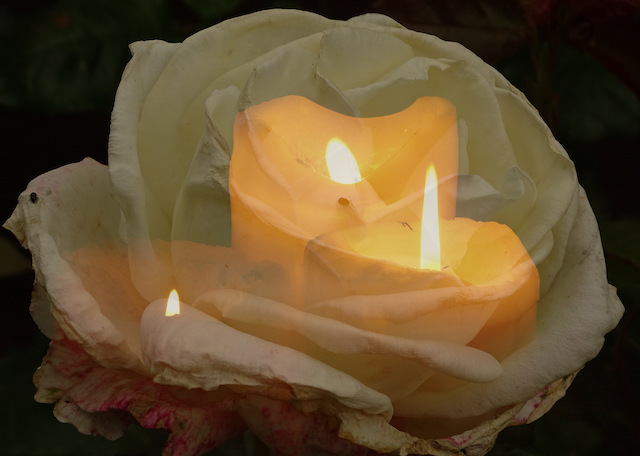
T. S. Eliot ends his poem ‘Little Gidding’ with the words ‘The fire and the rose are one’. For me the power of this image lies in the fact that both fire and rose have positive and negative effects. Fire can be a source of warmth and light, but it also has the power to destroy. Roses are flowers of incredible beauty, but their thorns can draw blood if you don’t handle them carefully.

The resurrection of Jesus Christ, doesn’t obliterate what happens to him on Good Friday. It doesn’t blot out its pain, or its darkness or its God-forsakenness, as if it never happened. What it does is it transforms it. It offers a new God-given perspective from which to view it, but it doesn’t erase it. The bruised body of a young Jewish man buried in a garden tomb on Good Friday evening still bears the marks of a crown of thorns and the cruel nails and the soldier’s spear. 

The Pascal Candle that we’ll light in St Finnbarr’s between sundown on Holy Saturday and dawn on Easter Day will burn with a flame lit from the new fire of Easter; but it’ll also be pierced with five grains of incense in the shape of a cross, symbolising the wounds of the crucified Christ. ‘The fire and the rose are one’.

Blessings
James