Screeching U-turn or Repentance?

When politicians change their mind about something, their opponents (and sometimes their supporters also) lambast them for doing so. Rishi Sunak was accused this week of a ‘screeching u-turn’ for suggesting that he might help people with their energy bills by temporarily removing VAT, when last year he refused to do such a thing. Liz Truss meanwhile has been criticised for changing from a ‘remainer’ to a ‘brexiteer’ and from a Liberal-Democrat to a Tory. Boris Johnson once said that Keir Starmer has ‘more flip flops than Bournemouth Beach’. The presumption is that changing your mind is a thoroughlybad thing to do, even when circumstances change.  This is all very adversarial and as the current Tory leadership race implies: “Whoever is not with me is against me”.

In the New Testament Greek the word that is generally translated into English as ‘Repent’ is ‘Metanoia’, which literally means “to change the mind”. Repentance is therefore concerned with fundamentally changing your mind about something.  Whilst the word Metanoia was actually a military term that described a soldier marching in one direction and then doing an about-face or to turn around, in the context of faith it means a whole lot more.

Contrary to the way that changing your mind seems to be viewed in political circles, repentance has a much more positive sense. A change in the way you think that leads to achange in the way that you live. When you really change your mind about something, it leads to change in the way you think about it, talk about it, feel about it, and the way that you act. Repentance is a decisive change in direction; it’s a change of mind that leads to a change of thinking that leads to a change of attitude that leads to a change of feeling that leads to a change of values that leads to a change in the way you live.

When John the Baptist appeared on the scene at the start of the Gospels, it was as one who was preparing the way for Jesus the Christ and he called everyone to repentance. In the Gospels of both Mark and Matthew, Jesus begins his public ministry with a call to “Repent”, for people to turn their lives around. In addition, the Apostle Paul when preaching to both Jews and Gentiles/Greeks urged them to “turn to God in repentance and have faith in our Lord Jesus”. That is what we are all called to do and to keep doing as part of being Christian.

As I write, Anglican Bishops from across the globe (including the seven from the Scottish Episcopal Church) are meeting at the Lambeth Conference. After a slightly shaky start, the organisers had the courage to have a change of heart in relation to the call on Human Dignity to be discussed next week and rather than deriding them for their ‘repentance’ we should applaud the fact that in the revised call they have opened up the possibility for genuine dialog between bishops who disagree to allow them to hear each other and disagree well. As Mark writes in his Gospel: “Whoever is not against us is for us”.

Let us hope and pray that as people in our communities and across the country face very difficult times ahead, that politicians can learn to have the humility to both change their minds, as situations and people’s circumstances change, and at the same time applaud others who do so. Now wouldn’t that transport us to a better world?

Blessings
James

On Ritual

In our tradition, we are very used to ritual. Our services of course contain many familiar ritual elements, but there’s considerably more to ritual than just elaborate religious ceremonies. In our lives rituals play a number of roles: rituals in the face of loss can help us with grief and dealing with the loss, rituals in our families can make us feel closer, and rituals with a partner or friend can reinforce the relationship. In short rituals can help us to express things that can’t easily be expressed in other ways and that is why we find them so useful in relation to God.

Recently it’s been brought home to just how important rituals are. For the most part the Sunday morning rituals that are a feature of our worship are very familiar, because they’re how things have been done for a long time. However that isn’t true for all rituals. For instance, the past couple of years have made a lot of what we took for granted and that was once familiar newly unfamiliar. We’ve made changes to the way that we meet in Church, how we greet each other and how we share the Eucharist. The purpose is still much the same, but the manner has changed in both small and in larger ways, the rituals subtly different. In the same way we’ve adapted the rituals to reflect changes in our congregations and the circumstances of our gatherings.

Many of us have found some of these changes unsettling and struggled a bit in the face of it.  However what’s really started me thinking more broadly about ritual, is not those ‘internal’ rituals of our weekly gatherings for prayer, praise and the breaking of bread, but the outward-facing rituals in which we help the wider community to find ways of engaging with events in the wider world. These are really important in our world right now, when we are all facing both actual and anticipated grief, joy, sadness, fear – virtually any emotion. In this rituals can help to restore our sense of control over our lives, however illusory this may be.

When we hear about war, the climate crisis, covid and almost any other change, we canexperience loss – we didn’t want it to happen, but there was nothing that we could do aboutit. That’s not a very unpleasant feeling, that sense that you’re not in charge of your life or most of what’s happening in the world around you. As Christians, it’s at times like this, when we can’t do anything ourselves that we turn to God, but what about those for whom ‘God’ has little obvious meaning?

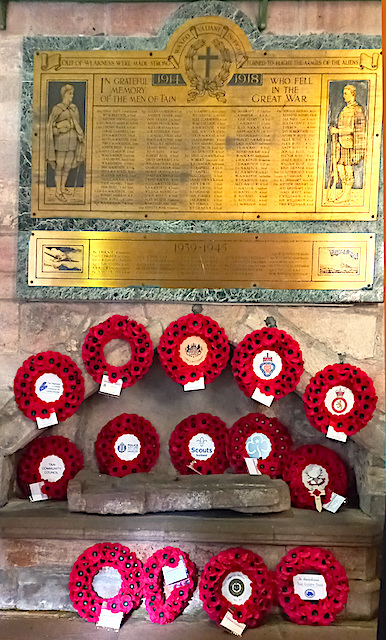
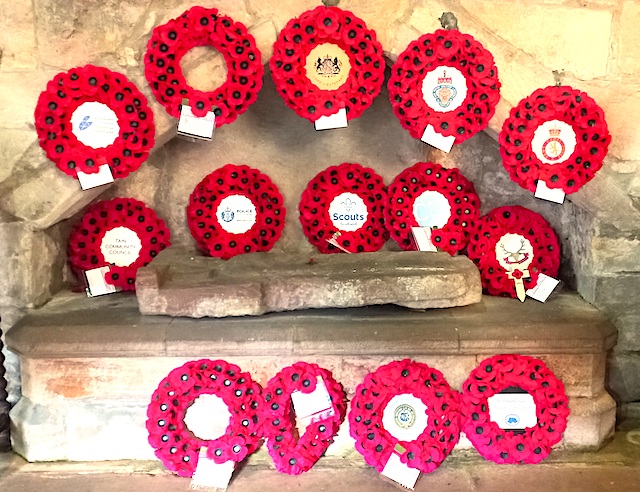
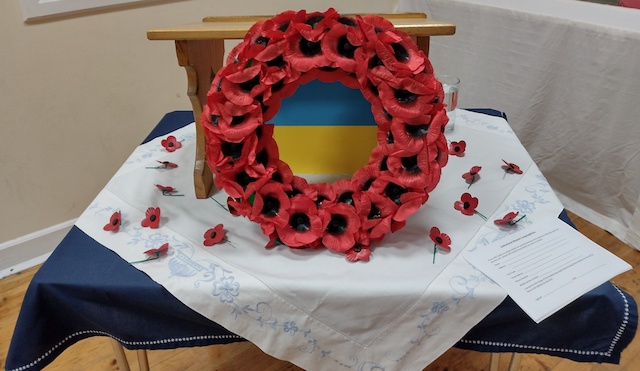
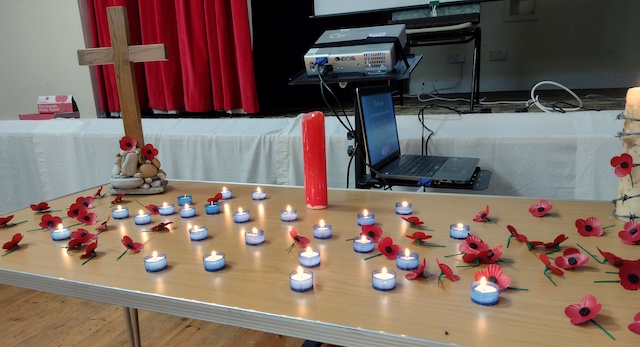
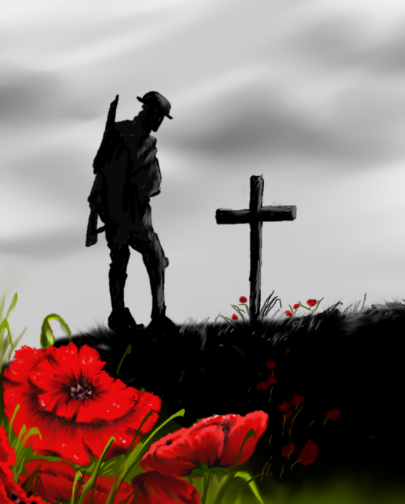
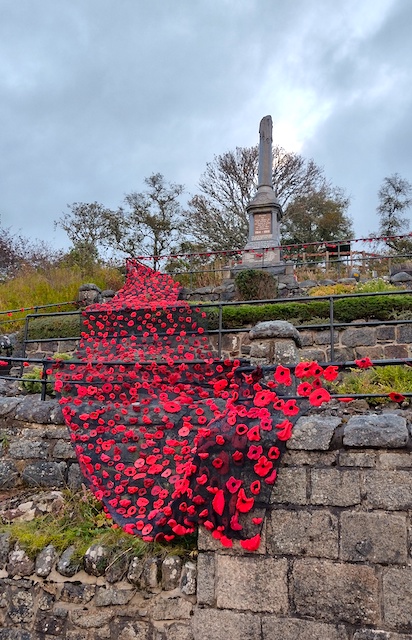
Over the last few months, we’ve tried to offer a number of rituals to our wider communities, to help with expressing ‘difficult to express’ emotions (both negative and positive ones) in relation to climate, the war in Ukraine, world peace, the Queen’s Platinum Jubilee and the marking of the Centenary of war memorials in our communities. We’ve marked these in planting trees, reading out names, placing small wooden crosses in flowerbeds, in singing and prayer, in music, in silence, with shells, with candles, with stones and in simply being there.

In all these circumstances people need some sort of ceremony and ritual to bring them together, so that they can share the emotions that they, and others around them, are feeling with each other. The numbers taking part in these events are frequently much higher than they are in our church services, but where’s the surprise in that?  That’s mission in action, just what Jesus urged us to do!

Ritual’s part of the rich heritage of our Church and something that we understand the importance of. People in the wider community recognise the truth of this and that’s why they ask us if we can help them to produce an appropriate response to whatever the situation is. It’s why people still come to us for funerals, weddings and the other occasional offices.  For my money it’s one of the most important parts of what we as the Church are here for – making God possible beyond our walls and in the lives of those in our communities.

Blessings
James
The Feast of Corpus Christi

The Feast of the Thanksgiving for Holy Communion, commonly called, Corpus Christi was first celebrated in the 14th Century. It began as a local custom to celebrate the Mystery of Christ’s presence in the Eucharist and slowly spread throughout the Church, finally being added to the Kalander in the 15th Century.  In our Kalander we calebrate Corpus Christi on the Thursday after Trinity.

William Harry Turton’s hymn “O thou who at thy Eucharist didst pray” sung to a lovely tune (Song 1) by Orlando Gibbons.

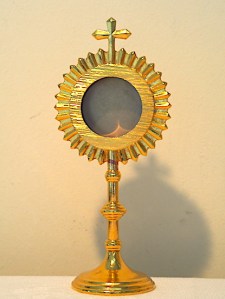
Perhaps the most famous aspect of Corpus Christi (literally the Body of Christ), that people associate with this feast day, is the great processions through cities, towns and villages.  The Blessed Sacrament is held aloft by a priest, in a monstrance, as a public statement that the sacrifice of Christ was for the salvation of the whole world.

Monstrances are one of those liturgical curios that appear sometimes, but in our tradition not very regularly.

The Host (the consecrated Bread) sits in the glass plate in the centre with ‘rays of glory streaming out from it‘. A reminder of the Glory of Christ, present in the Eucharist, and the glory of the Heavenly Banquet that we join when we take Communion together.

Traditionally, at the end of the Mass on Corpus Christi the Host (the consecrated Bread) is placed in a monstrance and the congregation spend some time reflecting on this Mystery of Christ made present in the bread and wine.

The officiating Priest would then take the monstrance and carry it aloft down through the church and out into the streets – with servers throwing rose petals down in front of it to make a carpet – a bit like confetti at a wedding – with bells ringing out to tell everyone that Christ was walking among them in the Eucharist

Corpus Christi represents more than just the Church giving thanks for the way that Christ remains, with us always – even unto the ends of the Earth. It’s a celebration that we, the Church, are united in and as the Body of Christ.

Gather up the fragments that nothing remains

Whilst we were away down south, I took a very full car load of ‘stuff’ to the local ‘recycling centre’. It was very busy and there were categories for every manner of thing and no-one was allowed anywhere near the ‘general waste’ skip until all other options were exhausted.

Whilst we were away I was also reflecting on the Eucharist and what it means in a broader sense than just what happens at the altar whenever we celebrate as Jesus commanded.

“Lord Jesus on the night when he was betrayed took a loaf of bread, and when he had given thanks, he broke it and said, ‘This is my body that is for you. Do this in remembrance of me.’ In the same way he took the cup also, after supper, saying, ‘This cup is the new covenant in my blood. Do this, as often as you drink it, in remembrance of me.’”

1 Corinthians 11:23-25

I was thinking about the way that we handle the communion elements and in particular what we do with the remaining elements if they are not to be reserved for those who aresick or otherwise unable to be in church. In the Communion service of the 1662 Book of Common Prayer, the minister is directed to “reverently eat and drink” what remains of the consecrated elements after the distribution of Communion.

This direction resonates with the passage from John’s Gospel where Jesus gave direction to the Disciples as to what to do with what remained after the Feeding of the Five Thousand: “Gather up the fragments that nothing remains” (John 6:12). 

You know, I think that this has more than a tangential bearing on the meaning of the Eucharist, and one that’s important in relation to how we ought to respond to one of the biggest environmental issues in the affluent West today – waste.  For instance it’s a singular abuse of stewardship to throw away nearly a third of all the food that’s produced.  This is often by the relatively affluent West and is at the expense of the global poor, and producing and distributing more than is required can only lead to depletion of resources and needlessdegradation of soils.

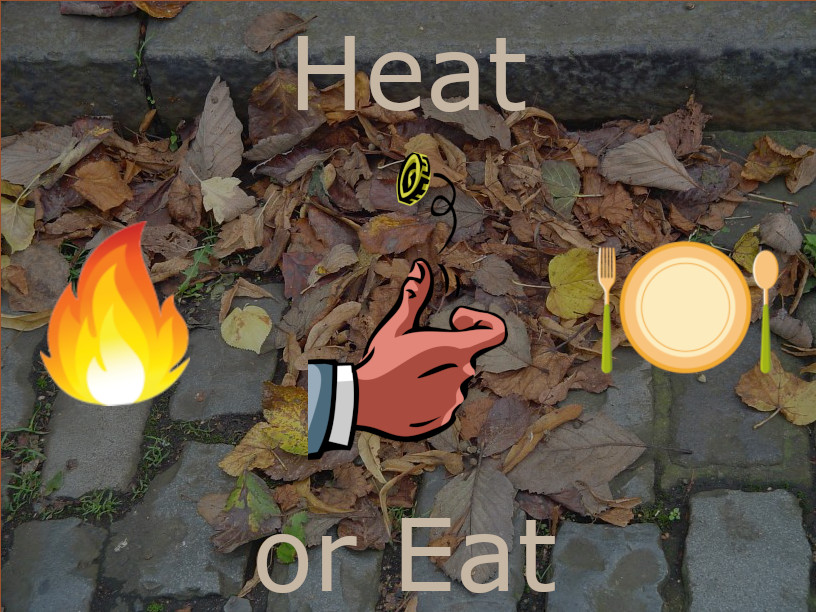
The war in Ukraine is having a huge impact on global food supply as Ukraine produces a significant amount of the wheat and sunflower seed (from which sunflower oil is extracted) that act as components of the staple diet of many around the world. For us in the West that means increased prices, but for many in poorer countries in for example Africa, it means starvation. Even in the West it is showing up the huge gap between rich and poor, with many in our country now struggling to put food on the table.

And so, it is in the light of these considerations that we should be able to see that how we, the worshipping community, handle and care for our spiritual food and drink, particularly in what remains and is left over from the Eucharistic Feast, is indicative of our attitude to the wider social and natural environment and supporting those in need both at home and abroad.

Blessings
James
Walking alongside each other

I was comparing some of the hymn books used in our churches and I started to notice a pattern. The later books no longer had as many of the hymns that contain war, battle, fight or armour imagery. So no “When a knight won his spurs” or “Mine Eyes Have Seen the Glory” and you should see what liberties have been taken changing “Onward Christian soldiers” into “Onward Christian pilgrims”.

Well that all started me thinking about the wars in various parts of the world: Ukraine, Yemen, Sudan, Myanmar, Syria and Afghanistan, to name but a few.

When he was Archbishop of Canterbury, Rowan Williams said that the whole weight human failure couldn’t extinguish the creative love of God. In an Easter sermon he said that conflict and failure are part of the human condition, but that Jesus’ death and Resurrection turns that on its head: 

We share one human story in which we are all caught up in one sad tangle of selfishness and fear and so on. But God has entered that human story; he has lived a life of divine and unconditional life in a human life of flesh and blood.”

Rowan Williams

The lesson to be learnt from pain and conflict is that when people walk alongside each other and learn to really listen to other people’s stories and what drives them:

to learn an openness to discovering things about themselves they didn’t know, seeing themselves through the eyes of someone else. What they see may be fair or unfair, but it’s a reality that has been driving someone’s reactions and decisions. It may well be based on misconceptions, on prejudice on ignorance of the situation that someone, or perhaps a whole community is facing. We all need to listen better to each other’s stories, however painful or humiliating that experience may be”

Rowan Williams

The Resurrection doesn’t take away the reality of threat or risk or suffering; it’s just there and that’s one of the hardest things to accept. How can you or I feel ‘happy’ in a world so full of atrocity, aggression and injustice? How can you or I know ‘joy’ when we’re aware of our own failings, our own shabbiness, our own depression, in short the whole mess that our lives can sometimes seem to be?

There are no easy answers to these questions, but in reflecting on war and conflict I quickly came to the realisation that the conflict in places like Ukraine aren’t something entirely detached from what you and I do and feel in our own lives. It’s not just about a few places where bad people do terrible things to other (good) people.

I suspect that few of us aren’t involved, to some extent, in conflict in our homes and families, our work places, our neighbourhoods and communities and dare I say it, our churches. Yes churches are very good at conflict and schism.

So perhaps this Easter season as we pray for the people of Ukraine and other war-torn places, we might also do well to reflect on where we’re complicit in conflict in our lives and the lives of those around us. We might all be the better for it and our world can’t help but be a better place as a result.

Blessings
James
Ride on Ride on

Over the past couple of weeks, I have had occasion to travel down to Inverness a number of times and it brought a smile to my face when I saw that the donkeys at the Donkey Sanctuary were out in the fields enjoying the warmer weather. Seeing donkeys always makes me think of the significant roles that these beautiful animals play in various stories in the bible. There’s the donkey that carried the heavily pregnant Mary all the way to Bethlehem for example. But did you know about the donkey who spoke? Balaam’s ass. You can read all about her in Numbers 22 – 24. She saw exactly what was going on – more than her boss did, in fact, and eventually spoke to draw his attention to the presence of an angel. 

Another donkey, one which we hear about as we step into Holy Week carried Jesus publicly into Jerusalem. It is well known that nearly all donkeys bear the mark of a cross on their backs and like them we carry the mark of the cross too, given to us at our baptism. Donkeys teach us a lot about discipleship. They remind us that we always carry Jesus invisibly, like Mary’s donkey, wherever we go. Every day Christ is carried into our world by us. As St Theresa said,

Christ has no body now on earth but ours, no hands but ours, no feet but ours. Ours are the feet on which he is to go about doing good, ours the eyes through which he is to look with compassion on the world, ours the hands with which he is to bless us now’.

St Theresa

So, on the days when we feel we’re carrying the world on our shoulders, we need to remember that we are also bearing Christ to meet the world’s pain and give people life.

There are times when, like Balaam’s ass, we shall see things that others can’t or won’t see. Then we have to do something about it. Balaam’s ass tried first of all to draw the boss’ attention to the demands of God, the angel standing in the way, and she got pretty rough treatment for her trouble. But then God gave her words to say, and Balaam began to take God seriously.

Being a Christian, being outspoken for God, isn’t always going to be easy or pleasant. Balaam was trying to maintain his reputation and wasn’t keen on anything standing in his way. We shall find ourselves challenging important people and vested interests – that can be very hard, like crucifixion.

The Palm Sunday donkey reminds us that when we go with Christ, there are no promises about easy rides. We know, however, that at the end of the suffering, after the death, there was resurrection. We know that Christ has promised to keep us company, but as we carry him with us in the world, he won’t avoid confrontation, or allow us to. ‘In the world’, he said, ‘you will have tribulation’. We know that, from personal experience, and from sharing in the pain of the world as people starve, exploit and kill each other. We shall have to hang on with some of the donkey’s stubbornness to the belief that Christ really has overcome the evil in the world, and that we shall share that victory.

Ride on, ride on in majesty!

Blessings
Simon

A short service for Ukraine

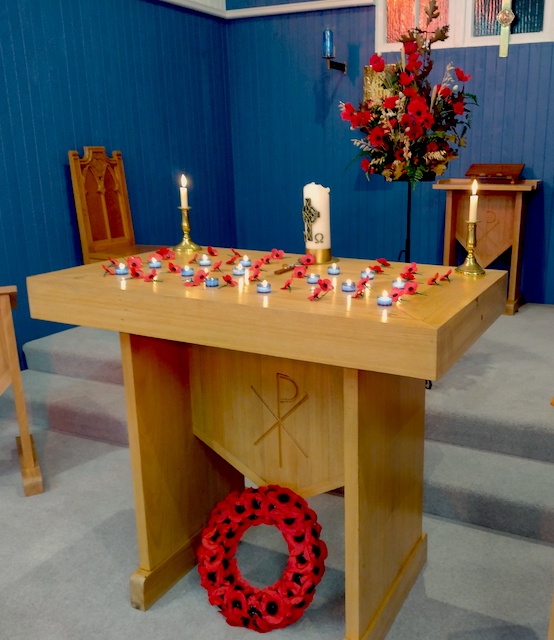
A short service consisting of a psalm, a reading and a prayer, which you might like to incorporate elements of into your daily prayer, perhaps also lighting a candle for the people of Ukraine.

From Psalm 83

O God, do not keep silence;
do not hold your peace or be still, O God!
Even now your enemies are in tumult;
those who hate you have raised their heads.

O God, do not keep silence

They lay crafty plans against your people;
they consult together against those you protect.
They say, ‘Come, let us wipe them out as a nation;
let the name of Israel be remembered no more.’

O God, do not keep silence

Fill their faces with shame,
so that they may seek your name, O Lord.
Let them know that you alone,
whose name is the Lord,
are the Most High over all the earth.

O God, do not keep silence

​A Reading from Romans 12:14-21

Bless those who persecute you; bless and do not curse them. 
Rejoice with those who rejoice, weep with those who weep. 
Live in harmony with one another; do not be haughty, 
but associate with the lowly; 
do not claim to be wiser than you are. 
Do not repay anyone evil for evil, 
but take thought for what is noble in the sight of all. 
If it is possible, so far as it depends on you, 
live peaceably with all. 

Beloved, never avenge yourselves, 
but leave room for the wrath of God; 
for it is written, ‘Vengeance is mine, I will repay, says the Lord.’ 
No, ‘if your enemies are hungry, feed them; 
if they are thirsty, give them something to drink; 
for by doing this you will heap burning coals on their heads.’ 

Do not be overcome by evil, but overcome evil with good.

A Prayer for the People of Ukraine

God of endless love and unchanging truth,

Our hearts despair at the extent of human wickedness,
And break for those who are being so tragically
and unjustly hurt and killed by the attack on Ukraine.

Yet we give you thanks that even in the midst of the horror,
there are so many glimpses of hope, 
in the human kindness and generosity that is being shown,
amongst a shocked and fearful people.

Today and in the days that follow,
We pray for every life that has been turn upside down 
or changed by injury or displacement, 
or loss of friends and loved ones
or fear for the future;

For those whose who are fearful and despairing;
For those who are selflessly responding to the needs of others, 
And will continue to provide care, support and healing.

We pray for all political and community leaders
And those who face the difficult task of protecting and defending their communities,
And nurturing those values on which their well-being depends.

Help us all to build a better world;
A world where difference is seen as an opportunity to broaden our understanding;
Disagreement as the chance to learn and grow,
Where faith is reclaimed to bring out the best of human flourishing,
And turn hearts to all that is good and true,

That your Kingdom may come on earth as it is in Heaven.

Our Father …

AMEN

Prayers for our Friends in Kyiv

Our friends from the Ukraine, the Kyiv Classic Accordion Duo made twelve visits to St Finnbarr’s to enthral all who heard them with skill and virtuosity and raise money for the charity Hippokrat, which supports survivors of the Chenobyl Nuclear Disaster.

About the Kyiv Classical Accordion Duo:
In 2006 Igor and Oleksii finished studying in the National Music Academy of Ukraine in Kiev. However they had begun performing professionally in 2002. Oleksii plays in the Orchestra of the National Radio of Ukraine; Igor works in the National Philharmonic of Ukraine. They decided to give the name Kyiv Duo Classic to the duo, however this doesn’t mean that Igor and Oleksiy perform only classical music; programmes of their concerts include music of Bach, Grieg, Vivaldi, Tchaikovsky, Rachmaninov as well as traditional Ukrainian and Russian music. Two contemporary button accordions make it possible to produce a sound like a small squeezebox and at the same time, like a big church organ, a string quartet and even an orchestra.

About their charity – HIPPOKRAT:
The main purpose of the Kyiv Classic Accordion Duo UK tours was to raise money for the HIPPOKRAT Society of Mothers of Disabled Children who suffered as a result of the explosion in 1986 at the Chernobyl Nuclear Energy Plant. The Chernigiv region suffered most from the radiation fall out and since 1986 a large number of children have been born with mental and physical problems. Many of these children are now young adults and in need of support that the state is unable to provide.

Prayer for all in Ukraine

We pray for Igor and Oleskiy, their families and friends, those supported by Hippokrat and all the people of Ukraine in this time of  danger, fear and conflict.

Lord of all the earth,
be present with the people of Ukraine
at this time of danger, fear, and conflict.
Grant that wise and peaceable counsels may yet prevail,
and give to all suffering nations
the freedom they desire and deserve.
We ask this through Jesus Christ our Lord.

Amen.

Holy God,

We hold before you all who live close to war and conflict;
and all who live close to the threat of war and violence.

We remember especially at this time, people in Ukraine and Russia.
We pray for nonviolence and peaceful resolutions of conflict.

Give us hearts of hospitality and sanctuary,
forgive us all our hostility and hatred.

Bring all people to the humanity you give us,
and to the reconciliation and healing for which you gave your life.

Strengthen us all to work with you to build justice and peace,
reconciliation and healing,
in our hearts and homes, in our streets,
in all communities, neighbourhoods and nations.

Bless all who live lives for the peace and wellbeing of others,
and make their service fruitful.

In the name of Christ.
Amen.

We pray that they beat their swords into ploughshares

The threat and the reality of exile resurface time and again in the Hebrew Bible. Historically, Israel and Judah experienced a number of major exiles.  The northern kingdom of Israel was overrun by the Assyrians around 720 BCE. These exiled people were deported and scattered within the Assyrian Empire, although we know little of their fate. In 597 BCE, the elite of the southern kingdom of Judah, including the prophet Ezekiel and those who had been in power, were exiled by the Babylonians as they asserted power over their weaker neighbour.

Jerusalem, the capital of the Kingdom of Judah, was besieged in 589 BCE by the Babylonian king, Nebuchadnezzar II. The city fell after an eighteen-month siege and Nebuchadnezzar pillaged and destroyed the city and burned the First Temple. After the fall of Jerusalem, the Judeans were exiled to Babylon. The fallen kingdom was then annexed as a Babylonian province.  Some Judeans fled to Egypt, although some also managed to remain behind in Judah their homeland.

Clearly, the ‘People of God’ were no strangers to foreign aggression, occupation and exile. Much of the Book of Isaiah, as well as those of other prophets, give us insight into how the people reacted to and subsequently coped with these things.

The most important lesson that people coming into ministry have to learn (often the hard way) is that they often can’t do anything about the pain, the grief and the sorrow of those committed to their charge. It’s a hard lesson. When people are suffering, you want nothing more than to take their pain away and not being able to do so makes you feel useless, inadequate and impotent. It takes time to learn that what you need to do is to walk alongside them, give them the time and space to talk, as they work through what’s happening to them and adjust to their changed circumstances. 

Prayer, lament and more prayer are the tools that the people of Judah and Israel used as they adjusted to their new situation. These are the tools that the clergy and others in ministry use as they walk alongside others and offer a listening ear.

It’s for this reason that the last two Lent Study Groups (2020 and 2021) have focussed on Prayer and Lament respectively. These are the tools that we all need as we struggle to make sense of what is happening in Ukraine, when we feel powerless and impotent in the face of the Russian invasion and other situations. 

For those who weren’t able to take part in these groups, and those who did, but would like a refresher, the resources are all still available on our web site (https://episcopaldornochtain.org/study-group-resources/). If you’re unable to access them from there, or would like help, please get in touch with a member of the clergy. Meantime, if we can all take time to pray for the Ukrainian people both at home and abroad, it might “by the power of the one at work within us, accomplish abundantly far more than all we can ask or imagine.” (Eph 3:20).

ALMIGHTY God, from whom all thoughts of truth and peace proceed: Save and deliver us, we humbly beseech thee, from the hands of our enemies; abate their pride, assuage their malice, and confound their devices; that we, being armed with thy defence, may be preserved evermore from all perils, kindle, we pray thee, in the hearts of all people the true love of peace, and guide with thy pure and peaceable wisdom those who take counsel for the nations of the earth; that in tranquillity thy kingdom may go forward till the earth be filled with the knowledge of thy love; through the merits of thy only Son, Jesus Christ our Lord.  Amen.

Blessings
James
We saw a star in the East and came to worship him.

The Week of Prayer for Christian Unity has just ended with a flourish, as a large group of Christians worshipped together on Zoom, in a service inspired by the Feast of the Epiphany and prepared by the Churches of the Middle East. For me, there is an interesting symbolism in this celebration of unity being centred on the Magi from the East, in that some strangers from afar who weren’t connected with the Jewish Tradition undertook long journeys to honour an extraordinary happening, God had become incarnate as a tiny baby. This was God being revealed to the wider gentile world – to all.

In thinking about unity, we shouldn’t however confuse unity with uniformity. Uniformity is all thinking the same and agreeing with each other. Unity is accepting and respecting difference in the pursuit of shared values and goals. In many areas, there’s a tendency for church congregations to be rather homogenous, though certainly in the Episcopal Church in the Highlands because there’s less scope for choosing a church to suit your preferences. Whilst homogeneity isn’t all bad, there are dangers in it: that we come to see what we like, what we choose and the way that we do things as ‘normal’, universally applicable and unchangeable for all time – ‘the proper way of doing things’. Sadly that results in folk becoming defensive and upset by anything or anybody that rocks the boat, challenges the ‘proper way’ or pushes us out of our comfort zone.

Our celebration on Tuesday evening brought together many people of different traditions and practices, to honour an extraordinary happening – the coming of God into our world as one of us – and what that has meant for people all over the world in the 2000 years since. It was a service that brought some of the riches of the Coptic Church, the Eastern Orthodox Church, the French Ecumenical Taizé community and invited us to celebrate using elements that were unfamiliar to most of those present – but you know what, we all enjoyed the experience.

We met as people from across the Churches and Denominations in Sutherland and Easter Ross and one or two from further afield. We met as Christians united in a common faith. We met as part of

a great multitude that no one could count, from every nation, from all tribes and peoples and languages, standing before the throne and before the Lamb”.

Revelation 7:9

We met “united in the same mind and the same purpose” (1 Corinthians 1:10).

We met because before Jesus died, he prayed to his Father:

I ask not only on behalf of these, but also on behalf of those who will believe in me through their word, that they may all be one. As you, Father, are in me and I am in you, may they also be in us, so that the world may believe that you have sent me. The glory that you have given me I have given them, so that they may be one, as we are one, I in them and you in me, that they may become completely one, so that the world may know that you have sent me and have loved them even as you have loved me.”

John 17:20-23

The Week of Prayer for Christian Unity may have ended on Tuesday, but we need to continue in our effort to work more closely together.  In every encounter that I have with Christians in another fellowship, denomination or congregation, I realise what riches each have to share with their fellow travellers in Christ. Now where did I put the link to that 2 hour and 47 minute video of a Greek Orthodox celebration of the Epiphany?

Blessings
James