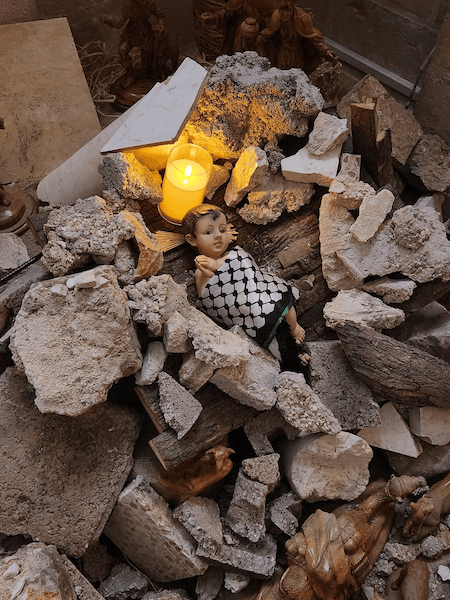
Christ in the Rubble

Crèche, December 2023, Evangelical Lutheran Christmas Church, Bethlehem. Photo: Rev Munther Isaac

As we prepare for Christmas, we might wish to reflect on this image of the ‘Nativity Scene’ at the Evangelical Lutheran Christmas Church in Bethlehem and also words from the Anglican Church in the Middle East and closer to home the SEC Palestine Group.

Archbishop Hosam Naoum, the Anglican Primate of the Province of Jerusalem and the Middle East, has launched a Christmas and Advent appeal for children and families in the Holy Land who are in urgent need.

In his Advent Pastoral letter, Archbishop Naoum has written:

As our beloved brothers in the Gospel of Jesus Christ, I invite you to join the 2023 Advent and Christmas Project as a means of living into the true meaning of Christmas by giving to those in need in the Holy Land. This Christmas Season we aim to bring smiles to the faces of as many children as possible, as well as support to struggling families. And so we would welcome and greatly appreciate your love, support, and generous contributions towards charities working to provide support for needy families at Christmas.

Due to the current situation in our beloved Holy Land and the heartbreaking scenes that have shattered our hearts, we have decided this year to limit our celebrations to prayers, liturgies and carols within our churches.

In a spirit of solidarity within the Body of Christ, I invite you to join us in this discipline by reflecting on the birth of the Lord Jesus Christ more than two thousand years ago, as well as on the conditions prevailing in the land at that time.” He went on to say that “they were no better than the circumstances here today.

Archbishop Hosam Naoum

The Scottish Episcopal Church Palestine Group has written:

“As Christmas approaches, we cannot allow our celebrations to divert attention from the unrelenting carnage being perpetrated in Gaza and the West Bank. The sentimentality of tinsel and baubles must not be allowed to obscure our apprehension of the infant Christ, born in the squalor of a stable, his life threatened before it had begun by the gratuitous violence of a bloodthirsty and repressive tyrant. The commercialization of Christmas, and the parody of Santa Claus which debases Christian charity, must distract us neither from the suffering of hungry and traumatized children nor from the example of St Nicholas of Myra.

Our worship will lack authenticity and integrity if those who are suffering are not held before God in prayer, and if that prayer is not reflected in the ways in which we spend money and decide what goods to purchase for loved ones or to consume ourselves. We need each to consider whether donations to charities bringing aid to the afflicted are not more urgent, and a clearer sign of human love in practice, than festive over-indulgence, and gifts to family and friends which may be of very transient value. We need also to consider whether our purchases enrich those who profit from the suffering of others.

Scottish Episcopal Church Palestine Group

St John of the Cross – “Dark Night of the Soul”

Today is the Church’s commemoration of St John of the Cross.

Zurbarán – John of the Cross – 1656

On a dark night,
Kindled in love with yearnings
–oh, happy chance!–
I went forth without being observed,
My house being now at rest.

In darkness and secure,
By the secret ladder, disguised
–oh, happy chance!–
In darkness and in concealment,
My house being now at rest.

In the happy night,
In secret, when none saw me,
Nor I beheld aught,
Without light or guide, save that which burned in my
heart.

This light guided me
More surely than the light of noonday
To the place where he (well I knew who!) was awaiting me–
A place where none appeared.

Oh, night that guided me,
Oh, night more lovely than the dawn,
Oh, night that joined Beloved with lover,
Lover transformed in the Beloved!

Upon my flowery breast,
Kept wholly for himself alone,
There he stayed sleeping, and I caressed him,
And the fanning of the cedars made a breeze.

The breeze blew from the turret
As I parted his locks;
With his gentle hand he wounded my neck
And caused all my senses to be suspended.

I remained, lost in oblivion;
My face I reclined on the Beloved.
All ceased and I abandoned myself,
Leaving my cares forgotten among the lilies.

“Dark Night of the Soul” John of the Cross (translated by Edgar Allison Peers)
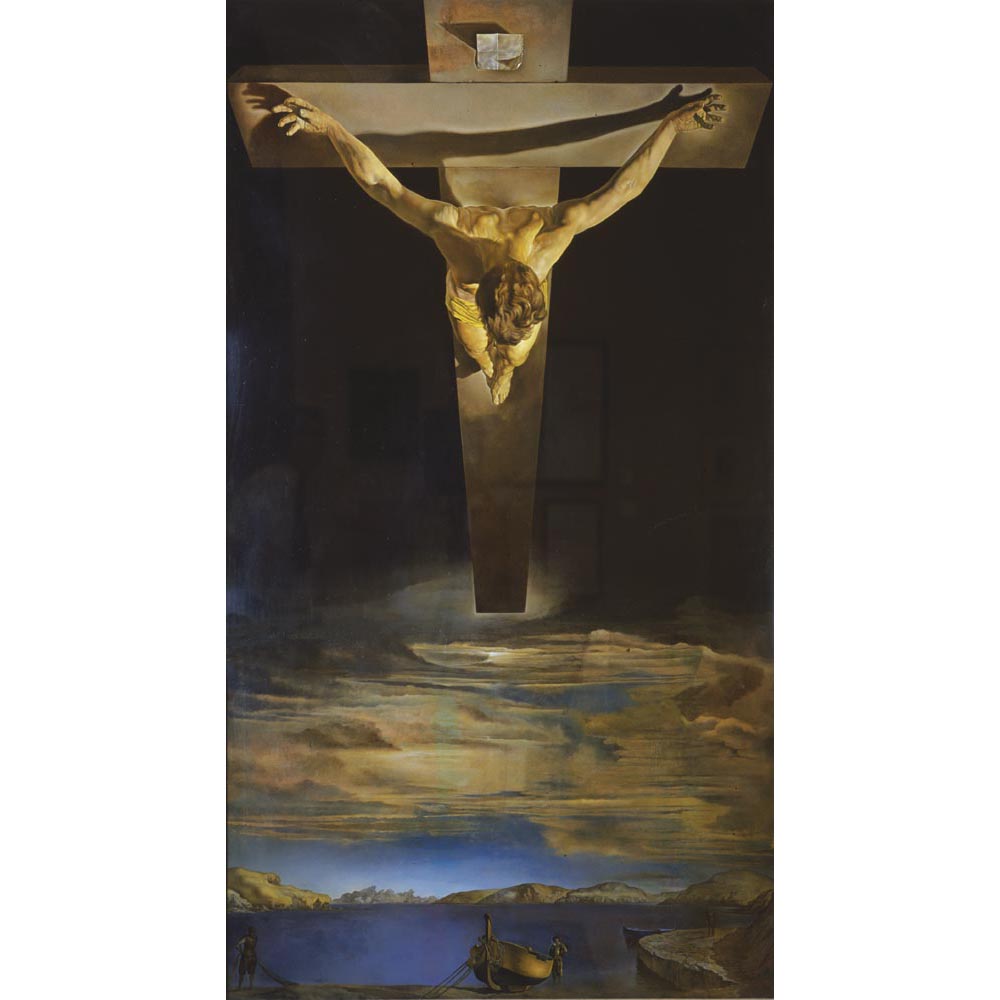
Christ of St John of the Cross – Salvador Dali – 1951

Pope Francis’ message to COP28

Choose life, choose the future!

Although Pope Francis was unable, on the advice of doctors, to be in Dubai to deliver his message in person, his hard-hitting message was delivered on his behalf by Cardinal Secretary of State Pietro Parolin.

In it he said:

Our world has become so multipolar and at the same time so complex that a different framework for effective cooperation is required. It is not enough to think only of balances of power… It is disturbing that global warming has been accompanied by a general cooling of multilateralism, a growing lack of trust within the international community, and a loss of the “shared awareness of being… a family of nations”… It is essential to rebuild trust, which is the foundation of multilateralism.

This is true in the case of care for creation, but also that of peace. These are the most urgent issues and they are closely linked. How much energy is humanity wasting on the numerous wars presently in course, such as those in Israel and Palestine, in Ukraine and in many parts of the world: conflicts that will not solve problems but only increase them! How many resources are being squandered on weaponry that destroys lives and devastates our common home! Once more I present this proposal: “With the money spent on weapons and other military expenditures, let us establish a global fund that can finally put an end to hunger” and carry out works for the sustainable development of the poorer countries and for combating climate change.

It is up to this generation to heed the cry of peoples, the young and children, and to lay the foundations of a new multilateralism. Why not begin precisely from our common home? Climate change signals the need for political change. Let us emerge from the narrowness of self-interest and nationalism; these are approaches belonging to the past. Let us join in embracing an alternative vision: this will help to bring about an ecological conversion, for “there are no lasting changes without cultural changes

Pope Francis made this appeal to the delegates:

To all of you I make this heartfelt appeal: Let us choose life! Let us choose the future! May we be attentive to the cry of the earth, may we hear the plea of the poor, may we be sensitive to the hopes of the young and the dreams of children! We have a grave responsibility: to ensure that they not be denied their future.

You can read the whole of the Pope’s message here.

Diocesan Advent Calendar

Clergy and others in the Diocese have contributed a series of Daily Reflections, Photos and a Piece of Music for each day of December up until 25th. These are delivered in the form of an Advent Calendar which is entitled “Journeying through Advent“.

The calendar can be found in the ‘Reflections‘ pull-down menu on our web site (https://episcopaldornochtain.org/) or directly at this link:
(https://calendar.myadvent.net/?id=j6yqx3y2eoojtd275b5nm7rowkwk6vzv).

Fr Simon and Canon James have both contributed to the calendar, perhaps you might try to guess which pieces are ours:-)

On the Feast of St Andrew

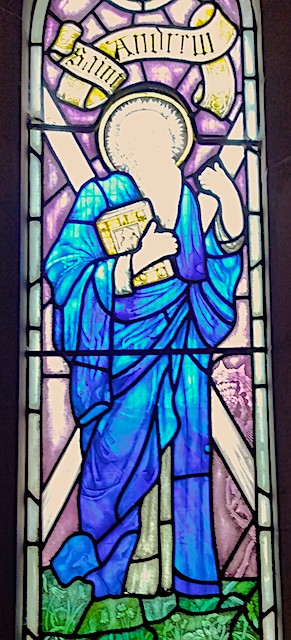
Detail from the ‘Souden’ window in St Andrew’s, Tain

Andrew son of Jonas and brother of Simon Peter was a fisherman by trade. The brothers seem to have come from Bethsaida, although at the beginning of Jesus’ public ministry they are in based in Capernaum. 

In John’s Gospel (John 1:40) we hear that Andrew was a disciple of John the Baptist before becoming a disciple of Jesus and one of the Twelve. As a result of Andrew’s first encounter with Jesus, he came to realise that Jesus was the Messiah. He then went to tell his brother Simon, whom he brought to Jesus. In the Eastern Church he is called Protokletos, meaning the ‘first called’, because his calling is the first mentioned in the Gospel narrative. The name ‘Andrew’ (from the Greek andreia, meaning ‘manliness’) seems to have been common among Jews from the 2nd century onward. His Aramaic name is unknown.

In the oldest representations Andrew is shown with a normal Latin cross. The X-shaped cross we now call ‘St Andrew’s Cross’ was associated with him from the 10th century and became common in the 14th. It is represented on the flag of Scotland and is also incorporated into the flag of the United Kingdom. His other symbol is, naturally enough, a fishing net.

Almighty God, 
who gave such grace to your apostle Andrew 
that he readily obeyed the call of your Son, Jesus Christ:
give us, who are called by your holy Word,
the grace to follow him without delay,
and to be messengers of the good news of your kingdom;
through the same Jesus Christ, our Lord,
who lives and reigns with you,
in the unity of the Holy Spirit,
one God, world without end.
Amen

In the season of expectant waiting …

The are many deeply troubling events and situations in our world just now. Over the past year or two many of the old certainties, both political and personal, seem to have been swept away. And so it was for Jesus’s Disciples after His death and resurrection and for His followers ever since, but if our faith means anything, it must speak to us in troubling times as well as times of joy and celebration.

At such times, we need to choose either to live by the ways of the world or by the ways of God. That doesn’t mean separating ourselves off as a holy huddle focussed in on ourselves, hiding away from a world of dubious motives and evil actions and having anything to do with the other people living in it. No, we’re called to be in the world but not living by many of its cherished values; to be God-centred rather than self-centred.  In Advent, as we start a new church year, we have a few weeks to pause and reflect on what Jesus the Christ really means in our lives; and how we might respond to that realisation.

In our tradition, we re-tell the story of Jesus each year. I find that leaving the old year behind at the end of November and starting a new year on the first Sunday of Advent gives me a boost, just when I need it, when the days are short and winter is really beginning to take hold. It’s that sense of anticipation, that waiting to see what’s going to happen, that pause before the busyness of the festive season.

However, once things have started, most of us want to get to the conclusion as quickly as possible, preferring things to happen at once if not before. However waiting is an important discipline in our lives. The scriptures remind us that “those who wait on the Lord will renew their strength”. In fact, patience is a wonderful gift of the Holy Spirit, allowing us to take our time and live in the moment rather than always wanting to have arrived at some point in the future.

In Jesus’ time, people had waited a long time for the coming of the Messiah.  We all might long to see more decisive action from God; bringing justice and peace to our world and some stability and certainty, not least in the Holy Land where such appalling things are happening. In the Christ Child there is a clear sign of God’s commitment to us, in spite of our waywardness. In Jesus, God is with us, as one of us, a mystery “which passes all understanding” and one that we need time to reflect on. God’s gift to us in this season of expectant waiting, is the space to prepare ourselves to be able to sense and accept all that God longs to give us.

Let us keep a watchful Advent, so that when the time comes, we may celebrate with joy the one who came, the one who will come again, the one who promises to accompany us each step of our life’s pilgrimage, however uncertain the times.

Blessings
James

Love your neighbour as yourself

I’ve been away this past week or two in Cheshire staying with my sister who is convalescing after sustaining a number of fractures. It has been a very frustrating time for her as she is not able to do much and is largely immobile. I have in the course of this also spent quite a lot of time on trains, which to my surprise ran largely to time.

As I travelled, a quite appalling situation has been unfolding in the Middle East. We have seen just how low humanity can stoop in the way that people treat other people. The history of conflict teaches us that increasing the level of violence rarely achieves anything except escalation, until eventually there has to be a sitting down to talk about it and resolving things through negotiation. Along the way there is generally an appalling loss of life and often many of those killed and maimed are not ‘combatants’ but innocent men, women and children.

Contrasting with some of the worse aspects of the human condition, I have witnesses many acts of kindness during my time away. Random acts of kindness to strangers on trains and at stations as well as the kindness of friends and neighbours of my sister who have brought round cakes, meals, flowers and those who have just dropped by for a bit of a chat.

Whilst I was in Cheshire, the rains from Storm Babet struck. This was of course a day or two before they arrived in Angus and Aberdeenshire then coming on to Sutherland and Easter Ross. Massive amounts of rain running off fields and overwhelming the culverts and brooks resulted in a great deal of flooding around my sister’s village and I spent a happy day bailing out a cellar until someone kindly lent us a pump to keep the water below ground floor level!!

We watched as cars and lorries rushed at the flood waters outside the house and every so often one would stop, the engine overwhelmed by the 18 inches of water. On one occasion a lorry driver was very abusive to a driver whose car was stranded in the middle of the flood, using language that I wouldn’t dare repeat here, because his progress was being obstructed, but one or two of those who passed by stopped to offer advice or see if they could help. Sadly we were marooned and couldn’t get out without letting water into the house – perhaps I should have taken a pair of waders:-)

In the Gospel this Sunday, Jesus says:

“‘You shall love the Lord your God with all your heart, and with all your soul, and with all your mind.’ This is the greatest and first commandment. And a second is like it: ‘You shall love your neighbour as yourself.’ On these two commandments hang all the law and the prophets.

I give grateful thanks that many of the people that I encountered during my time away seem to embody that message and I hope and pray that others will see their example and do likewise.  Our world and particularly the Middle East so desperately needs that.

Blessings
James

A Prayer for Israel and Palestine

For he is our peace; in his flesh he has made both groups into one and has broken down the dividing wall, that is, the hostility between us.

Ephesians 2:14

O God the creator of all life

We bring before you all the people who call Israel and Palestine home.
We particularly remember those living in those parts of this land who are facing the constant fear of armed conflict.

We ask your forgiveness for the anger, hatred and violence that all of us have the potential to carry within us.

We beseech you to soften hearts and open minds so that the sanctity of life is always protected, the right to freedom of worship upheld and the security of a safe home defended.

We pray that justice will flow like rivers. That human dignity will be respected and, that each of us may strive to do justice, love mercy and walk humbly with you our God.

Amen

Who is running this show?

I have recently been reviewing a book for the Church Times. The author is Annie Worsley who was an academic – a physical geographer whose specialism was landform. She and her family had visited the Highlands of Scotland for many years and in particular the more remote parts of Wester Ross. A decade ago she and her husband decided to trade in their busy lives in the North West of England and settle on a couple of old crofts in South Erradale to the West of the Torridon Mountains. They were both fond of walking and climbing and looked forward to getting better acquainted with this remote area. 

However as in many things in life, the best laid plans … Annie developed a debilitating autoimmune condition as a result of Lyme disease which reduced her to what she describes as “muddleheadedness and painful hobbling”. As so often happens, the plans we make are rendered worthless by events beyond our control. This was the case for Annie and her husband who were not able to tramp the Western Highlands together.

However Annie was a keen photographer and observer of the natural world.  She was able to get out for short slow walks and also observe the world around by looking out of the windows. So for several years she recorded what was happening in the vicinity of their home at Red River Croft in pictures and copious notes.  The book “Windswept”, that I was sent to review, was the result of her observations, reflections and recollections.  Annie adapted to her changed circumstances and her delightful book is testament to that.

Well that set me thinking about the extent to which God controls what happens in theworld. While Scripture affirms the sovereignty and power of God, it also provides examples when God doesn’t seem to be able to accomplish something. For example in Matthew’s Gospel, Jesus seems to be unable gather Israel because they were unwilling –

Jerusalem, Jerusalem, the city that kills the prophets and stones those who are sent to it! How often have I desired to gather your children together as a hen gathers her brood under her wings, and you were not willing!

Matthew 23:37-38

or in the second letter of Peter we read –

But do not ignore this one fact, beloved, that with the Lord one day is like a thousand years, and a thousand years are like one day. The Lord is not slow about his promise, as some think of slowness, but is patient with you, not wanting any to perish, but all to come to repentance.

2 Peter 3:8-10

Of course many in our world will never come to God or to repentance. But even so God’s will isn’t simply imposed on us.  Without ‘free will’, we’d just be robots not free agents, able to respond to those around us and to the the God who loves us. As Peter says in his first letter –

For it is God’s will that by doing right you should silence the ignorance of the foolish. As servants of God, live as free people, yet do not use your freedom as a pretext for evil. Honour everyone. Love the family of believers. Fear God. Honour the emperor.

1 Peter 2:15-17

In Mark’s Gospel we read –

 “And looking at those who sat around him, he said, ‘Here are my mother and my brothers! Whoever does the will of God is my brother and sister and mother.’

Mark 3:34-35

Well brothers and sisters, through prayer and reflection we can endeavour to discern the will of God for us in our lives and make the most of the opportunities that open up, even if they may not be what we initially desired, hoped for or planned.

Blessings
James

The Business of Creation

It seems to me that sometimes in church we seem to see creation as something that happened. It’s as though God ‘did creation’ in under a week, rested a while and that’s it. There are of course subsequently instances of God’s revelation but it’s always revelation that happened ‘way back then’ and is recorded in Scripture. From time to time in the Hebrew Scriptures God appeared through the odd burning bush a few smitings and getting the people of Israel out of a jam occasionally, such as out of the hands of the Egyptians. God also sent various prophets to try to get the message across, to no avail, the people just killed them.

Finally, rather fed up, God sent his only begotten son to show sinful humanity how it should be done, even to the extent of laying down His life. God knew that most people wouldn’t get it, but that the penny would drop for a minority and that would make all thedifference. Christ’s ministry was then written up in the Gospels and added to by revelation to the Apostle Paul and to St John the Divine and then that was it. There’s nothing further to be said except continuous praise and thanksgiving to God.

Now I stress that this is only how it sometimes seems.  That’s not what I believe and for me that understanding of things just doesn’t work. God may have rested on the Sabbath, but come Monday morning, was back in the office continuing the work of creation as part of continuing revelation. God’s revelation occurs not only in what was created but also in the ways of creation, in it’s development and evolution, but also in the lives of individuals, communities and cosmically. 

The evidence is all around us, if we only have eyes to see and ears to hear, but sometimes it’s revealed in living ‘parables’ that many neither see nor hear, what is all around them if they only stopped to look and listen. None of this denies the truth of Scripture, it’s just that it doesn’t end there. If one believes, as I do, that God’s continuing revelation is a part of who/what God is then it follows as night follows day that creation must be continuing because that’s a fundamental part of the nature of God.

I find it awesome how God’s creation can so often adapt and change no matter what humanity does to it: spoil heaps, poisoned ground, polluted air and contaminated seas and waterways, creation has considerable in-built ability to bring forth organisms and communities that can colonise and ameliorate.  However the problem is that it’s not always on a timescale that’s helpful to humanity. That of course is why we have a climate crisis.Now that is something to reflect on this month, in this the Season of Creation.

Blessings
James