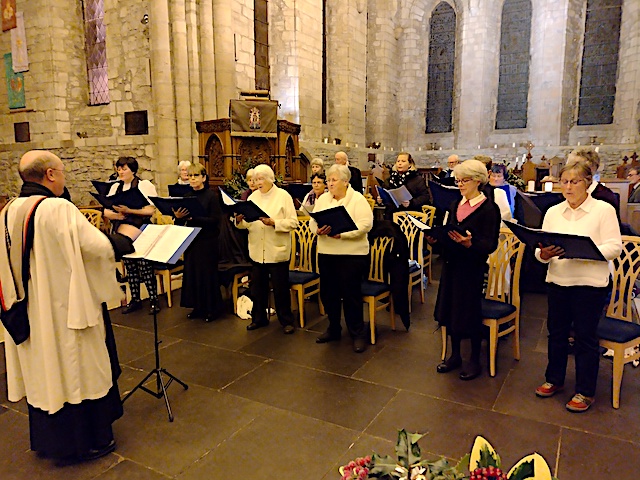
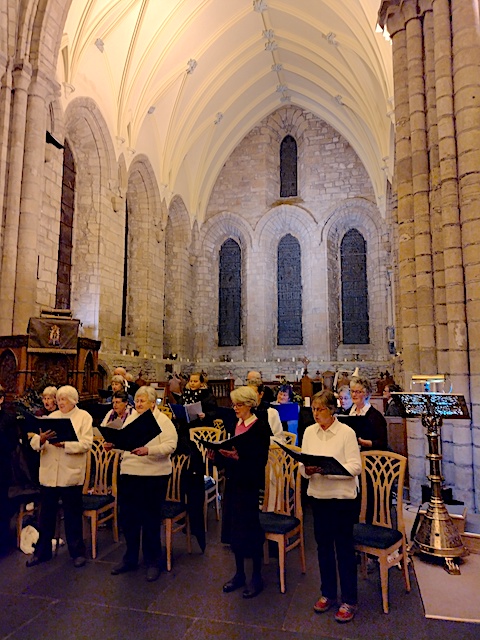
This evening in Dornoch Cathedral, we ushered in Advent with a gloriously uplifting Advent Carol Service organised by Fr Simon.
A choir of nearly 30 voices and Roddy on the organ, helped the congregation of about 60, sing a number of well-known Advent Carols and they also sang a number of pieces on their own.
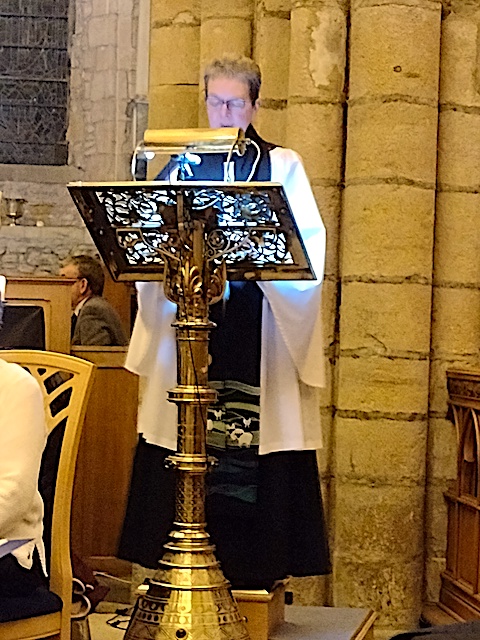
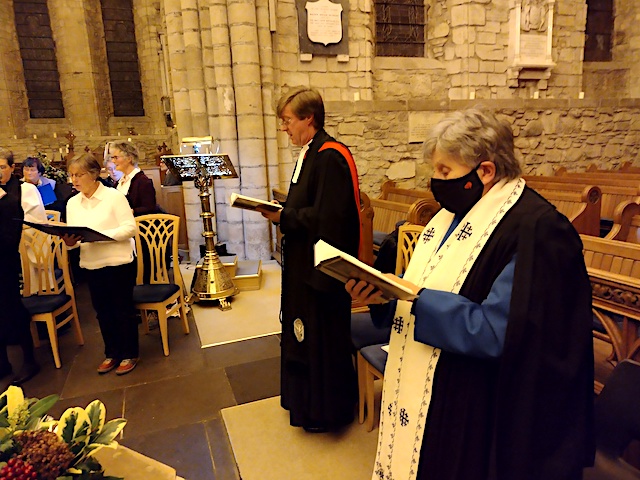
Interspersed between the Carols were Advent readings given by five different clergy from the Scottish Episcopal Church and the Church of Scotland, ranging from Genesis to the Gospel of John.
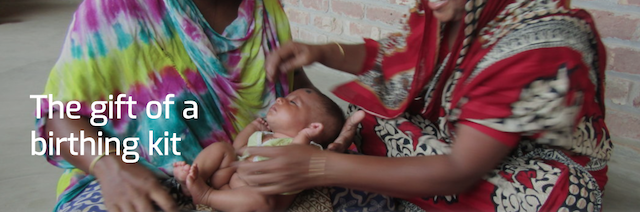
The service gave Glory to God and at the same time raised money for Clean Birthing Kits for parts of the world where many women die in childbirth, as a result of infections contracted whilst giving birth.
This fund-raising is part of a wider effort coordinated by the Rotary Club of East Sutherland and the retiring collection in aid of the charity ImpACT raised over £250 – a huge thank you to everyone who contributed.
Bishop Mark looks at the hopes and expectations around COP26 as we seek to care for God’s creation
As I write this, I’m sitting watching the leaves changing colour outside my office window. There’s a tree which is just at the corner of the churchyard at Arpafeelie which always begins to turn first, its leaves slowly, then quickly, becoming golden before plunging to a striking mix of reds then browns.
As I have watched the autumn begin, the plants begin to bed down for the winter in this changing of the season; I remember that once the bare winter is over then the cycle will come round again. We will have the cool, clear spring and then the joyful warmth of summer. So it has been for much of my life. Yet as we have stayed at home over these past months because of the pandemic, I have appreciated the slow but ever-moving changing of the seasons in a new way.
But just as I can anticipate the leaves coming back on that tree, it is becoming clear that in other places around the world many others no longer know what their seasons will hold. People can’t be confident that the rains will come, or know if their land will flood. People can no longer be confident that their crops will grow, or know if they will have the time and energy to harvest. People and places are struggling and dying now because of the twin crises of climate change and biodiversity loss. People are increasingly anxious and increasingly fearful, and there is growing anger and concern for the future.
In Scotland we have a stable climate. As is so often the case, the worst affects of climate crisis will be felt that much more strongly in places where their climate is not so stable. So the changes that I can see, and the emotions which flow through me as I know they flow through many in our Church, are much more pressing in other parts of our world.
I’ve been thinking about those emotions and reactions as we all prepare for COP26 in Glasgow. The hopes and expectations of so many people are that political leaders will listen to the voices of people around the world who are simply frightened for the very ground they stand on and the lives around them. The Scottish Episcopal Church has put in place and will continue to develop processes which enable us to have a much lighter footprint on the ground, and will enable us to make a better use of the resource we have so that we don’t contribute to stripping the environment of those things which produce the very air that we breathe.
There will be moments of tears, moments of anger, and moments of laughter in Glasgow, but I hope there will be moments of prayer. Why are we going? Why is our Anglican Communion delegation gathering? It is because as a church, and as people of faith, that’s what we do: we pray. Our prayers are to God who created this beautiful little planet we all live on. Our prayers are that God will help us to do everything in our power to protect the environment we live in.
With prayer, with conversation and simply by being visibly present, we can use the time to push home the point to political leaders that this crisis is real and that people of the world, especially those with the least ability to affect change, are being impacted by our continual drive for greater consumption, greater profits, and greater power.
We will try and insist that they listen to the quiet voices, voices that might not be physically present, and we will pray again that world leaders make the right decisions for our planet.
The Scottish Episcopal Church will be there along with old friends and hopefully new friends. We will spend our time carefully encouraging, noisily supporting and – I suspect – sometimes loudly reacting to what is happening because to honour God means caring for God’s creation, not simply for what it gives us but so that we can pass it on, healing and restoring, to those who will come after us.
Please pray for all who will gather in Glasgow, for the leaders of the nations and those of us who will bring hope and prayer.
The Season of Creation is a time to renew our relationship with our Creator and all creation through celebration, conversation, and commitment together. During the Season of Creation, we join our sisters and brothers in the ecumenical family in prayer and action for our common home.
Ecumenical Patriarch of the Orthodox Churches, Dimitrios I declared 1st September as a day of prayer for creation for the Orthodox in 1989. The Orthodox church year starts on that day with a commemoration of how God created the world. On 4th October, Roman Catholics and other churches from the Western traditions commemorate Francis of Assisi, known to many as the author of the Canticle of the Creatures. The beginning and the end date of Season of Creation are therefore linked with the concern for creation in the Eastern and the Western traditions respectively.
Since then Christians worldwide have progressively embraced the season as part of their annual calendar. Pope Francis made the Roman Catholic Church’s adoption of the season official in 2015 and in 2020 he said:
“This is the season for letting our prayer be inspired anew by closeness to nature…to reflect on our lifestyles…for undertaking prophetic actions…directing the planet towards life, not death.”
Pope Francis
This Season is now observed in most of the mainline denominations worldwide, including several Provinces of the Anglican Communion, and forms a focus for Christian reflection on the environment. Over the years, it has evolved to include justice for the poor as well as justice for the environment and in fact there is a close relationship between these ‘two cries of St Francis.’
In the Episcopal Church
In the SEC, the Faith and Order Board and College of Bishops have now approved the introduction of a Season of Creation to our liturgical calendar, running from the first Sunday of September for four weeks, concluding with Thanksgiving for Harvest on the fifth Sunday.
This reflects the commitment of the Scottish Episcopal Church to responding to the global environmental and climate crisis, which has drawn attention to what has perhaps become a neglected aspect of our faith: that God created the world, that it is good, and that we, as human beings created in God’s image, have a particular responsibility for the care of God’s creation. It is right that this be reflected in our worship.
This introduction will be offered on the morning of Friday, 13 August at 10am, and the evening of Wednesday, 18 August at 7:30pm.
It is necessary to register in advance for these events. If you would like to join either of these Zoom sessions, please email Sandra Brindley at office@anglican.org to register, and you will be supplied with the necessary log-in information.
Service of Dedication in St Duthac’s Collegiate Church in Tain
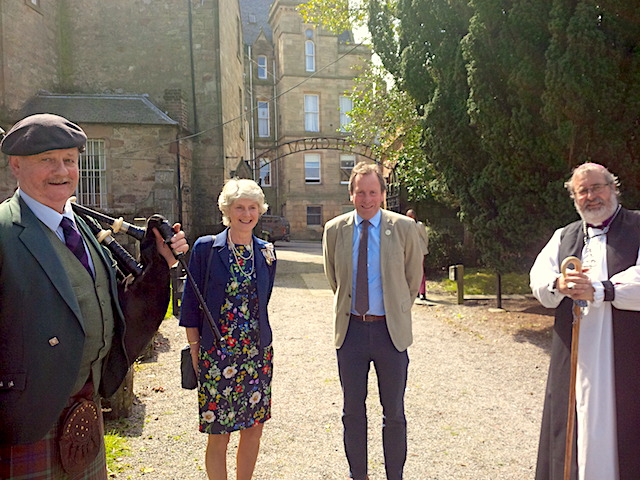
Today the Northern Pilgrims’ Way was launched with a dedication service in St Duthac’s Collegiate Church in Tain. Bishop Mark led the service, Jamie Campbell was at the organ and Rev Lizzie Campbell sang the hymns and an anthem and Rev James Currall read the lessons. The Lord’s Lieutenants of Ross-shire (Joanie Whiteford) and Sutherland (Monica Main) were in attendance along with a number of representatives of the Churches.
During the service, an information board was dedicated and the members of the congregations were given blessed cockle shells and candles as symbols of the pilgrimage, but in his address Bishop Mark gave strict instructions that the shells were to be given to pilgrims on the way, that those present encountered in the coming months. He also warned that launching the Way was only the beginning of something and not the end.
You can watch the service on Youtube below:
The original pilgrims were not just trying to get from A to B. The trials and tribulations of the journey were part of the experience, as was calling at recognised holy sites along the way. Modern pilgrims want to feel that they are following in the footsteps of these previous generations. So re-creating a pilgrimage route is not as simple as looking at a map and working out the shortest way from one place to another.
The Northern Pilgrims’ Way is what is known in the trade as a braided route. In other words, it offers the pilgrim alternative tracks between the start and end points. While some routes have more history attached to them than others, all are genuine pilgrimage ways through the North of Scotland.
Map of the Northern Pilgrim’s Way
In our time, pilgrimage is being revived in many denominations. Indeed, it is a feature of most main religions and seems to answer a deep-seated need within us to re-connect with the creator of our world and to work out our own place in this creation.
Further events are planned in the coming months at Thurso and at Kirkwall where the route ends.
3rd July 2021 in Old St Peter’s Kirk, Thurso at 12:30pm
20th August 2021 in East Church, Kirkwall at 12:00noon
This year it will not be possible for the Churches to get together as usual, except via Zoom and there will be a variety of such services taking place.
National Service
This will be hosted by the Scottish Committee of the WDP and will be held at 2pm on 5th March (Zoom open from 1:45pm).
Easter Ross Service
Hosted by the Easter Ross Inter-Church Group and will also be held at 2pm on 5th March.
Sutherland Service
Hosted by Lairg CoS and will be held at 6:45pm on 5th March
Zoom Details
All are welcome at any of these Services and I have circulated Zoom joining details for the Sutherland and Easter Ross Services to the members of the relevant congregations by email. If anyone wants Zoom details for the National Service or wishes to join one of the other, but han’t got the appropriate details, email me and I will pass them on. For security reasons these details will no be shared on web sites or on social media.
A file containing the Order of Service is available here
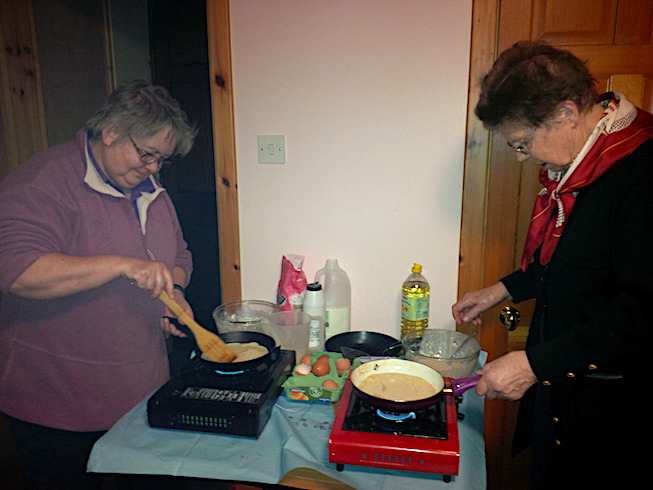
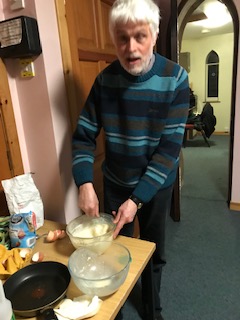
This year you will have to make your own pancakes, but the usual quiz and other entertainment will be available and people in all our congregations will be able to join in the fun.
If you have a ‘Party Piece‘ that you would like to contribute, then let James, Janet or Beatrice know and then everyone will be able to appreciate your special talent!!
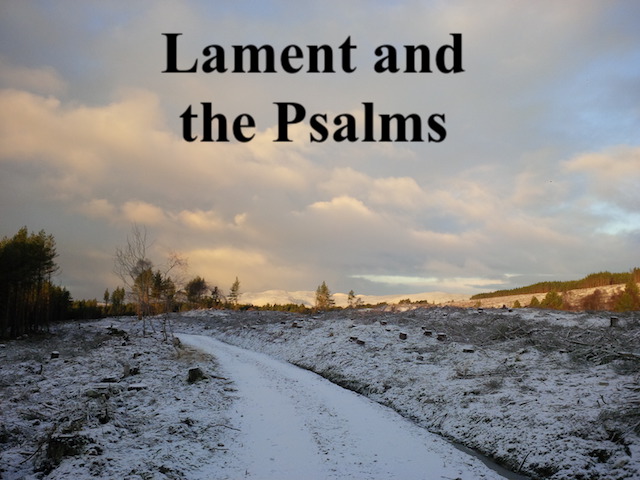
In our Lent Study this year we will look at Lament and the Psalms.
A quick search in dictionaries for a definition of lament reveals that it’s: to express sorrow, regret or unhappiness about something, or it’s a formal expression of sorrow or mourning. But Biblical Lament is actually much more than this. It’s not just a formal expression of sorrow. When we experience loss, grief is inevitable. In St. Augustine’s terms, we’re each a collection of loves that bind us to people, places, and practices. Whenever these bonds of love are severed, we grieve. Grief isn’t a choice; we’re subject to it whether we like it or not.
Lament, by contrast, is the exercise of spiritual agency in the face of loss. As a spiritual practice lament seeks to incorporate the experience of loss into the broader story of our lives before God. Where grief threatens to shatter the coherence of our story, lament re-opens our hearts to the possibility of a recovered sense of wholeness. Lament doesn’t internalise our pain, sorrow or loss, but helps us to call out to God. So it’s not just an expression of deep emotion resulting from loss, it calls to God for action and ends in praise to God. To lament is to join a long line of those who have wrestled with God in the midst of their sorrow.
We find lament throughout the Old Testament. Most clearly we find lament in the Psalms and these are referred to extensively throughout the New Testament. The Psalms are the Prayer Book of the Bible. As such they encompass the full range of human experiences—and in particular make room for experiences of suffering through Psalms of Lament.
The sessions will be centred around the following headings:
The Need for Lament
The Power of Lament
Lament and the Suffering of Others
Collective Grief
Lament as an Act of Love
There will be a group meeting on Zoom Wednesday Evenings from 7:30-9:00pm (24th February and 3rd, 10th, 17th and 24th March)
Zoom details have been circulated by email
The material will also be available on paper, by email and on the Web Site at:
Can we Christians align our beliefs and everyday habits in the twenty-first century? Christians have been formulating ‘rules of life’ at least as far back as the fourth century. The sixth-century Rule of St Benedict is probably the most widely known Christian rule of life, but a lot has changed since then! Is there scope for a Christian rule of life in the twenty- first century?
Advances in technology and communication, particularly social media, enrich our present-day lives whilst at the same time driving us to distraction. A cacophony of voices vies for our attention: how do we hear the Gospel above them all?
The Revd Dr Michael Hull, SEI’s Director of Studies (above), will facilitate an online discussion of issues about belief and habit, faith and practice, with insights from Justin Whitmel Earley’s “The Common Rule: Habits of Purpose for an Age of Distraction” (Downers Grove, IL: IVP Books, 2019) available via: https://www.thecommonrule.org
The discussion will be held on Wednesday 20 January 2021 from 7pm to 8pm and delivered via Zoom. The link and password will be emailed on the morning of Wednesday 20 January. To register, please visit this link.







 Scottish Episcopal Church - Dornoch, Lairg, Brora, Tain & Tongue