Walking Together

A number of things have happened recently which have caused me to reflect on community and what it means. Hitherto, I have tended to think of community as something relatively fixed, with a slow rate of change, but … Consider what happens when something unexpected or life-changing happens. Suppose someone is rushed to hospital or dies unexpectedly; in both cases a spontaneous community forms. A community that involves family and friends who although they already have relationships with each other, gather in support of those directly affected and each other. But there is more to it than that.

A member of my family was rushed to hospital on New Years day and as members of his family we gathered, both physically and virtually, to support him and each other in the changed circumstances of his life. As a result I spent last week visiting the Royal Shrewsbury Hospital each day for a few hours; and what struck me, was not just the community around each bed, but the community of friends and relatives of all those in the ward. People who hitherto didn’t know each other, but who took the time to care for each other, a community of the concerned relatives and friends who were brought together spontaneously by what had happened to their nearest and dearest. It doesn’t stop there. This gathered community extended to all those in the care teams at the hospital, who took the time to care for the relatives and friends as well as those in the beds. We all interacted in many and varied ways, pooling our knowledge and resources. It wasn’t organised, there was no-one leading it, a collection of one-to-one ministries — people being there for one another, walking together.

When anything unexpected happens it can be very difficult to deal with, but when someone who is close to you dies unexpectedly, it is particularly challenging. At times like that, having a community of family, friends and possibly even strangers, gather to provide mutual support is a particular blessing. No-one can fully understand what someone who is bereaved is going through. Bereavement is different for everybody involved each time it occurs, but a community of unconditional mutual support is hugely important, even if that support is more about providing space for grieving than anything else; providing a ministry of presence — people being there for one another, walking together .

Being there for one another, walking together – that for me sums up both community and ministry. The ministry to which we are all called by virtue of being followers of Christ. As Paul wrote in his letter to the Galatians: “Bear one another’s burdens, and in this way you will fulfil the law of Christ.” (Gal 6:2) However if you want a longer version, then you can do no better than to turn my favourite spiritual writer, Henri Nouwen, who wrote in 1983:

More and more, the desire grows in me simply to walk around, greet people, enter their homes, sit on their doorsteps, play ball, throw water, and be known as someone who wants to live with them. It is a privilege to have the time to practice this simple ministry of presence. Still, it is not as simple as it seems. My own desire might be to be useful, to do something significant, or to be part of some impressive project. But I wonder more and more if the first thing shouldn’t be to know people by name, to eat and drink with them, to listen to their stories and tell your own, and to let them know with words, handshakes, and hugs that you do not simply like them, but truly love them.” (from: Gracias! a Latin American Journal by Henri Nouwen)

Now you don’t need any special training to do that, being human is more than enough.

Blessings

James

He’s got the Whole World in His Hand

I love the season of Advent crowned as it is by the Christmas Eve/Day services, but as Advent proceeds more and more busyness intrudes into the sense of preparation, anticipation and prayerful reflection. For me therefore, the really special time, is the time between Boxing Day and the third of January. It’s a time when many businesses are closed and the world slows down just a little. A time of preparation for the New Year and a time to pause before the routine normality of life reasserts itself in January.

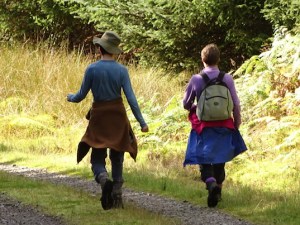
It doesn’t always work out quite as described, but even when there are perturbations, I still find it a time when there is space for reflection and prayer. For us this year, having the car break down on 28th December helped immensely, because there was simply no temptation to go anywhere or do any of the things that require a car if you live in a rural area. For many years we have gone for a long walk as early as we can manage on New Year’s day and this year was no exception. Lack of a car meant that we could only do a walk that started and ended at home.

So it was off up a rather slippery Achue road, across the moors to the summit of Cnoc Dubh Beag (the small hillock), then wading through the snowy landscape up to the trig point at the top of Creag a’ Bhealaich (crag of the pass) – of which there are several in Scotland, ours being the smallest. The sun was shining, it was very frosty and the air was fresh and clear. On the tops the views were stunning, though there were clouds gathering in the west. A reminder if ever we need it, that we do live in a most beautiful part of the world.

In spite of the feeling of elation, which can be almost overwhelming at such times, the bright sun, the freshness and the beauty cannot hide the fact that in many parts of that landscape people are suffering. In communities and families, as well as the holiday joy and gladness, there is worry, there is sickness, there is grief and there is sadness. Everyday life contains all of these things, and believing that the “Word became flesh and dwelt among us” doesn’t remove them, but what it does is to provide the possibility of hope. God is there in those communities and in those families, He’s there to be found, but sometimes it’s difficult to see it, to sense it and to feel the benefit of it.

We all have our part to play in helping those in our families and communities who are having a tough time to sense the love of God. And to be able to trust in the Christian hope comes from knowing that God comes to us in our hour of need, leads us into his all-encompassing love, acts in our lives and arranges for our salvation. Perhaps this might just offer a ray of sunlight to those who found that 2017 didn’t end the way that they would have liked it to and hope that in 2018, whilst the old normal can never be restored, a new normal is possible in which love, trust and peace will conquer all.

There’s a Gaelic carol which includes these verses:

’Nuair dh’èirich grian na fìreantachd,
Le gathan dìleas blath;
Bu mhòr a bha de dh’fheum oirre,
Bu dèisneach cor gach àit.
When rose that sun of Righteousness,
With rays so warm and true;
Greatly had we need of them,
As woe in each place grew.
Fo dheàrrsadh grian na fìreantachd,
‘S a chridh bidh sith a’ fàs;
Gu’n toir i ’reothadh millteach às,
‘S gu’n lion i e le blàths.
Beneath that Sun of Righteousness,
God’s warmth and peace will grow;
It drives away the spoiling frost,
And makes the heart to glow.

John Maclean – the Tiree Bard

Blessings and Peace to you this New Year
James

In his masters steps …

This slideshow requires JavaScript.

Two dozen hardy souls braved the elements, “thou the snow lay round about deep and crisp and even” to Kai and Mike’s traditional readings and carols at the Crask on Thursday (even if a couple of days late for the Feast of Stephen).

We sat around a furnace of a stove, sang, listened and of course shared in Kai and Mike’s legendary hospitality – scones, mince pies, tea, coffee and all the rest.  Thanks to everyone,  it was truly wonderful.

A lovely gentle service at the Crask

The December Crask service attracted a sizeable congregation including several people who had not been before.  We reflected on the journey towards Christmas which starts at the Annunciation (March 25th) and culminates in the Word becoming Flesh in a manger in Bethlehem.

Don’t forget the traditional Carols at the Crask service and fellowship next Thursday (December 28th) starting at 2pm.

Have a blessed Christmas.

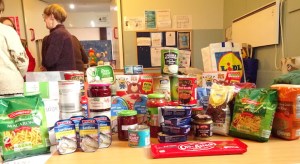
and the food rolled in

Just a small selection …

Yesterday saw a very successful Special Collection for the Food Bank which St Finnbarr’s held in the Dornoch Social Club.  There was a steady stream of contributors, most of whom stopped for coffee/tea and a chat.

A huge thank you to those who contributed and to Marian and the other members of the congregation who worked so hard throughout the morning.  Margaret and Alan’s car will be much relieved when it’s all over and it’s suspension can return to normal:-)

Christmas Services

  • Sunday 24th Dec (4th Sunday in Advent) at 11:00am at both St Andrews, Tain and St Finnbarr’s, Dornoch.

  • Sunday 24th Dec at 6:30pm – Lessons and Carols in Lairg Parish Church (Lairg Christians Together), followed by seasonal refreshments in the hall.

  • Sunday 24th Dec – Christmas Midnight Services 11:00pm at St Finnbarr’s, Dornoch and 11:30pm at St Andrews, Tain.

  • Monday 25th DecChristmas Day Services – St Maelrubha’s, Lairg at 8:15am, St Finnbarr’s, Dornoch at 9:30am and St Andrews, Tain at 10:30am.

  • Thursday 28th DecChristmas Carols, Readings and Music – The Crask Inn at 2:00pm.

Encourage one another and build up each other

As always, this month’s gathering at the Crask was relaxed, deeply spiritual and most enjoyable; not least because we marked the feast of St Margaret of Scotland who should be seen as such a splendid example to us all. During the course of our post-Gospel discussion, one of our number told a story that she first heard as a schoolgirl from Mother Theresa of Calcutta. This story can be found in many world cultures, Christian, Jewish, Islamic, Hindu, Buddhist, Oriental, Chinese and more.

One version of what is called the Parable of the long chopsticks or Allegory of the long spoons goes like this:

A curious man once asked to visit heaven and hell. Expecting hell to be a terrible, frightening place, he was amazed to find people seated around a lovely banquet table. The table was piled high with every delicious thing one could possibly want. The man thought, Perhaps hell isn’t so bad after all.

Looking closely, however, he noticed that everyone at the table was miserable and thin.

They were starving, because, although there was a mountain of food before them, they had been given six-foot-long chopsticks with which they had to eat. There was no way to carry the food to their mouths with such long chopsticks, and so no one could eat a bite.

The man was then taken to heaven. To his surprise, he found the situation was exactly the same as he had seen in hell. People were gathered around a banquet table piled with food. Everyone held a pair of six-foot-long chopsticks in their hands. But here in heaven, they were well fed with everyone happily eating the delicious food. He asked what was different. The difference: in heaven they were using their extra-long chopsticks to feed one another rather than trying to feed themselves.

As Christians, we are part of a community of faith. In fact Christianity is a faith of relationship, focussed on the community and not on the individual. This is very clearly expressed in the writing of the Apostle Paul and is a constant theme in Jesus’s teaching. It can also come as quite a shock to many people in our society, where spirituality is increasingly seen as purely about an individual’s relationship with God, and nothing to do with anyone else. Without the corrective of the community of faith, it’s however so easy to build God in one’s own image – the most common form of idolatry.

In our life as Christians, there are many pitfalls that we might fall into. There are the clearly recognisable sins: murder, adultery, stealing, bearing false witness, but these are fairly easy to deal with, in that you probably know when you’re committing them. The more insidious ones are the ones that come disguised as virtue, these might be described as sins of the spirit.

As Eugene Peterson wrote “It is in our virtuous behaviour that we are liable to the gravest of sins. It is while we are being good that we have the chance to be really bad. It is in the context of being responsible, being obedient, that we most easily substitute our wills for God’s will, because it is so easy to suppose that they are identical.” It is in the course of being faithful Christians that we’re most likely to fall victim to pride, arrogance or insensitivity to what Jesus called “the least of these my brethren”. Ironically, it is those of us in positions of leadership, trust or responsibility that are often most at risk. In all the things that make up Church life, it’s so easy to lose sight of what is at the core of being a Christian – the business of loving God and loving our neighbour, no matter who that neighbour many be.

Even within our congregations or the wider Christian community, individual Christians can’t manage on their own, nor should they try. We’re all responsible to one another for encouragement and support in faith, love, and hope. Others need our support in being Christian, and we need theirs. This Advent, as we prepare to welcome the incarnation of our Lord and Saviour Jesus Christ, coming into the world as a tiny, vulnerable baby, it would perhaps do each of us good to reflect on what it means to be a Christian in our congregations and in our wider community, wherever in this beautiful part of the world we might live. The hope that overcomes the uncertainty and anxiety about the future, that few if any of us are immune from, is fostered by encouraging each other in our faith and in the way we live our lives.

As a final thought, it’s no accident that the writers of our liturgies (both those in the Scottish Prayer Book and more recently) finish with a benediction: “And the blessing of God Almighty, the Father, the Son, and the Holy Spirit (or Ghost), be amongst you (not upon you) and remain with you (plural) always.”

To you the community of faith in the North-Eastern Highlands:

Blessings
James

Caithness and Sutherland Women’s Aid

Recently at the invitation of St Finnbarr’s, Dornoch, a small group of women gathered in the Dornoch Social Club to learn about the work of Caithness and Sutherland Women’s Aid (CASWA) which St Finnbarrs Charity Shop has supported with donations for several years. Those present were from the congregation of St Finnbarrs, volunteers from the Charity Shop, members of the Dornoch and District Community Association (DADCA) coffee group and some members of the Dornoch Cathedral Guild.

In an informal and interactive talk, the two speakers Carol an adult support worker and Jackie a child support worker, gave the group an idea of the different forms of abuse which women suffer, how children in a family can be affected and how CASWA supports them.

The physical nature of abuse is probably fairly well known but the speakers emphasised the insidious mental abuse to which many of the women who come to them are subjected. The coercive, dominating and controlling behaviour exerted by partners undermines women and leads to loss of confidence and self-esteem. The increasing role of social media in this kind of abuse was highlighted. Just one example of several we were given was that some women are tracked by their partners mobile phones when they are out of the house. Social media abuse is also a growing problem among young women still at school.

The work of CASWA is confidential and support workers are non-judgemental. Their role is to offer emotional and practical to help to abuse sufferers, to help them decide what to do, not tell them what to do. They then support them and any children involved in following through with their decisions. Although CASWA can no longer fund a safe house for abused women and children they have access to a national data base of organisations and authorities that can provide safe accommodation. If women and any children they may have are at immediate risk of harm they are therefore able to make referrals if necessary.

CASWA is responding to increasing numbers of requests for help. This reflects national trends. In 2016 -2017 there were 58,810 domestic abuse incidents reported to police in Scotland and there are certainly many more which were not reported.

CASWA can be contacted on:

Tel 0345 408 0151 (24 hour answer service)
National Domestic Abuse Helpline 0800 027 1234 (24 hours)
Office hours 9am – 5pm Monday – Friday

or by Email at: info@caswa.org.uk

Jonah: the Advent Study 2017

The book of Jonah is about the relationship between a rebellious prophet and a relentless God. It’s one of the most famous stories in the Old Testament perhaps because of the miraculous moment when Jonah is swallowed by a whale. The message of Jonah, however, takes us beyond the miraculous to ask deep questions of all of us about God’s calling and our response. In the belly of the whale Jonah prays and the way that he pray provides considerable food for thought. The ultimate message of Jonah may be that God’s will is not easily subverted, but our God is nothing if not both persistent and compassionate in seeking us out and bringing us home.

Come and join us as we consider all of this in a series of three Advent Study sessions on Thursdays: 30th Nov, 7th Dec and 14th Dec from 2:00-3:30pm, followed by refreshments. The sessions will take place at James and Anna’s house in Spinningdale.

SEI November Newsletter

The Scottish Episcopal Institute, which is responsible for training priests, deacons and lay readers in our Church, now produces a monthly newsletter.  If you are interested in what the Institute and its students (including our own Don Grant) are doing, you can read about it here SEI November 2017 News-sheet.