D-Day Bells – 6th June 2024 at 6:30pm

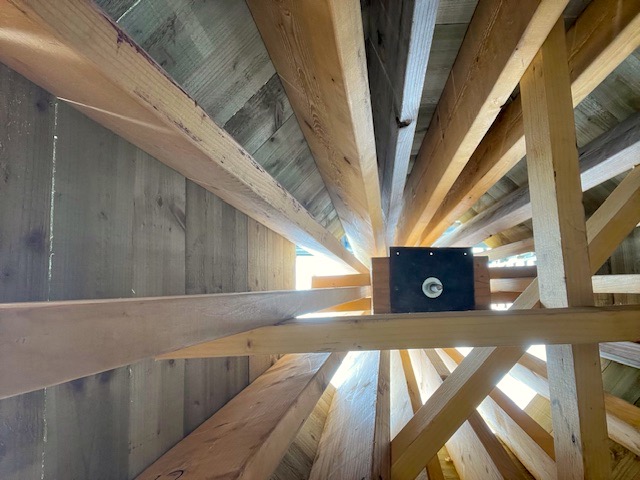
St Finnbarr’s Bell Tower

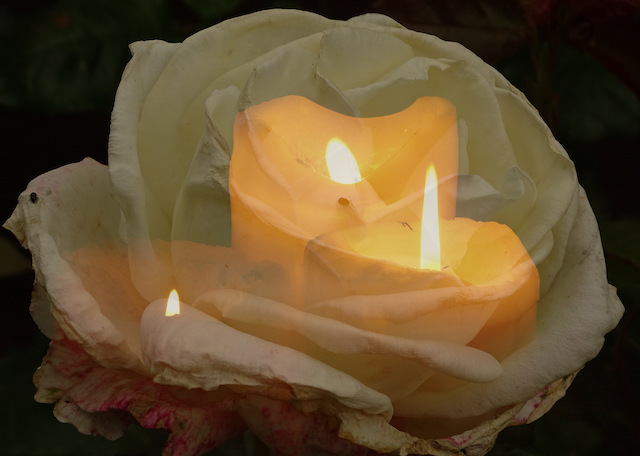
At 6:30pm tomorrow evening, bells will be rung in St Finnbarr’s Dornoch, St Andrew’s Tain and St Columba’s Brora to mark the 80th anniversary of the D-Day Landings during WWII. This timing it to coincide with ringing of bells in many other places both in the Highlands, the rest of Scotland and beyond.

All are welcome at any of these churches to witness to this marking of the courage all all those who were involved in this massive operation by Air, Sea and Land; just turn up.

The bells will be rung for 5-10 minutes at each location.

Service of Blessing for St Andrew’s Restored Tower

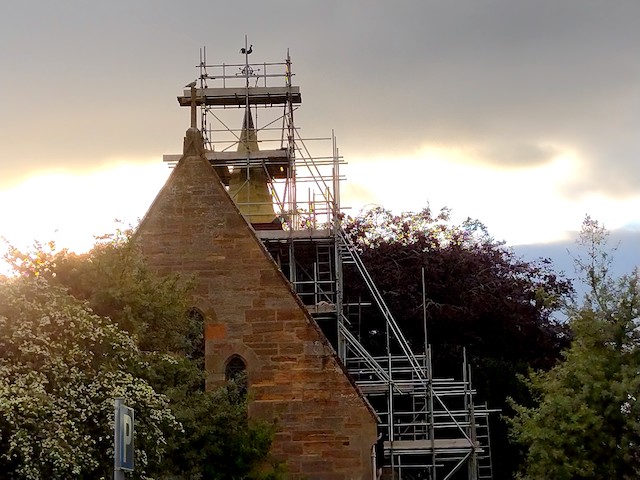
At 2:30pm on Friday afternoon this week (7th June) Canon James and one or two others will climb the St Andrew’s scaffolding to conduct a service of blessing of the tower, belfry and bell before the scaffolding is removed in the coming week or two and access will once again be impossible.

If anyone wishes to be present on the ground during the service, you are most welcome to join us.

The service will last about 15 minutes.

Almighty God,
we offer to you all the work that has been undertaken to restore this tower and belfry.
Bless, sanctify and hallow all that has been done in this tower,
all those who have used their skills to restore it and
all those who of their generosity contributed to making this work possible.
Bless all who look upon it and all who ring or hear its bell
and grant that the message of the bell may lift the hearts of all in our community.
Amen

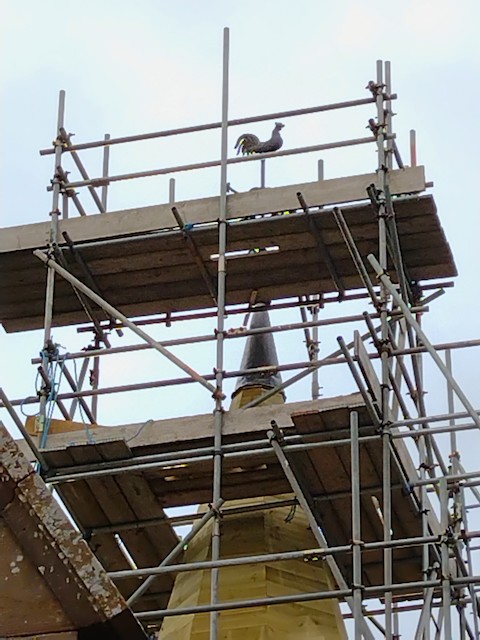
The Bird Flies Again

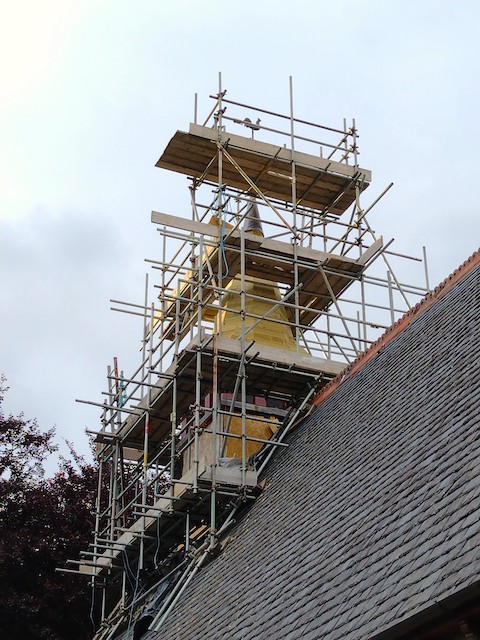
In the last couple of weeks, the tower works at St Andrew’s have come on by leaps and bounds and this coming week, the roofers will be back to add the slates to the spire …

… and then the scaffolding can be removed from inside the church, in time for Flora and Angus’s wedding in July.

The Feast of Corpus Christi

Eucharist

The Feast of the Thanksgiving for Holy Communion, commonly called, Corpus Christi was first celebrated in the 14th Century. It began as a local custom to celebrate the Mystery of Christ’s presence in the Eucharist and slowly spread throughout the Church, finally being added to the Kalander in the 15th Century.  In our Kalander we calebrate Corpus Christi on the Thursday after Trinity.

William Harry Turton’s hymn “O thou who at thy Eucharist didst pray” sung to a lovely tune (Song 1) by Orlando Gibbons.

Perhaps the most famous aspect of Corpus Christi (literally the Body of Christ), that people associate with this feast day, is the great processions through cities, towns and villages.  The Blessed Sacrament is held aloft by a priest, in a monstrance, as a public statement that the sacrifice of Christ was for the salvation of the whole world.

Monstrances are one of those liturgical curios that appear sometimes, but in our tradition not very regularly.

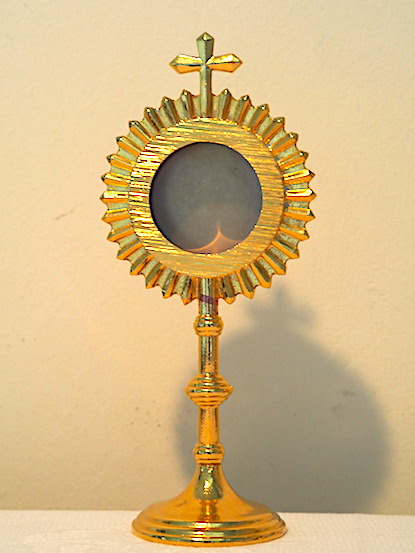
Monstrance

The Host (the consecrated Bread) sits in the glass plate in the centre with ‘rays of glory streaming out from it‘. A reminder of the Glory of Christ, present in the Eucharist, and the glory of the Heavenly Banquet that we join when we take Communion together.

Traditionally, at the end of the Mass on Corpus Christi the Host (the consecrated Bread) is placed in a monstrance and the congregation spend some time reflecting on this Mystery of Christ made present in the bread and wine.

The officiating Priest would then take the monstrance and carry it aloft down through the church and out into the streets – with servers throwing rose petals down in front of it to make a carpet – a bit like confetti at a wedding – with bells ringing out to tell everyone that Christ was walking among them in the Eucharist

Corpus Christi represents more than just the Church giving thanks for the way that Christ remains, with us always – even unto the ends of the Earth. It’s a celebration that we, the Church, are united in and as the Body of Christ.

Like the sound of a rushing wind

Christmas, Lent, Holy Week, Easter and Pentecost are behind us and we have now arrived at the Feast of Trinity and the start of what is often referred to as ‘ordinary time’.  Since December we have reflected on God’s coming to earth as a human child at Christmas and the change that makes to God’s relationship with human beings, we have reflected on our relationship with God in Lent.  The levels to which human beings can stoop to get their own way and to stay in power are in many ways the focus of Holy Week with God rising above it all in the Resurrection at Easter. 

We have heard about how God the Son appeared to His despondent disciples during the seven weeks of Easter, culminating in His Ascension to be reunited with God the Father. Finally last week we reflected on God the Holy Spirit descending upon the disciples empowering them to continue the Son’s teaching and action in the world. ‘God in three persons, Blessèd Trinity’ as that well know Trinity hymn ‘Holy, Holy, Holy’ puts it.

In my sermon last week on the Feast of Pentecost I said:

The Ascension doesn’t mean that Jesus is abandoning them, that He’s running away. He’s leaving so that something more powerful can take his place. He repeatedly tells them what it is that will take his place. He tells them that he is sending them the Holy Spirit, the advocate, the Spirit of Truth, the Comforter. The purpose of the Holy Spirit is to do in them what He himself had been doing among them. The message is simple, something that’s familiar (Jesus with the disciples in person) is to be replaced by something that’s unfamiliar (God’s Spirit within them). 

The Holy Spirit is God’s way of being present with them, and also with us, all the time (if we allow that to happen), making our life and work continuous with the life and work of Jesus. So in the same way that God was present to the disciples in Jesus, he can also be present to others through the disciples and through each of us. Everything that Jesus said and did amongst the disciples can be continued in what they and we say and do. The Holy Spirit is the divine power, God at work in and through us as the perpetuation of Jesus presence in the world amongst those who follow him.

After the service, a visitor (who incidently was from New Zealand and who with a friend from England was nearing the end of their cycle ride from Land’s End to John O’Groats) remarked that it was wonderful to hear a sermon preached about the Holy Spirit, because it always seems to be a rather mysterious and little talked about aspect of God. At that service we also sang one of my favourite hymns ‘Spirit of God, come dwell within me’ (not to be confused with the better know ‘Spirit of the living God’ or ‘Spirit of God unseen as the wind’ sung to the ‘Skye Boat Song’). No, this one is sung to a wonderful Gaelic Air called ‘Leaving Lismore’.  The first verse and chorus are:

Spirit of God, come dwell within me.
Open my heart, O come set me free.
Fill me with love for Jesus, my Lord.
O fill me with living water.

Jesus is living, Jesus is here.
Jesus, my Lord, come closer to me.
Jesus, our Saviour, dying for me,
and rising to save his people

Now that seems to me to capture rather neatly what the Spirit of God is and what the Holy Spirit does for us in our lives and should provide encouragement to us all.

Blessings
James

Pay Attention!!

Cartoon by Dave Walker from Cartoon Church used with permission

I was browsing though a book that recently arrived on my desk, when I came across this rather interesting passage:

Even of those who do come [to church], we find many behaving themselves in such a careless Manner, as if the Worship of God was either not their Business there, or not worth minding. Some sit all the Time of the Prayers; or put themselves into such other lazy and irreverent Postures, as shew sufficiently that they have no Sense of what they should be doing, nor any Awe or Reverence of the glorious Being they come to address. Others lay themselves to sleep, or trifle away their Time thinking of their worldly Affairs. Others gaze and stare upon the Congregations, or keep talking and whispering with their Neighbours; and this is especially observable while the Lessons are reading; as if the Holy Scriptures, though given by Inspiration of God, were not always to be heard, marked, learned and inwardly digested . . . Others there are, who do indeed shew some Inclination to mind the Prayers and all the rest of the Service; but they do it with so much Ignorance, Distraction, or Confusion, as discover that they do not rightly understand the Difference between one Part of the Service and another . . . We often find them repeating after the Minister what he alone should speak, and they should only hearken to. They are also apt, when they join the Prayers, to say them after him so loud, as must needs be troublesome, and disturb those that are near them . . .

It comes from a tract ‘Directions for a devout and decent behaviour in the public worship of God; more particularly in the use of the Common Prayer appointed by the Church of England’, which was published in the early 1700s. It was apparently so popular that by 1799 it had reached it’s thirtieth edition and had been translated into both Welsh and French.

Just in case you thought that this was purely an English problem and we in Scotland were immune from such deviations from ‘seemly conduct’, closer to home the ‘Directory of Publick Worship of God’, published in Edinburgh in 1645 for the benefit of Scottish congregations included this paragraph: 

The publick worship being begun, the people are wholly to attend upon it, forbearing to read any thing, except what the minister is then reading or citing; and abstaining much more from all private whisperings, conferences, salutations, or doing reverence to any person present, or coming in; as also from all gazing, sleeping, and other indecent behaviour, which may disturb the minister or people, or hinder themselves or others in the service of God.

So that is us all told!  It set me wondering if inattentiveness to what is going on in church is such a bad thing or if what my training rector when I was a curate used to call “looking about yourself” might actually be part of encountering God rather than a turn away from God.  It is interesting that whilst Scottish edition of ‘The Directory’ is concerned with signs of inattentiveness that cause noise and distract others, the other document is much more concerned with the internal thoughts of worshippers that manifest themselves in the distracted behaviours.

The last two verses from “Lenten Thoughts of a High Anglican” a poem by John Betjeman, that recounts the day-dream of a man rather distracted by a lady in church, reads:

The parson said that we shouldn’t stare
Around when we come to church,
Or the Unknown God we are seeking
May forever elude our search.

But I hope that the preacher will not think
It unorthodox and odd
If I add that I glimpse in “the Mistress”
A hint of the Unknown God.

I wonder if how we behave in church nowadays and any advice on such matters shouldmake more allowance for the fact that we’re all different in how we encounter God and shouldn’t be quite so judgemental about outward signs and how we interpret them. I wonder what feedback such exhortations might elicit today – perhaps you might let me know:-)

Later on in the ‘Directory’ it says:

IT is the duty of the minister not only to teach the people committed to his charge in publick, but privately; and particularly to admonish, exhort, reprove, and comfort them, upon all seasonable occasions, so far as his time, strength, and personal safety will permit.

That last clause certainly gives food for thought and I wonder how Our Lord viewed His ‘personal safety’ when He was out and about in Galilee and Jerusalem admonishing, exhorting, reproving and comforting!!

Blessings
James

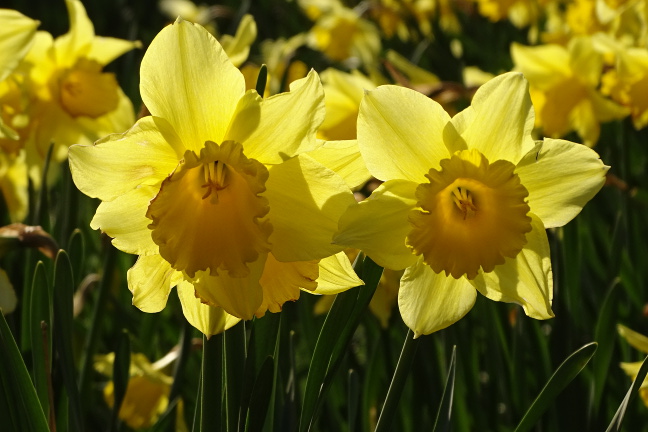
Daffodil Day – Saturday 13th April 2024

You are invited to a

Daffodil Day

at

The Duthac Centre, Tain

on Saturday 13th April 2pm-4pm

Beautiful Daffodils,
Refreshments with Home Baking,

Homemade cakes to buy,
Guess the Sweeties in the Tin,
Craft Stalls,
Daffodils for Sale,
Raffle,
Lucky Squares,

Preserves Stall,
Plant Stall,
Book Stall.

Fun for all the family

Donations Welcome

Organised by the Tain and Dornoch Firth Fundraising Group
in aid of Marie Curie which provides care and support through terminal illness
.

For more information contact Pat on 01862 894020

Resurrection (of the tower)

Alleluia Christ is Risen!!

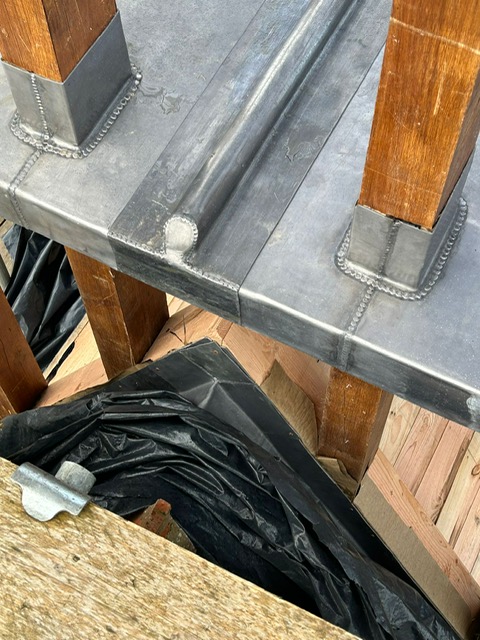
Alongside our Easter joy, it is so good to see that the tower at St Andrew’s is now taking shape and fascinating to admire the skill of the joiners and roofers as they carefully craft timber, lead and slate and also the input of painters and metal workers as they all contribute. We all look forward to them completing their task, so that we can celebrate all that they have achieved.

Alleluia Christ is Risen!!

Imagining the Resurrection

Nothing” David Hume, enlightenment philosopher, historian, economist, librarian, and essayist, maintained: 

is more dangerous to reason than flights of the imagination.and nothing has been the occasion of more mistakes among philosophers.

Hume has hardly proved the most popular philosopher in Christian circles. Nevertheless, ever since the era of the Church Fathers many theologians have done their work as if nothing were more dangerous to theological reason than flights of the imagination.

Undoubtedly the imagination can lead us into a mess at times. That happens when we use images in attempts to describe and explain abstract realities as though they were the reality itself. At the same time, was there not value in the view championed by the romantics – that art and the imagination provide an authentic way of reaching reality?  The poet Keats put it this way: “What the imagination seizes as beauty must be truth”.

In ‘A Midsummer Night’s Dream’ Shakespeare writes:

Lovers and madmen have such seething brains, such shaping fantasies, that apprehend more than cool reason ever comprehends. The lunatic, the lover and the poet are of imagination all compact”.

What then has any of this to do with Easter and Christ’s resurrection?  Well, I wonder ifsome images help us to understand those mysteries much better than a more literal understanding of what the Gospels are telling us about such matters. If we take things too literally, we might fail to see what the Resurrection actually means and why it’s so important. However a word of caution, in doing so we need to avoid any temptation to try to actually describe what a risen life might look like?  So what can we learn from a moreimaginative approach to Christ’s Resurrection and even our own?

Many Christians find it easier (and bizarrely more comforting) to think about the life and death of Jesus rather than His resurrection. Their imagination fails, once they move beyond Good Friday. Amos Wilder, the American poet, minister, and theologian, observed: 

Imagination is a necessary component of all profound knowing and celebration”.

Great artists create ‘symbols’ through which we can share their experience and insights. They invite us to enter in our imaginations, into the work of their imaginations. In imagining the human body, artists as different as El Greco and Rodin go behind the familiar appearance of the human body to re-express it in a new way. They move beyondorganic, material bodies beyond mere replicas, to glimpse hidden splendour and beauty. This is much the same as seeing beyond skin colour, gender, disability or any other observable characteristic, to see the real person within. They discover an inner glory in their subjects and, as it were, propel them into another world. The creative imaginations and hands of the artist liberate new life from within the constraints of ordinary life.

The Apostle Paul repeatedly speaks of God the Father as having “raised Jesus from the dead”. Might we see God the Father as the ultimate artist who sets free Jesus’ real bodily glory? In doing this for his crucified Son he promises to transform each of us into the splendour and beauty of what Paul calls the ‘spiritual body’. Paul encourages such an imaginative leap when he recalls an analogy from his Jewish background. Even dull readers, he expects, can marvel at the growth that transforms a grain into a mature plant ready for the harvest.

But someone will ask, ‘How are the dead raised? With what kind of body do they come?’ Fool! What you sow does not come to life unless it dies. And as for what you sow, you do not sow the body that is to be, but a bare seed, perhaps of wheat or of some other grain. But God gives it a body as he has chosen, and to each kind of seed its own body.” (1 Cor. 15:35-38).

Here Paul invites us for all our foolishness, to make the leap from the lesser miracle of harvest to the great wonder of the risen life: 

So it is with the resurrection of the dead. What is sown is perishable, what is raised is imperishable. It is sown in dishonour, it is raised in glory. It is sown in weakness, it is raised in power. It is sown a physical body, it is raised a spiritual body. If there is a physical body, there is also a spiritual body.” (1 Cor. 15:42-44).

Over the past 18 months some of us have had to spend quite a bit of time thinking about church buildings, as we work to get St Andrew’s belfry tower repaired. In spite of the fact that once again we’ll celebrate the Resurrection with scaffolding inside the back of the church, Easter urges us to disconnect with the physical world and use our imaginations to see beyond such things as mere buildings.

At Easter, nothing trumps God’s Son being raised from the dead. Without that, Christianity is nothing at all and so as Christians we must never forget that it’s the risen Christ that’s at the heart of our faith and Easter is that time of the year when we try to use our imaginations to enter as fully as we’re able into the mystery of God Incarnate, Resurrected and Ascended and what that means for our lives.

May this Easter be a time of blessing for you and all those that you love.

Blessings
James

A Meditation on Good Friday

At the foot of the Cross” James Tissot (1896) Brooklyn Museum

Here we are at the foot of the Cross.

The Passion of our Lord is a very familiar story. A story that we have heard many times. The problem with familiar stories is the temptation to skip ahead, to fail to really listen to the now part of the story, to have already moved on to the next part. You see we know what happens next – or at least we think we do.

Here we are at the foot of the Cross. Where has everybody gone? 

Why are there are now so few remaining?

Meanwhile, standing near the cross of Jesus were his mother, and his mother’s sister, Mary the wife of Clopas, and Mary Magdalene. 

When Jesus saw his mother and the disciple whom he loved standing beside her, he said to his mother, “Woman, here is your son.” 

Then he said to the disciple, “Here is your mother.” 

Did many of those who packed churches across the world on Sunday think that they knew what happened next in the story? Did they think that they just had to cheer and someone else would do all the hard work? Do all those who were gathered in church in Lairg, Tain and Dornoch on Sunday think that they know what happens next? Do we think that we know what happens next?

Here we are at the foot of the Cross. At the beginning of something new, challenging and uncertain.

But the important thing is – that we are here. Why are we here? We are here as, were those at Golgotha, because although we know that something has ended, we trust in God’s mercy and grace and have hope that something new will happen. We don’t know what it is that will happen, unless we’re tempted to read ahead in the story and risk getting it totally wrong – like the crowd and the Jewish Authorities, to jump to conclusions and make assumptions about what God has in mind for us.

Here we are at the foot of the Cross. Not knowing what will happen next.

If things are really going to happen in our lives, we have to enter a state of not knowing what will happen, of not knowing how we will emerge at the end. Knowing is a characteristic of Divinity and not of humanity. In humility we need to recognise our humanity and God’s Divinity and enter into the state of not knowing so that He who knows can lead us to where He wants us to be.

In order to really enter into the momentous events of today, we need to abandon reading ahead in the story, abandon the idea that we have the slightest idea what happens next. Now let us close our eyes and listen to the story again told by a stranger and through it enter into that uncertainty and hope.

Amen.