Crask Weekend Services

From Saturday 2nd February, there will be a Eucharist on the First Saturday of each month starting at 5:00pm.  This is in addition to the established pattern of services on the Third Thursday of the month at noon.  There will no longer be a monthly Sunday evening Eucharist at the Crask.

The track behind and the road ahead

The period between Christmas Day and the New Year is a time both of looking back over the last year and looking forward to the coming one. It’s no coincidence that the Roman God Janus, God of beginnings and endings, after whom January is named, had two faces, one looking forward and the other back.

As we look back over the past year and reflect on all that has happened, I’m sure that there are many things that we wish had not happened and things that didn’t happen that we wish had. Those who try to live their lives as Christians aren’t plucked away from the hard realities of life into some paradise where we can leave far behind: pain, anguish, tears, anxiety, loss and grief.

Many of us haven’t had a particularly easy year: the loss of close family or friends, difficult relationships, health problems, worry about the future. There are people who talk as if being raised with Christ removes all these things, all doubt, all pain, all difficult responsibilities and trying relationships They’re either fantasising or living in the world of the more sentimental Victorian hymn writers.

When Paul wrote about being raised with Christ, he was talking about a miracle. But that miracle isn’t about being delivered from our present circumstances, it’s about being transformed by them. Transformed by the Christian hope that through having faith and trust in God, all things can be made anew, so that as St Julian of Norwich wrote of a vision in her “Revelations of Divine Love” in which Jesus informed her that: “All shall be well, and all shall be well, and all manner of thing shall be well”.

May all blessings be yours in 2019
James

Carols and Taindeer

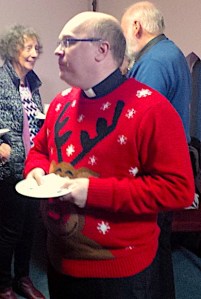
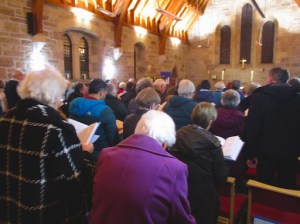
A joyful sound came from St Andrew’s, Tain this afternoon as we retold the story of the Incarnation in readings and Carols at our Carol Service.  The the leaders, readers and congregation were in fine voice, but the prize for the best jumper must go to the organist:-)

As the picture implies there were refreshments – mince pies and mulled wine – but clearly Simon has finished his, or else the reindeer got to them first:-)

Thanks everyone you all did a splendid job.

Silent Night and not so silent afternoon

A very special and moving Crask Carol Service this afternoon, including a very heartfelt reading of an account of the Christmas Truce in 1914 in the trenches of WW1.  A lovely atmosphere, a packed room a very fitting set of readings, poems and carols, not forgetting the refreshments aftwerwards.

This slideshow requires JavaScript.

A huge thanks to Kai and Mike for organising it all, to all those who read and played and sang and to Denise and Douglas and those who assisted them with the refreshments.

On the Feast of Stephen

After the business and excitement of Christmas Day, perhaps a peaceful and relaxing St Stephen’s Day, although the prospect of ‘deep, crisp and even‘ snow seems rather remote given the temperature today.

Hereabouts we had very busy gathering at our midnight and Christmas Day services and there is still time to sing more carols at the Carol Services at The Crask on Thursday @ 2pm or at St Andrew’s Tain on Friday @ 3pm.

Many blessings for the remainder of Christmastide.

And all the angels sang for him!

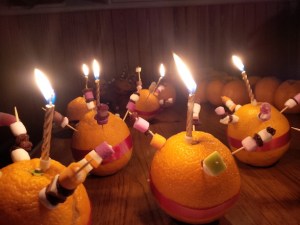
What a lovely afternoon of prayer and carols, nativity readings and Christingle making we had in Lairg.  Folk from all of the local Churches and Fellowships and many others from round and about came together to mark Christmas in the Lairg Christians Together (LCT) Family Christmas Service.

A group of the children who attend the LCT Big Club sang “A Starry Night”, and they were really good and we all joined in the final chorus.

At the end, the Christingles were lit and the congregation processed out of the Church and to the hall for mince pies, sausage rolls, shortbread and tea and coffee.

A splendid occasion for young and old.  Thanks to everyone who organised, helped, read, sang, played and made tea and to everyone who came and provided such a wonderful atmosphere.

Go Tell it on the Mountain

Over sixty people enjoyed a selection of carols, readings, poetry and music this evening in St Finnbarr’s, as we reflected on the story of the nativity and its meaning.

A splendid retiring collection raised over £300 for the homeless charity Emmaus, which houses, feeds and provides work for people who have been homeless whilst they get back on their feet again.

By providing a stable home and meaningful work,
we help companions
 to regain their self-esteem
and find a positive way to move forward with their lives.

At the interval, there were mince pies, shortbread and tea and coffee, and if I was looking for a picture for a caption competition, this one might serve that purpose:-)

A huge thank you to all those who organised, read, sang and played and another one to all those who came and gave so generously for people less fortunate than themselves.  Now go tell it on the mountain, and wherever else you happen to be.

Xmas and Christmas – C S Lewis

Some of you have enquired about the C S Lewis essay from which came my sermon illustration this morning, so I am posting the whole essay for those who are interested.  For me what is really interesting is that this essay was published, not recently, but nearly 65 years ago!!
Xmas and Christmas: A Lost Chapter from Herodotus

by C. S. Lewis

And beyond this there lies in the ocean, turned towards the west and north, the island of Niatirb which Hecataeus indeed declares to be the same size and shape as Sicily, but it is larger, though in calling it triangular a man would not miss the mark. It is densely inhabited by men who wear clothes not very different from the other barbarians who occupy the north western parts of Europe though they do not agree with them in language. These islanders, surpassing all the men of whom we know in patience and endurance, use the following customs.

In the middle of winter when fogs and rains most abound they have a great festival which they call Exmas and for fifty days they prepare for it in the fashion I shall describe. First of all, every citizen is obliged to send to each of his friends and relations a square piece of hard paper stamped with a picture, which in their speech is called an Exmas-card. But the pictures represent birds sitting on branches, or trees with a dark green prickly leaf, or else men in such garments as the Niatirbians believe that their ancestors wore two hundred years ago riding in coaches such as their ancestors used, or houses with snow on their roofs. And the Niatirbians are unwilling to say what these pictures have to do with the festival; guarding (as I suppose) some sacred mystery. And because all men must send these cards the marketplace is filled with the crowd of those buying them, so that there is great labour and weariness.

But having bought as many as they suppose to be sufficient, they return to their houses and find there the like cards which others have sent to them. And when they find cards from any to whom they also have sent cards, they throw them away and give thanks to the gods that this labour at least is over for another year. But when they find cards from any to whom they have not sent, then they beat their breasts and wail and utter curses against the sender; and, having sufficiently lamented their misfortune, they put on their boots again and go out into the fog and rain and buy a card for him also. And let this account suffice about Exmas-cards.

They also send gifts to one another, suffering the same things about the gifts as about the cards, or even worse. For every citizen has to guess the value of the gift which every friend will send to him so that he may send one of equal value, whether he can afford it or not. And they buy as gifts for one another such things as no man ever bought for himself. For the sellers, understanding the custom, put forth all kinds of trumpery, and whatever, being useless and ridiculous, they have been unable to sell throughout the year they now sell as an Exmas gift. And though the Niatirbians profess themselves to lack sufficient necessary things, such as metal, leather, wood and paper, yet an incredible quantity of these things is wasted every year, being made into the gifts.

But during these fifty days the oldest, poorest, and most miserable of the citizens put on false beards and red robes and walk about the market-place; being disguised (in my opinion) as Cronos. And the sellers of gifts no less than the purchaser’s become pale and weary, because of the crowds and the fog, so that any man who came into a Niatirbian city at this season would think some great public calamity had fallen on Niatirb. This fifty days of preparation is called in their barbarian speech the Exmas Rush.

But when the day of the festival comes, then most of the citizens, being exhausted with the Rush, lie in bed till noon. But in the evening they eat five times as much supper as on other days and, crowning themselves with crowns of paper, they become intoxicated. And on the day after Exmas they are very grave, being internally disordered by the supper and the drinking and reckoning how much they have spent on gifts and on the wine. For wine is so dear among the Niatirbians that a man must swallow the worth of a talent before he is well intoxicated.

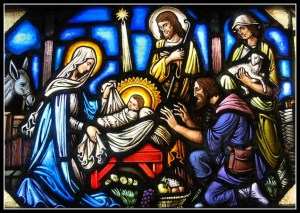
Such, then, are their customs about the Exmas. But the few among the Niatirbians have also a festival, separate and to themselves, called Crissmas, which is on the same day as Exmas. And those who keep Crissmas, doing the opposite to the majority of the Niatirbians, rise early on that day with shining faces and go before sunrise to certain temples where they partake of a sacred feast. And in most of the temples they set out images of a fair woman with a new-born Child on her knees and certain animals and shepherds adoring the Child. (The reason of these images is given in a certain sacred story which I know but do not repeat.)

But I myself conversed with a priest in one of these temples and asked him why they kept Crissmas on the same day as Exmas; for it appeared to me inconvenient. But the priest replied, “It is not lawful, O stranger, for us to change the date of Chrissmas, but would that Zeus would put it into the minds of the Niatirbians to keep Exmas at some other time or not to keep it at all. For Exmas and the Rush distract the minds even of the few from sacred things. And we indeed are glad that men should make merry at Crissmas; but in Exmas there is no merriment left.” And when I asked him why they endured the Rush, he replied, “It is, O Stranger, a racket”; using (as I suppose) the words of some oracle and speaking unintelligibly to me (for a racket is an instrument which the barbarians use in a game called tennis).

But what Hecataeus says, that Exmas and Crissmas are the same, is not credible. For first, the pictures which are stamped on the Exmas-cards have nothing to do with the sacred story which the priests tell about Crissmas. And secondly, the most part of the Niatirbians, not believing the religion of the few, nevertheless send the gifts and cards and participate in the Rush and drink, wearing paper caps. But it is not likely that men, even being barbarians, should suffer so many and great things in honour of a god they do not believe in. And now, enough about Niatirb.
The Life of the Beloved: an Advent Study

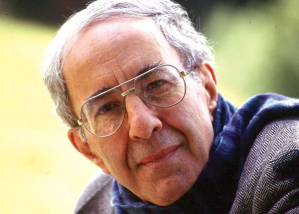
Henri Nouwen was a gifted spiritual teacher who was born in the Netherlands in 1932 and early on became a priest. Throughout his life he studied philosophy, theology and psychology and spent much time traveling, living in community and speaking publicly. He writes lovely prose and his work is full of his own personal and intimate experiences of God’s love.

Henri devoted much of his later ministry to emphasizing the idea that our identity is as the Beloved Children of God. In an interview, he said that he believed the central moment in Jesus’s public ministry was his baptism in the River Jordan, when as he came out of the water he heard the voice of God saying, “You are my beloved son on whom my favour rests.” Nouwen writes: “That is the core experience of Jesus. . . . He is reminded in a deep, deep way of who he is. . . . I think his whole life is continually claiming that identity in the midst of everything.

In 1992 Nouwen travelled to Garden Grove, California where he delivered three sermons extolling the fact that we are all beloved daughters and sons of God. The sermons were delivered and televised at the famous Crystal Cathedral.

This Advent study is based on this series of sermons which are entitled:

  • Being the Beloved

  • Becoming the Beloved

  • Disciples of the Beloved

The sessions will start at 2pm on Wednesdays: 5th, 12th and 19th December, at James and Anna’s house in Spinningdale.

Sessions will last a little over an hour and there will be refreshments afterwards for those who can stay. Everyone is most welcome to join us.

The Joy of Christmas

Tuesday 18th December 2018 at 7pm

St Finnbarr’s Episcopal Church, Dornoch

An evening of Carols and Poetry for Christmas

Refreshments will be served

A collection will be taken in aid of the homelessness charity Emmaus.