Where to Celebrate the Birth of Jesus – 2019

All are welcome to share with us in celebrating Christ’s Birth at any of our services in this part of the world:

Dornoch

Dec 10th – Carols for Christian Aid at Dornoch Cathedral at 7:00pm

Dec 24th – Christmas Midnight Sung Eucharist at St Finnbarr’s at 11:00pm

Dec 25th – Christmas Day Holy Communion from the Reserved Sacrament at St Finnbarr’s at 9:30am

Tain

Dec 22nd – Carol Service at St Andrew’s at 3:00pm

Dec 24th – Christmas Midnight Sung Eucharist at St Andrew’s at 11:00pm

Dec 25th – Christmas Day Sung Eucharist at St Andrew’s at 10:30am

Brora

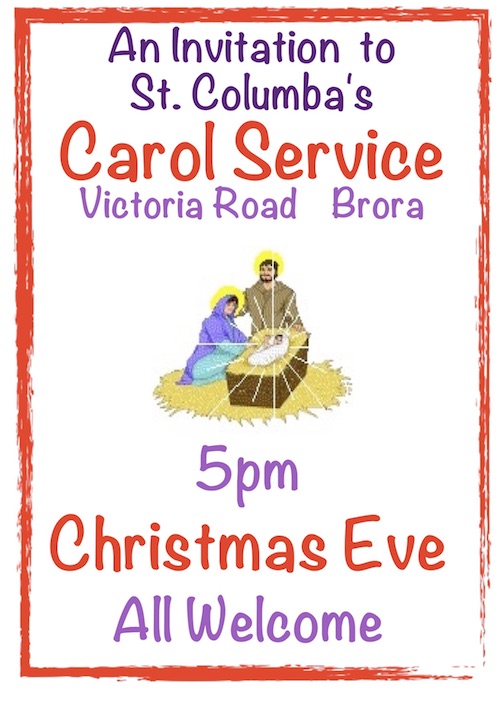
Dec 24th – Carol Service at St Columba’s at 5:00pm

Dec 25th – Christmas Day Sung Eucharist at St Columba’s at 9:00am

Lairg

Dec 25th – Christmas Day Sung Eucharist in Lairg Parish Church at 8:15am

Crask

Dec 19th – Monthly Thursday service at the Crask Inn at 12 Noon

Dec 28th – Carols at the Crask Inn at 2:00pm

The Hub at Bonar Bridge

Dec 17th – Carols at the Hub at 5:30pm

‘Carols from Tain’

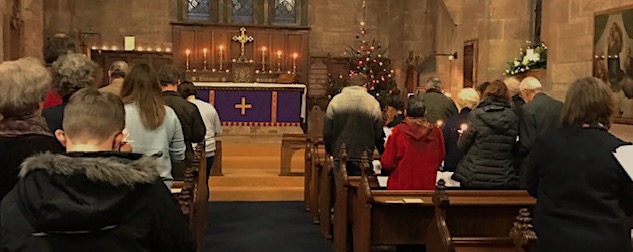
They couldn’t wait for Carols from Kings, a nearly full St Andrew’s sang and listened to a set of traditional readings this afternoon and then shared fellowship, mince pies and mulled wine together as they prepared to celebrate the Incarnation on Tuesday Evening and Wednesday Morning.

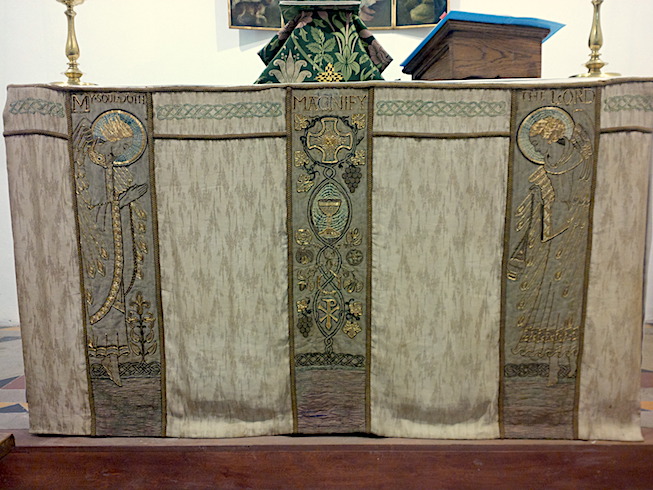
My Soul Doth Magnify the Lord

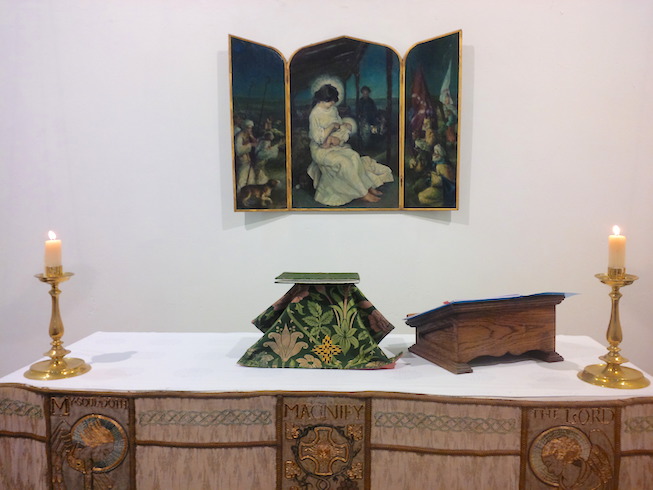
Today we honour Mary, the mother of Jesus as part of our Advent preparation for Christmas.  In the Lady Chapel of the Cathedral of the Isles in Millport, there is a wonderful Altar Frontal with three Art Nouveau panels proclaiming “My Soul Doth Magnify the Lord“.

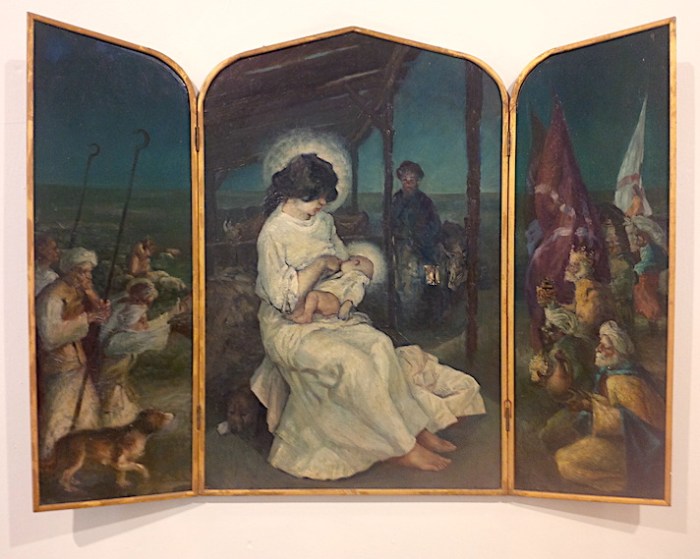
Behind the Altar is a Triptych by Donald Swan depicting, in the centre panel, a very real and very human Mary discretely feeding the Baby Jesus:

He hath filled the hungry with good things; and the rich he hath sent empty away.

Carol, Carol and more Carols …

Copyright BBC

A programme that you may be interested tomorrow evening (9th December) is:

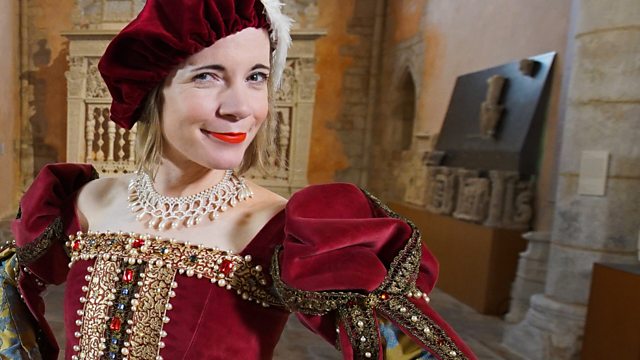
Lucy Worsley’s Christmas Carol Odyssey

It is on BBC Four at 9pm.

The blurb on the BBC web site says:

Lucy Worsley reveals that there’s much more to our best-loved carols than meets the eye. She reveals how their stories add up to a special kind of history of Christmas itself. In the ancient past, the wassail, a pagan fertility ritual, gave us door-to-door carol singing. Wassailing was also an integral part of an older midwinter festival that was adopted by Christianity when it came to Britain, and was rebranded as ‘Christmas’.

Religion, however, soon turned its back on carols. They were far too frivolous for the Puritans, who wanted to ban Christmas altogether. In strict Protestant Britain, the carol survived outside the Church and new ones turned up in some surprising places. Lucy visits the British Library, where she discovers an 18th-century children’s book that contains a little memory game called The Twelve Days of Christmas. Christmas carols could also be politically dangerous and subversive. 

Eventually, the Church of England couldn’t resist the power of the carol, and finally opened its doors to all of them, thanks to a chance pairing of words and music in Hark the Herald Angels Sing. In the 20th century, Ralph Vaughan Williams’s passion for English folk music took him to the villages of Surrey.

Finally, in the snowy Austrian Alps, Lucy discovers the simple story of a young parish priest with a poem in search of a tune. When he found one, the result was Silent Night. During the First World War, this simple carol would become a hymn for peace during the famous Christmas truce of 1914. Silent Night also reminds us that carols are, and have always been, ‘popular music’, music for the people, fulfilling an enduring need to celebrate and sing together at Christmas.

Copyright BBC

Seeing in the New Year

Yesterday, the Feast of St Andrew, was also the eve of the new Church Year, which begins with Advent today.

This slideshow requires JavaScript.

The congregation of St Andrew’s, together with family and friends celebrated with a lovely service in Church, followed by Soup, Haggis, Neaps, shortbread and tablet, during which those gathered mused over a wide-ranging quiz.  This was followed by a variety of entertainments, including: a monologue, poetry and musical numbers accompanied by the assembled company on bell plates.

Suffice to say, a good time was had by all.

A promise that we can trust

Usually by the beginning of December, there is a very obvious focus on what is often referred to as “The Run Up to Christmas”. I don’t know if it’s just me, but this year it feels as though several things have pushed that to one side. If the full power of the consumer bonanza that ‘preparation for Christmas’ represents is knocked out of kilter this year, then I suppose that I feel a sense of relief, but how heartfelt that is probably depends on why!!

Firstly, there’s the General Election, which is dominating the news agenda. Politicians from of all hues trying to woo us with promises, lots of promises. Now many of these promises are for things that we might feel might make our lives, our country and perhaps the world better; but I would have to say that you don’t have to be a financial genius to realise that some of these promises are perhaps rather more realistic than others and few stand much detailed scrutiny. Advent (the name we as Christians would give to this ‘run up to Christmas’) is also about a promise: the promise that God’s future and our future are entwined in Christ. Christ is coming into our world and our world never being the same again.

Secondly, there’s a growing call, encapsulated in protests across the world on what has come to be called ‘Black Friday’, to address the very serious and increasing problem of Climate Change. Black Friday is all about consumption about buying more and more ‘stuff’ by making it appear cheaper though at what environmental cost isn’t clear. The protesters argue that if we want to save the planet, Christmas shouldn’t be about excessive consumption – what’s needed is a serious change in the way that we live our lives. Well I’ll happily say “Alleluia” to that. In Christianity, we also have a name for a change in the way that we live our lives, and that’s ‘Repentance’ (which literally means ‘to turn around or to change the mind’) and surprise surprise, that’s also a theme of Advent.

The final theme of Advent is hope, and as we look forward to a time when the General Election will be over and the buying spree will be finished, there’ll be Christmas, when we celebrate God coming amongst us, as one of us. Now that’s a promise that we can trust and it won’t cost a penny or destroy the planet!!

Enjoy the waiting and the anticipation and I wish you all the Joy of Christmas when it arrives.

Blessings

James

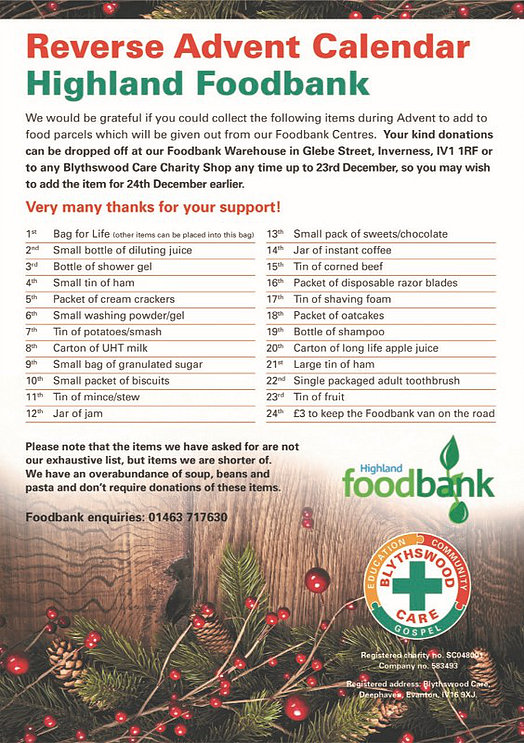
Reverse Advent Calendar

Every day people in the Highlands are struggling to put food on the table. Reasons range from redundancy to receiving an unexpected bill on a low income. Highland Foodbank, part of the work of Blythswood Care, provides a minimum of three days emergency food and support to local people in crisis.

This Reverse Advent Calendar idea is a good way of helping those who are struggling over the winter, by gathering together items that the Food Bank is often short of, day by day throughout Advent.

We did this in Remembrance

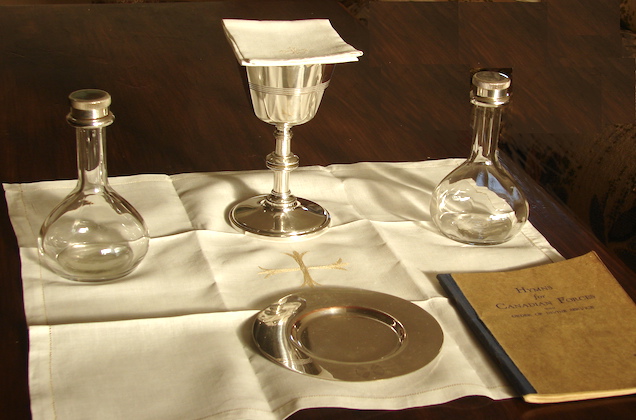
A few months ago, a neighbour of one of our Churches  arrived a short while before the Sunday Service and showed me small tan attache case. When we opened the case, it revealed a ‘Field Communion Set’ of the type issued to the Padres of our armed forces and those of many of our allies.This gentleman’s Father, who’d been a Minister in the Church in Canada, had enlisted as a Padre in the Canadian Army during the Second World War.

Amazingly the contents of this case was last used at Juno Beach, during the D-Day Landings of 6 June 1944. He’d been clearing out as he and his wife are planning to move into a smaller house and he felt that thecase and its contents would be more use in the Church than stuck at the back of his wardrobe.

This set me wondering about that day 75 years ago and it’s impact on us now. 21,000 troops landed on Juno Beach on D-Day, approximately 14,000 of them were Canadians from the Third Canadian Infantry Division and the Second Canadian Armoured Brigade, the remainder were British. Of the Canadians who landed: 340 were killed, 574 were wounded, and 47 were captured. Now D-Day is generally considered to be one of the allied ‘successes’ of WWII, but notwithstanding that, the allied casualties on D-Day are estimated at 10,000, including 4414 deaths with the remainder wounded or missing; a salutary reminder that wars bring much destruction, suffering and grief, whoever is considered to be the ‘winner’.

On or around 11th November each year, at War Memorials up and down the land, we remember those who’ve gone before us and what they’ve contributed to the way that we live our lives today. The previous Monday, we celebrated All Souls, remembering those that we’ve known, who’ve meant so much to us who have now died, and I always find that an extremely moving service.

It’s very difficult to judge at the time, what impact people or events today will have in the future. Will particular figures go down in history as visionary and inspiration leaders, who whilst not fully appreciated in their time have left a lasting and positive legacy, or as people whose ideology and poor judgement made them instigators of hard times? It’s much easier to judge in retrospect those who’ve been major influences on our lives, those who’ve made us the people that we are today.

During Holy Week we’re confronted with death more than during any other season of the liturgical year. We’re called to mediate not just on death in general or on our own death in particular, but on the death of Jesus Christ who is God and Man. We’re challenged to look at Him dying on a cross and to find there the meaning of our own life and death. What strikes me most in all that’s read and said during these days is that Jesus of Nazareth did not die for himself, but for us, and that in following Him we too are called to make our death a death for others.

What makes you and me Christians isn’t only our belief that He who was without sin died for our sake on the cross and thus opened for us the way to His heavenly Father, but also that through His death our death is transformed from a totally absurd end of all that gives life its meaning into an event that liberates us and those whom we love.

It’s because of the liberating death of Christ that I dare say to you that mother’s death isn’t simply an absurd end to a beautiful, altruistic life. Rather, her death is an event that allows her altruism to yield a rich harvest. Jesus died so that we might live, and everyone who dies in union with Him participates in the life-giving power of His death. I think that we need to start seeing the profound meaning of this dying for each other in and through the death of Christ in order to catch a glimpse of what eternal life might mean. Eternity is born in time, and every time someone dies whom we have loved dearly, eternity can break into our mortal existence a little bit more.”

At the time it must have seemed to many that Jesus Christ’s mission as Messiah was a total failure. He died mocked and ridiculed by Crucifixion, one or the cruelest execution methods ever devised, judged to be a dangerous revolutionary who broke all the rules, mixed with all sorts of undesirable people and had to be done away with. His ministry lasted only three short years, and when he died his disciples went back to whatever they were doing before he came along. You wouldn’t expect such a person to leave a lasting legacy. But he did. The movement that followed in the wake of his Resurrection is still very much alive and we are its heirs.

Over the two millennia since that Resurrection, the Christian Faith has motivated and inspired many people, and helped them through difficult times. The armed forces still value their Padres as an important part of providing support and maintaining morale amongst their personnel. These men and women, whilst remaining unarmed, go to war with the rest of the soldiers, sailors and aircrew and are there for them when they need someone to talk to.

On Remembrance Sunday, we used that Canadian Field Communion Set in our celebration of the Eucharist, a visible and very tangible connection to those who fought on the beaches of Normandy and in other places and in other wars. This wonderful gift has the effect of bringing some of those who we remember on Remembrance Sunday very close indeed. “Do this in Remembrance of Me” we say at the Eucharist and this year we “Did this in Remembrance of Them”.