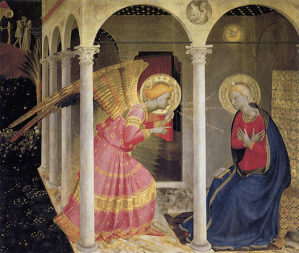
The Annunciation – a reflection by Rev Nicholas Court

On Wednesday this week, it will be exactly 9 months to go to Christmas – and I have been invited to share a few musings with you, reflecting upon the lovely Feast of the Annunciation which this Wednesday brings us. It is a feast of great encouragement, because centre-stage is Mary, and it serves to remind us that we find in Her the sort of disciple weare all called to be. We see in this teenage Mother our own potential as Christians – all that we can be and become if we only open our hearts in loving trust to God as She did, despite the human doubts and weaknesses that are part of who we are. Mary is full of questions – when Mary receives the visit from Gabriel at the Annunciation – ‘How can this be?’ is Her questioning response. And She continues to question when Her Son wanders off into the Temple – ‘Why have you done this?’
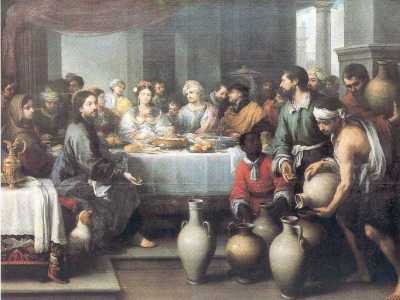
At Cana She offers us the perfect model of prayer – “They have no wine” – and during His public ministry Jesus does not single His Mother out for honour because of Her biological role, but responds to Her as someone who hears God’s word and gives it flesh and bones.

Like all the disciples of Jesus, the Mary we meet in the Gospels walks by faith and not by sight. She treasures what words She has received from and about Jesus, and ponders them in Her heart. You can hear the Mary of the Magnificat glorying in the power of God who lovingly overturns all the signs of toxic power within society. The Mary of the Magnificat is not some simpering waif of a virgin but more like a warrior queen, robustly challenging the forces of sin and human greed in the name of the God whose power transforms our world. It’s as if Mary says, “Make my song yours too, because as Gabriel told me – ‘With God no thing shall be impossible’.”

We were reminded in last Sunday’s Gospel of that devastating scene atop Calvary, where She stands grieving at the foot of Her Son’s cross. The beloved disciple, another model for all followers of Christ, is told by the dying Jesus to cherish Mary as his Mother, and She is told to care for him as Her own. When the church is born with the coming of the Holy Spirit at Pentecost, Mary is there again, at the heart of the community, no longer grieving, but worshipping Her Son.

Mary’s questions at the Annunciation are our questions too – how is it that God can work through such weak instruments as we too often feel ourselves to be – something we feel particularly acutely as we face our current crisis? Well, just look where else we encounter Mary. She is there, watching as the tasteless water of our lives is turned into the life-giving wine of Her Son’s grace. Like Mary, we are invited to treasure all that we know of Jesus and ponder it in our hearts. Her Magnificat blesses us, not because by some accident of birth we are members of the Church, but because we too are part of the humanity in which She and Her Son shared – and this is something to really celebrate!
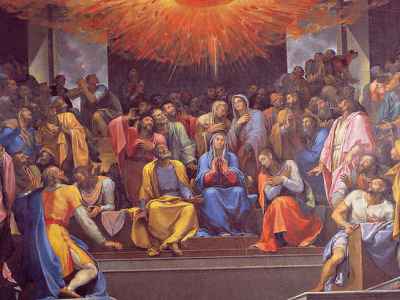
Before I conclude, I’d like to leave you with a lovely and whimsical poem, written by an Anglican Priest called Penelope Dent – whom it is my guess may not a fashionable size zero (but I may be wrong)! She conjures up a Mary who is so very human – much more of a Mother, and less of a queen – a Mary who knows what it is to be thoroughly human, and who like a best friend, prays daily for us, out of love, to Her Son. It’s called My Fat Virgin Mary:

I’m tired of skinny Virgin Marys,
Medieval, milk-mild.
The one I want has a bosom and a heart.
Brooding, maternal and magnificent.
You listen, you love
And you understand.

O most funny,
Glorious, vulgar fat Lady.
I love you
And the God who made your commodious bosom,
Head rest, heart rest
For the uncomforted.

Hold us and love us,
You who dare to be big
And despise corsets.
You who love life
And bottles of stout, pork pies
and bags of greasy chips,
Wrapped in newspaper.

Belligerently beautiful,
Queen of all fat women,
Defender of the unloved.
Accuser of the small-minded, sawdust people,
Who never get involved nor find the time to love your Son,

Wrapped in themselves.
O most funny Lady, most funny Lady,
Mother of mothers,
Praise be to you for showing us your acceptance,
Your grief and your rejoicing.
Praise be to you for daring to be big,
Proud of your girth
And all Glorious within.


Churches Now Closed

Following the directive from Boris Johnson this evening (23rd March) and updated guidance from the College of Bishops, our Churches will no longer be open to the public for either services or private prayer.  So from now on we must all pray at home.

Two prayers from the Scottish Prayer Book

In the time of any common Plague or Sickness.

O ALMIGHTY and merciful God, with whom are the issues of life and death: Grant us, we beseech thee, help and deliverance in this time of grievous sickness and mortality, and sanctify to us this affliction, that in our sore distress we may turn our hearts unto thee; through Jesus Christ our Lord. Amen

For Hospitals and Infirmaries.

ALMIGHTY God, whose blessed Son Jesus Christ went about doing good, and healing all manner of sickness and disease among the people: Continue, we beseech thee, his gracious work among us in all hospitals and infirmaries; console and heal the sufferers; grant to the physicians, surgeons, and nurses, wisdom and skill, sympathy and patience; prosper their work, O Lord, with thy continual blessing; through the same Jesus Christ our Lord. Amen

A smile is contagious

Sunday is Mothering Sunday and I’ve spent the last two days distributing Mothering Sunday Posies, and you know it would have been worth it for just one of the smiles returned by those who received one, but I’ve had dozens of smiles and feel so blessed.

For the fit and healthy, there are posies in St Andrew’s, Tain and St Finnbarr’s, Dornoch, so please feel free to drop by at some time on Sunday (between 10am and 4pm), to offer a prayer and pick one up (whilst stocks last:-)

Must rush as I have to go out round and about again, no handshakes, no cups of coffee, just a brief chat and a beaming smile at the door – God Bless.

Be a Flower that Blooms

Most people will have realised that this coming Sunday (22nd March) is Mother’s Day – or to give it the ‘proper’ title, Mothering Sunday. Mothering Sunday is a good occasion to think about the nature of God – for, as Julian of Norwich said in the fourteenth century, ‘as truly as God is our Father, so also is God our Mother’.

People sometimes think that feminine imagery for God is very new, but it actually goes way back to some of the early books of the Bible. The prophet Hosea described the way God cared for his people in a very maternal way.

It was I who taught Ephraim to walk, I took them up in my arms, but they did not know that I healed them. I led with cords of human kindness, with the bands of love. I was to them like those who lift infants to their cheeks. I bent down to them and fed them.’ (Hosea 11.3-4).

Now, we don’t have to start calling God ‘Mother’ – that isn’t necessarily any more helpful than ‘Father’. But it is worth noting that there is this element in the biblical tradition, and it has been picked up by people in the centuries since.

So how can we respond to this God who is mother and father and so much else besides? On Mothering Sunday, like so many others do, perhaps we could say it with flowers.

How on earth can we do that? No floral delivery company has a way to cope with it! But we do talk about offering ourselves to God. I don’t suppose you have ever thought of yourself as a flower, even though flower allusions abound in our language; we talk about being ‘fresh as a daisy’, or we describe someone as being ‘a shrinking violet’. People are sometimes ‘prickly’.

But when you think about it, what kind of flower are you? Are you like a camellia, rather startlingly beautiful? Or like rosemary, starting to bloom right at the beginning of your life and continuing year on year? Are you one of those plants that doesn’t flower often? Or one that props others up? Are you a plant with rather insignificant flowers, but always there in the background to help others give of their best? Do you fill the world with fragrance, or give flavour to life?

Are you one of the plants that bring hope in the dark days of winter? Some plants are very beautiful when their flowers are dead – some people come into their own towards the end of their lives.

Sometimes we put a single flower into a vase and enjoy its beauty. At other times, we put many different varieties together in an arrangement. There is an important place for our individual response to God, but when we come together as a church we discover new things about ourselves as we relate to each other as well as to God. Like a flower arrangement, we can bring out the best in each other, and complement and support each other.

On our own perhaps we don’t look very exciting – that doesn’t mean we don’t have our own beauty – but put with others, the ones who are a bit shy can find support, and those who are rather exotic can lend their colour and perfume to the more retiring. Even those who are prickly can be a great support to those who are fragile.

So we can give God quite a bouquet – and it we listen carefully, we’ll hear God say, as every mother does, ‘Thank you dear, that’s just lovely!

Blessings
Simon

National Day of Prayer – Sunday 22nd March 2020

Churches in Scotland* have joined together to Call for a National Day of Prayer in response to the Covid-19 pandemic.

Taking place on Sunday 22 March, people of faith are being encouraged to light a candle and place it in their window at 7pm.**

We are urged to “join in prayerful solidarity with this witness”, describing the candle as “a visible symbol of the light of life, Jesus Christ, the source of hope in this life.

The following prayer can be used when lighting the candle:

For all that is good in life, thank you,
For the love of family and friends, thank you,
For the kindness of good neighbour and Samaritan stranger, thank you.

May those who are vulnerable, hungry or homeless, experience support,
May those who are sick, know healing,
May those who are anxious or bereaved, sense comfort.

Bless and guide political leaders and decision-makers, with wisdom,
Bless and guide health workers and key workers, with strength and well-being,
Bless and guide each one of us, as we adapt to a new way of living.

And may the light shining from our windows,
across road and wynd, glen and ben, kyle and isle,
be reflected in our hearts and hands and hopes.

Through Jesus Christ our Lord, Amen.

* These include the Scottish Episcopal Church, the Roman Catholic Church, the Church of Scotland, the United Free Church, the United Reformed Church, the Baptist Union of Scotland, the Methodist Church, the Society of Friends (Quakers), Congregational Federation in Scotland, the Salvation Army, the Church of the Nazarene, and Redeemed Christian Church of God.

** Please take all necessary fire precautions when using a lit candle. Ensure you remain with the lit candle at all times, and do not leave it to burn if you leave the room. Ensure there are no fabrics or materials such as curtains near the candle.

Arise, take up your mat and walk

This slideshow requires JavaScript.

World Day of Prayer services in Brora, Dornoch, Lairg and Tain on Friday.  Wonderful ecumenical gatherings that engaged creatively with the material prepared by the Christian Women of Zimbabwe. Prayerful, reflective, thoughful, joyous and uplifting are all words that could be applied to the three services that I was at.  Not to mention the food and fellowship that was shared after each of the services.  A huge thanks to all those who organised the services, took part in them and most of all to the Christian Woman of Zimbabwe.

To Keep a True Lent

Tuesday was Shrove Tuesday, or to give it its more common name, Pancake Day. It’s traditionally the last day of indulgence before the start of the season of the Church year called Lent. This season lasts for 46 days (or 40 if Sundays are excluded, as they traditionally are). For many people Lent’s a time for abstinence and when I was a boy, there was no chocolate, no cakes and no biscuits from Ash Wednesday until Easter Day. As I’ve grown older, I’ve come to see Lent as something far richer than simply a time of giving up treats. This isn’t of course a new idea, as long ago as 1648, Robert Herrick wrote a poem called “To Keep a True Lent”. The first verse of which is:

Is this a fast, to keep
The larder lean?
And clean
From fat of veals and sheep?

His initial reply to the question is:

No; ‘tis a fast to dole
Thy sheaf of wheat,
And meat,
Unto the hungry soul.

And he finishes:

To show a heart grief-rent;
To starve thy sin,
Not bin;
And that’s to keep thy Lent.

He attaches importance in attending to the physical needs of those less fortunate than oneself and then to one’s own spiritual needs – “to starve thy sin not bin”. Giving up treats can of course serve both purposes. In the case of the former, we can spend the money saved giving to the food bank or to charity and in the latter, the discipline of refraining from and refusing treats serves as an all too frequent reminder of this particular goal.

You don’t have to be religious to see a need to examine your life and the way you live it; to examine your relationships and how you interact with others; to strip away the masks that you hide behind and the stories that you tell yourself to justify what you do and think. The main difference for those who believe in God is that there’s nowhere to hide. You can tell yourself that your actions are always entirely justified, as much as you like, but there’s simply no hiding from the scrutiny of an all-seeing, all-knowing deity.

Some say we’re now living in a surveillance society, with CCTV cameras everywhere you turn, but for those with a faith in God, it’s always been like that. Consequently it means we have to live life., as Paul wrote to the Ephesians: “as children of light— for the fruit of the light is found in all that is good and right and true. Take no part in the unfruitful works of darkness, but instead expose them. For it is shameful even to mention what such people do secretly; but everything exposed by the light becomes visible”. The difference for me between CCTV and God is that I’d rather be judged by the creator of the world, than by the creator of the webcam and whoever may be watching it on youtube, twitter or facebook.

Seven weeks a year of spiritual spring-cleaning through self-reflection and increasing self-awareness, might be helpful to anyone, religious or not, as they strive to become a better person. As the Scottish Prayer Book describes the penitent in the invitation to confession: “Ye that do truly and earnestly repent you of your sins, and are in love and charity with your neighbours, and intend to lead a new life”. That just about sums up for me what Lent’s about. Have a fruitful time between now and Easter and enjoy the Easter Eggs all the more.

Blessings
James

Food for the Body and the Mind

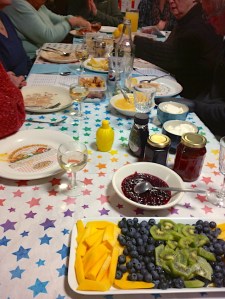
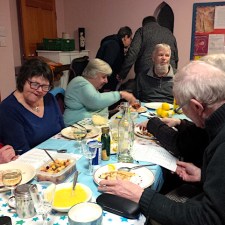
Lent has now begun. However, in anticipation of Lent, last night we had a splendid pancake feast, with a challenging quiz to keep us amused, perplexed and stretched between pancakes: Patron Saints, pancake facts, knots, geology and pancakes around the world – no-one was an expert in all of these.

Thanks to the quiz setters, the batter mixers, cooks and all who brought goodies to share.


Gender and Liturgy in Conversation – 29th-30th May 2020

Responding to the Sacred:

Gender & Liturgy in Conversation

A two day conference bringing together liturgists and theologians, activists and academics to discuss directions for liturgical revision.

Speakers include:

  • Dr Bridget Nichols,
  • Professor Lisa Isherwood,
  • Dr Bill Paterson and
  • Dr Armand Léon Van Ommen.

12pm Friday 29th – 4pm Saturday 30th May

Iris Murdoch Suite University of Stirling

For more information there is a facebook page:  Gender and Liturgy Conference

To purchase tickets visit:  eventbrite.co.uk

If you wish to know more about what is envisaged, consult the current draft programme (subject to revision) or speak to James.

Lament for Lent

Lent is only a couple of weeks away and during Lent you might like to consider this resource from the Church Mission Society

Church Mission Society has announced a “Lament for Lent” campaign with free resources to help the church to lament in the face of increasing unrest and uncertainty as persecution against Christians, war, racism, are on the rise together with the climate crisis and other threats to the wellbeing of the world.

The campaign’s key free six-week resource, Only With Eyes That Have Cried, is written by leading theologian and missiologist Dr Cathy Ross, who heads up CMS’s Pioneer Mission Leadership Training Centre in Oxford. She said: “There is much to lament in our world and we need the space and the permission to do so. We need to take time to lament violence, war, racism, exploitation of women and trafficking, the state of our planet and the climate crisis. As Greta Thunberg says, ‘Our house is still on fire’.

Through the campaign CMS hopes Christians will learn to embrace, rather than move on too quickly from personal or collective grief, by developing a deeper trust and confidence in God. The campaign draws upon ideas expressed by Ugandan theologian Emmanuel Katongole in his book, Born from Lament: the Theology and Politics of Hope in Africa, wherein he examines the violence and suffering that beset DR Congo in recent years and asked, “How does one live with this?”, “Can there be a future and if so, what kind?” and “Where is God?”.

As well as using examples from the Psalms, ‘Only With Eyes That Have Cried’ relays the experience of CMS mission partners such as Ruth Radley who experienced the power of lament while serving in South Sudan. Through stories like Ruth’s, people will read about lament as resistance, lament as innovation, lament as activism and lament as hope.

To help people Lament for Lent, CMS is offering the six-week Only With Eyes That Have Cried resource for free to individuals and churches. Written by Cathy Ross, it also contains prayers by Ian Adams, chaplain of Ridley College, Cambridge and CMS mission spirituality adviser, as well as creative suggestions to help people embrace lament as a spiritual discipline that can deepen their experience of God.

Dr Ross concludes: “Through Lent this year we hope that you will learn not only to lament but also to take action – this is what is profound about lament – it moves us from grief to action.

Copies may be obtained through the Church Mission Society Website or by phoning 01865 787519.