
St Finnbarr’s now has a smart, freshly painted gate and handrail – thanks Joanna and Caroline.
St Finnbarr’s now has a smart, freshly painted gate and handrail – thanks Joanna and Caroline.
There are three sets of Liturgical Resources at the right hand side of each page on our web site :
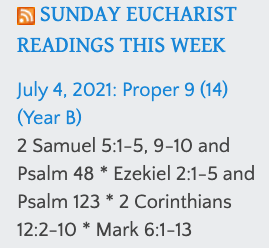
This links to a web site that provides a list of the readings for the next important Feast Day (which is usually the following Sunday). Clicking on it will take you to the readings themselves. The site providing this is a US university and so occasionally the next Feast Day is one that we don’t celebrate, but it is usually accurate. If there are two OT readings and two Psalms, we use the second of each.
This links to a web site that provides a list of the readings for the Daily Eucharist today. Clicking on it will take you to the readings themselves. One caveat is that since the site is a Roman Catholic one, the Sunday readings do not always align with the ones that we use, but it’s fine for other days.
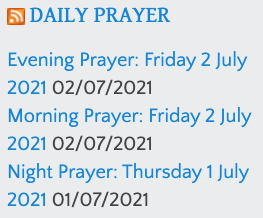
This links to the services published on the Scottish Episcopal Church Daily Prayer web pages and is updated three time a day with Morning, Evening and Night Prayer, at 5am, 12pm and 6pm respectively.
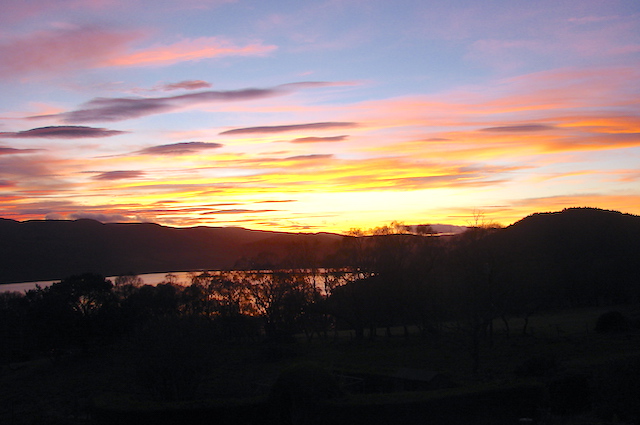
The climate crisis, which has been creeping up on us for years, is a reflection and also a cause, of deep injustice in our world. This crisis arises from the abuse of God’s creation, and our broken relationship with our neighbours worldwide and especially the poor and those in less developed parts of the world who are already suffering most from its consequences.
Climate change and other forms of environmental degradation are caused by over-consumption, primarily in the developed world, and so any solution has to be underpinned by reduced consumption. Consumption is something for which we are all responsible. Everything we buy has a carbon footprint, everything we use has a carbon footprint and everything we consume has a carbon footprint. The earth doesn’t belong to any of us, each of us lives on it for a while and during that time, we’ve a duty to be good stewards of what we inherited.
Since the root of the problem is that the population of the developed world vastly over-consume the resources of the world, that means us. The only real solution is a reduction in consumption for each of us individually and for us collectively. How we do that depends very much on our individual circumstances and it’s for that reason that prayer and reflection must lie at the heart of our approach.
This problem isn’t simply about Carbon Budgets or Environmental Degradation, this problem is about Justice. Those most affected by these matters are the poor, the disadvantaged, those who live in the Third World and less developed nations. We should therefore refer to this matter as Climate Justice, which helps us to think of it not only in scientific/technological terms. We need to reflect on how our decisions affect others in our society and our brothers and sisters around the world and also how they will affect our children and grandchildren.
During the UN General Assembly’s High-level Meeting on the Protection of the Global Climate for Present and Future Generations back in March 2019, Mary Robinson, the former President of Ireland spoke about Climate Justice.
“Climate justice insists on a shift from a discourse on greenhouse gases and melting ice caps into a civil rights movement with the people and communities most vulnerable to climate impacts at its heart,” … “Now, thanks to the recent marches, strikes and protests by hundreds of thousands of schoolchildren, we have begun to understand the intergenerational injustice of climate change,”
Mary Robinson 2019
The Young Christian Climate Network are staging a relay from the G7 meeting in St Ives to Glasgow to coincide with the start of COP26 at the end of October, when heads of state, climate experts and negotiators meet to discuss action to address the climate emergency. It’s clear that this group of young Christians care deeply about Climate Justice and the care of creation and they want to see systematic change on a global and a local scale. After all it’s the world that they and our children and grandchildren will have to live in for rather longer than most of us. The least we can do is to pray for them on their pilgrimage – may God bless them.
Blessings
James
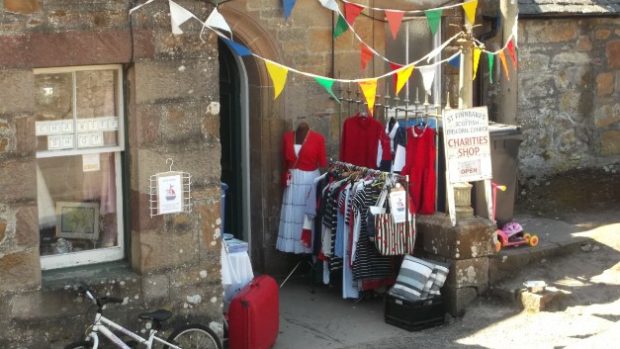
St Finnbarr’s Charities Shop has recently distributed £12,500 in donations to various groups and charities. As usual these are mostly local groups based in East Sutherland but this year two, Maggies and Mikeysline, which have centres in Inverness have been included. They both work with vulnerable groups throughout our area, one in cancer care and the other in mental health support.
The complete list of charities and groups supported is listed below:
The hard work and dedication of the volunteers means that the Charities Shop is now open Monday to Saturday 10am-1pm. The continuing Covid restrictions mean that we are only able to have a very small number of customers in the shop at one time and we would like to say thank you to our customers who wait so patiently in a queue to come in. The Charities Shop would not be so successful without the many donations of goods to sell and the support of our customers both returning and new – thank you. We look forward to seeing you in the shop.

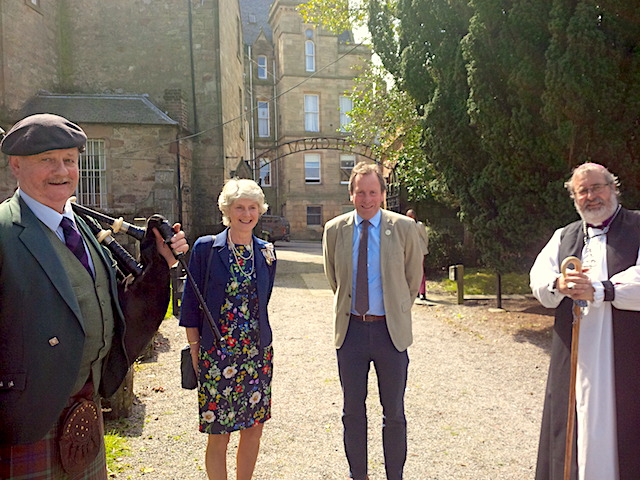
Today the Northern Pilgrims’ Way was launched with a dedication service in St Duthac’s Collegiate Church in Tain. Bishop Mark led the service, Jamie Campbell was at the organ and Rev Lizzie Campbell sang the hymns and an anthem and Rev James Currall read the lessons. The Lord’s Lieutenants of Ross-shire (Joanie Whiteford) and Sutherland (Monica Main) were in attendance along with a number of representatives of the Churches.
During the service, an information board was dedicated and the members of the congregations were given blessed cockle shells and candles as symbols of the pilgrimage, but in his address Bishop Mark gave strict instructions that the shells were to be given to pilgrims on the way, that those present encountered in the coming months. He also warned that launching the Way was only the beginning of something and not the end.
You can watch the service on Youtube below:
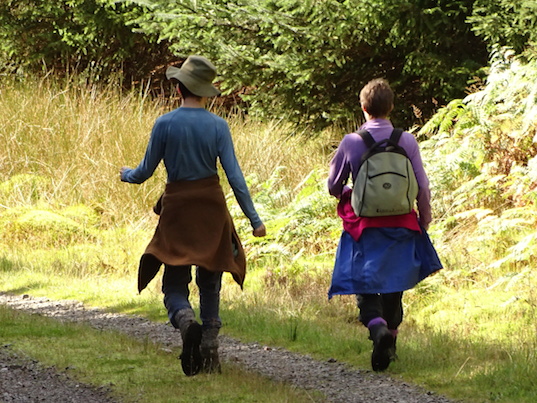
The original pilgrims were not just trying to get from A to B. The trials and tribulations of the journey were part of the experience, as was calling at recognised holy sites along the way. Modern pilgrims want to feel that they are following in the footsteps of these previous generations. So re-creating a pilgrimage route is not as simple as looking at a map and working out the shortest way from one place to another.
The Northern Pilgrims’ Way is what is known in the trade as a braided route. In other words, it offers the pilgrim alternative tracks between the start and end points. While some routes have more history attached to them than others, all are genuine pilgrimage ways through the North of Scotland.

In our time, pilgrimage is being revived in many denominations. Indeed, it is a feature of most main religions and seems to answer a deep-seated need within us to re-connect with the creator of our world and to work out our own place in this creation.
Further events are planned in the coming months at Thurso and at Kirkwall where the route ends.
The Passion, Resurrection, Ascension, Pentecost – we’ve travelled a long way in our journey with Christ since Palm Sunday on 28th March. Back then we were in lockdown, now the restrictions are easing and joy of joys, we were able to have our first wedding in church last week after a gap of nearly two years.
In many ways, living under restrictions is ‘easy’ You have a long list of things that you can’t do and also a list of things you must do and, as we’ve all done over the last 15 months, you learn to live your life doing what you must and trying not to do what’s not permitted. So at one level, it’s ‘easy’ but at a deeper level it’s very hard indeed. Not being able to see loved ones, not being able to do things that have been part of our lives for years and apparently small, but very significant things like being able to sit where you want in church or shake someone’s hand when you meet them.
Under the Old Covenant of Moses, the people of Israel lived under ‘The Law’. So in Exodus, we have 10 Commandments but there are 613 statements and principles of law, ethics, and spiritual practice (or Mitzvot) contained in the Torah (mostly Deuteronomy, Numbers and Leviticus) (248 of these are positive – things that one should do – and 365 negative – things that one shouldn’t do).
The purpose of these ‘rules’ is however to try to help people to find God through encounters with the holy. In a sense the summary of the Law, that we use at some times of year in our liturgy, is a pointer to the underlying principles, which is why Jesus came not to abolish the rules rather it refocus people on those principles.
Our Lord Jesus Christ said:
The first commandment is this:
“Hear, O Israel, the Lord our God is the only Lord.
You shall love the Lord your God with all your heart,
with all your soul,with all your mind and with all your strength.”The second is this:
“Love your neighbour as yourself.”
There is no other commandment greater than these.
SEC 1982 Liturgy
Living by rules, as opposed to something closer to the essence of things, has a tendency to separate the observer of rule from the real purpose of the rule, which in itself althoughrecognisable, is much more difficult to define. The practices that Jesus was reacting against, were a set of rules which, although they may have at some time had a role in helping people to approach the holy, had long since become somewhat divorced from that purpose and an end in themselves.
As Covid restrictions are relaxed, we’ll have to make more decisions for ourselves as to what to do and what not to do, without as rigid a framework as we’ve had. That means that we’ll have to understand the purpose or ‘spirit’ of the rules we’ve been used to and the likely effect of deviating from them. To use religious language, we’ll have to ‘discern’ what we should do in order to continue to keep ourselves and others safe, rather than be told what to do. There’ll still be rules, just fewer of them and we’ll have to continue to live our lives within them. However, just because a politician says that you’re allowed to hug other people, that doesn’t mean that you must or even that most of the time you should. The careful and judicious use of new and very welcome freedoms is what discernment is about.
Perhaps the simplest definition discernment is that it’s nothing more than the ability to decide between truth and error, right and wrong. Discernment is the quality of being able to grasp and comprehend what is obscure, it’s the ability to judge people and situations well. In the religious context however it’s no more or less than knowing or attempting to know the mind of God.
Under the New Covenant of Jesus, it’s not the rules that are important, it’s this seeking to know the mind of God. Religious practice isn’t in itself a route to the holy, but may help to get us to a place where an encounter with the holy may happen. Not the only route and absolutely no guarantees. We use practices that have traditionally been helpful, rather than trying to conjure up encounters with the holy all on our own.
Our joint task in ministry is to walk with others as they try to encounter something that neither they or we can ever fully understand – the Mystery of God, that unseen and unknowable force at the very centre of our being. That’s always going to be a pretty tricky task, just as is trying to protect ourselves and those that we care for, from an unseen and ultimately unknowable danger!
Blessings
James
“For he is our peace; in his flesh he has made both groups into one and has broken down the dividing wall, that is, the hostility between us.“
Ephesians 2:14
O God the creator of all life
We bring before you all the people who call Israel and Palestine home.
We particularly remember those living in those parts of this land who are facing the constant fear of armed conflict.
We ask your forgiveness for the anger, hatred and violence that all of us have the potential to carry within us.
We beseech you to soften hearts and open minds so that the sanctity of life is always protected, the right to freedom of worship upheld and the security of a safe home defended.
We pray that justice will flow like rivers. That human dignity will be respected and, that each of us may strive to do justice, love mercy and walk humbly with you our God.
Amen
Dear Friends
A number of you have asked about charity support for India.
Rev Dr Hamilton Inbadas has written this piece for your information
Situation in India
As you are aware the situation in India continues to be worrying. When you hear journalists say that the real number of infections and deaths are far higher than shown, that is not an exaggeration. The past few weeks have been difficult for us too. Almost daily we kept hearing about hospitalisations, ICU admissions and deaths of people we have studied/worked with and those whom we know.
Our parents on both sides managed to get the second doses of the Oxford vaccines just before our villages hit an acute shortage of vaccines. That is a relief. The number of infection seems to be stabilizing. But as we well know even if this signals the turn of the tide, there is still a lot to deal with for the next few months, at least. Please continue to pray.
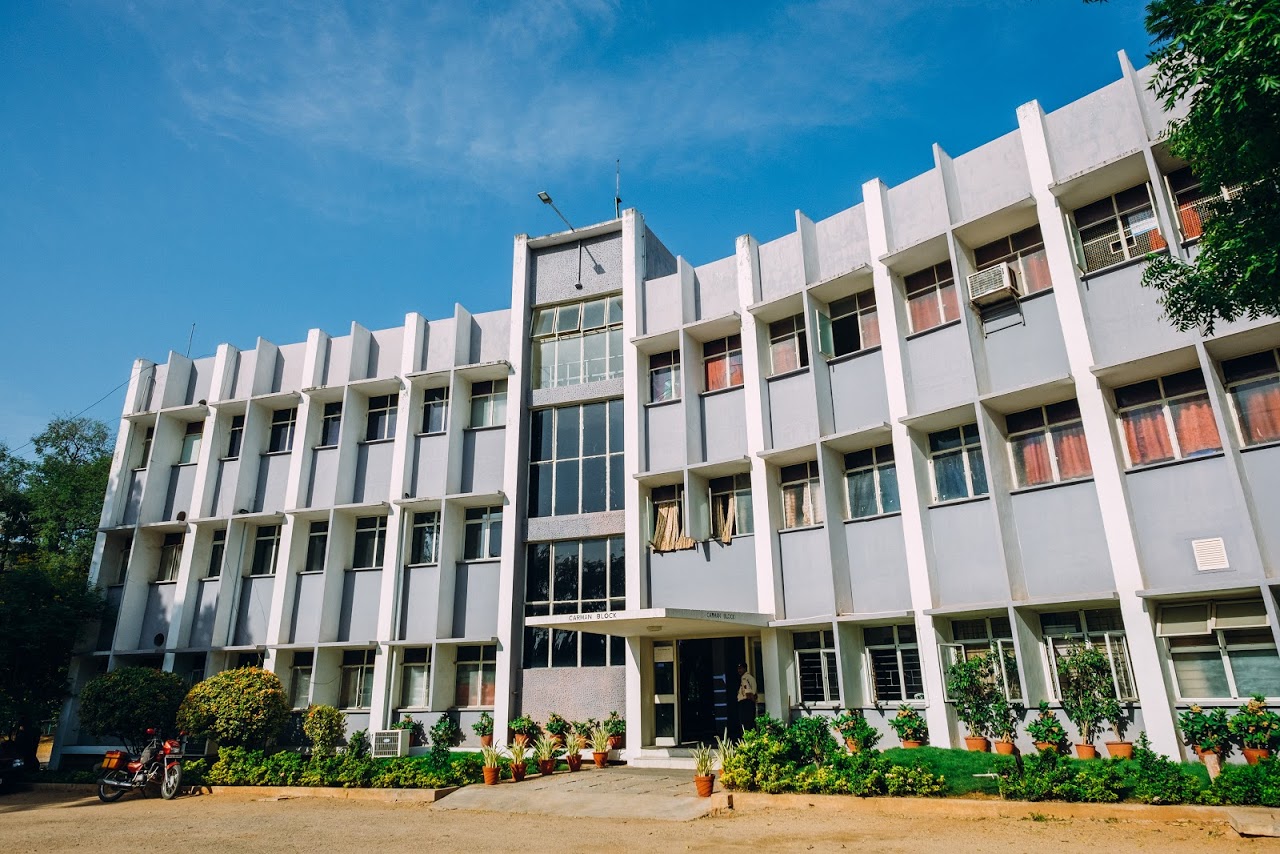
Several of you have asked if there is a charity I could recommend for making a donation. The Christian Medical College in Vellore, South India is a teaching hospital that provides excellent care for anyone regardless of religion or caste. CMC also has clinics in rural areas where otherwise there would be no access to medical care. Grace and I had the privilege of working as palliative care chaplains there for several years.
If you wish to make a donation, please follow this link. Donations are received through Friends of Vellore UK, which makes transferring funds easier:
https://givecmc.org/covid-19/?fbclid=IwAR0IdQpxcAoLJcbSFLRWm9yU1ghMu5ymaAp6pXfPi4Fn6Jc1THhqSF_4bJM
Blessings
+Mark
Anna and I are very excited, because we now have a definite plan to travel south in June to meet our granddaughter Alanna for the first time. We have been able to start making travel plans because of the gradual relaxation of the rules on travelling and visiting, as a result of the relative success of the lockdown and the vaccine rollout.
Over the last year the majority of the population have had to make considerable sacrifices to protect each other from what has turned out to be a very infectious virus. We are now moving into a more settled phase, as the restrictions are relaxed, but we all need to stay vigilant. The need to avoid complacency is underlined for us in the news reports, as we see how easily Covid can pop up again in areas of our country and in countries around the word.
Simon and I are very grateful to all of you for the support that you have given us in very challenging times, when many of out familiar patterns of church activity have had to be modified or curtailed. We have gradually been restoring patterns of worship, but we have still a little way to go and things will never return to exactly how they were before. Over the next few months we will be taking stock and looking at how under the new circumstances that we and our communities find ourselves in, we can be faithful witnesses to the God who made us and who cares for us. This will include renewing our commitment to the folk on the North Coast by finding a suitable venue for our monthly gatherings.
For some of you new opportunities have opened up with on-line services and we will continue to develop these as they have enable people who are unable to get to services in church or other venue because of health issues or travelling distance to worship with us. You will all have received an email with details of our Zoom Morning and Evening Prayer services.
Even if you don’t join these services in person, you can join them in spirit. Morning and Evening Prayer are said daily in some form by clergy and many lay people around the world, so however you engage with them, you are joining “such a great cloud of witnesses” (Heb 12:1). To make it easier for you, a list of the Psalms and Readings for these services is attached to this newsletter and you will find a similar list in each month’s edition.
We have had some success with online social activities, the longest-running of these being the Tuesday Coffee Mornings at 10:30am (now preceded by Morning Prayer at 10am). On those Tuesdays where other business prevents me from joining in, I do miss the lively chat and camaraderie that is always evident. We have also had successful on-line Advent and Lent Study Groups and this way of doing things can bring together people who would not ordinarily want to travel long distances on cold winter night, though I am sure that we have all missed activities where we can be physically in the same room together – it just isn’t the same on-line.
We’re now of course in the Season of Easter, when as Christians we celebrate the Resurrection of Jesus Christ from the dead. What we all need in the coming weeks is resurrection in our lives as we take steps in the direction of a life beyond lockdowns and restrictions on mixing and movement. For the disciples of Jesus, Resurrection didn’t mean returning to life as it had been, but to a new life of hope, in which all sorts of new possibilities opened up, possibilities that they could never have imagined.
For all of us, the old life that we lived can never return. The experience of the last year has changed all of us and so much else beside. However as we start to forge a future for ourselves, the wonderful thing is – who knows what might happen? Maybe, just maybe, the world might be a better place for everyone.
Blessings
James
We are now in the 40 days from the Resurrection at Easter until the Ascension. In this time Jesus appeared many times to individuals and groups, as our Eucharistic Prayer for this season puts it so beautifully:
Making himself known in the breaking of the bread,
speaking peace to the fearful disciples,
welcoming weary fishers on the shore,
he renewed the promise of his presence,
and of new birth in the Spirit
who sets the seal of freedom on your sons and daughters.
Using some of the passages describing these events, together with short reflections and prayers and some rather wonderful paintings by the French Artist Tissot, Stations of the Resurrection provides the opportunity to see how Jesus came to the Disciples as they tried to make sense of all that had happened and tried to return to their old lives. Their dreams had been shattered and they found themselves feeling ineffective and discouraged. If that is how you have been feeling over the past year or so then maybe it will give you renewed hope in the future.
 Scottish Episcopal Church - Dornoch, Lairg, Brora, Tain & Tongue