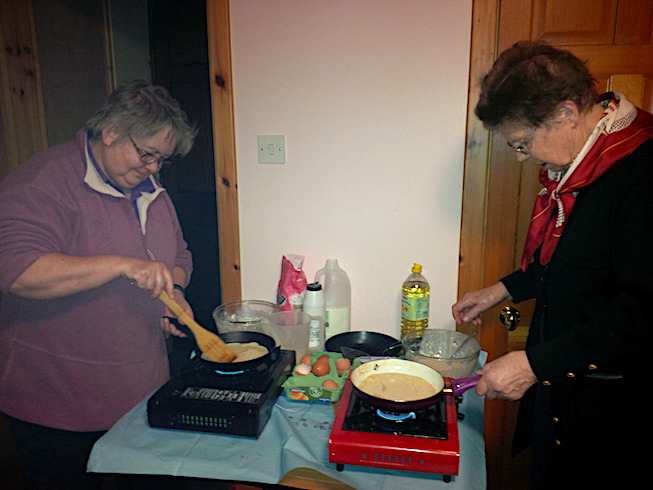
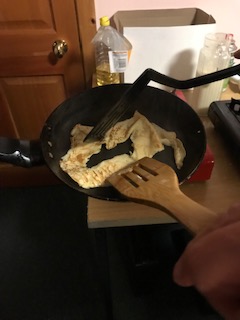
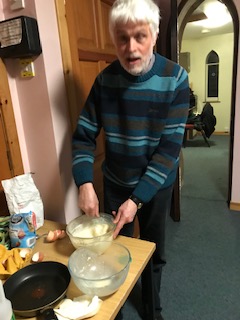
Our traditionally and very popular Pancake Party and Quiz takes place on Shrove Tuesday in St Andrew’s hall. The Quiz has been prepared and the catering is in hand, so all is now ready.
Points to note:
Pancake mix will be supplied but you should bring whatever you like in the way of fillings either savoury or sweet.
Please sign up on the list in St Andrew’s Hall or let Canon James know of your intention to attend (and how many people will accompany you) so that seating plans etc, can be worked out and sufficient accommodation and pancake mix can be provided.
“I have heard of your faith in the Lord Jesus and your love toward all the saints, and for this reason I do not cease to give thanks for you as I remember you in my prayers. I pray that the God of our Lord Jesus Christ, the Father of glory, may give you a spirit of wisdom and revelation as you come to know him, so that, with the eyes of your heart enlightened, you may know what is the hope to which he has called you, what are the riches of his glorious inheritance among the saints, and what is the immeasurable greatness of his power for us who believe, according to the working of his great power”
(Ephesians 1:15-19)
May God give us the wisdom and courage to tell the stories of faith that transform lives.
One of the World Day of Prayer Guiding Principles is that ‘Prayer is rooted in listening to God and to one another‘.
The theme of the worship service “I Have Heard About Your Faith,” based on the letter to the Ephesians, is an invitation to active listening, which is the ground of our prayers. Following the example of the letter (1:15-19), where the author praises the church for their faith in Jesus and love toward all the saints, the service this year makes this personal through the witness of the saints with stories from the lives of women in Taiwan.
The service shares the letters of encouragement sent to women who faced suffering and injustice. Their stories of faith concern issues that are shared by women and girls around the world and that continue to challenge us to prayerful action. They remind us of the urgency to protect the environment and have a nuclear-free homeland; to be aware of the gender stereotypes women face when challenging the traditional role in the workplace or in the family, and to care for the healing of the victims of verbal and sexual abuse.
It also encourages us to think about the hidden struggle of the essential workers, who during the pandemic, had to balance work and family in a vulnerable economic situation both in Taiwan and elsewhere. The sisters, who prepared the service, thank God for the natural resources of their island and pray for wisdom in face of the political isolation of Taiwan in the international community. They ask for our prayers.
Services Locally
Brora
St Columba’s Episcopal Church, Victoria Road, Brora
2:00pm
Dornoch
Oversteps Care Home, Earls Cross Road, Dornoch
West Church Hall, Sutherland Road, Dornoch
11:00am
2:00pm
Tain Area
Kilmuir & Logie Easter Church Of Scotland, on the B817 at Kilmuir
3:00pm
Lairg
Lairg Church of Scotland, Church Hill, Lairg
7:00pm
All are Welcome at any of these services
“For once you were darkness, but now in the Lord you are light. Live as children of light – for the fruit of the light is found in all that is good and right and true.“
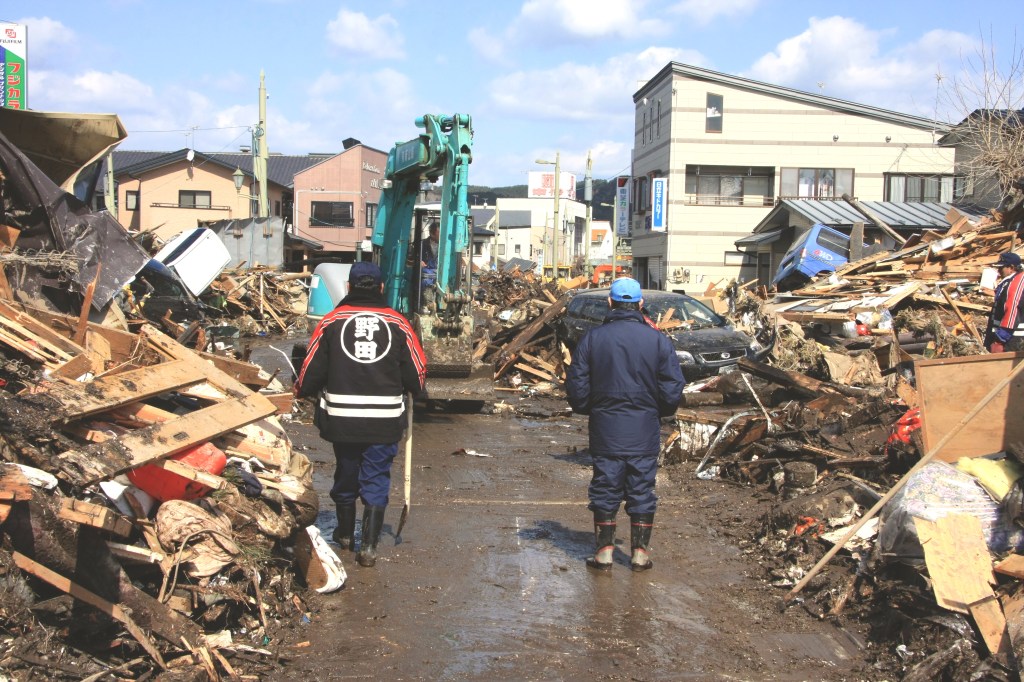
A Japanese Coastal Village after the 2011 Earthquake and Tsunami
In the past few months, we’ve seen and heard of events that have at times been quite difficult to take in. Major floods in Pakistan and Afghanistan, torrential rains in India and Nigeria, and recently: two major earthquakes in the Middle East.
The stories and images coming out of Turkey and Syria are devastating. In the aftermath of an earthquake of 7.8 on the Richter scale in southern Turkey and Northern Syria, buildings have been flattened, and many homes have been reduced to rubble. The death toll is already well on the way to 30,000 and in the days and weeks ahead, it’s expected to climb much higher.
Such disasters are bound to cause us to wonder ‘where God is in such things?’ So this is a good time to consider the gifts that God gives to help us in the difficulties of life and especially when our worlds are quite literally turned upside down.
Many people who’ve undergone adversity, experience a new sense of belonging to each other. There’s a remarkable sense of bonding between people who’ve experienced a particular disaster and who may’ve narrowly escaped death. There may be also a sense of guilt at having survived when friends and loved ones haven’t. God can give us the gift of a new sense of belonging and closeness to each other and also to God Himself.
Often, people deal with disaster by clinging to hope, expressed in phrases such as, “We’ll get through this together.” Such statements may be made through gritted teeth, in the anguish of physical and emotional pain. However, Hope has nothing to do with wishful thinking. Hope is the gift of openness to an unseen or unimagined future. It can keep us going, even when we can’t live and act in the ways we might normally be able to. The timing of the Japanese Earthquake and Tsunami in March 2011, just before the start of the Cherry Blossom season (the Sakura season) was very important in providing hope.
A crucial gift in God’s enabling is patience. It’s hope that enables waiting patiently for what is yet to be. Those of us, who can live active lives are accustomed to being more of less competent in what we do and can find patient waiting very difficult. Patience is the slow but definite practice of hope. It’s an active and loving holding on, perhaps without any other purpose than simply remaining; it’s “being” in the here and now.
With time, however, God also gives healing. It’s remarkable how there’s so a close relationship between time and healing. With time, we discover that in fact all along healing’s been taking place. There’s healing in the very nature of things, and of course there’s also the active work of healers, agents of God.
Experiences of suffering and distress are often also times of learning. Pain’s a great teacher. Many people say that’s at such times they learned the most valuable lessons of life. In particular, the value of things. That the things for which we spend so much time, money, and effort are worth almost nothing. When one’s experienced the loss of everything, all of one’s clothes and possessions swept away by an earthquake, tsunami, flooding or whatever, what remains is life itself, one’s family, and one’s relationship with God. In times of pain, illness and patient waiting, people come to reflect on the meaning of their lives, work, and priorities.
Flowing from these gifts, it’s both interesting and deeply moving to see something else emerge. In many contexts of disaster and distress, we see the depth of human caring. Those in ministry and in the caring professions often find that people in deep grief or pain reach out in concern for others. They want to be assured that some other person is being cared for. We may marvel at that, but it can be seen as a gift emerging from the very nature of our humanity. Our pain doesn’t destroy our better selves but rather brings them to the surface. Even as he suffered, Jesus prayed for those who crucified him. From the cross, he urged John to care for his mother.
Finally, the Suffering God enables faith. This isn’t a pre-condition of the other gifts. Rather, faith may be implied in those other gifts, but neither recognized nor acknowledged. Many people in their anguish call out to God, sometimes in accusing ways, just read the Psalms for examples. Sometimes, people, who say they don’t believe in God, call out to God. In contrast many, who’ve said they believe, find they can’t call out to God. Perhaps they imagined that their faith in God would mean that nothing like this could ever happen to them.
Faith emerges as the quiet, sometimes unrecognized gift that simply keeps us going. Faith isn’t the absence of struggle and doubt. Faith insists on dealing with the truth, with reality, with life and relationship; and through that keeping-on going, faith emerges in new forms.
It may be a new quality of prayer, or a new dimension of care, or a new commitment to reach out to those less fortunate. Such faith eventually finds its voice, to speak truth in the face of easy solutions or cheap grace. It speaks of the suffering God, who can and does help us in our hour of need.
The philosopher Charles Taylor has said that we must learn to understand what it means to have faith in our world. A world that isn’t a machine, controlled by a master manipulator of the levers. No, our task is to understand what it means to be with God and God with us, in a far less controlled, less predictable, but nonetheless, created world. In such a world, we must learn the meaning of belonging. We must learn to respect the earth, as many indigenous cultures have done since time immemorial and stop thinking that we can control everything for our own benefit.
We must learn also that the world isn’t just “our environment” but is rather the context in which we live with God. In so doing, we must learn see what God is doing in the world, and learn to live with and work with that, towards the unity with God seeks and the fulfilment of creation, in which all things come to their rest, in peace and harmony with God.
Our task, then, is to learn to see what God’s doing towards that redemption and to join God. That’s our theological and practical task—and what a privilege it is to be involved with God and God’s people in this way.
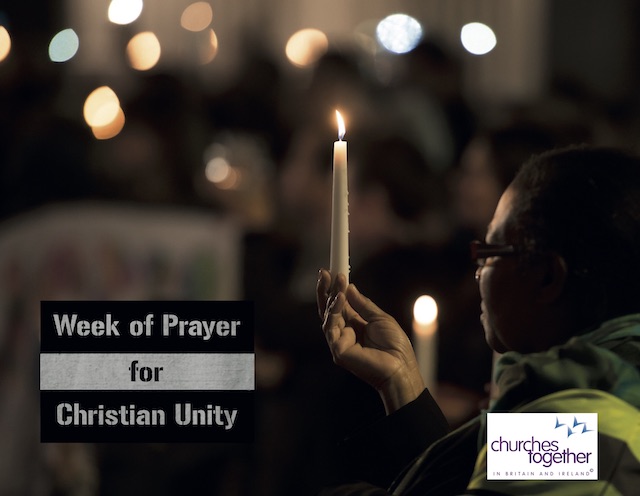
The Week of Prayer for Christian Unity ended on Wednesday. During the week, in many places, there were services where Christians from different denominations joined together to celebrate what they have in common, laying aside those things that divide them. Now, I’d be fairly certain that if any of us were to spell out the difference between our denomination and one of the others we’d make a reasonable job of describing the essential character of our own, but a less good job of the other. Such has been the case throughout Christian history. But these considerations don’t just apply to Christians or to religions, they apply whatever ‘groups’ or ‘tribes’ we belong to and the difference they have to other similar ‘groups’ or ‘tribes’.
Anna and I lived for 25 years in the West of Scotland, in Ayrshire, where sectarianism is still alive and well and where even today the chances of getting some jobs may depend on your denomination, which might be revealed simply by the name of the school you attended. But I’m not sure that sectarianism’s actually got anything to do with religion, with denomination or with belief. It’s more about prejudice and prejudice often arising from ignorance of the ‘others’.
What we seem to be missing in our increasingly polarised culture is a shared humanity. That person who you or I are yelling at (literally or metaphorically), who has a different political, social or religious opinion than us, they’re actually human too, and you or I are no better or worse than them.
When we can learn to admit that we’re not perfect, that we make mistakes all the time and that we constantly change and evolve our opinions and beliefs … then we can begin to have more compassion for ourselves and begin to see ourselves as someone that’s lovable and worthy of grace and compassion, even though we’re not perfect and not living up to our own ideals. At that point we begin to see others, with differing views or opinions, with that same grace and compassion, no matter how different they are or how many mistakes they’ve made. Why? Because we realise that they’re a person, just like us, with hopes and fears, struggling to do the best they can with the resources that they have, the situation that they find themselves in and what they believe to be true.
Irene Butter, who as a child survived not one, but two holocaust concentration camps, perfectly summarizes these ideas in a single sentence: “Enemies are people who’s story you haven’t heard, or who’s face you haven’t seen.” We need to remind ourselves of this whenever we come across another person who doesn’t see the world in exactly the same way that we do.
St Paul reminds us that human standards of judgment count for nothing in God’s eyes. The human standards that say for instance: that my way of being a Christian is better than your way, that my way of worship is better than yours. The scandal of the cross is that God chooses vulnerability, weakness, suffering, and death in order to bring new life. God places the greatest value on our service to others, even when service may mean suffering and rejection. In Christ we’re a new creation, even in (or perhaps because of) our weakness and vulnerability.
It great to hear people talking about unity, so long as they don’t mean simply that “we can all be united if you come over to my way of thinking”. That’s akin to my suggesting that the solution to Christian disunity is for them all to become Episcopalians – and you know what, I don’t think that would solve anything. We like most denominations can’t even agree amongst ourselves!
The key to the Week of Prayer for Christian Unity is the word ‘Prayer’. Unity is something that we should fervently pray for, we might never achieve it, but that doesn’t mean that we shouldn’t try, remembering that Unity isn’t Uniformity!!
Yesterday in St Andrew’s we held a service for the Week of Prayer for Christian Unity. A sizeable group drawn from across the Churches and Fellowships around Tain, Invergordon, Ardgay and Dornoch gathered together for a Service prepared by Christians in Minnesota. The focus was on injustice and in particular racial injustice, remembering George Floyd who died during ill-treatment by police in Minnesota and also marking the 30th anniversary of the brutal killing of Stephen Lawrence in London.
Folk from a variety of churches and fellowships contributed to the service which included hymns, readings, prayers and a ritual where we built a cairn at the foot of the cross as we acknowledged our complicity in injustice.
It also included a rather wonderful Franciscan Benediction:
May God bless you with discomfort at easy answers, half-truths, and superficial relationships, so that you may live deep within your heart.
May God bless you with anger at injustice, oppression and exploitation of people, so that you may work for justice, freedom and peace.
May God bless you with tears to shed for those who suffer pain, rejection, hunger, and war, so that you may reach out your hand to comfort them and turn their pain into joy.
And may God bless you with enough foolishness to believe that you can make a difference in the world, so that you can do what others claim cannot be done to bring justice and kindness to all our children and the poor.
Amen
(Attributed to the early followers of St Francis)
… and afterwards?
Well of course there were lovely refreshments and a time for fellowship where Christian who don’t get to meet up very often were able to relax and share.
A huge thank you to everyone who contributed to both the service and the refreshments.
The Week of Prayer for Christian Unity is traditionally observed from the 18th to the 25th January – the octave of St. Peter and St. Paul. It is also customary to have at least one service to which Christians from all Churches and Fellowships are invited.
Accordingly there will be a service in St Andrew’s Church in Tain at 3pm on Wednesday 25th January.
St Andrew’s Episcopal Church, Manse Road, Tain
Wednesday 25th January at 3pm
All welcome to join together in Unity
For this Week of Prayer for Christian Unity we are guided by the churches of Minneapolis as we seek to explore how the work of Christian unity can contribute to the promotion of racial justice across all levels of society. Through this resource, the CTBI writers’ group has also focussed our attention on the 30th anniversary of the murder of Stephen Lawrence, which falls this year. The work of restoring hope through justice undertaken in Stephen’s memory continues to inspire and change lives for the better.
As we join with other Christians around the world for the Week of Prayer we pray that our hearts will be open to see and hear the many ways in which racism continues to destroy lives, and to discern the steps we can take as individuals and communities to heal the hurts and build a better future for everyone.
The 21st December was the shortest day and the longest night. Nature seems to have gone to sleep. The leaves have fallen off all but the most resolute of oak trees and the garden lacks life.
As early as the 2nd century, the Romans believed that the ‘Unconquered Sun’ would rise again and warm the earth and bring things back to life. Darkness and Light. Death and New Life. And they prayed to their god ‘Sol Invictus’ or ‘Helios’ if you prefer, that light would come again. It’s no accident that the Christian Church celebrates the birth of the ‘true light’ at the darkest time of the year. He is the light that darkness could not overcome.
There’ll always be a struggle between darkness and light.
We feel that at both a personal level and in the public world around us as well. Nowhere is this more graphically seen than in the destruction and war being waged in Ukraine, in parts of the Middle East and in parts of Africa. Bombs and bullets, terror and violence seem to be the only language being used in these parts of the world, including the lands of the Bible and the places that we hear about in the story of the Incarnation.
And, of course it’s the innocents who suffer and it always has been.
Who could fail but be shocked by the sheer terror on the faces of children and families as homes and schools, hospitals and clinics and essential parts of the infrastructure of towns and cities are destroyed in ways calculated to instil fear, misery and suffering into the largest number of innocents? Whether these images come from from Aleppo or Mosul, from Gaza or Nablus, from Kiev or Kherson and so many other places whose names we either don’t know or can’t remember, as we watch on our TV screens or read our newspapers, we are appalled.
The story of the birth of Jesus resonates with the story of humanity at it’s darkest hour.
These verses of Malcolm Guite’s poem ‘Refugee’ puts it so well:
We think of him as safe beneath the steeple, Or cosy in a crib beside the font, But he is with a million displaced people On the long road of weariness and want.
For even as we sing our final carol His family is up and on that road, Fleeing the wrath of someone else’s quarrel, Glancing behind and shouldering their load.
Malcolm Guite “Refugee”
At this time of year, as Christians we hear and proclaim the universal message of the need for peace on earth. Peace isn’t just the absence of conflict and war. Each of us has some responsibility to create at least some of that peace in our own life and community, not least by working for a more just society and world.
These are the ‘hopes and fears’ we focus on at Christmas and as we remember the Holy Innocents.
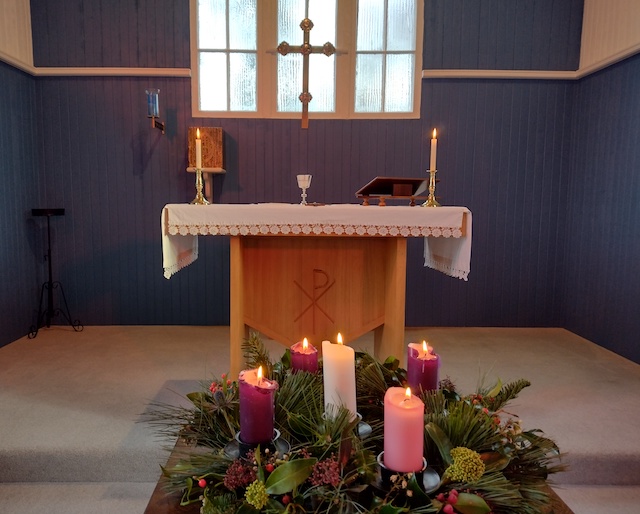
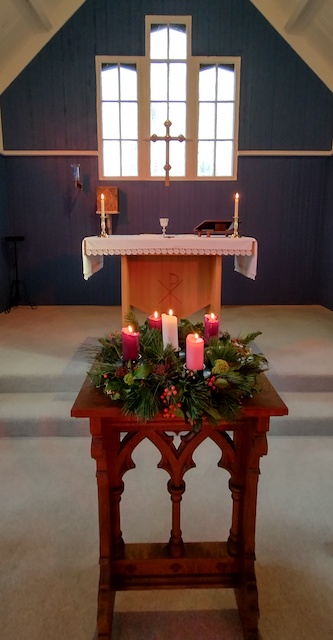
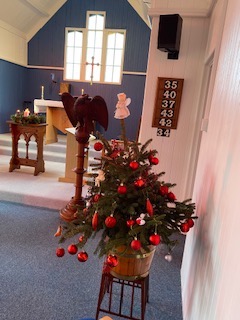
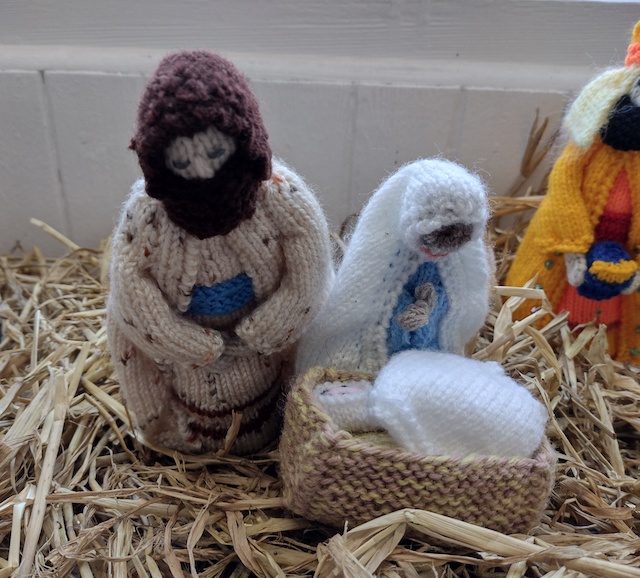
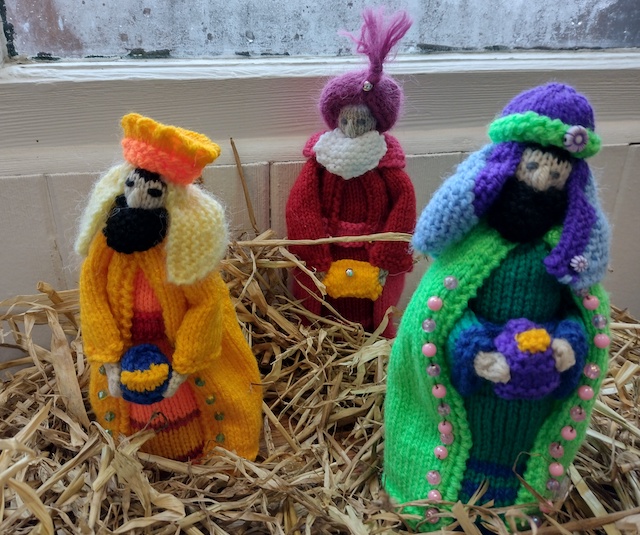
Our final celebration of the birth of Jesus took place today in St Columba’s, Brora at Noon. Lots of Carols and Christmas readings, prayers and then a celebration of the Eucharist.
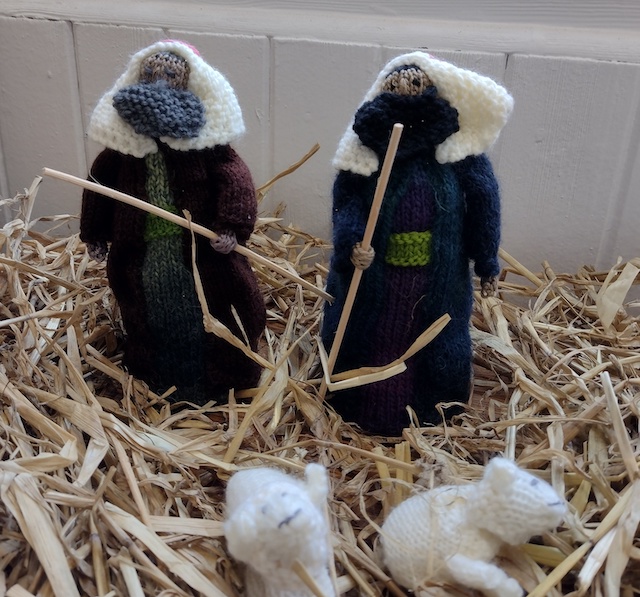
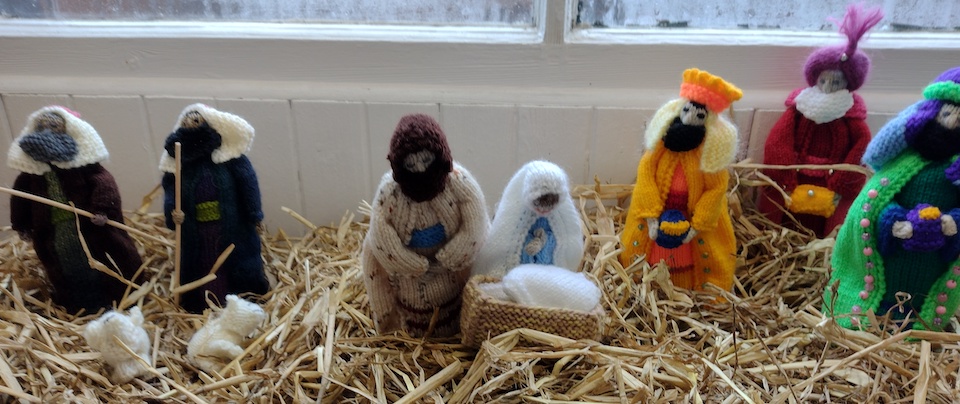
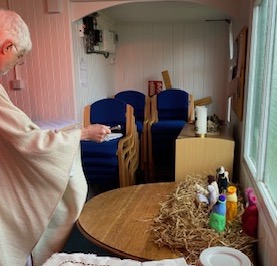
We blessed the Crib…
Afterwards we shared food and fellowship, whilst carols continued to play in the background.










 Scottish Episcopal Church - Dornoch, Lairg, Brora, Tain & Tongue