The “Two-Book” Approach to Revelation

Yesterday, when I was out walking our Collie, Moss, in a generally fairly uniform patch of managed pinewoods, I saw a single rather striking white foxglove. Now most of the foxgloves around us are purple, but there weren’t even any of those in the vicinity either. I found this discovery a very moving spiritual experience and it set me thinking about the revelation of God. 

One view is that God’s Revelation is more or less circumscribed by Scripture and that any consideration of God in Creation is confined to a literal interpretation of Genesis 1 and 2, which themselves contain two quite different accounts of Creation. It would seem that at that point all creatures had been designed and given their place on earth and nothing much has changed in that regard since. God of course also revealed himself in Jesus Christ in ways narrated by the Gospels and attested to in the Epistles.

This view seems to suggest to me that God did Creation and then retired for a while, popping up in the lives of the people of Israel for about 6000 years before deciding to do something decisive about these rebellious folk who had played fast and loose with the Covenant that He entered into with Moses on Mount Sinai and which we know as the Ten Commandments. He decided to enter into a New Covenant through the life and ministry, death and resurrection of His only begotten Son Jesus Christ. Then having sorted things out and inspired a number of folk to write it all up for our instruction, He retired and stopped revealing Himself.

Well you won’t be surprised to hear that I don’t buy that rather reductionist view of God and Revelation. Do we not see the face of God in each other and in the whole of the created world revealing itself anew every day? Of course I am not the first to suggest such a radical thing.  It seems to me that it’s exactly what St Francis’ life and work revolved around and The Patristic theologian Maximus the Confessor claimed that “Creation is the accuser of the ungodly” and even went as far as to say “that by means of the visible [natural] world we should understand whence we came, what we are, for what purpose we were made and where we are going

Pope John Paul II picked up the theme in January 2000 when he said:

In beholding the glory of the Trinity in creation, man must contemplate, sing and rediscover wonder. In contemporary society people become indifferent ‘not for lack of wonders, but for lack of wonder’ (G. K. Chesterton). For the believer, to contemplate creation is also to hear a message, to listen to a paradoxical and silent voice, as the ‘Psalm of the sun’ suggests: ‘The heavens are telling the glory of God; and the firmament proclaims his handiwork. Day to day pours forth speech, and night to night declares knowledge. There is no speech, nor are there words; their voice is not heard; yet their voice goes out through all the earth, and their words to the end of the world’ (Ps 19: 1-5).

JOHN PAUL II – GENERAL AUDIENCE – Wednesday 26 January 2000

Nor is this only a recent idea, Article II of the Belgic Confession of the Reformed Churches of the Netherlands from 1561 asks: 

By What Means God is Made Known unto Us”.

Article II of the Belgic Confession

The answer:

We know Him by two means: First, by the creation, preservation, and government of the universe; which is before our eyes as a most elegant book, wherein all creatures, great and small, are as so many characters leading us to see clearly the invisible things of God, even his everlasting power and divinity, as the apostle Paul says (Rom. 1:20). ‘All which things are sufficient to convince men and leave them without excuse’. Second, He makes Himself more clearly and fully known to us by His holy and divine Word, that is to say, as far as is necessary for us to know in this life, to His glory and our salvation.

Article II of the Belgic Confession

So as you enjoy the summer weather (whatever form that may take), I urge you to rejoice in God’s continuing revelation in all of His Creation and in everyone that you meet and treat both with the care and respect that they deserve as beloved creations of their Creator.

Blessings
James

Tackling the Environmental Crisis

At the recent meeting of the Scottish Episcopal Church General Synod, there was a presentation on the Provincial Net Zero Action Plan and in the motion concerning its adoption, Canon James spoke. This is what he said:

—————–

I am encouraged by many of he words that I find in the plan before us, but …

The Environmental Crisis is very much more than global warming and CO2 emissions hardly scratch the surface of the problem. The elephant in the room is that at it’s heart, the crisis arises from the abuse of God’s creation and in particular the over-consumption in the developed world and our consequently broken relationship with our neighbours worldwide, especially the poor and those in less developed countries.

Global warming and other forms of environmental degradation aren’t simply caused by using the wrong technology for energy generation. This is an inconvenient truth, frequently glossed over, because it needs real change, rather than attempting to ‘green up’ business-as-usual. The values and vision section doesn’t even hint at this.

There’s a radical inequality in how the earth’s resources are used.  The awkward reality is that there’s no solution, that isn’t underpinned by substantially reduced consumption in the developed world. Our lifestyles result from using more than our fair share of the gifts of God’s creation, a free gift held in trust by each generation. Our high rate of consumption produces environmental problems and the rest of the world faces the most severe consequences.

As Christians shouldn’t we treat the resources of the world as part of our relationship with God. Our access to and exploitation of them isn’t a right. Gratitude is central to our faith, thankfulness for God’s grace and generosity key features of that relationship and our discipleship. 

Social justice is a central value in all of this. Christian leaders such as Patriarch Bartholomew and Pope Francis have pointed out the link between environmental destruction and poverty, between ecological justice and social justice:

A church that neglects to pray for the natural environment is a church that refuses to offer food and drink to a suffering humanity. A society that ignores the mandate to care for all human beings is a society that mistreats the very creation of God. It is tantamount to blasphemy.

Patriarch Bartholomew I

We are faced not with two separate crises, one environmental and the other social, but with one crisis both social and environmental. Strategies for a solution demand an approach combating poverty, restoring dignity to the excluded, and at the same time protecting nature.

Pope Francis in “Laudato si”

The environmental crisis is a series of inter-related difficult and complex problems, that none of us has the answer to. Pope Francis writes in Laudato si:

To seek only a technical remedy to each environmental problem which comes up is to separate what is in reality interconnected and to mask the true and deepest problems of the global system.

Pope Francis in “Laudato si”

When faced with difficult and complex problems, the people of God have historically turned to God in Prayer and Lament. In an age where much of the prevailing narrative is that humanity can overcome all problems by scientific endeavour or technological advance, it’s counter-cultural to suggest that perhaps an important part of our response is to turn to God rather than engage in ceaseless activity. However Christianity has never shied away from being counter-cultural has it?

We can be easily convinced that solving the environmental crisis is simply a matter of acting differently, more effectively, more sustainably or taking more action. But let’s not forget that human action led to the crisis in first place.  So surely our approach has to start and end with God, as theologian John Zizioulas wrote:

If faith is about ultimate things, about life and death issues, this particular problem certainly falls within that category. … Church and theology must have something constructive to say on a matter like this. Otherwise they risk being irrelevant and unable to live up to their own claim to the Truth. For a truth which does not offer life is empty of all meaning.”

John Zizioulas

Can our rather technocratic strategy help us to bring hope to an anxious world through the resources of the Christian faith and what makes us church? What is our hope-filled vision for the rest of the world? 

As Christians we have a responsibility not only to take action to contribute less to the problem, but to be prophetic voices in the world. In the words of Walter Brueggemann we have a threefold prophetic task:

The prophetic tasks of the Church are to tell the truth in a society that lives in illusion, grieve in a society that practices denial, and express hope in a society that lives in despair.”

Walter Brueggemann

Coronation Tree Planting

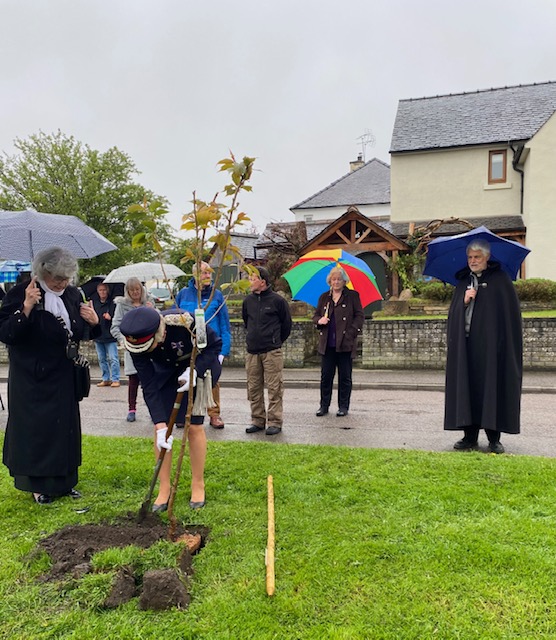
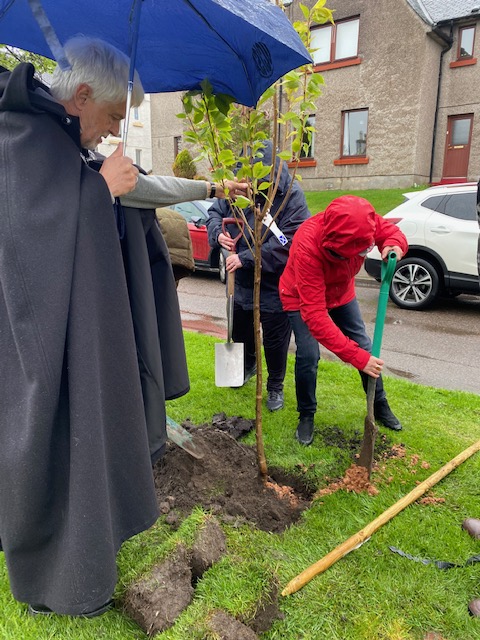
Yesterday evening representatives of the churches and members of the community in Tain planted trees in memory of those who planted the original row of trees in Manse Street, to mark the Coronation of His Majesty King Charles III.

The following readings from Scripture were read:

Lord Lieutenant Joanie Whiteford
Genesis 17:7 NKJV

And I will establish My covenant between Me and you and your descendants after you in their generations, for an everlasting covenant, to be God to you and your descendants after you.

Jack Reid
Job 14:7 NKJV

For there is hope for a tree, if it is cut down, that it will sprout again,
And that its tender shoots will not cease.

Fin Macrae
Jeremiah 29:7 NKJV

And seek the peace of the city where I have caused you to be carried away captive, and pray to the Lord for it; for in its peace you will have peace.

Rev. James Currall
2Kings 11:12 NKJV

And he brought out the king’s son, put the crown on him, and gave him the Testimony; they made him king and anointed him, and they clapped their hands and said, “Long live the king!

Marie Macleod
2Kings 11:12 NKJV (in Gaelic)

Given the weather, there was no need to water the trees once they had been planted:-)

We Prayed for their Majesties

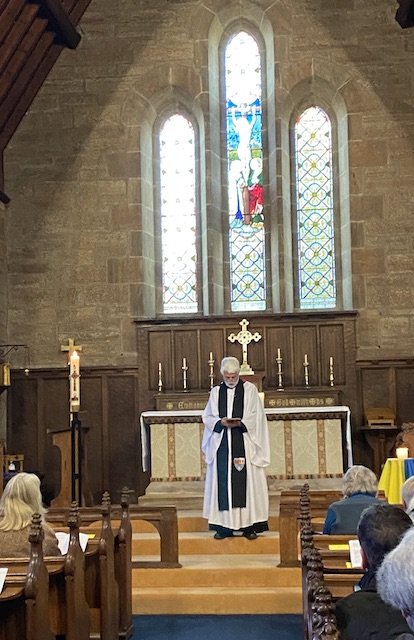
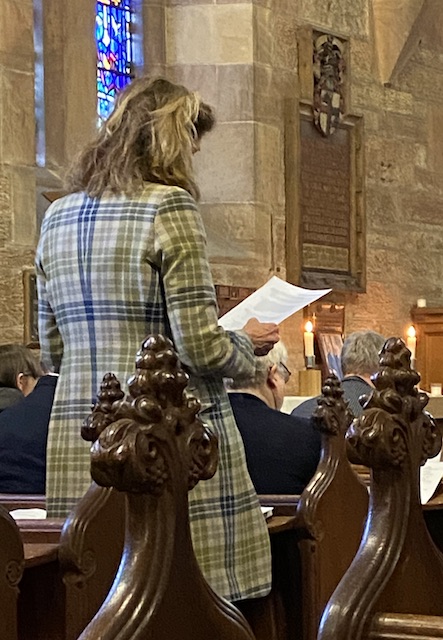
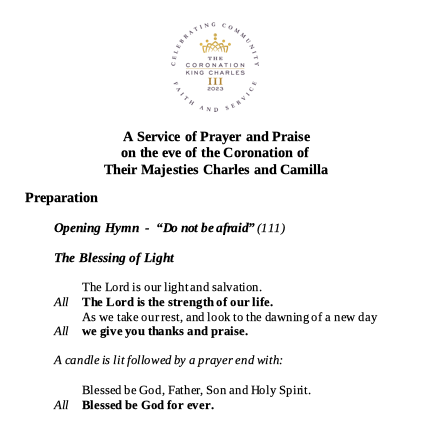
People from a range of congregations, fellowships and traditions joined together in a service of Prayer and Thanksgiving for their Majesties Charles and Camilla yesterday on the eve of their Coronation. It was a very moving occasion.

Tain & North Highland YMCA SCIO Fun Day – 8th May 2023

Tain & North Highland YMCA SCIOare holding a Fun day next Monday 8th May 2023, as part of the Kings Coronation events.

The Fun Day is from 10am until 2pm

There will be:

  • The usual stalls,
  • Bouncy Castle,
  • Face painter
  • Raffles etc etc.

This event is being held to:

  1. To celebrate the Coronation 
  2. To raise valuable funds (our electric alone has gone up by £4k this year). 
  3. To thank the Adult volunteers who support Tain & North Highland YMCA SCIO
    (volunteering being an important part of the Kings theme for the weekend) 

The Lord Lieutenant -. Joanie Whiteford – will be there to officially unveil the new logo and name.

It’s always the innocent who suffer most

For the first half of the 20th century, present-day Sudan was a colony of the British Empire. Sudan achieved independence from Britain in 1956 but civil war was already brewing between the north and the south. Part of the problem is the clash of cultures, religions and ethnicities of sub-Saharan Africa with those of the Arab Islamic world. Since 1956 there have been only 11 years of peace and so more than 50 years of civil war at one level or another. 

Sudan is the largest country in Africa and borders nine other countries, including Egypt, Chad, Kenya and Ethiopia. The capital of Sudan, Khartoum, sits where the White Nile and the Blue Nile join together to form the Nile which flows north to Egypt and into the Mediterranean. Now Sudan has a population estimated to be about 40 million, of which 52 percent of which are African, and 40 percent Arab. Over two thirds of the population is Muslim while Animists and Christians, who for the most part live in southern Sudan, account for a third. Arabic is the official language, and the government has attempted to impose Islamic sharia law on the whole country since 1983, which led to Sudan’s longest civil war, from 1983 to 2005 and involved not just southern Sudan but the people of the Nuba mountains, Blue Nile and eastern Sudan as well, and the peace agreement in 2005 left those other conflicts unresolved.

The Darfur conflict erupted 20 year ago in April 2003 when the Sudan Liberation Movement attacked Sudanese military forces at the al-Fashir airport in North Darfur. In the years that followed, hundreds of thousands of people were killed, and millions more displaced in the war between rebel forces and the military.

Recently our news media have been awash with the rapid escalation in violence in Sudan. Intense clashes between Sudan’s military and the country’s main paramilitary force have killed hundreds of people and sent thousands fleeing for safety, and this latest civil war threatens to destabilise the wider region.

There is currently a power struggle between the two main factions of the military. The Sudanese Armed Forces (SAF), broadly loyal to Gen Abdel Fattah al-Burhan, the country’s de facto ruler, are pitted against the paramilitaries of the Rapid Support Forces (RSF), a collection of militia who follow a former warlord Gen Mohamed Hamdan Dagalo, known as Hemedti.

As well as a tussle for power, at the root of much of the conflict are the economic and political disparities in the regions, and since no government, civilian or military, has seriously addressed these, it was only a matter of time before the violence in specific regions like Darfur expanded to engulf the centre and has led to the rapid exodus from Khartoum and ordinary people try to escape the fighting.

For civilians in Sudan at the moment, simply holding on to hope is a huge challenge. Those stepping out of their front doors don’t know whether they’ll return alive. As Christian’s we need to pray for the safety of those living in fear. We need to pray for justice and healing, and for an outcome that doesn’t open the way to more radicalisation and tension. And we need to pray that the Sudanese people may in due course be ruled by a government that respects human rights, freedom of worship, equality and dignity for all of whatever race or religion.

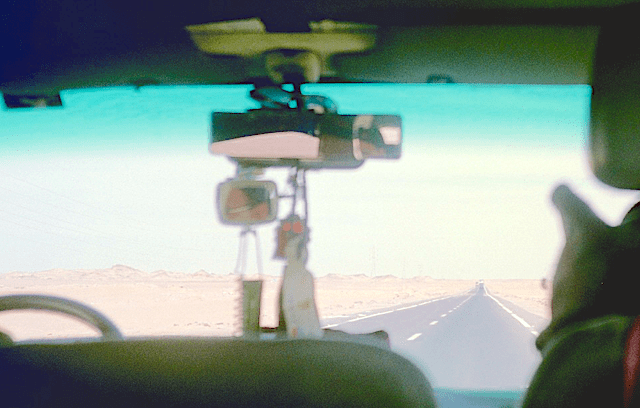
Driving the long desert road in Southern Egypt towards the Sudanese border in 2004

Blessings
James

The Queen’s Coronation 2nd June 1953

1952/53 were very memorable years for me. Life up until then had been spent mainly in London, living with the smog and amongst the damaged buildings, with reconstruction going on everywhere. Despite all the damage done, there seemed to be hundreds of people everywhere and even the unsafe remains of houses were used for large families to live in, until better accommodation could be found. Queues for everything resulted in people getting to know almost everyone in the area. There was always excitement when deliveries of goods which had not been seen for a while, arrived, and the resultant rush for the queue was inevitable as only so much could be delivered, so it was on a very much “first come, first served” basis. We seemed to know everyone, there were shortages of everything, all the people appeared to work together in communities and although food was rationed and there was never enough of it, we didn’t starve.

The biggest news in 1952 was the shattering blow of the death of the king. He and his family had been a great support to the Londoners and the country and to be taken just as things were recovering for all of us was a great sadness. However, Princess Elizabeth was a real beauty and we could not have asked for more in a future queen. We did not have a television at that time, so were not so aware of the fact that she and the Duke of Edinburgh were carrying out royal duties abroad, nor the fact that her children, Charles and Ann, were left behind. Although this behaviour appears harsh now, it was quite common in those days and the man of the house was not expected to take much time with the children as he was the bread winner.

I was in the lucky position of having spent a lot of time in Central London, my grand-parents were all employed near to Buckingham Palace, so I was taken to see many of the “Changing of the Guard”, and was frequently by the gate when the King and Queen drove through. My maternal grand-father served in the Army for many years in India; when returning with the family to England in 1930’s he had been injured and was given a civilian post at the Royal Chelsea Hospital. My grandmother was employed as Chef, so many of my youngest days were spent “helping out” with the Chelsea Pensioners (as only an under five can!) I was also taken to see the parades and horses, so by the time the coronation came along, it wasn’t such a “big deal” for me. I had also had a “peep” at the Coronation coach when it was taken out of mothballs for a “refresh”, I cannot remember what they were doing to it, but the Gold on it stayed in my mind to this day. I think there must have been a sense of foreboding about the king’s health at the time, but I really cannot remember at what age I was when I was in the privileged position of seeing the coach.

At my new school there was great excitement and plans made for celebrations of the Coronation. We were such lucky children, the school was brand new, up to date with modern facilities, including indoor toilets – something the previous school sadly lacked. We were also divided up into smaller classes of about 30 children, whereas before we were altogether in one classroom. We made bunting and learned dances and songs and we all had a union jack flag to wave on the day. During the weeks coming up to the Coronation, we came home with gifts galore, including a red propelling pencil and notebook, a book about the Queen, a cup and saucer with the Coronation details on it and a teaspoon. We also had our own (rough) notebooks which we had never had before. We felt we were the luckiest children in England. I can also remember dancing around the Maypole, but only once as I think we enjoyed getting tangled up too much!

On the day of the Coronation we all had a day off and we had a street party. There were about 40 children over the age of 5, the younger ones were accompanied by their mothers. I had never, in my entire life, seen so much food, how the ladies prepared it, I shall never know, but children don’t think about that when an array of “specials” is on the table. I think a lot of the supplies were donated by the American base which was close by; as we tasted “Candy bars” for the first time. The food consisted of jelly and blancmange, lots of tinned fruit including mandarins and peaches. Fresh orange juice was on the table, with real straws to drink through. Sausage rolls and cheese straws and lots of fairy cakes of different styles, most with red, white and blue icing. Piles of sandwiches were demolished as quick as lightening – these were all white bread, containing a variety of fillings from cheese and jam to egg and cress, the mums really did us all proud – how with the meagre rations I don’t know.

About two weeks before the big event, there were roughly 12 of us girls from our street chosen to “perform” after the Coronation. We went through choreography for three songs:

  • She wears Red Feathers and a Hooly Hooly Skirt,
  • There’s a lovely lass, lives by a lovely stream and
  • Sisters.

I was chosen with a few others to sing “She wears Red Feathers” and were set to making our “costumes” which consisted of red crepe paper, red feathers and a hair band with red flowers sown onto it.

The order of Coronation Day was as follows – detailed as well as I remember:

Not sure how the coverage of the Coronation went, but it appeared to be broken down into three sections. Everyone was invited into our house as my father had won the Football Pools and bought a TV out of the winnings. I was not impressed – everything was in black and white and I expected to see the coach in gold that I had seen years before in the Coach House. Not only that the TV screen was only about 9 inches square so the picture was very small, I couldn’t see very much between people’s legs, so was more than pleased when we were allowed to start on the food. I don’t think my father was very impressed with my reaction.

When the TV coverage was finished, everyone piled out to eat what was left of the food. That didn’t take long! Then the girls got ready for the “entertainment”. By then it had started drizzling and by the time we came out, singing our hearts out, with the choreography to match, it was pouring down. My mother was going slightly ballistic. I couldn’t understand why, as the rain was mushing our costumes which were only paper, but of course, the red dye was all over us. It wasn’t until I recently spoke to a friend who was at this “do” and she told me she was frozen, so our mothers had insisted that we kept our liberty bodices and vests on (along with our long legged brown drawers with pockets in). Imagine the sight, sexy south sea maidens in pretty red spliced skirts and bikinis with liberty bodices, vests and brown knickers underneath, all turning red with the dye out of the crepe paper.

I got used to the black and white TV, although we were only allowed to watch Andy Pandy and Muffin the Mule and a bit later on The Flower Pot Men, I was immensely proud of my father for getting the TV, although I heard later that my friend’s father had gone to see it and came back saying he wouldn’t be buying anything like that – far too small, “I will buy a 12 one“. Apparently he did this, but it took him two years to save up as it was very expensive. Personally, I preferred listening to the radio, they had special children’s programmes: Dick Barton – Special Agent and Journey into Space were two I used to try not to miss. Also, on Sundays, after a church service, there was Family Favourites which was a programme mainly for servicemen overseas – where special requests were played for them. This was followed by Billy Cotton’s Band Show, Life with the Lyons and Archie Andrews or other comedy programmes – good family listening.

Sadly, I have not managed to see “live” on TV, or attend any special Royal Event since, always otherwise occupied, but I hope to see all of the King Charles Coronation and shall stay by the TV and record as much as I can as it is well deserved, he has been a splendid “King in Waiting” and I hope he manages a long and happy reign with his Queen Camilla.

Granny Smith

Coronation Tree planting – 10th May 2023

New Wine Church Tain 

Invites you to join us for an ecumenical 

‘Tree planting’ to commemorate the 

Coronation of 

His Majesty 

King Charles III 

Wednesday 10th May @7.30pm 

On Manse Street Tain 

For more details  call 07879 663 729  SC035127 

On the the eve of the Coronation – 5th May 2023

Service of Prayer and Praise 

on the the eve of the Coronation

Their Majesties Charles and Camilla

The clergy and congregation of

St Andrew’s Episcopal Church, Tain

invite you to join us on

Friday 5th May

at 7:30pm

to pray for Their Majesties

and for all who have roles in the 

Coronation Ceremonies

at

Westminster Abbey

St Aidan’s Lectures now online

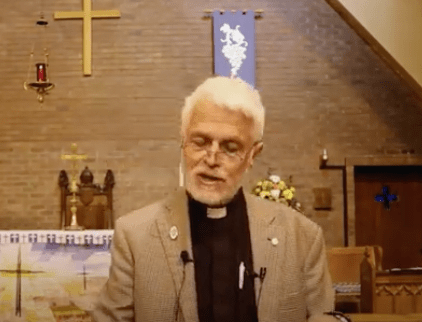
James delivering the first lecture at St Aidan’s

The first two St Aidan’s lectures have now been posted on the Glasgow and Galloway YouTube channel, which can be found at:

https://www.youtube.com/channel/UCULDcu3RKVr-hHQY2pLRfXw

The remaining two will be posted there over the next couple of weeks.

The lectures this year are being delivered by Rev Dr James Currall and are entitled

The Environmental Crisis and the Church

Details of the lectures can be found in this post on our web site.