John 3.1-17
During the season of Lent, one of my favourite musical works to listen to (or even better to join in with) is John Stainer’s Crucifixion – a meditation on the sacred passion of Our Lord. Holy Redeemer. Some of you may not think you know any of it, but I’m sure you will recall at least the most well-known chorus – God, So loved the world.
God so loved the world, that He gave His only begotten Son, that who so believeth in Him should not perish but have everlasting life.
It’s a most beautiful piece of music through which Stainer cleverly captures the mood of these words of scripture.
The great Martin Luther called John 3:16 “the Gospel in a nutshell.”
John 3:16 is well-known and often-quoted, you can find it on posters and billboards, printed on T-shirts and hats, and even on car window stickers. But I wonder, how many of us could go on to quote John 3:17?
Who among us knows Nicodemus’ backstory by heart? And if we’re being honest, how many of us could have identified Nicodemus as the one to whom Jesus is speaking in John chapter 3?
While John 3:16 has rightly earned its place among the most memorable and hopeful verses in the New Testament, its larger context is actually a powerful witness to the love of the God we meet in Jesus.
Nicodemus, says John’s Gospel, was a leader among the Jews. In public, his loyalties were clearly devoted to the Jewish establishment. But in private, Nicodemus had his doubts. And so, he visits Jesus under the cover of nightfall. “Rabbi,” Nicodemus says, “we know that you are a teacher who has come from God; for no one can do these signs that you do apart from the presence of God.”
To put it another way, Nicodemus saw that Jesus was a good teacher and a knowledgeable interpreter of Torah, but Jesus was also filled with God’s life-giving Spirit, and Nicodemus wanted that kind of relationship with God, too.
Then, as Jesus so often does, he says something that utterly astounds everyone: “Very truly, I tell you, no one can see the kingdom of God without being born from above.” In other words, glimpsing the Kingdom of God isn’t a matter of praying a certain way or believing a certain way or following a certain set of liturgical customs; it’s about a complete rebirth of our entire existence!
On hearing this, Nicodemus asks an honest question that seems almost laughably quaint and naïve to our 21st-century ears: “How can anyone be born after having grown old? Can one enter a second time into the mother’s womb and be born?”
But for as off-the-mark as Nicodemus’ question might seem to us, might it not also demonstrate something important about the way God tends to work?
Just think about Abraham and Sarah for example. God promises them a son. The ancient scribe matter-of-factly cues us into the dramatic irony surrounding this promise, writing flatly, “It had ceased to be with Sarah after the manner of women.” In fact, when she heard about the absurd promise of a child, Sarah laughed! Even the name of the promised child—Isaac—means “he laughs.”
And what about Moses? God speaks to him through a burning bush, proclaiming that he would be God’s agent in delivering the Hebrew people. Moses’ response: “Who, me? You must have the wrong guy! I don’t even know your name!”
Perhaps most astonishing of all is the moment God decided to convert the Apostle Paul. The Book of Acts recalls that Paul was “still breathing threats and murder against the disciples of the Lord” when God sent a dazzling bolt of light and called him to become an apostle.
The same dynamic is at play here with Jesus and Nicodemus.
God is once again working around the edges, making possible what was long thought impossible. Nicodemus comes to Jesus under the cover of nightfall – the gospel writer’s code for uncertainty and apprehension. He’s well aware that Jesus is a capable, insightful teacher, and he’s demonstrated his knowledge of Torah. But there’s something else about him, something Nicodemus can’t quite put his finger on, so he takes a chance and asks Jesus about it face-to-face: “Rabbi, we know that you are a teacher who has come from God; for no one can do these signs that you do apart from the presence of God.”
Jesus tells Nicodemus that in order to see the kingdom of God, we have to give our whole selves over to an entirely different way of being. We have to be “born from above.” Jesus is inviting Nicodemus into a deeper relationship with the Living God, and what’s Nicodemus’ response? Is it “Yes! Sign me up! What do I do first?”
No. He says, “So let me get the mechanics of this straight. I’m born from my mother, and you’re saying I have to be born again. That’s impossible!”
We can almost hear Sarah’s laughter and Moses’ hesitation and Paul’s seething rippling through the background. But the truth is, this happens all the time among people of faith, doesn’t it?
Jesus says, “Do unto others,” and we say, “Okay, as long as I know who they are and I get along okay with them.”
Jesus says, “Give your life to the work of the Kingdom,” and we say, “How about a monthly standing order?”
Jesus says, “Love one another and forgive one another as you are loved and forgiven,” and we say, “Well, define love. Set some ground rules for us around this whole forgiveness thing.”
And yet, Sarah gave birth to her son anyway, Moses found the grace to accept God’s call, Paul put away his old life and devoted himself to the Risen Christ.
The same is true for Nicodemus.
After he leaves Jesus, he returns to his position among the Jewish establishment. His conversion doesn’t happen with a bolt or a flash; there’s no really memorable story that gets passed down through the ages. But deep down, and ever so slightly, something begins to turn.
Nicodemus’ rebirth happens over the course of a long journey, which began under the cover of darkness when he took a chance on Jesus. He was an uncertain, fly-by-night sceptic. And the truth is, with the exception of one brief mention in John chapter 7, we never hear from Nicodemus again – that is, until the end of John’s Gospel. And it is here that Nicodemus’ birth from above is laid bare.
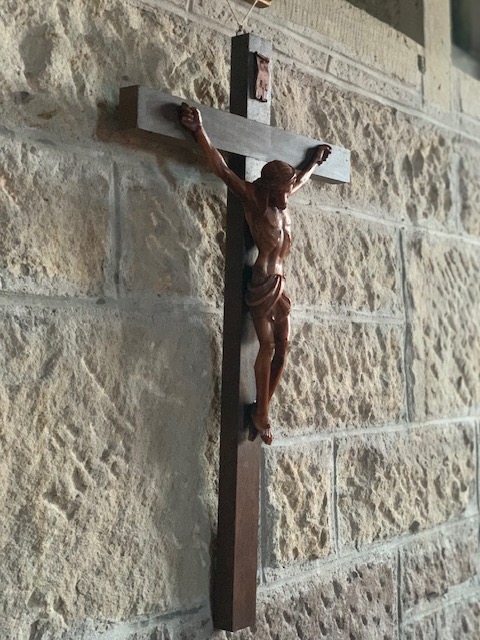
As Jesus hangs crucified, after all of the other disciples had fled for fear of persecution, there stands Nicodemus at the foot of the cross, armed with myrrh and aloes and the other provisions for Jewish burial, ready to bear the broken and lifeless body of the crucified Lord to its grave.
Jesus said, “For God so loved the world that he gave his only Son, so that everyone who believes in him may not perish but may have eternal life.”
We can never fully know what Nicodemus was thinking as he departed Jesus’ company after hearing these words. But we can be sure that something within him was changed. And little by little, his heart was broken open and he was born anew, finding his way through darkness and doubt, to the cross. I pray that we would be willing to meet him there.
Amen.
 Scottish Episcopal Church - Dornoch, Lairg, Brora, Tain & Tongue