Matthew 3.13-17
Last Sunday morning, we saw the three magi visit the infant Jesus – in the course of a week, we have fast forward about 30 years and we meet the adult Jesus as he emerges on the edges of the river Jordan to be baptised by his cousin, John.
It is a peculiar story. Jesus enters the scene not as a valiant king or leader we might expect from the way Matthew starts the gospel, but instead comes in the most humble way possible, alongside sinners coming to repent and receive cleansing waters from the River.
Here, though, Matthew is very intentional in his telling. He takes on what one commentator notes as the tone of the “apologetics,” those who engage in the theological or philosophical practice of explaining or defending a point with careful justification and strong conviction.
His retelling of some stories and events is intended not simply to act as a historical record, but also (and maybe more pointedly) to provide a response or defence to his audience concerning certain implications that others, and maybe they, have drawn
In the case of the birth narrative, Matthew wanted to be clear that this child born was not some ordinary baby born out of wedlock to a teenage mother, but a child conceived by the Holy Spirit – one that God had planned for in a unique and miraculous way.
Similarly, in the telling of Jesus’ baptism, Matthew takes time to include a conversation between John and Jesus that answers the inevitable question believers would have – if Jesus was without sin, why did he need to be baptised?
The answer fits neatly into Matthew’s ongoing perspective that Jesus Christ was the fulfilment of what had been promised. Matthew liked things to be done decently and in good order. In his gospel, Jesus’ baptism is a reflection of that, as a part of fulfilling a plan set into motion long ago. His approach to this moment is pivotal, and illustrates the kind of leader and messiah Christ will be – one who truly walks alongside the people and is a servant of all. Such humility echoes prophets like Isaiah, and foreshadows the events that are to come.
But back to the riverside where we discover more about who exactly Jesus is.
After he convinces John to actually baptise him, the heavens break open. The Spirit of God descends like a dove in what I imagine to be a Hollywood inspired cinematic glory, and the voice of God speaks to all who have gathered.
This is another unique feature of Matthew’s telling – in Luke and Mark this voice is heard only by Jesus, but in Matthew it is a public proclamation: “This is my Son, the Beloved, with whom I am well pleased.” In this proclamation, God claims and affirms Jesus’ identity and commissions him to carry out his purpose on earth.
It is from this text, along with the Great Commission (see Matthew 28:18-20) that we draw our understanding of the sacrament of Baptism.
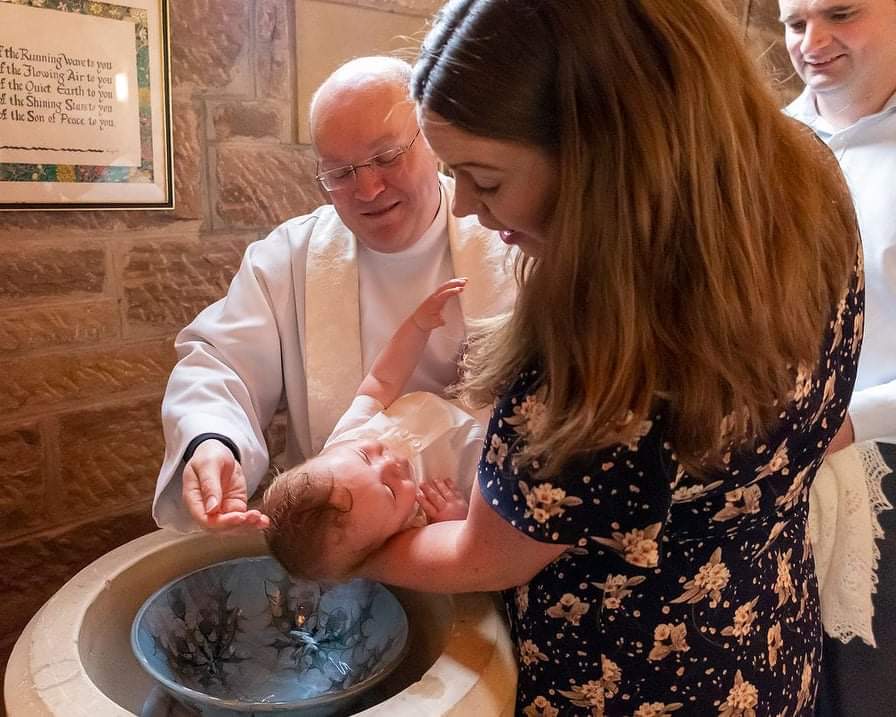
Along with communion, we identify it as something Christ participated in and instructed us to do in the same way. The concluding words of our passage from today celebrate God’s claiming of Christ as his beloved Son. In the same way, in baptism we affirm God’s love for us, and proclaim for the one being baptised, whether a sweet and squirmy infant, a tenacious and talented teen or a weathered and wise adult, that they belong to God. Baptism gives us a new label to wear – “child of God.”
To understand this new label, we first should unpack a bit more about what baptism does and means. Baptism is “a sign and seal of incorporation into Christ .” In it, we are connected in a tangible way to Jesus and reminded of the grace and love extended to us by God. We believe that the Holy Spirit binds us in covenant to God in this sacrament, which is a symbol of inclusion in the church universal.
As we begin a new year together, it is particularly appropriate to think about these things, and the new life given to us in Christ. Baptism reminds us of that reality which has already happened, and is a way that we can respond. It enacts and seals what the Word of God proclaims: God’s redeeming grace is offered to all people . There are numerous other explanations for what happens in Baptism, all with rich symbolism that ties into the totality of the gospel narrative and speaks to the breadth and depth of this symbol. But, for today, I encourage you to hold in your mind that Baptism is a sacrament that reminds us we are “claimed” as Christ’s own forever. Now, this is a claim that has happened well before the water hits our head. It is a promise as old as God, but in Baptism we write it on a label for all the world to see.
Baptism reminds us of the best versions of ourselves, our core identity that was woven into our beings by a compassionate creator.
Theologian and former Archbishop of Canterbury, Rowan Williams says the Church has come to view baptism as “a kind of restoration of what it is to be truly human. To be baptised is to recover the humanity that God first intended.”
Baptism is the mark of a new creation. Reminding ourselves of this assures us that God wants, above all else, to be in a loving relationship with us, God’s beloved children.
This is the root of our identity as Christians – that we belong to God. This is true from the very beginning. It is not something we have earned because we are particularly attractive or talented. It is because God created us to be in relationship, going so far as to send Jesus to make sure we knew just how much He loved us. In order to truly be faithful disciples, we have to allow this name, this label, to be the one that transcends all of the other labels we take on. Above all else, we have to remember that we are children of God.
Of course, that is quickly tested. In our lives we juggle many different names and roles. Some of them fit in well with the idea of being a child of God, others? Not so much. And sometimes, instead of letting God proclaim who we are, beloved, we allow the world around us to define us.
As we grow, we sometimes forget the heavenly voice, and we begin to listen to other voices that confuse us. Perhaps we hear voices when we are children through report cards that tell us that we are not clever enough or don’t sing nicely enough to be in the choir. As teenagers, we hear voices through the callous comments of other teens who tell us that we are not cool enough, not the right size or shape. As adults, we hear voices that tell us we are not successful enough or that we do not have enough money. Somehow, as God’s voice gets drowned out, we listen to these other voices, and we are tempted to forget who we are. We are tempted to forget that a congregation of Christians and God himself have claimed us as beloved children of God .
God’s promise to us is a promise sealed in the waters of Baptism, and God will continue to repeat it to us as many times as it takes for us to believe it.
 Scottish Episcopal Church - Dornoch, Lairg, Brora, Tain & Tongue