Sermon Matthew 2.13-23
The very last hour of the school term before the Christmas Holidays can for many Head Teachers be a little bit sad. Just before the children and staff go home full of festive cheer, it is our job to walk around school to check that all signs of Christmas have been removed. No tinsel, no trees, no pictures of santa, no cards pinned to notice boards – everything must come down, ready for the beginning of the new term when we return in January.
I know the big day was only a few days ago, but I wonder if anyone in church this morning has already taken down their Christmas decorations at home, or at least started thinking about doing so? We haven’t. We leave them up as long as possible. In fact, for us the Christmas decs stay up until at least the feast of the Epiphany – twelve days after Christmas.
It’s really important to appreciate these twelve days of Christmas and we can understand this short span of time as a sort of bridge between the birth of Jesus and his presentation to the world as its Saviour. We know so little about the years between Bethlehem and Jesus’ appearance at the Jordan River, asking to be baptised by John and so it seems entirely appropriate that we should pause here, on the first Sunday of the season of Christmas, to consider how Jesus got from the manger to Nazareth, the village where he would grow to adulthood.
St Matthew follows a clear pattern to tell us this story in our gospel today. He uses three dreams, three “obediences,” and three geographic locations to describe how prophecies about the Messiah are fulfilled in the birth of Jesus. Today’s reading picks up the tale where we left off on Christmas Eve. The magi have come to pay homage to a king. On their way, they have stopped to ask Herod where to find him. Herod tries to smooth-talk the magi into letting him know how their quest turns out, but an angel of the Lord warns them to go home by a different way than the one by which they came, and they follow this advice. The main character in this story is not the magi who have just left, and it is not Mary who gave birth to Jesus. It is not Herod, the evil and paranoid king. This is Joseph’s story.
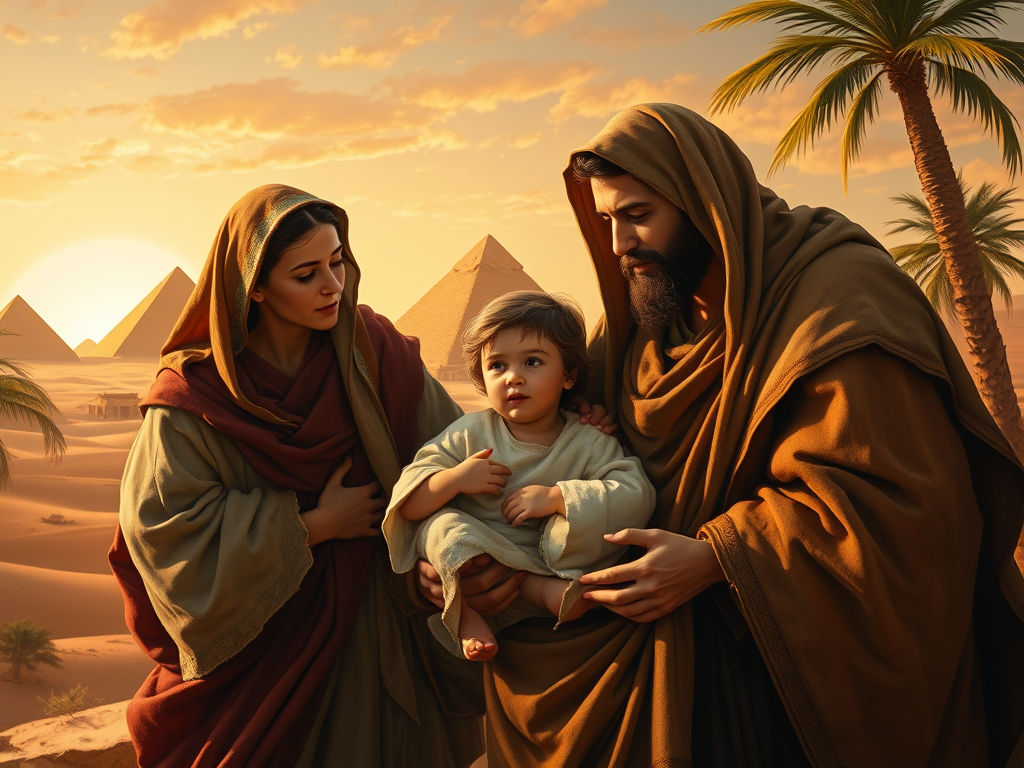
Our gospel passage falls neatly into three sections: God’s call into Egypt, what happens in a kind of “meanwhile, back at the ranch,” sort of section and God’s call back from Egypt, to a final destination in Galilee. While the writing may be tidy and well-organised, the story Matthew tells is certainly not. This young family did a lot of travelling, and many who preach on the story choose to focus on Jesus the Refugee as the main point.
Such a focus offers plenty of material. We could talk about the obvious parallels in Matthew’s Gospel with Old Testament writings. We could consider how Joseph’s flight into Egypt recalls another Joseph, back in Genesis, who went to Egypt against his will, but who became Pharaoh’s right-hand man and made it possible for the nation of Israel to survive, grow, and thrive, even under the hardship of slavery. Matthew reminds us of the story of the baby Moses, hidden in the bulrushes to protect him from Pharaoh’s slaughter of newborn Hebrew boys in Egypt. It is clear that Matthew draws a connection between the return of Moses to Egypt after Pharaoh’s death, and Joseph’s sudden return when he learns through a dream that Herod is dead. The young family’s trip back home to Israel reminds us of the journey Moses led through the wilderness, as the Israelites escaped their captivity in Egypt and headed toward the Promised Land. Matthew connects the story of Jesus’ early travels to God’s call, protection, and provision for his people throughout history. It’s a powerful connection. And there are certainly strong connections between Jesus the Refugee and the plight of refugees throughout the world right now. Refugees who have been displaced by politics, war, and the struggle with poverty – those who have the same fears and anxiety that Joseph and Mary must have experienced, as they did whatever they could to protect the young child, Jesus.
But nagging in the back of my mind, and perhaps in the back of yours, is the horror of what happens “meanwhile, back at the ranch.” While it’s important to see how the greater story of God’s activity among his people is connected to, and completed in, the story of Jesus, we cannot ignore those middle verses, the ones that speak of an unspeakable tragedy.
When Herod saw that he had been tricked by the wise men, he was infuriated, and he sent and killed all the children in and around Bethlehem who were two years old or under, according to the time that he had learned from the wise men. Then was fulfilled what had been spoken through the prophet Jeremiah: “A voice was heard in Ramah, wailing and loud lamentation, Rachel weeping for her children; she refused to be consoled, because they are no more.”
The question has been bothering us since the beginning of human history: How can a just and loving God allow evil to exist? How can God let innocent people suffer, while evil people thrive and prosper? The book of Job is filled with this question. In priest training school, they even give us a name for the problem: theodicy. But giving it a name, and even knowing that brilliant theologians have been struggling to find an answer for as long as we can imagine, doesn’t help when it becomes personal. When it’s your child being put to the sword, the question is no longer hypothetical. The pain is real, and the only question we can raise is “Why, God?”
Make no mistake: the slaughter of those children in Bethlehem was not God’s idea. It was Herod’s. Herod the Great never felt his position was secure, and he was known for his paranoia and brutality. He even had his favourite wife and some of his sons murdered when he suspected them of treachery. He decreed that forty Jewish nobles should be brought to Jericho to be killed when he died, so that there would be abundant mourning throughout the land at his death. Thankfully, the son who succeeded him decided not to carry out this final wish.
Matthew is the only source to describe Herod’s murder of the children in Bethlehem. Some scholars think the event wasn’t noteworthy for first century historians to record, partly because it was only one of many atrocities committed by Herod, and partly because the number of children affected was probably no more than twenty, given that Bethlehem was such a small village. Such violence against innocent children may have been unremarkable by first century standards, given that children were considered to be little more than property at that time. They were expendable. But Matthew names it as an atrocity. Matthew tells us that God cares that children are massacred. Misuse and abuse of children was common then, but Matthew explicitly calls that out as being wrong. Misuse and abuse of children is far too common now, and so we, in our day, must also call that out as being wrong.
We hear of the children in our own country who are victims of human trafficking. In our nation, the number of Child abuse cases continues to increase year on year. Atrocities against children are just as real now as they were in Bethlehem in 4 BC.
Some amongst us have suffered the terrible loss of their own children. Maybe they did not die violent deaths, but the loss is still real, and the pain is still acute. Some know, as others may not, what it means to weep with Rachel, who will not be consoled, because her children are no more.
So, when we ask, “Why, God? How is this Good News?” it may not help to know that Matthew is painting a bigger picture of God’s providence and protection for his people. Being reminded that God is not willing for any to perish, but wants to give each of us eternal life might seem like an empty promise. Knowing that bad things happening to innocent people has more to do with our sinful condition than God’s will for us might be difficult to explain. We can’t just shrug off the sorrow. We can’t diminish the pain of the here and now.
It’s a dangerous thing to be human, to be vulnerable, to face the fact of our own mortality. The Good News is not always sweetness and light. That pretty baby in the manger grows up to die on a cross. God has to watch his own Son, his only Son, die a horrible death. And God grieves.
God grieves over all the Herods and the Pharaohs and the murderers and abusers of innocent children. God grieves over us when we turn away from him. God grieves as only a bereft parent can grieve. That is exactly why this story is part of the Christmas story. Christ came to be God With Us – Immanuel. He came to be God with us in our sorrow, God with us in our fear, God with us in our wandering, God with us. Always.
The world is filled with darkness, with evil evident in every corner. But God is with us. The violence that surrounded Christ’s birth was the same violence that would eventually lead to his crucifixion. Christ went into every dark place we humans must go, even into the darkness of the grave. But he rose again. There is no darkness that can frighten God. God is with us.
Christmas is a dangerous season. It’s dangerous to be human, to admit our mortality, to hold in tension both this awareness of our vulnerability, and the awareness of God’s great gift to us in the person of Jesus Christ, who made himself vulnerable to the power of evil, and yet conquered it. The joy of Christmas depends on the joy of the resurrection at Easter.
There’s a little detail in this story, Joseph’s story, which we need to notice. Every time an angel of the Lord appeared to Joseph in a dream, Joseph immediately did what he was told to do. He did not ask, as the weeping mothers of Bethlehem must have asked, “Why, God?” He got up in the night, packed his family’s belongings, and he went where he was told to go. Even when he was afraid, he obeyed.
Only Joseph saw the angel. Only Joseph had the dreams. Only Joseph knew the magnitude of his task, to protect the Messiah from the danger of Herod’s henchmen. Just as Mary did not argue with the angel who told her she would give birth to the Saviour of the World, Joseph did not argue with the angel who said, “Go!” He just went. He answered God’s call with action.
God is calling us, today. He is calling us to be a voice for peace, justice, and grace. He is calling us to challenge the way things are in the world, to stand against evil when we see it, to be the presence of God for those who suffer violence and abuse, to let them know that God is with us, Immanuel.
When we challenge the world, we make enemies. Herods and Pharaohs will try to crush us. But our job is to connect the human story with Christ’s story, to rescue our history from being reduced to a timeline, and allow it to be converted into God’s event. That event is the breaking into our sin-filled world of the kingdom of God. As we become aware of God’s constant working in our lives, we are called to participate in that work. Whether we are sent to Egypt or Nazareth, whether we are called to feed the hungry or clothe the naked or heal the sick, whether we are tasked with comforting the bereaved or spreading hope to those who have lost it, God calls us. May we, like Joseph, answer that call without hesitation, knowing that God is with us, Immanuel. Amen.
 Scottish Episcopal Church - Dornoch, Lairg, Brora, Tain & Tongue