Well doesn’t our church look absolutely beautiful! Special thanks from all of us to those of you who have decorated our building for the Christmas Season. Between you, you’ve created a scene that brings a smile to our lips and lifts our hearts to heaven.
You’ll have to forgive me for my slightly croaky voice this evening – when putting up our tree at home I accidentally swallowed some of the decorations and now I’ve ended up with a bad case of tinselitus!
Seriously though, our church tree looks so pretty and I’d like us to think a bit about it this evening.
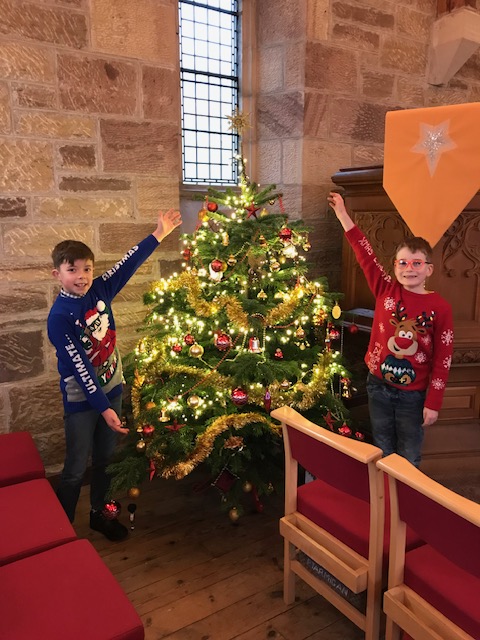
You know, it’s not long ago that having Christmas trees in church was rather frowned upon by some congregations who considered its origins to be connected with pagan practices, and indeed we know that evergreen trees have been used in a variety of religious rites throughout history – the Vikings connected to their great sun god Balder through the worship of the pine tree for example.
But whatever you think about it, the Christmas tree has become one of the main symbols for the Christmas season and it would be a shame to see a wonderful resource go to waste.
Whilst preparing for this evening’s sermon, I’ve been exploring the story of how the evergreen tree first became associated with Christianity and I came across this legend.
Back in the eighth century, St. Boniface was working as a missionary among the Hessian people (who lived in part of the country we now call Germany). One night he came upon a pagan ritual of human sacrifice to Thor, the thunder God. The hessians believed the presence of Thor was in a large oak tree and were preparing the sacrifice in the form of a young man underneath the tree.
We are told that Boniface was a large man with a commanding presence, and just as the youth was about to be killed he stormed into the gathering and ordered that the ceremony be stopped.
As the group stood in fear of this large stranger he challenged their god and ordered the tree chopped down. As the majestic tree fell to the ground, legend says that it revealed for the first time a young fir tree growing between the broken branches of the fallen oak. The people were in awe of the presence of the young tree inside the old one and before they could claim the miracle for Thor, Boniface claimed it for Christ.
He said to them, “This little tree, a young child of the forest, shall be your holy tree tonight. It is the wood of peace, for your houses are built of fir. It is the sign of endless life, for its leaves are ever green. See how it points straight to heaven. Let this be called the tree of the Christ Child; gather around it, not in the wild woods, but in your homes. There it will shelter no deeds of blood, but loving gifts and rites of kindness.”
I don’t know how much of that legend is based in fact. But I do know that the attitude of Boniface in the story represents the true attitude of faith.
Faith is not learning about which symbols are sacred and deciding whether or not they truly represent God. Faith is looking at everything in a new way and seeing God everywhere you look. Faith is looking at your dining table tomorrow and every day and seeing an altar spread with the love of God. Faith is looking at a person that others look down their noses at and seeing in them the possibilities for beauty and restoration. Faith is receiving a hug from a friend and feeling the arms of God wrapped around you. Faith is not seeing different things…faith is seeing things differently.
The Christmas tree is a symbol of joy to people both inside and outside the church. Entire cities gather for the lighting of the town tree, and children in homes across the world take delight in the sparkling lights and bright decorations.
The Christmas tree is no respecter of persons. All nations, races, classes…even all faiths often put up a tree. And to me, that’s what the Christian faith is all about.
From the very beginning in the Hebrew Scriptures when God called Abraham, the intent was that the Word of God be spread to all people and that it be a blessing to all nations.
God is the God of all and the salvation we proclaim in Jesus is offered to all.
The Christmas tree may well be the only symbol we have left that can represent faith to the entire world, exactly because it is common to our experience. And isn’t that what Jesus did so often? What did Jesus choose as the symbols for himself? Bread and wine…nothing exclusive to this group or that…but things that were common and fundamental to the experience of everyone — basic food…a loaf of bread, a cup of wine.
Our beautiful Christmas tree is a reminder that our calling is not to be separated from the world, but simply to live in it and look at it differently. It’s the same physical world…out there and in here. This is not the place to see different things. The church is the place to see things differently. It is the place where those trapped in a cycle of addiction are welcomed and loved as children of God. This is the place where death is seen as the beginning of life, where giving is seen to be receiving, and where becoming a servant of others is proclaimed to be the true foundation of leadership. This is the place where the commonplace is seen as a miracle and where ordinary people realise that they are capable of the most extraordinary things. It is here that water becomes wine, and that wine becomes the life of Christ poured out for us. This is not the place to see different things. This is the place to see things differently. It is the place of transformation.
Once a year, evergreen trees across the globe are transformed. They sparkle with lights and shelter gifts of love beneath their branches. Everybody understands it, everyone has access to it. The Christmas tree turns no one away. So it is with the God we proclaim. God is the God of all. God is the light that shines in the darkness, sheltering gifts of love beneath ever-living branches. The tree stands here, reminding us that our God transforms the ordinary. God takes the secular and makes it sacred…the meaningless suddenly has purpose, the aimless have vision, and the people that walked in darkness have seen a great light.
So my dear friends, don’t come to Christ expecting to see different things. Come to Him expecting to see things differently!
 Scottish Episcopal Church - Dornoch, Lairg, Brora, Tain & Tongue