* Genesis 18:1-10a and Psalm 15 * Colossians 1:15-28 * Luke 10:38-42
We start with a trick question for you today: Are you a Mary or a Martha?
If you have ever spent time reading or listening to interpretations of today’s gospel passage, you probably understand the dichotomy implicit in the question. Martha, we often say, is the “active” one, rushing around, busying herself with the demanding practicalities of life. Mary, on the other hand, is the “contemplative” one, resting attentively at Jesus’ feet, engaged in a more conventionally prayerful, intellectual encounter with her Lord.
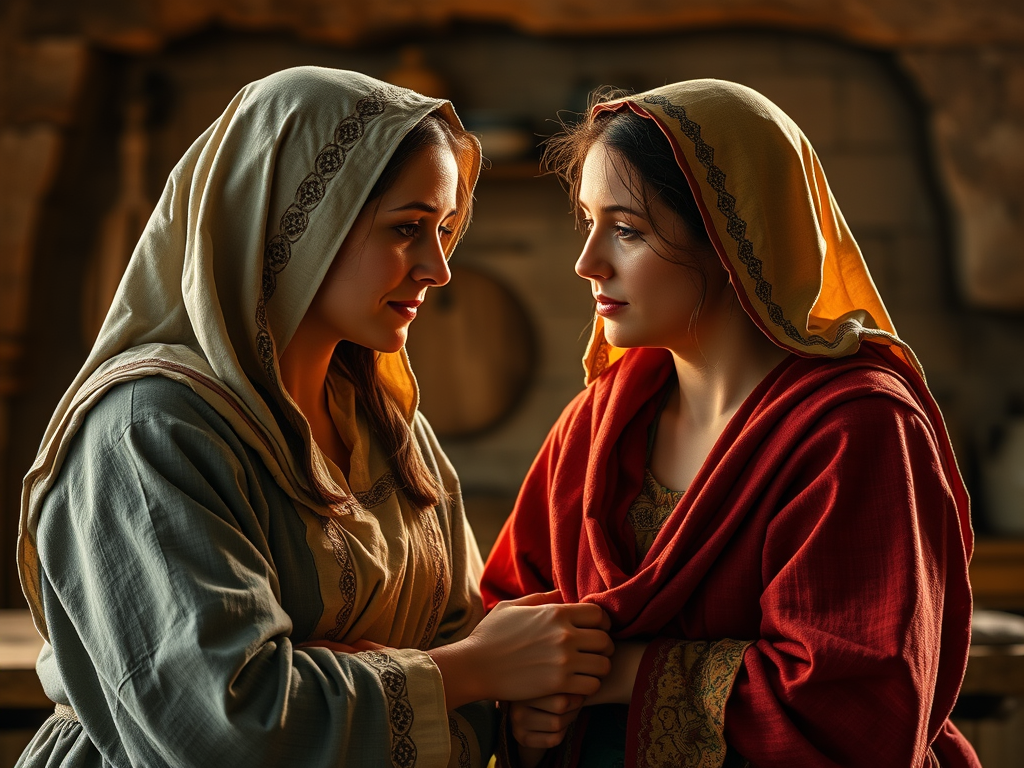
Two sisters, two followers of Jesus, and, we are told, two diverging possibilities for discipleship, with Mary’s prayerful receptiveness being “the better part” and, therefore, the one to which we are usually taught to aspire.
It’s not surprising that we tend to engage with the story in this way, as a sort of spiritual personality test. And don’t we love personality tests. Consider the enduring popularity of frameworks and tools that measure and compare our dispositions, from astrological signs to the Enneagram to those random Facebook quizzes that reveal which dog breed or Disney Princess you resemble. (And by the way, I am both a Papillon and Princess Elsa from Frozen).
We are and always have been—in ways both meaningful and absurd—people desperately seeking a glimpse of ourselves. We sift through our habits and tendencies for some definitive indicator of who we are, some solid thing at our core, a name by which we might be distinguishable in this increasingly crowded and confusing world.
And so, when we hear Luke’s Gospel today, we might ask ourselves: which one are you? Martha or Mary? Busy or mindful? Striving or tranquil? Perhaps, as you hear the question right now, you can already feel the pressure of having the right answer, of measuring up, of choosing that “better part.”
But before you get too lost in all of that, remember what was said at the outset: it’s a trick question. It is a false choice.
It is false, quite simply, because it is not the choice that Jesus, by way of this text, asks us to make. Jesus is not setting the sisters against one another, nor is he creating a hierarchy of models of discipleship. The dichotomies that we read into the text are in fact our own fabrications, borne of our own desire to render the world understandable through categories and labels. We do this all the time!
This is not Jesus’ agenda.
When he tells Martha that Mary has “chosen the better part” he is not challenging Martha’s “personality,” nor is he even rejecting Martha’s present busyness, but is instead gently calling her back to the fullness of herself, reminding her of both the ground of her being and the telos, the purposeful endpoint, of all of this good, hard, and necessary work: namely, himself.
Martha lives and serves, as we all do, in the name of Jesus, the One who has knocked upon her door and who now lives in the midst of her activities. It is his holy name that imbues her practical work with luminous significance. The cooking and the cleaning and the mending and the tending of small, daily things—all of this holds the possibility of divine service, but only when those things are done in mindfulness of God’s ever-present love. That mindfulness is what we must bring to the table as disciples, and so Jesus simply wants Martha not to lose sight of him, knowing, as he does, how easy it is to become “worried and distracted by many things.”
What he offers, then, is not a competition between Mary and Martha as archetypes of greater and lesser discipleship, nor a distinction between the relative virtues of being and doing, but instead the continuous and crucial choice that each of us must make, in all that we do, between remembering Jesus or forgetting him. This is a Gospel story that calls us to remember. This is a Gospel story in which Martha is asked—as we are—to do this—all of this, everything—in remembrance of him.
And how badly we need that reminder, especially now, caught up as we are in the continuous maelstrom of those “many things” that trouble the world around us. How tempting it can be to look at the state of the world, or even the state of the Church, and to feel a slow panic begin rise within, repeating to ourselves like a mantra, or a plea: more to be done, more to be done, more to be done.
Of course, there is more to be done. Much more, and much of it will be different from what we have done before in our lives and who we have been before. The Kingdom requires us to roll up our sleeves. But as we do so, as we make our lists and tend to the cracks and the spills and the dusty corners of our days, we cannot forget that we do not act by ourselves or for ourselves. We do so in the name of Jesus. We do so in and through the power of his peace.
This is what Martha needed to remember, and it is a necessary reminder whenever we sit down, as individuals or as a community, to consider who we are and where we are going. We must ask ourselves not only what to do, but why, and for whom? Why do we work so hard to try keep our churches healthy? Why do we persist with our traditions in the midst of widespread apathy and violence? Why do we dare to dream of a world that is guided by love and justice when too often we see a world burdened by fear and inequality? The answer cannot simply be, as Episcopalians love to say, “because we’ve always done it that way.” The answer must be Jesus. We work hard because of Jesus. We persist because of Jesus. We dare to dream because of Jesus. We cannot and must not forget this; we cannot forget him, no matter what we do.
We are not given, in the text, Martha’s response to the Lord. It would not really make much sense, though, to infer that she suddenly dropped all of her work at that moment and sat alongside her sister. After all, there were still mouths to feed, still places to be set at the table, still broken fragments of this or that to be gathered up and repaired. There still are all of these things to be done, and there always will be, and thanks be to God for the grace we are each given to do the necessary, unglamorous work that sustains us. It is holy work, done upon the holy ground that is, in fact, everywhere, once we remember to look for it.
So no, you are not a Martha. You are not a Mary. All of us are both of them, and neither, for love requires us sometimes to strive and other times to be still. They are not separate paths, but merely the varied landscape of the single Way back home.
You are a follower of Jesus. A servant of Jesus. A lover of Jesus.
Will you follow him back to yourself?
Will you not forget him, for as long as you live?
Those are not trick questions!
 Scottish Episcopal Church - Dornoch, Lairg, Brora, Tain & Tongue