There is a beautiful traditional analogy that describes worship in the Episcopal Church as that of a symphony orchestra. The members of the congregation are the players in the orchestra, with many different instruments represented among them. The musical score is the particular liturgy we are using and the conductor is the celebrant or officiant, who leads and helps tie everything together. And who is the audience at this joyous performance? Well, the audience is God!
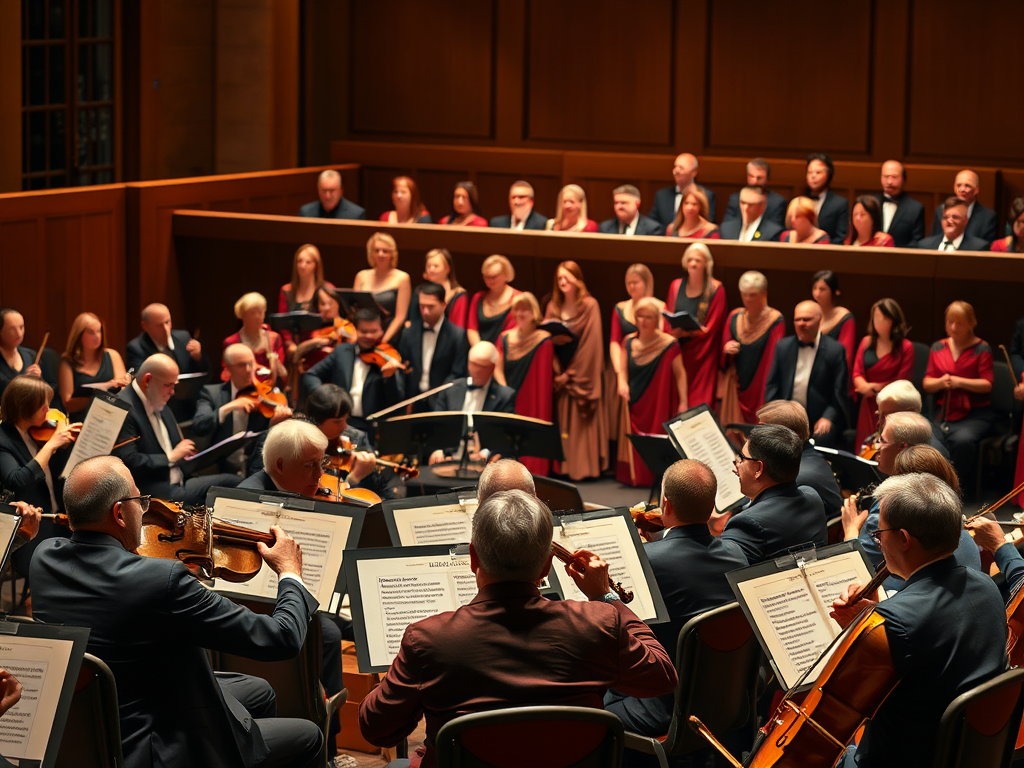
This analogy illustrates the basic truth that our worship in the Episcopal tradition is participatory. There is a lot of action on the part of the congregation making them active participants in what is going on. I think this musical image is also a helpful one for understanding the church’s mission. The ideal of our working together in unity can also benefit from an illustration from classical music.
My own favourite metaphor for the church at its best, is the 4th movement of Beethoven’s Ninth Symphony. It is beautiful and stirring. Everyone knows the central melody, the “Ode to Joy.”
Anyone who has experienced the great pleasure of attending a live performance of this wonderful work might agree that it can indeed provide a symbolic vision of what the church can be at its best.
The Ninth Symphony builds magnificently toward its final, 4th movement. Beethoven’s masterpiece grows, with gradually unfolding themes of deep beauty. Finally, having gone through every form of instrumental expression, the composer calls forth the human voice. Singing is required to bring ultimate expression to the composer’s vision.
As the symphony ends in a spectacular climax, the conductor, the orchestra, the quartet of lead singers, and the full chorus are all working feverishly. Every orchestra member is playing with inspired fervour. The quartet of soloists and the chorus are singing at full volume. The conductor, beating time with baton in hand, works exhaustively to tie the pieces of the musical whole together into one intricate, moving entity. She urges forth every last ounce of spirit left in the performers. All work exuberantly together to bring about a great piece of musical love.
Yes, the final movement of Beethoven’s Ninth Symphony may well be an ideal expression of God’s kingdom. It is certainly my own vision of how the church can act — that is, with everybody working together to produce the greatest expression of love, and with no one standing idly by:
with everyone involved, doing his or her part
without discord
with no in-fighting
with everyone focused on one purpose
with everyone inspired, exuberant,
working feverishly to love God
with all their being and to love God’s
children as themselves
with everyone following the will of the leader.
This is the example set by Jesus. His whole life was one continual effort to work to produce love, healing, happiness, and salvation among all people. Certainly, that was the example the early church sought to emulate.
Remembering the first Pentecost Day, the day when the disciples were set on fire with the Holy Spirit, it is natural to think of the finale of Beethoven’s great symphony. The glory of the finale is my idea of what that first Pentecost was like. That first day of the church’s reaching out to the world, spreading the joy of the good news of God.
On that day, the early followers of Jesus received the power of the Holy Spirit and were enabled to go out working together, pooling their resources, caring for the community and the common goal, providing generously for the needy, following the lead of their Lord.
On this Pentecost Sunday, we find ourselves emphasising our responsibilities as members of the Body of Christ to go beyond this service and beyond our community to act out the truths of our faith: to work together; to make our best effort to follow the direction of our Lord Jesus Christ; and to do so with the same feeling of commitment as that of the participants in a fine performance of Beethoven’s Ninth.
For thirty years Beethoven thought about, worked on, and developed an idea to use a chorus based on a work by the German poet Johann Schiller. Near the end of his life, in the maturity of his artistic expression, Beethoven finally made use of the Schiller poem in the incomparable fourth movement of the Ninth Symphony.
The poem used in the chorus, often called the “Ode to Joy,” is based on the theme of joy, love, and, perhaps above all else, the unity of humankind.
One of the central stanzas reads this way:
Let thy magic bring together
all whom earth born laws divide.
All mankind shall be as brothers.
Indeed, all humanity shall be as brothers and sisters, because of God’s action in Christ.
I don’t know about you, but this week I have been worried by the ‘preparing for war’ rhetoric spread across our media outlets. We need to pray fervently for peace, for the Holy Spirit to breathe into the hearts of world leaders.
The great vision of Beethoven, revealed in the final movement of his final symphony, is one with our vision of the Kingdom of God. The vision that is the same as the goal of our faith in God that all humankind will live in harmony – impossible as that might seem right now.
So, let us dedicate ourselves on this Sunday of Pentecost, to live into this vision — to begin anew acting in concert, in harmony, and with love, so that we may treat all those around us as sisters and brothers, so that, together, following the lead of our Lord, we can produce a great act of Christian love, bringing peace to this world in a time of fear and growing tensions.
Come Holy Spirit, and lead us into peace.
Amen
 Scottish Episcopal Church - Dornoch, Lairg, Brora, Tain & Tongue